
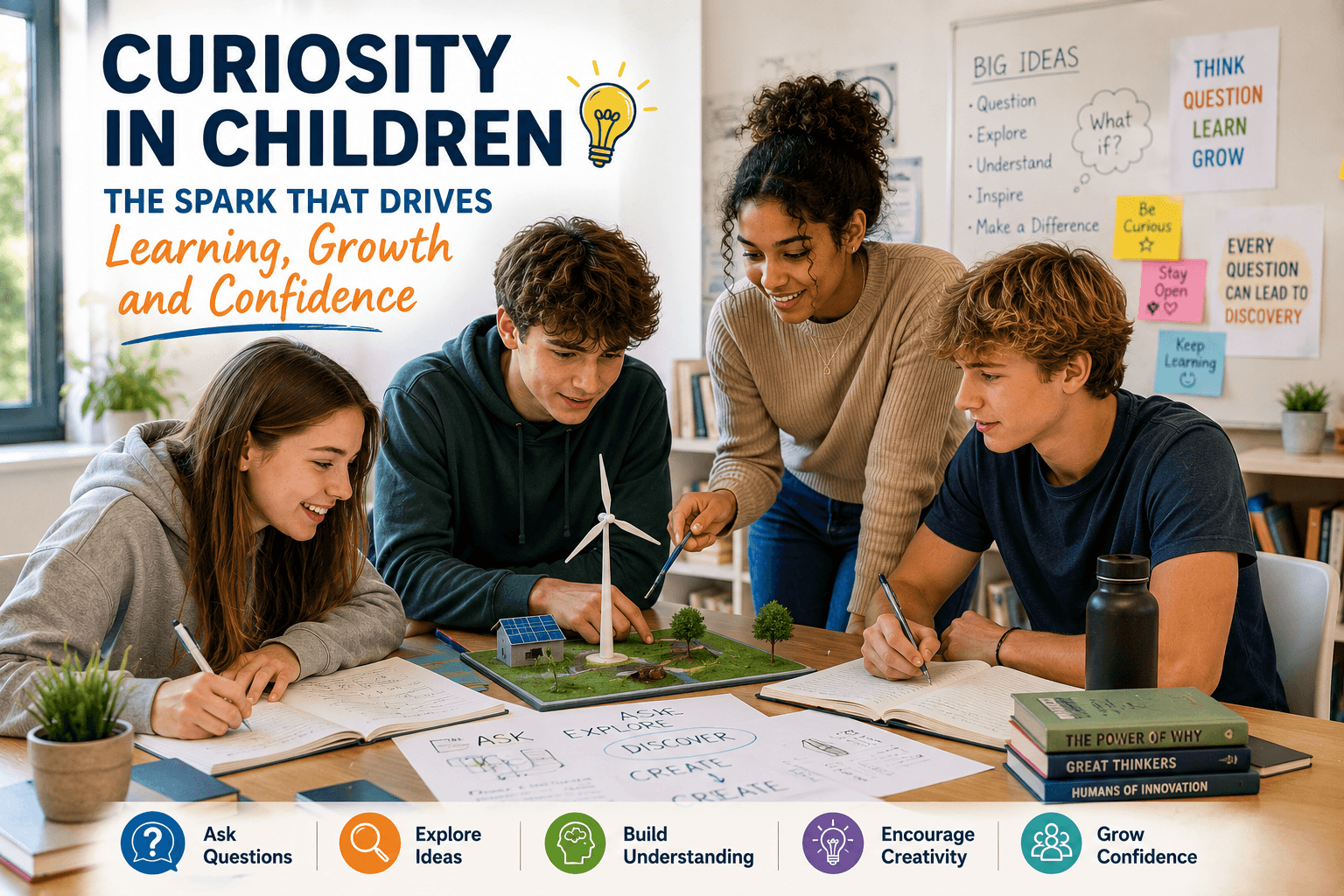
Curiosity in children is often one of the earliest signs that learning is taking place. Whether a young person is asking questions, exploring a new hobby, experimenting with an idea or trying to understand how something works, curiosity helps drive discovery and growth.
However, curiosity is sometimes misunderstood. Adults can occasionally see endless questions as interruptions or distractions. Yet history shows that curiosity has played a central role in almost every important discovery, invention and breakthrough.
At Kids Fitness First, we believe curiosity deserves encouragement because it helps young people build confidence, develop strengths and engage more fully with the world around them.
Why Curiosity in Children Matters
Learning begins with a question.
Before a child can solve a problem, they first need to become interested in it. Before they develop expertise, they usually become curious. Consequently, curiosity acts as the starting point for many valuable learning experiences.
Think about how young children naturally interact with the world.
They ask:
- Why?
- How?
- What happens if?
- Can I try?
These questions help them gather information and develop understanding. Furthermore, they encourage independent thinking rather than passive acceptance.
As a result, curiosity supports deeper learning because it encourages children to actively participate in the learning process.
Curiosity in Children Helps Build Confidence
Confidence often develops through successful experiences. However, confidence rarely appears overnight.
Instead, it tends to grow when children are encouraged to explore, experiment and learn from experience.
For example, imagine a teenager who becomes interested in photography.
Initially, they may know very little about cameras. Nevertheless, curiosity encourages them to learn. They watch videos, practise techniques and experiment with different settings.
Over time, knowledge grows.
Skills improve.
Confidence develops.
This process happens in many areas of life.
Whether the interest is sport, science, technology, art, reading or community projects, curiosity frequently acts as the spark that starts the journey.
How Schools Can Encourage Curiosity in Children
Schools have an important opportunity to nurture curiosity.
Although curriculum requirements are essential, students also benefit from opportunities to ask questions and explore ideas.
Teachers can support curiosity by:
- Encouraging discussion
- Welcoming thoughtful questions
- Using real-world examples
- Promoting problem-solving activities
- Supporting independent projects
- Creating opportunities for exploration
Importantly, curiosity does not require complicated resources.
Sometimes a simple question can generate meaningful learning.
For instance, asking students how they would solve a local community challenge can stimulate creativity, teamwork and critical thinking simultaneously.
Curiosity in Children and Creative Thinking
Creativity and curiosity often work together.
Curiosity encourages children to ask questions.
Creativity helps them explore possible answers.
Therefore, when curiosity is encouraged, creative thinking frequently develops alongside it.
Many innovations begin because someone wonders whether there might be a different way to approach a problem.
Similarly, children who enjoy exploring ideas often develop flexibility in their thinking.
They learn to consider alternatives.
They become more comfortable with uncertainty.
They begin to understand that there may be multiple solutions to a challenge.
These skills are increasingly valuable in a rapidly changing world.
The Connection Between Curiosity and Different Ways of Learning
Not every child expresses curiosity in the same way.
Some ask many questions.
Others quietly investigate topics independently.
Meanwhile, some children prefer practical experimentation, while others enjoy discussion and debate.
Recognising these differences is important.
Different ways of learning often reflect different ways of exploring the world.
Consequently, adults should avoid assuming that curiosity always looks the same.
A child reading extensively about a favourite topic may be expressing curiosity.
Likewise, a teenager building projects, creating artwork or learning coding skills may be demonstrating the same quality through a different route.
The key is recognising engagement and exploration rather than focusing on one specific behaviour.
Encouraging Curiosity at Home
Parents play a significant role in encouraging curiosity.
Fortunately, supporting curiosity does not require specialist knowledge. Instead, it often begins with creating an environment where questions are welcomed and exploration is encouraged.
For example, when a child asks a question, adults do not always need to provide an immediate answer.
Instead, they might ask:
- What do you think?
- How could we find out?
- Where could we look for information?
- Shall we explore that together?
As a result, children learn that curiosity is valuable and that learning is an ongoing process.
Furthermore, this approach helps develop independence and confidence.
The Role of Screen Time and Curiosity
Technology offers many opportunities for learning and exploration. However, balance remains important.
When children spend time exploring nature, participating in physical activities, reading, creating projects and engaging with other people, they often encounter experiences that spark new questions and interests.
Consequently, a balanced lifestyle can provide a wider range of opportunities for curiosity to develop.
For instance, a walk outdoors may inspire questions about wildlife.
Likewise, a sports activity may generate interest in health, movement or teamwork.
Similarly, community projects can encourage young people to learn about social issues and problem-solving.
Technology can support curiosity, but real-world experiences remain equally important.
Why Curiosity Matters for the Future
The future is difficult to predict.
New technologies, industries and opportunities continue to emerge. Therefore, the ability to learn, adapt and explore may become increasingly valuable.
Curiosity supports these capabilities.
People who remain curious often continue learning throughout their lives. They seek new information, develop new skills and remain open to different perspectives.
Consequently, curiosity can support personal development long after formal education has ended.
Employers increasingly value:
- Problem-solving
- Adaptability
- Creativity
- Communication
- Initiative
- Continuous learning
Interestingly, curiosity helps strengthen all of these qualities.
Therefore, encouraging curiosity today may help prepare young people for opportunities that do not yet exist.
Building a Culture of Curiosity
Creating a culture of curiosity benefits everyone.
At home, this might mean encouraging questions and exploring interests together.
In schools, it may involve creating opportunities for investigation, discussion and discovery.
Within communities, it can involve supporting activities that encourage participation, creativity and learning.
Most importantly, curiosity should not be viewed as something that belongs only to certain people.
Every child possesses the capacity to be curious.
However, the way curiosity appears may vary significantly from one person to another.
Some express it through conversation.
Others express it through reading.
Meanwhile, many demonstrate curiosity through building, creating, exploring or solving problems.
Recognising these different expressions of curiosity helps ensure more young people feel valued and understood.
Practical Ways to Encourage Curiosity
Families, schools and community organisations can encourage curiosity through simple everyday actions.
These include:
Encourage Open Questions
Questions that begin with “why,” “how,” and “what if” often stimulate deeper thinking.
Celebrate Exploration
Not every activity needs a specific outcome. Sometimes the learning happens during the process itself.
Allow Time for Discovery
Busy schedules can sometimes leave little room for exploration. Therefore, allowing time for curiosity-driven activities can be beneficial.
Introduce New Experiences
New environments, hobbies, books, activities and conversations often spark fresh interests.
Value Different Interests
Children do not all become interested in the same things. Supporting a variety of interests helps encourage authentic engagement.
Conclusion
Curiosity in children is far more than a personality trait. It is a powerful driver of learning, creativity, confidence and development.
When young people feel encouraged to ask questions, explore ideas and discover their interests, they gain valuable opportunities to learn about themselves and the world around them.
Furthermore, curiosity helps build skills that remain useful throughout life, including adaptability, problem-solving and continuous learning.
Parents, teachers and communities all have an important role to play.
By creating environments that welcome questions, encourage exploration and recognise different ways of learning, we can help more young people develop the confidence to follow their interests and discover their strengths.
Every question has the potential to start a journey.
Sometimes that journey begins with a simple word:
“Why?”
Disclaimer
This article is intended for educational and informational purposes only. It does not provide medical, psychological, educational or professional advice. Every child is unique, and experiences will vary.