
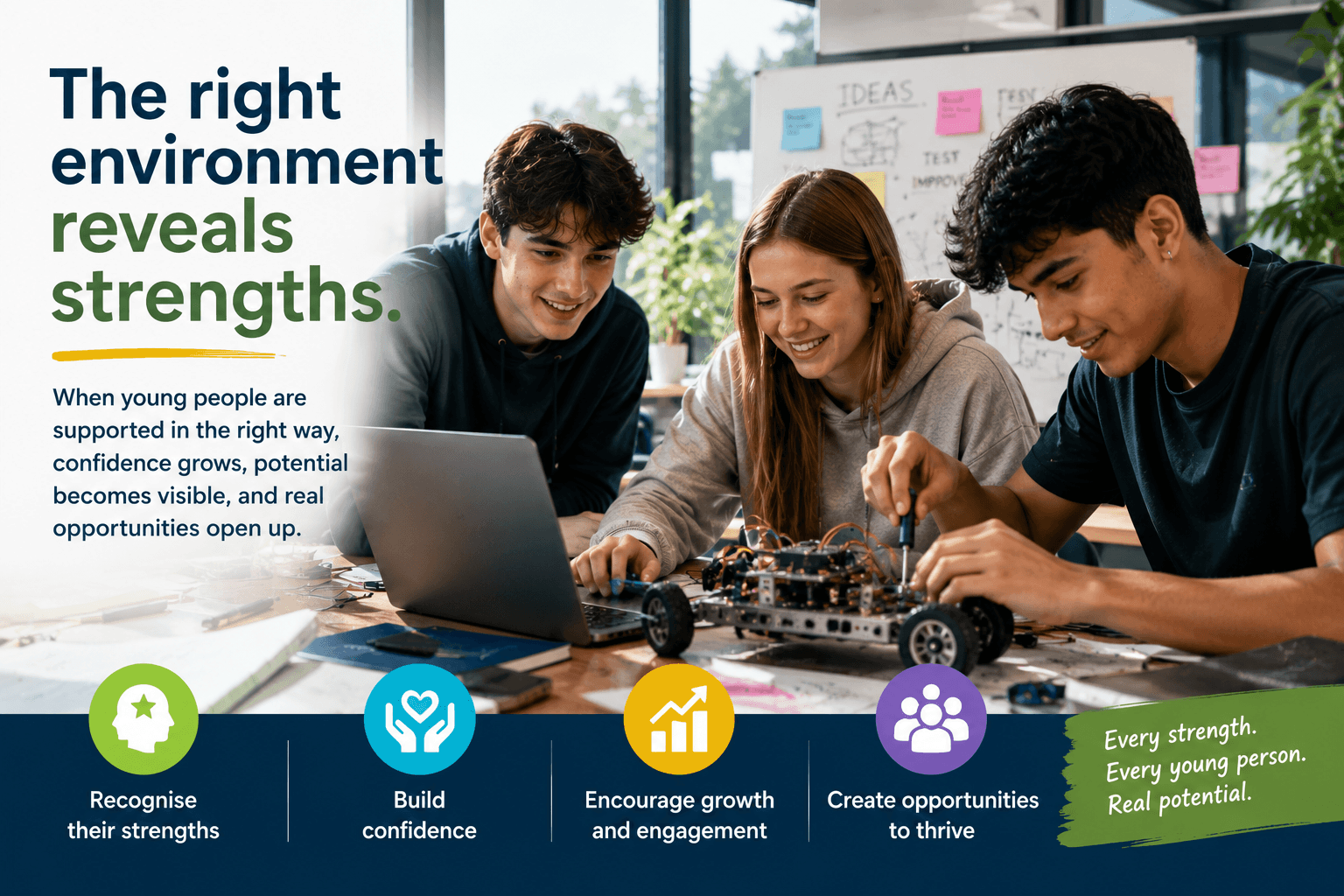
The right environment for strengths can make a remarkable difference in a child’s confidence, engagement and development. Many parents have experienced the same puzzling situation.
A child may appear disengaged in one setting yet become deeply focused in another. They may struggle with one type of task while demonstrating remarkable ability in something completely different. As a result, adults are often left wondering what explains the difference.
The answer is not always about ability.
Quite often, it is about environment.
The right environment for strengths can reveal capabilities that remain hidden in other situations. Furthermore, when children find settings that match how they naturally learn, think, explore and engage, confidence often begins to grow naturally.
Understanding this principle can change how parents, teachers and young people view success.
Why Environment Matters More Than We Realise
Modern education and society often focus on standard measures.
For example, children may be assessed through written work, examinations, classroom participation, or specific behavioural expectations. While these measures can provide useful information, they do not always capture the full picture.
Some children demonstrate their strengths through movement.
Others learn best by building, creating, experimenting, or solving practical problems.
Meanwhile, some young people excel when working independently, while others thrive through collaboration.
The challenge is that one environment rarely suits everyone equally.
As a result, a child’s abilities can remain hidden simply because the conditions needed to express those abilities are missing.
This does not mean there is anything wrong with the child.
Instead, it highlights the importance of understanding where strengths naturally emerge.
The Difference Between Fitting In and Contributing
Many children spend years trying to fit into systems that were not designed around their strengths.
They learn to adapt.
They learn to cope.
Sometimes they become very good at masking their natural preferences.
However, fitting in and contributing are not the same thing.
A young person may successfully comply with expectations while still feeling disconnected from their strongest abilities.
In contrast, when strengths are recognised and encouraged, children often begin making meaningful contributions.
They solve problems.
They create ideas.
They support others.
They become engaged because they can see that what they do matters.
Consequently, confidence develops from experience rather than from praise alone.
Strengths Often Appear in Unexpected Places
One of the most important lessons for parents and educators is that strengths do not always appear where we expect them.
A child who seems distracted during a lesson may spend hours designing complex structures.
A teenager who dislikes written assignments may produce remarkable digital creations.
Another young person may struggle to explain an idea verbally but demonstrate deep understanding through practical work.
Therefore, it is essential to look beyond traditional indicators.
Sometimes the strongest evidence of capability appears during hobbies, projects, games, creative activities, sports, or independent exploration.
The question becomes:
Where does this young person willingly invest their energy?
The answer often provides valuable clues.
Looking for Patterns of Engagement
Engagement is different from compliance.
Compliance happens when someone completes a task because they have been told to.
Engagement happens when curiosity, interest, and motivation come from within.
Parents frequently notice this distinction.
A child may resist one activity yet become completely absorbed in another.
Rather than focusing solely on what a child avoids, it can be helpful to observe what captures their attention naturally.
For example:
• What activities do they return to repeatedly?
• What topics do they talk about most?
• When do they lose track of time?
• Which tasks do they choose without being asked?
These patterns often reveal strengths that deserve further exploration.
Confidence Grows Through Contribution
Many people assume confidence comes first.
In reality, confidence often develops after meaningful contribution.
A child builds confidence when they see evidence that their efforts matter.
This might happen through:
• Completing a project
• Helping others
• Solving a problem
• Learning a new skill
• Creating something valuable
• Sharing knowledge
Each success becomes a piece of evidence.
Over time, these experiences help young people develop a stronger understanding of their abilities.
Importantly, this process does not require perfection.
It requires opportunities.
Helping Children Find Their Place
Parents and educators play an important role in creating opportunities for exploration.
First, it helps to stay curious.
Rather than asking only, “What does this child struggle with?” it can be equally valuable to ask, “What comes naturally to them?”
Next, provide opportunities to experiment.
Exposure to different activities allows strengths to emerge.
Some children discover their interests through sport.
Others find them through music, technology, design, construction, reading, storytelling, nature, or problem-solving.
Furthermore, encourage persistence without forcing conformity.
Children benefit from challenge.
However, challenge works best when it is connected to meaningful engagement.
The goal is not to make every child identical.
The goal is to help every child discover where they can contribute.
The Importance of Being Seen
Every young person wants to feel understood.
Unfortunately, strengths are sometimes overlooked because they do not match traditional expectations.
This is why learning to see strengths is so important.
When adults recognise effort, creativity, curiosity, persistence, and problem-solving, children begin to view themselves differently.
They feel valued.
They feel capable.
Most importantly, they feel seen.
That sense of recognition can have a lasting impact on motivation and wellbeing.
Creating More Opportunities for Success
Success does not need to look the same for everyone.
Different children succeed in different ways.
Therefore, creating a variety of opportunities is essential.
Schools, families, and communities can support this by offering experiences that include:
• Physical activity
• Creative projects
• Teamwork
• Independent learning
• Hands-on activities
• Real-world problem-solving
• Leadership opportunities
The more varied the opportunities, the greater the chance that strengths will emerge.
A Strengths-Based Future
Every child has abilities that deserve recognition.
Sometimes those abilities appear early.
Sometimes they take time to emerge.
However, when young people find the right environment for strengths, remarkable things can happen.
Engagement increases.
Confidence grows.
Contribution becomes possible.
Most importantly, children begin to understand that their value is not determined by a single test, grade, or expectation.
Instead, they discover that their unique combination of abilities can make a meaningful difference.
And that discovery can change the direction of a life.
Disclaimer
This article is provided for educational and informational purposes only. It does not provide medical, psychological, diagnostic, or professional advice. Every child is unique, and individual experiences may vary. If you have concerns about a child’s development, learning, or wellbeing, please seek guidance from an appropriately qualified professional.