
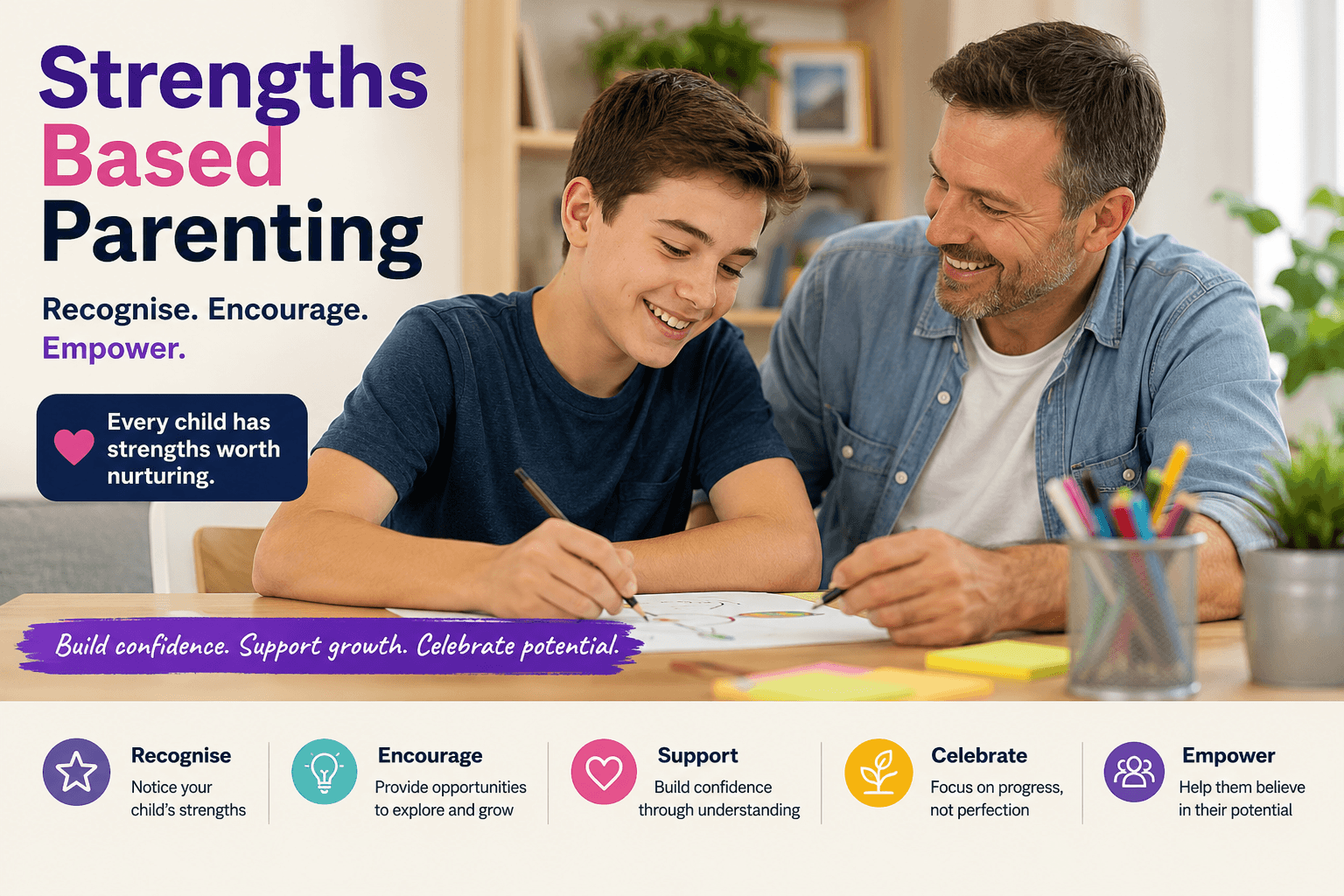
Every parent wants to help their child succeed. However, success can mean different things to different families. While academic achievement, sporting performance and measurable outcomes are often discussed, many parents are beginning to recognise the value of a different approach.
Strengths based parenting focuses on identifying and developing a child’s natural abilities, interests and positive qualities. Rather than concentrating primarily on weaknesses, this approach encourages parents to recognise what is already working well and build upon it.
At Kids Fitness First, we believe every child possesses strengths worth developing. When adults learn to notice and nurture those strengths, they create opportunities for confidence, participation and personal growth. If you are not yet sure what those strengths are, begin with recognising hidden strengths in children or the broader different-strengths framework. If learning itself is the concern, our guide to different ways of learning keeps that question separate from parenting technique.
What Is Strengths Based Parenting?
Strengths based parenting is an approach that encourages parents to identify their child’s positive qualities and create opportunities for those qualities to develop.
This does not mean ignoring challenges.
Instead, it means recognising that growth often happens most effectively when children feel capable, valued and understood.
For example, a child who enjoys storytelling may benefit from opportunities to write, create presentations or explore creative projects.
Similarly, a young person who enjoys building and designing may thrive when given practical challenges that encourage problem-solving and innovation.
Consequently, strengths become foundations for development rather than simply characteristics to be noticed.
Why Strengths Based Parenting Helps Build Confidence
Confidence rarely appears overnight.
Instead, confidence develops through experience.
When children repeatedly experience situations where they can contribute, participate and succeed, they begin to develop belief in their own abilities.
Strengths based parenting supports this process because it helps children recognise what they can do rather than focusing exclusively on what they find difficult.
Furthermore, recognising strengths often encourages greater engagement.
Children are naturally more likely to invest effort in activities that feel meaningful and rewarding.
As a result, confidence grows alongside competence.
Strengths Based Parenting and Different Ways of Learning
Every child learns differently.
Some enjoy reading.
Others learn through conversation.
Meanwhile, some prefer practical experiences, creative activities or movement-based learning.
Strengths based parenting recognises these differences.
Rather than expecting all children to learn in exactly the same way, parents can explore how their child naturally engages with information and experiences.
This perspective encourages flexibility and understanding.
Moreover, it helps create environments where children feel comfortable exploring new ideas and developing new skills.
Looking Beyond Traditional Measures of Success
Modern society often focuses on measurable outcomes.
Test scores can be recorded.
Results can be compared.
Achievements can be celebrated.
However, many valuable qualities are not easily measured.
Curiosity.
Empathy.
Creativity.
Leadership.
Persistence.
Problem-solving.
These strengths often contribute significantly to long-term success and wellbeing.
Therefore, strengths based parenting encourages adults to look beyond narrow definitions of achievement and recognise a wider range of capabilities.
Practical Ways to Use Strengths Based Parenting at Home
Parents can begin using strengths based parenting through simple everyday actions.
Notice Positive Patterns
Observe activities that consistently generate enthusiasm and engagement.
Ask Reflective Questions
Encourage children to think about what they enjoy and why they enjoy it.
Celebrate Effort and Growth
Focus on progress rather than perfection.
Encourage Exploration
Provide opportunities to try new activities and experiences.
Recognise Individuality
Avoid comparing children to siblings, classmates or peers.
Each child develops in their own way and at their own pace.
Strengths Based Parenting and Resilience
Resilience is not about avoiding difficulties.
Instead, resilience involves developing the confidence to navigate challenges.
Children who understand their strengths often feel more capable when facing setbacks.
For example, a child who recognises their creativity may use creative thinking to solve problems.
Likewise, a child who values persistence may continue working towards a goal despite obstacles.
Consequently, strengths become valuable resources during difficult situations.
Supporting Healthy Development Through Strength Recognition
Healthy development involves much more than academic achievement.
Children benefit when they feel:
Valued
Included
Capable
Encouraged
Connected
Strengths based parenting supports these outcomes by helping children develop a positive understanding of themselves.
Furthermore, this approach aligns closely with the mission of Kids Fitness First, which encourages healthy development through confidence, participation and strengths-based support.
Conclusion
Strengths based parenting is not about ignoring challenges or lowering expectations. Instead, it is about recognising potential, encouraging growth and helping children understand their own capabilities.
When parents focus on strengths alongside development, they create opportunities for confidence, resilience and lifelong learning.
Most importantly, children who feel recognised for their abilities are often more willing to participate, explore and contribute to the world around them.
Disclaimer
This article is intended for educational and informational purposes only. It does not provide medical, psychological or professional advice.