
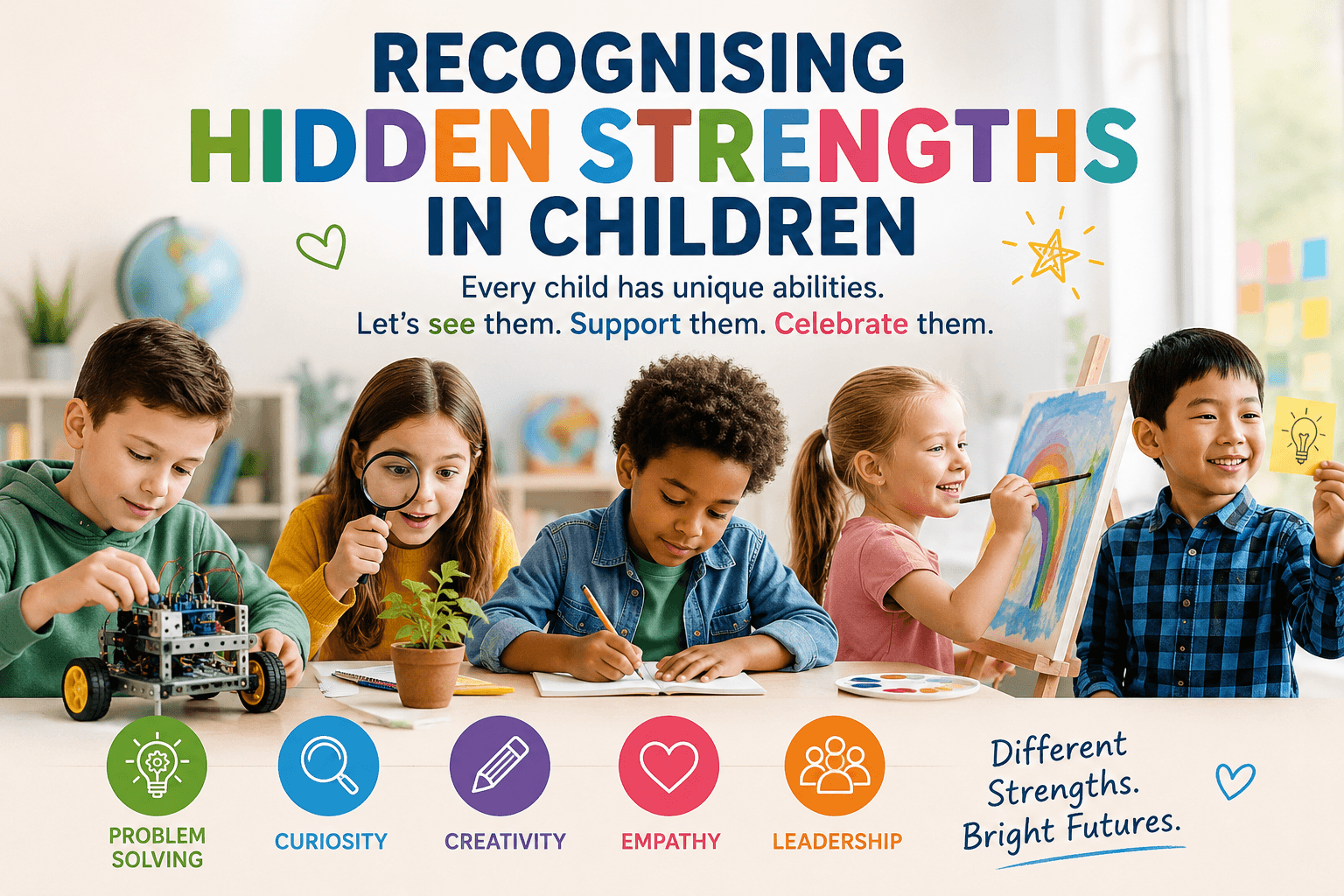
Many conversations about education focus on grades, test results and measurable achievements. While these can be useful indicators of progress, they do not always tell the full story. Recognising hidden strengths in children means looking beyond traditional measures and understanding that talent often appears in many different forms.
Some children excel in structured environments. Others demonstrate remarkable creativity, curiosity, determination, empathy, problem-solving ability or innovative thinking that may not always be captured by conventional assessments. When adults learn to notice these qualities, they create opportunities for children to develop confidence, resilience and a stronger sense of identity.
Understanding strengths is not about lowering expectations. It is about broadening our view of what success can look like and helping young people discover where they naturally shine.
Why Hidden Strengths Are Often Overlooked
Modern education systems have many demands. Teachers must assess progress, schools must meet standards, and parents naturally want to know how their children are performing.
However, some strengths are easier to measure than others.
Reading scores can be recorded.
Maths tests can be marked.
Attendance can be tracked.
But how do we measure imagination? How do we score curiosity? How do we quantify determination, originality or the ability to see solutions that others miss?
Many of history’s most influential thinkers, inventors, artists and entrepreneurs possessed qualities that may not have fitted neatly into conventional educational frameworks. Their greatest strengths often emerged because they viewed the world differently, asked unusual questions or approached problems from unique perspectives.
Children today possess those same possibilities.
The challenge is making sure we recognise them.
Recognising Hidden Strengths in Children at Home
Parents are often the first people to notice strengths that others may miss.
A child who spends hours building complex creations from everyday objects may be demonstrating engineering thinking.
A child who constantly asks questions may be developing advanced curiosity and investigative skills.
A child who creates stories, drawings or imaginative games may be exercising creativity and innovation.
These abilities may not always receive the same attention as test scores, yet they can become the foundations for future success.
One practical approach is to observe what naturally captures a child’s attention.
Ask yourself:
- What activities do they choose when no one is directing them?
- What topics do they talk about repeatedly?
- When do they appear most engaged?
- What challenges do they willingly tackle without being asked?
The answers often reveal valuable clues about underlying strengths.
The Difference Between Interest and Strength
Not every interest becomes a lifelong passion.
However, sustained interest often points towards areas where natural strengths may exist.
Children tend to invest energy in activities that feel rewarding.
When they repeatedly return to certain subjects, hobbies or challenges, they may be signalling an area of emerging capability.
Parents do not need to identify a child’s future career.
Instead, they can create opportunities to explore interests and see where those experiences lead.
Recognising Hidden Strengths in Children Within Schools
Schools play an important role in helping children discover their abilities.
Teachers see children in group settings, learning environments and social situations that parents may not observe.
This provides valuable opportunities to identify strengths that extend beyond academic performance.
For example:
- Leadership qualities during group projects
- Creative problem solving during classroom activities
- Kindness and empathy towards peers
- Persistence when facing difficult tasks
- Original thinking during discussions
These characteristics contribute significantly to long-term success and wellbeing.
When schools actively recognise a wider range of strengths, more children feel valued and included.
This can help create learning environments where confidence grows alongside academic development.
The Importance of Different Ways of Thinking
Every child experiences and interprets the world in their own way.
Some process information visually.
Others learn through movement, discussion, experimentation or practical application.
Different thinking styles can bring different advantages.
A child who notices patterns others miss may offer unique solutions.
A child who thinks creatively may generate innovative ideas.
A child who questions assumptions may identify opportunities for improvement.
Rather than expecting every child to think in exactly the same way, we can encourage diverse approaches to learning and problem solving.
This benefits not only individual children but also the wider communities they will eventually contribute to.
Curiosity as a Strength
Curiosity is one of the most powerful drivers of learning.
Children who ask questions are often exploring possibilities, testing ideas and building understanding.
While constant questions can sometimes feel challenging for adults, curiosity should be viewed as a valuable strength.
Many discoveries, inventions and innovations began with someone asking a simple question:
“What if?”
Encouraging curiosity helps children develop confidence in their own thinking and supports lifelong learning.
Building Confidence Through Strength Recognition
Confidence grows when children feel seen and valued.
This does not mean praising everything indiscriminately.
Instead, it involves recognising genuine effort, progress and capability.
For example:
Instead of saying:
“You’re clever.”
Try:
“I noticed how determined you were when solving that problem.”
Instead of focusing only on outcomes, focus on the strengths demonstrated during the process.
This helps children understand that abilities can be developed and that effort, persistence and creativity matter.
Over time, this approach encourages a healthier relationship with learning and achievement.
Creating Opportunities for Strength Development
Recognising strengths is only the first step.
Children also need opportunities to develop them.
Parents, teachers and communities can support this by providing varied experiences.
Examples include:
- Sports and physical activities
- Creative arts
- Reading and storytelling
- Science projects
- Outdoor exploration
- Community volunteering
- Team activities
- Problem-solving challenges
Exposure to different experiences helps children discover abilities they may not have realised they possessed.
Importantly, development should not be limited to areas where a child already excels.
Exploration often reveals unexpected strengths.
The Long-Term Value of Strength-Based Thinking
When children grow up understanding their strengths, they often develop greater self-awareness.
Self-awareness can support:
- Better decision making
- Increased confidence
- Improved resilience
- Stronger motivation
- More positive participation in education and community life
A strengths-based perspective also encourages adults to move away from a “one-size-fits-all” view of success.
Instead of asking:
“How does this child compare to others?”
We can ask:
“What strengths does this child bring?”
This shift in perspective creates more opportunities for growth and inclusion.
Helping Every Child Feel Valued
One of the most powerful things adults can do is help children recognise their own potential.
Many strengths emerge gradually.
Some appear early.
Others take years to develop.
The role of parents, teachers and supportive communities is not to predict exactly where a child’s journey will lead.
It is to create environments where curiosity, creativity, determination and individuality are encouraged.
When children feel valued for who they are and supported in developing their unique abilities, they gain the confidence to contribute positively to the world around them.
That confidence can become the foundation for future learning, personal growth and lifelong wellbeing.
Conclusion
Recognising hidden strengths in children encourages us to look beyond narrow definitions of success and appreciate the many ways young people can contribute, learn and grow.
Every child possesses qualities worth developing.
Some strengths are immediately visible.
Others emerge through time, encouragement and opportunity.
By creating environments that value curiosity, creativity, determination and different ways of thinking, parents, teachers and communities can help children discover abilities that may otherwise remain hidden.
The goal is not to fit every child into the same mould.
The goal is to help every child recognise and develop the strengths that make them uniquely capable.
Disclaimer
This article is intended for educational and informational purposes only. It does not provide medical, psychological or diagnostic advice. Every child is unique, and parents or carers seeking specific support should consult appropriately qualified professionals where necessary.