Teamwork and Collaboration in Teenagers: Helping Young People Work Together with Confidence
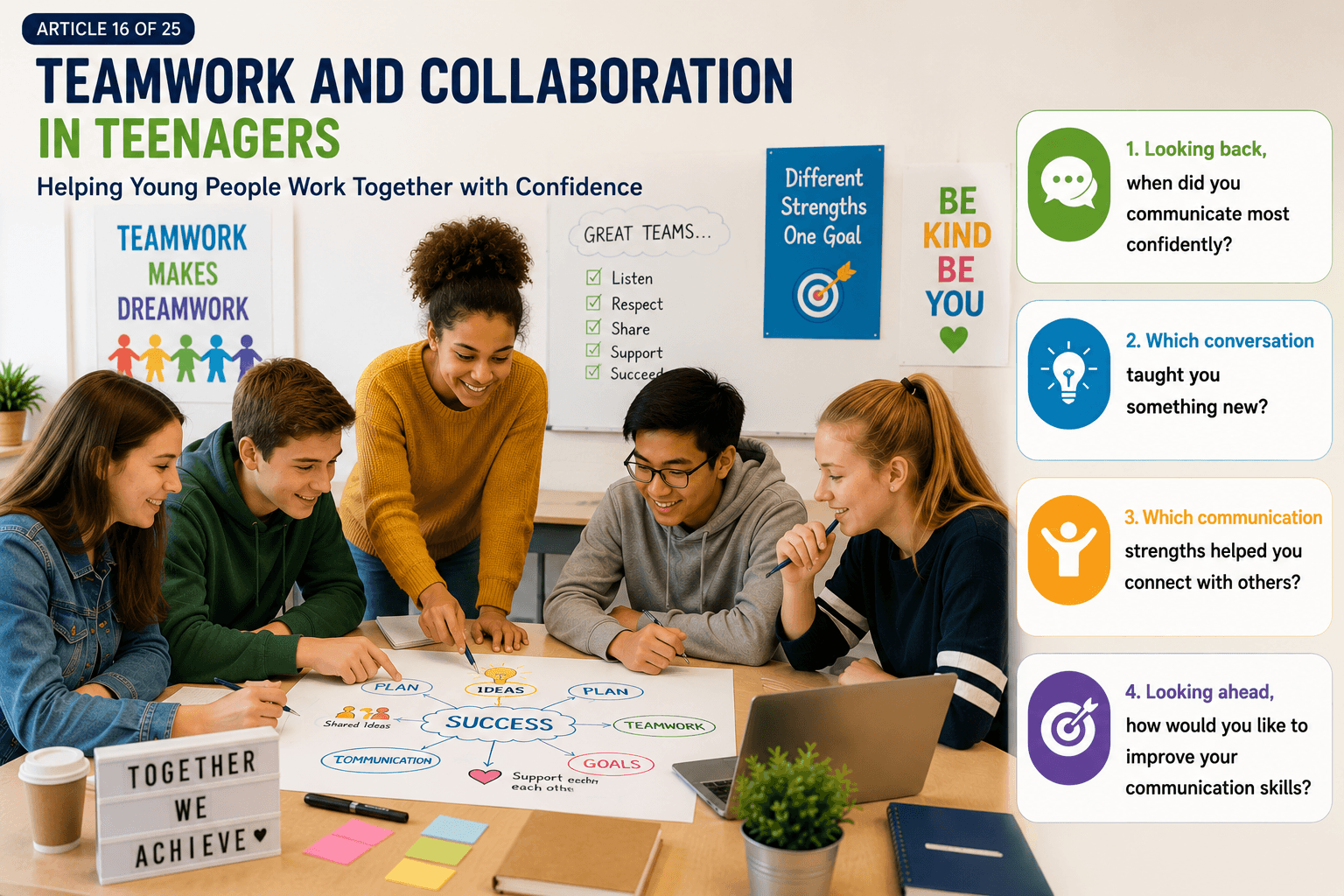
Teamwork and collaboration in teenagers develop whenever young people work with others towards a shared purpose. This may happen during a classroom project, a sports activity, a family task, a community event or a creative challenge.
Working effectively with others involves much more than simply being placed in a group. Teenagers need opportunities to listen, contribute, organise, compromise and recognise the value of different strengths.
Some young people naturally enjoy group activities. Others prefer to observe before taking part. A few may feel more comfortable when they understand their role clearly. Therefore, adults should avoid assuming that everyone will collaborate in the same way.
A strengths-based approach recognises that effective teams include many different contributions. One teenager may generate ideas, another may organise the work, while someone else may notice important details or help the group remain calm.
Each role can support the success of the whole team.
Why Teamwork and Collaboration in Teenagers Matter
Teamwork and collaboration in teenagers support many skills that young people will use throughout education, employment and adult life.
Group experiences can help teenagers develop:
- communication;
- active listening;
- responsibility;
- leadership;
- adaptability;
- patience;
- problem-solving;
- respect for different viewpoints;
- confidence in contributing ideas;
- awareness of other people’s needs.
These abilities grow through repeated experience rather than one lesson.
For example, a group project may require teenagers to plan tasks, divide responsibilities and respond when something changes. Although the final product matters, the process also teaches valuable lessons about cooperation.
Likewise, sports teams, volunteering activities and family projects provide opportunities to practise communication and responsibility in real situations.
Every Team Needs Different Strengths
Strong teams do not require every person to think or behave in the same way.
In fact, a team often becomes more effective when members bring different skills and perspectives.
One teenager may be good at presenting ideas. Another may enjoy practical tasks. Someone else may be organised, creative, observant or supportive.
Adults can help young people recognise these differences by asking:
- Who is good at planning?
- Who enjoys explaining ideas?
- Who notices important details?
- Who keeps the group organised?
- Who helps others feel included?
- Who enjoys practical work?
- Who can review the final result?
These questions shift attention away from popularity or confidence alone.
They also show teenagers that contribution can take many forms.
Teamwork and Collaboration in Teenagers Begin With Listening
Listening is one of the most important parts of teamwork.
A group cannot work effectively if everyone is waiting for their own turn to speak without considering what others are saying.
Active listening involves:
- giving attention;
- allowing others to finish;
- asking useful questions;
- checking understanding;
- responding respectfully;
- considering ideas before rejecting them.
Teenagers often improve their communication when adults model these behaviours consistently.
For instance, a teacher can pause after a student speaks and ask another person to summarise the point before adding a new idea.
Similarly, parents can encourage family discussions where each person has time to contribute.
Good listening does not mean agreeing with everything. Instead, it means showing that another person’s view has been heard and considered.
Sharing Responsibility
Teamwork becomes stronger when responsibility is shared fairly.
Problems can arise when one person completes most of the work while others remain passive. On the other hand, confusion may develop when no one knows who is responsible for each task.
Clear roles can help.
A group might assign responsibilities such as:
- project organiser;
- researcher;
- note-taker;
- materials coordinator;
- presenter;
- timekeeper;
- reviewer.
These roles should not become permanent labels. Teenagers benefit from trying different responsibilities over time.
A quiet student may discover that they enjoy leading a small task. Meanwhile, a confident speaker may learn the value of listening and supporting others.
Rotating roles allows young people to develop a wider range of skills.
Working Through Different Opinions
Differences of opinion are a normal part of collaboration.
Teenagers may disagree about ideas, priorities, methods or responsibilities. These moments can become valuable learning opportunities when adults help young people respond constructively.
Useful approaches include:
- allowing each person to explain their view;
- identifying the shared goal;
- separating the idea from the person;
- comparing practical advantages;
- looking for common ground;
- agreeing on a fair decision-making method;
- reviewing the choice afterwards.
Adults can encourage respectful language such as:
- “I understand your point, although I see it differently.”
- “Could we combine these ideas?”
- “What outcome are we all trying to achieve?”
- “Which option best fits the task?”
- “Can we test both approaches?”
These phrases help teenagers disagree without making the discussion personal.
Teamwork and Collaboration in Teenagers at School
Schools provide regular opportunities for group learning.
However, simply placing students together does not guarantee effective teamwork. Some groups may divide the task unfairly, while others may lack clear direction.
Teachers can strengthen collaboration by:
- explaining the purpose of the task;
- setting clear expectations;
- assigning or discussing roles;
- allowing preparation time;
- checking progress;
- encouraging reflection;
- recognising individual and group contributions.
Project-based learning can be especially useful because it gives students a shared outcome.
For example, a group may design a model, research a community issue, organise a presentation or plan an event.
These activities allow different strengths to become visible.
A student who rarely speaks during a traditional lesson may become highly engaged during practical planning. Another may demonstrate leadership through organisation rather than public speaking.
Collaboration Beyond the Classroom
Teamwork also develops through everyday life.
Families can encourage collaboration by involving teenagers in:
- planning meals;
- organising journeys;
- preparing celebrations;
- completing household projects;
- caring for pets;
- gardening;
- budgeting for an activity;
- supporting community events.
These tasks show young people that teamwork is not limited to school.
Furthermore, practical responsibilities help teenagers see how their contribution affects others.
Community activities can also be valuable. Volunteering, youth groups, sports, music and creative projects provide opportunities to work with people of different ages and backgrounds.
As a result, teenagers learn that collaboration often requires flexibility and respect.
The Difference Between Cooperation and Collaboration
Cooperation and collaboration are closely related, but they are not exactly the same.
Cooperation often means dividing a task and completing separate parts.
Collaboration involves thinking and working together throughout the process.
For example, four students may cooperate by each writing one section of a presentation. However, they collaborate when they discuss the overall message, review each other’s work and make shared decisions.
Both approaches can be useful.
Nevertheless, collaboration often develops deeper communication and problem-solving because the group remains connected throughout the task.
Helping Quieter Teenagers Contribute
Not every teenager feels comfortable speaking quickly in a group.
Some need time to process information before responding. Others may prefer writing ideas down first.
Adults can make teamwork more inclusive by offering different ways to contribute.
These may include:
- silent brainstorming before discussion;
- written notes;
- smaller group conversations;
- clearly assigned roles;
- preparation time;
- visual planning boards;
- practical responsibilities.
A young person should not be judged as uninterested simply because they communicate differently.
Sometimes the most thoughtful contribution arrives after a period of observation.
Preventing One Person From Dominating
Confident speakers can bring energy to a group. However, teamwork becomes less effective when one person controls every decision.
Adults can help by introducing simple structures.
For example:
- everyone shares one idea before anyone speaks twice;
- each person leads one part of the task;
- the group uses a timer for presentations;
- decisions require input from every member;
- the chairperson summarises all options before choosing.
These methods create space for wider participation without criticising confident students.
They also teach leadership through inclusion rather than control.
Giving Useful Feedback
Feedback helps teenagers understand how they contribute to a group.
General praise such as “Good teamwork” can feel positive, but specific feedback is more useful.
Adults might say:
- “You listened carefully before suggesting a solution.”
- “Your planning helped everyone stay organised.”
- “You made sure each person had a role.”
- “You helped the group find common ground.”
- “You noticed a detail that improved the final result.”
- “You remained calm when the plan changed.”
- “You encouraged someone else to share an idea.”
This feedback identifies the behaviour that supported the team.
Consequently, teenagers are more likely to repeat it.
Learning From Group Challenges
Not every group experience will go smoothly.
A project may take longer than expected. Responsibilities may be misunderstood. Someone may miss a deadline or disagree with the chosen direction.
These situations can still provide valuable learning.
After the activity, adults can ask:
- What worked well?
- Which part of the teamwork was most effective?
- Where did communication become unclear?
- Did everyone understand their role?
- How were disagreements handled?
- What could the group do differently next time?
Reflection turns experience into learning.
Without reflection, teenagers may remember only that the task felt difficult. With guidance, they can identify practical improvements.
Building Confidence Through Contribution
Teenagers often gain confidence when they see that their contribution matters.
A young person may not feel confident in every area, yet they may bring an important strength to a group.
Perhaps they organise information clearly, support others or suggest a practical solution.
When adults recognise this contribution, the teenager receives evidence that their abilities have value.
This can encourage greater participation in future activities.
Confidence develops most effectively when it is connected to real experience.
Leadership Within a Team
Leadership does not always mean being in charge.
Teenagers can lead by:
- keeping the group focused;
- listening to different viewpoints;
- helping resolve disagreements;
- encouraging quieter members;
- organising materials;
- taking responsibility;
- modelling respectful behaviour;
- adapting when circumstances change.
These forms of leadership often strengthen the whole group.
Adults should therefore avoid presenting leadership only as public speaking or giving instructions.
Quiet, thoughtful leadership can be equally valuable.
Digital Teamwork and Collaboration
Many teenagers now collaborate through digital platforms.
Online tools can support shared documents, research, planning and communication. However, digital teamwork still requires clear expectations.
Young people benefit from guidance about:
- respectful written communication;
- responding within agreed times;
- protecting personal information;
- checking sources;
- dividing tasks clearly;
- avoiding misunderstandings caused by tone;
- using group channels responsibly.
Digital collaboration should support the task rather than replace meaningful discussion.
When possible, groups benefit from combining online planning with direct conversation.
Creating a Positive Team Culture
A positive team culture does not happen automatically.
It develops when members understand how they are expected to treat one another.
Helpful principles include:
- Every contribution deserves consideration.
- Questions are welcome.
- Different strengths are valuable.
- Disagreement should remain respectful.
- Responsibilities should be clear.
- Asking for help is acceptable.
- Progress matters more than perfection.
- The group shares responsibility for the outcome.
When adults reinforce these principles, teenagers become more willing to participate.
They also learn that effective teamwork depends on behaviour as much as ability.
Reflection Questions
- Looking back, which contribution helped the group most?
- How did the team respond when opinions differed?
- Which personal strength supported the shared task?
- Looking ahead, what teamwork skill would be useful to practise next?
Conclusion
Teamwork and collaboration in teenagers develop through meaningful participation, shared responsibility and regular reflection.
Parents, teachers and communities can support these skills by creating opportunities for young people to listen, contribute and work towards common goals.
Every teenager brings different strengths to a group. Some lead through ideas, while others contribute through planning, practical work or thoughtful support.
When adults recognise these differences, teamwork becomes more inclusive and effective.
The aim is not to make every group experience perfect. Instead, it is to help young people understand how cooperation, communication and responsibility contribute to shared success.
These skills can support teenagers throughout education, employment, family life and community participation.
Suggested Internal Links
- Read Communication Skills for Teenagers: Helping Young People Express Ideas with Confidence
- Explore Building Emotional Resilience in Teenagers
Disclaimer
This article is provided for general educational and informational purposes only. It does not offer medical, psychological, diagnostic or therapeutic advice. Every young person develops differently. Anyone with specific concerns about a teenager’s learning, development or wellbeing should seek guidance from an appropriately qualified professional.