
Problem-Solving Skills in Children: Building Confidence Through Everyday Challenges
Problem-solving skills in children develop whenever young people face a question, make a decision or work out how to move forward. These skills are not limited to mathematics, science or formal schoolwork. They appear when a child builds something, organises an activity, settles a disagreement, follows instructions or finds another way to complete a task.
Adults sometimes step in quickly when a young person encounters difficulty. Usually, this comes from a desire to help. However, when children receive enough time and encouragement to think for themselves, everyday challenges can become valuable learning opportunities.
Problem-solving does not mean finding the correct answer immediately. Instead, it involves understanding a situation, exploring possibilities, trying an approach and learning from what happens next.
This process supports much more than academic achievement. It can also encourage confidence, patience, communication, creativity and independent thinking.
Why Problem-Solving Skills in Children Matter
Young people will meet many situations where instructions are incomplete, circumstances change or the first idea does not work. Therefore, learning how to respond thoughtfully is an important part of development.
Strong problem-solving skills can help children:
- examine a situation before reacting;
- identify different possible responses;
- make decisions with greater confidence;
- explain their ideas clearly;
- work constructively with other people;
- adapt when circumstances change;
- learn from mistakes without giving up.
These abilities develop gradually. A teenager does not become an independent problem-solver through one lesson or activity. Instead, confidence grows through repeated experience.
For example, a student who helps plan a class project may need to divide responsibilities, manage limited materials and respond when part of the plan changes. Although the activity may seem simple, it includes several forms of problem-solving.
Likewise, a young person preparing a meal, repairing an object or organising a sports activity must think ahead, make choices and adjust when necessary.
Different Children Solve Problems Differently
There is no single correct style of problem-solving.
Some young people think aloud and develop ideas through discussion. Others prefer to observe quietly before speaking. One child may draw a diagram, while another may begin by testing materials or asking questions.
A highly organised student may create a detailed plan before starting. Meanwhile, a more exploratory thinker may discover the answer by experimenting.
Each approach can be valuable.
Difficulties can arise when adults expect every child to follow the same process. For instance, a young person who does not immediately explain an answer may still be thinking deeply. Similarly, someone who tests several ideas may not be unfocused; they may be learning through exploration.
A strengths-based approach looks beyond the surface and asks:
What kind of thinking is happening here?
That question helps adults recognise ability rather than judging only the visible method.
Problem-Solving Skills in Children Begin With Good Questions
Questions are central to problem-solving.
When adults provide every answer immediately, young people may complete the task but miss the opportunity to think independently. By contrast, a thoughtful question can guide a child without taking control.
Useful questions include:
- What do you already know?
- What is the main challenge?
- What could you try first?
- Is there another way to approach it?
- What happened when you tried that?
- What might you change next time?
- Who or what could help?
- Which part of the task feels most manageable?
These questions encourage reflection. Moreover, they show that the adult is interested in the young person’s thinking rather than only the final result.
Open questions are usually more helpful than rapid instructions. They allow children to explain how they see the situation and often reveal strengths that might otherwise remain unnoticed.
The Importance of Time
Thinking takes time.
Adults often work more quickly because they have greater experience. Consequently, a solution that appears obvious to a parent or teacher may still be new to a child.
When adults rush the process, young people may begin to believe that speed matters more than understanding. However, many valuable ideas emerge only after observation, discussion or experimentation.
Allowing time does not mean leaving a child without support. Instead, it means resisting the urge to solve the problem immediately.
A useful approach is to pause before helping. Give the young person an opportunity to consider the situation, then offer a prompt if needed.
For example:
“Take a moment. What do you notice?”
This simple invitation can create enough space for independent thought.
Learning From Ideas That Do Not Work
Not every attempt will succeed, and that is part of learning.
An unsuccessful idea provides information. It shows what happened under certain conditions and helps narrow the available options.
Unfortunately, some children become reluctant to experiment because they fear being wrong. When every mistake receives immediate correction, they may begin choosing only safe tasks with predictable answers.
Adults can create a healthier learning environment by responding calmly:
- What did that attempt show us?
- Which part worked?
- What could be adjusted?
- What would you try differently?
- Did anything unexpected happen?
This language treats the experience as useful evidence rather than failure.
As a result, children learn that progress often involves testing, reviewing and improving.
Building Problem-Solving Skills Through Everyday Life
Families do not need specialist equipment or complicated activities to encourage problem-solving. Everyday life already provides many suitable opportunities.
Cooking and preparing food
Cooking requires planning, measuring, sequencing and adapting. A missing ingredient can become an opportunity to consider alternatives.
Instead of immediately providing the answer, an adult might ask:
“What could we use instead?”
Building and repairing
Simple construction projects help young people understand materials, balance, measurement and cause and effect.
This might involve assembling furniture, creating a model, repairing a bicycle or designing storage for a bedroom.
Planning a journey or activity
Teenagers can help compare routes, organise timings, calculate costs and prepare what is needed.
These tasks connect decision-making with real responsibility.
Games and puzzles
Board games, strategy games and practical puzzles encourage planning and flexible thinking. They also help young people experience changing circumstances in a safe setting.
Outdoor activities
Gardening, hiking, team sports and nature projects involve observation, adaptation and practical judgement.
The important feature is not the activity itself. Instead, it is the opportunity to think, decide and learn from the result.
Problem-Solving Skills in Children at School
Schools provide daily opportunities to encourage independent thinking.
However, students may become passive if most lessons follow a pattern of listening, remembering and repeating. Therefore, teachers can strengthen problem-solving by including tasks that allow more than one possible approach.
Helpful strategies include:
- project-based learning;
- practical experiments;
- collaborative challenges;
- real-world scenarios;
- open-ended questions;
- student-led discussion;
- opportunities to explain different methods;
- reflection after completing a task.
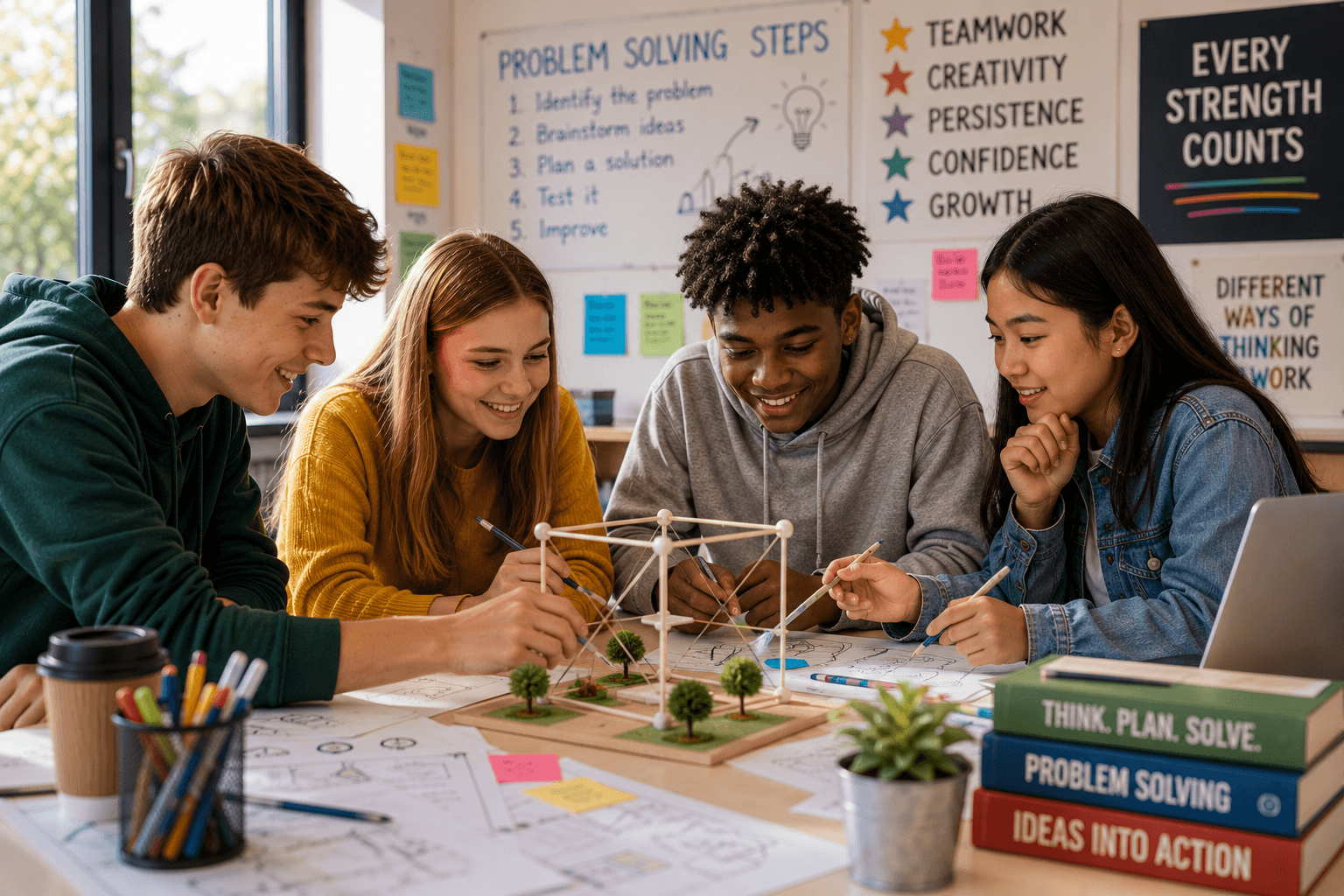
For example, a teacher might present a design challenge with limited materials. Different groups may create very different solutions, yet each approach can demonstrate planning, creativity and teamwork.
Afterwards, the class can discuss what worked, what changed and what they learned.
This reflection is important because it turns activity into understanding.
The Role of Teamwork
Many problems are easier to solve together.
Group activities allow young people to hear different viewpoints and recognise that another person may notice something they missed.
Within a team, one student may generate ideas, another may organise the process and someone else may test the details. These are all valuable contributions.
Adults can support effective teamwork by helping children:
- listen without interrupting;
- explain their reasoning;
- disagree respectfully;
- divide responsibilities;
- recognise each person’s contribution;
- review the result together.
Importantly, leadership should not always belong to the loudest student. Quiet observation, careful planning and thoughtful questions are also forms of leadership.
Confidence Grows Through Useful Contribution
Young people often feel more confident when they see that their ideas have practical value.
A child may not consider themselves academically confident, yet they may solve real-world problems extremely well. Another may notice patterns, identify risks or suggest an original approach that improves a group project.
When adults recognise these contributions, children begin to understand their own strengths more clearly.
Specific feedback is especially helpful.
Instead of saying only, “Well done,” try:
- You noticed a detail everyone else missed.
- Your question helped the group understand the problem.
- You stayed with the task when the first idea did not work.
- You found a practical way to organise the materials.
- You listened to everyone before suggesting a solution.
This kind of feedback tells young people exactly what they did effectively.
When Adults Should Step In
Encouraging independence does not mean withholding support.
Young people still need clear boundaries, appropriate supervision and guidance suited to their age and experience. Adults should intervene when safety is involved or when a child genuinely lacks the information needed to continue.
The goal is not to make every task difficult. Rather, it is to provide the right amount of support.
This can be understood as a gradual process:
- Demonstrate the task.
- Complete it together.
- Offer prompts while the child takes the lead.
- Allow the child to work independently.
- Review the experience afterwards.
As confidence grows, adults can reduce the level of support.
Recognising Strengths Through Problem-Solving
Problem-solving activities often reveal abilities that traditional tests may not capture.
A young person may demonstrate:
- original thinking;
- strong visual awareness;
- practical intelligence;
- persistence;
- pattern recognition;
- communication;
- leadership;
- empathy;
- adaptability;
- attention to detail.
These qualities can become important in education, work and community life.
Therefore, adults should pay attention not only to whether a child reaches the expected answer but also to how they approach the challenge.
Sometimes the most valuable strength appears in the process.
Creating an Environment Where Ideas Are Welcome
Young people are more likely to share ideas when they feel respected.
Adults can encourage this by avoiding ridicule, excessive correction or immediate judgement. Even an impractical suggestion can become the beginning of a useful conversation.
A supportive environment communicates:
- Questions are welcome.
- Different approaches are worth exploring.
- Mistakes provide information.
- Asking for help is acceptable.
- Improvement matters more than perfection.
- Every person can contribute.
Over time, this atmosphere supports both confidence and participation.
Conclusion
Problem-solving skills in children develop through ordinary experiences, thoughtful questions and opportunities to make meaningful decisions.
Parents and teachers do not need to provide every answer. Often, the most useful support is time, encouragement and a question that helps a young person take the next step independently.
Children may solve problems in different ways. Some plan carefully, while others learn through discussion or experimentation. By recognising these approaches, adults can help young people understand their strengths and become more confident contributors.
Every practical challenge can become a learning opportunity. When young people are trusted to explore, test and reflect, they develop skills that can support them throughout education and adult life.
Suggested Internal Links
- Read Curiosity in Children: Encouraging Questions That Build Confidence and Learning
- Explore Creative Thinking in Children
Disclaimer
This article is provided for general educational and informational purposes only. It does not offer medical, psychological, diagnostic or therapeutic advice. Every child develops differently. Anyone with specific concerns about a child’s learning, development or wellbeing should seek guidance from an appropriately qualified professional.