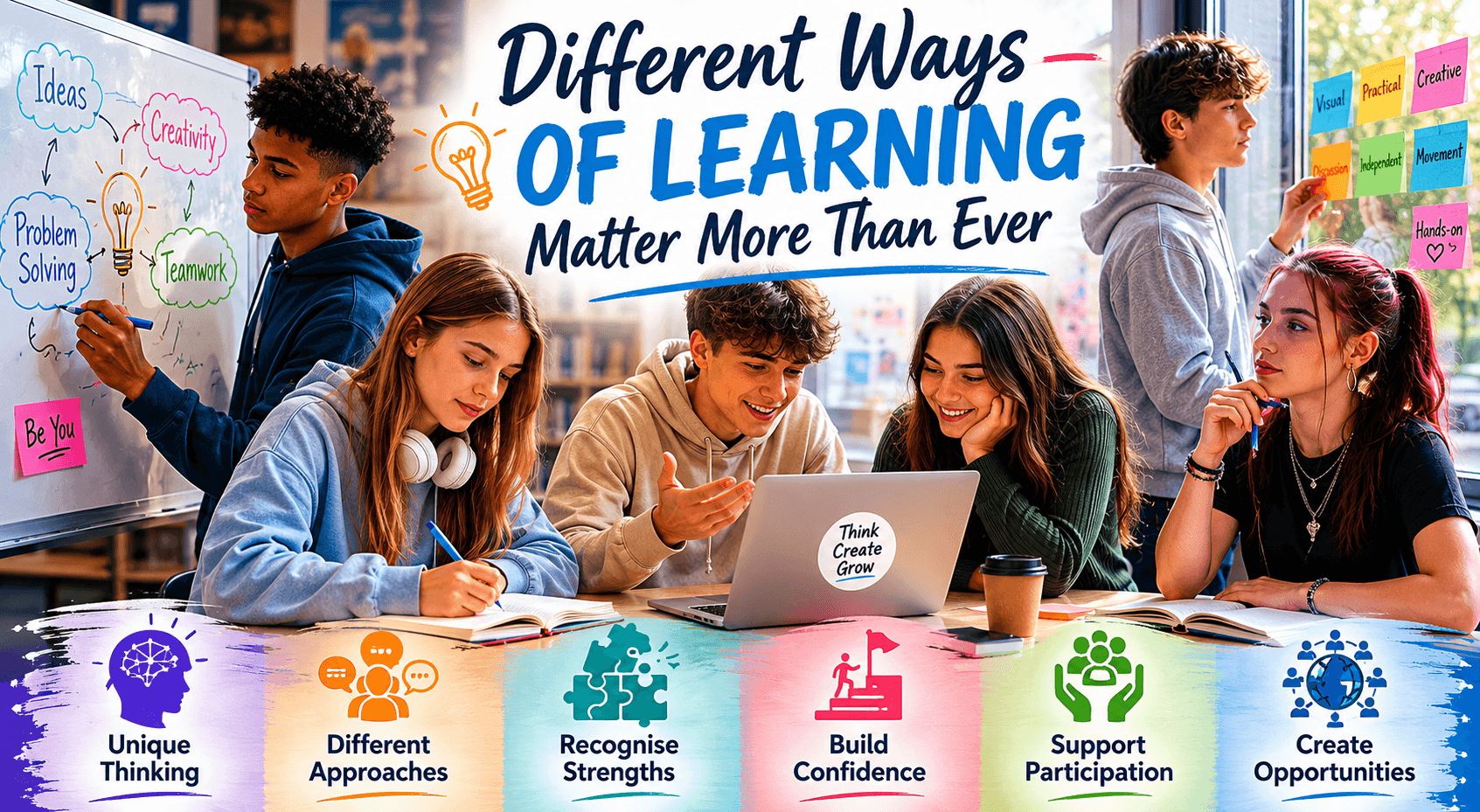
Different ways of learning have always existed, yet modern education systems and workplaces often reward a narrow set of skills. As a result, many children and adults may overlook talents that simply emerge in different ways.
At Kids Fitness First, we believe understanding different ways of learning is one of the most important steps towards supporting healthy development, building confidence and helping young people participate fully in society.
The goal is not to place people into categories or labels. Instead, it is to recognise that human beings are naturally diverse, and that diversity often brings valuable strengths, perspectives and abilities.
When families, schools and communities understand this principle, they can create environments where more people have opportunities to thrive..
Different Ways of Learning Are a Normal Part of Human Diversity
One of the most important ideas often overlooked in education is that people do not absorb information in exactly the same way.
Some individuals enjoy reading and reflecting quietly.
Others learn best through conversation.
Some prefer practical experience.
Others discover ideas through movement, creativity, experimentation or problem-solving.
None of these approaches is inherently better than another.
They simply represent different ways of learning.
Throughout history, societies have benefited from people who think differently. Inventors, artists, engineers, entrepreneurs, athletes, scientists and community leaders often approach problems from unique perspectives.
What may appear unusual in one setting can become a major strength in another.
Recognising this can change how we view education, development and potential.
How Different Ways of Learning Influence Confidence
Confidence is often discussed as though it is something people either have or do not have.
In reality, confidence frequently develops through experience.
When children repeatedly encounter situations that allow them to use their natural strengths, confidence often grows.
When those strengths are not recognised, confidence may take longer to develop.
Imagine a child who loves building, creating and solving practical problems.
If their abilities are recognised and encouraged, they may begin to see themselves as capable and valuable.
The same principle applies to children who communicate through art, storytelling, technology, sport, music or leadership.
Different ways of learning can provide different pathways towards confidence.
This is why strengths-based approaches are becoming increasingly important in schools and youth development programmes.
Different Ways of Learning in Schools
Schools face the challenge of supporting many learners within the same environment.
While educational frameworks provide consistency, they also work best when they recognise the variety of ways students engage with learning.
Simple adjustments can make a significant difference.
These might include:
- Offering visual explanations alongside written instructions
- Including practical activities where appropriate
- Encouraging discussion and collaboration
- Providing opportunities for creative expression
- Allowing students to demonstrate understanding in different ways
These approaches do not lower standards.
Instead, they acknowledge that learning can happen through multiple routes.
Many educators already use these methods successfully because they help create inclusive environments that encourage participation.
Looking Beyond Traditional Measures
Academic results are important, but they do not capture every aspect of human capability.
Qualities such as:
- Curiosity
- Creativity
- Persistence
- Leadership
- Empathy
- Adaptability
- Communication
also contribute significantly to success throughout life.
Many of these qualities develop through experiences that extend beyond traditional classroom assessment.
By recognising a wider range of strengths, schools can help students appreciate the value they bring to their communities.
Different Ways of Learning and Family Life
Parents often observe learning differences long before formal education systems do.
Some children ask endless questions.
Some prefer practical projects.
Some enjoy independent exploration.
Others thrive through social interaction.
Understanding different ways of learning can help families create supportive environments at home.
This does not require expensive resources or complicated programmes.
Often it begins with simple observation.
Questions parents may consider include:
- What activities generate enthusiasm?
- When does engagement seem highest?
- Which environments encourage participation?
- What strengths appear repeatedly over time?
The answers can provide valuable clues about how a child naturally interacts with the world.
Encouraging Exploration
Children develop through exploration.
Opportunities to try new activities can help uncover strengths that might otherwise remain hidden.
Examples include:
- Sport and physical activity
- Creative arts
- Music
- Reading
- Technology projects
- Outdoor learning
- Community involvement
- Team activities
The purpose is not to identify a perfect pathway immediately.
The purpose is to provide opportunities for discovery.
Over time, patterns often emerge.
The Impact of Screen Time on Learning Experiences
Modern technology offers many benefits, but balance remains important.
Excessive screen time may reduce opportunities for physical activity, face-to-face communication and hands-on experiences.
These experiences often play an important role in helping children explore different ways of learning.
Children benefit from a variety of environments.
Movement develops coordination.
Social interaction develops communication.
Creative activities develop imagination.
Outdoor experiences encourage curiosity.
Technology can be part of that mix, but it works best alongside a broad range of real-world opportunities.
This aligns closely with the mission of Kids Fitness First, which promotes healthy development through balanced lifestyles and active participation.
Creating Environments That Recognise Different Ways of Learning
Whether at home, in schools or within communities, small changes can create more supportive environments.
These include:
Encouraging Questions
Questions are often signs of curiosity and engagement.
Rather than viewing questions as interruptions, they can be seen as opportunities for exploration.
Celebrating Progress
Progress looks different for different people.
Recognising effort, growth and participation can help maintain motivation.
Providing Choice
Where appropriate, offering choices allows individuals to engage through approaches that feel meaningful to them.
Valuing Diverse Strengths
Not all strengths are immediately visible.
Some emerge through creativity.
Some through relationships.
Some through practical skills.
Some through innovative thinking.
Recognising these contributions helps build a culture of inclusion and respect.
Looking Towards the Future
The future will require a wide range of skills and perspectives.
Innovation, collaboration and problem-solving depend on diverse ways of thinking.
This makes understanding different ways of learning more relevant than ever.
By recognising strengths, encouraging participation and supporting development, families and communities can help create environments where more young people feel valued and engaged.
Every individual brings something unique.
The challenge is not to make everyone learn in exactly the same way.
The challenge is to create opportunities where different strengths can be recognised and developed.
Conclusion
Different ways of learning are a natural and valuable part of human diversity.
When parents, teachers and communities recognise this, they create opportunities for greater confidence, participation and development.
By focusing on strengths, encouraging exploration and valuing diverse perspectives, we can help young people discover the many ways they can contribute to the world around them.
Disclaimer
This article is provided for educational and informational purposes only. It does not provide medical, psychological, educational or professional advice. Every child and adult is unique, and experiences may vary.