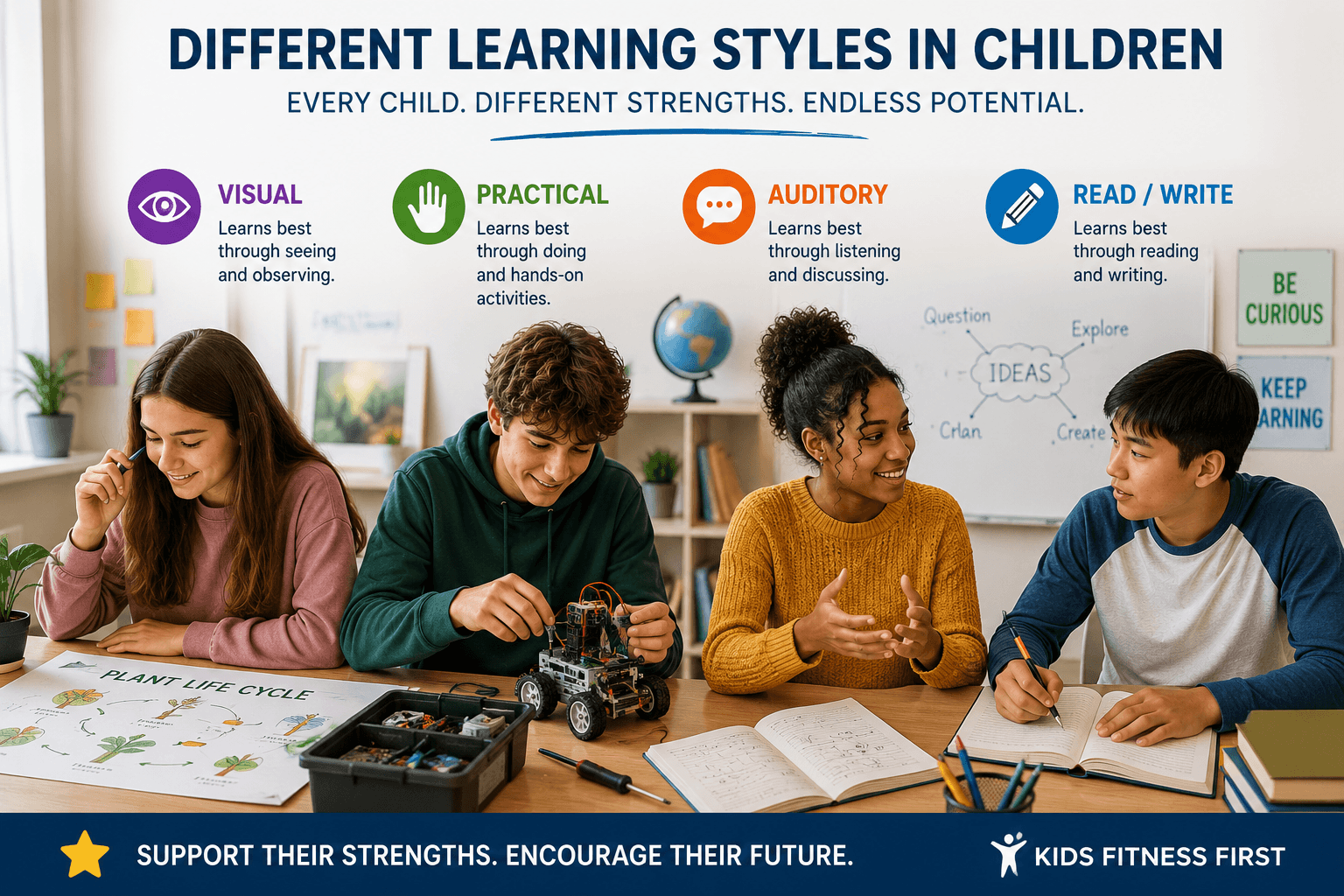
Different learning styles in children can influence how young people engage with education, build confidence and participate in everyday life. For generations, education systems have been designed around standardisation. Children are often taught the same material, in the same way, at the same pace, and then assessed using the same measures. While this approach can provide structure, it does not always reflect the reality of how young people learn.
Understanding different learning styles in children can help parents, teachers and communities create environments where more young people feel engaged, valued and able to participate. Importantly, recognising differences does not mean lowering standards. Instead, it means creating more pathways towards success.
At Kids Fitness First, we believe that every child has strengths worth developing. Sometimes the challenge is not the child. Sometimes the challenge is ensuring the environment allows those strengths to emerge.
What Are Different Learning Styles in Children?
Children absorb information in many different ways.
Some learn best by listening.
Others learn by doing.
Some enjoy visual information such as diagrams, demonstrations and images.
Meanwhile, others understand concepts more clearly when they can discuss ideas aloud with other people.
These differences are a normal part of human development. As a result, two children sitting in the same classroom may experience the same lesson very differently.
One child may immediately understand a concept after reading about it.
Another may only fully understand it after building, creating, experimenting or talking it through.
Neither approach is better. They are simply different.
Why Standard Approaches Can Miss Hidden Strengths
Most systems require consistency. Consequently, schools often need structured lessons, standard assessments and common benchmarks.
However, when one method becomes the dominant way of measuring success, some strengths may become less visible.
For example, a young person may struggle to demonstrate understanding through written work while showing remarkable creativity through practical projects.
Similarly, another student may find traditional tests difficult but excel when solving real-world problems.
In these situations, the issue may not be a lack of ability.
Instead, there may be a mismatch between how learning is being measured and how understanding is being demonstrated.
This distinction is important because it changes the conversation from limitation to opportunity.
Different Learning Styles in Children and Confidence
Confidence often develops through successful experiences.
When children regularly experience situations where their strengths are recognised, they are more likely to participate, contribute and engage.
On the other hand, if their strongest abilities rarely have opportunities to be displayed, confidence may take longer to develop.
This does not mean children need constant praise.
Rather, it means they benefit from opportunities to demonstrate competence in ways that align with their natural strengths.
For example:
• Practical learners may thrive during projects and hands-on activities.
• Creative learners may excel through design, storytelling and problem-solving.
• Collaborative learners may develop confidence through teamwork.
• Independent learners may flourish when given space to explore ideas individually.
Consequently, broadening opportunities can help more children experience success.
The Importance of Curiosity and Exploration
Curiosity plays a powerful role in learning.
Children naturally explore, question and experiment. Through these experiences they begin to understand how the world works.
Therefore, encouraging curiosity can often be just as valuable as focusing exclusively on outcomes.
When young people feel safe to ask questions, make mistakes and explore ideas, learning becomes an active process rather than a passive one.
Furthermore, curiosity supports long-term engagement because it helps learning feel meaningful and relevant.
Parents and teachers can encourage curiosity by:
• Asking open-ended questions.
• Encouraging exploration.
• Celebrating effort and discovery.
• Allowing time for experimentation.
• Connecting learning to real-world interests.
How Schools Can Support Different Learning Styles in Children
Schools already support a wide range of learners every day.
Nevertheless, even small adjustments can help broaden participation.
For example, lessons can include:
Visual elements
Practical demonstrations
Group discussions
Hands-on activities
Independent reflection
Real-world examples
As a result, more students have opportunities to connect with the material in meaningful ways.
Importantly, this approach does not replace academic standards.
Instead, it expands the number of routes available to reach them.
How Parents Can Help at Home
Learning does not only happen in classrooms.
Home environments also play an important role.
Parents do not need specialist knowledge to support development. Often, simple observations can provide valuable insights.
Consider questions such as:
What activities does my child enjoy?
When do they appear most engaged?
What types of tasks seem to energise them?
How do they prefer to explore new ideas?
These observations can help identify strengths that may otherwise go unnoticed.
Additionally, parents can create opportunities for practical experiences, creative projects, outdoor activities and conversations that encourage learning beyond formal education.
Looking Beyond Labels
People often look for simple explanations.
However, children are complex individuals with unique combinations of strengths, interests, motivations and experiences.
Therefore, focusing exclusively on labels can sometimes distract from understanding the whole person.
A strengths-based perspective encourages adults to ask different questions.
Instead of asking:
“What is wrong?”
It encourages questions such as:
“What is working well?”
“What strengths are visible?”
“What opportunities could help this young person thrive?”
This shift in perspective can open new possibilities for support and development.
Building Environments Where More Children Can Succeed
Every child deserves opportunities to participate, contribute and develop confidence.
Although standard systems provide structure, flexibility often creates opportunity.
By recognising different learning styles in children, families and educators can help ensure that more strengths are seen, more talents are nurtured and more young people feel included.
After all, the goal is not to make every child learn in exactly the same way.
The goal is to help every child discover how they learn best and provide opportunities to build upon those strengths.
CONCLUSION
Children bring a wide range of abilities, interests and perspectives to the world. When adults recognise different learning styles in children, they create opportunities for confidence, engagement and participation to grow.
Rather than focusing only on standard measures, a strengths-based approach encourages us to look for potential, curiosity and capability. Through understanding, flexibility and encouragement, we can help more young people discover their own path to learning and development.
DISCLAIMER
This article is provided for educational and informational purposes only. It does not provide medical, diagnostic or therapeutic advice. Every child is unique, and families should seek appropriate professional guidance where required.