
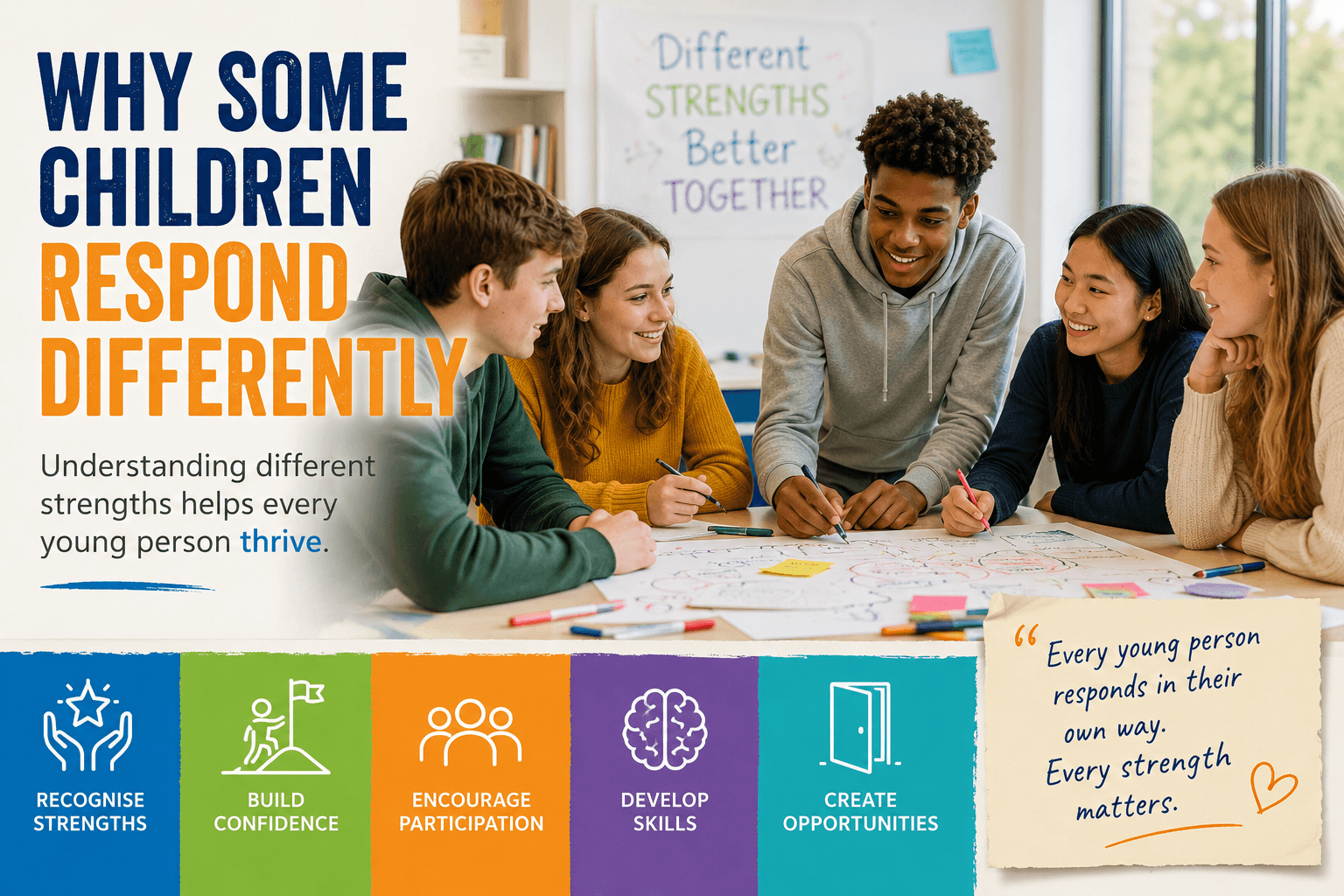
Why Some Children Respond Differently
Every Parent Has Experienced It
Perhaps you’ve seen it yourself.
Two children can experience exactly the same situation yet react in completely different ways.
One teenager walks confidently into a new classroom and immediately starts talking to others. Another quietly observes everything before deciding where they feel comfortable.
One enjoys trying something new without hesitation. Another prefers to watch first, ask questions and think carefully before joining in.
Neither response is necessarily right or wrong.
Understanding why some children respond differently can help parents and teachers see these situations from a new perspective. Rather than expecting every young person to react in the same way, we can begin recognising that different responses often reflect different strengths.
At Kids Fitness First, we believe that every child deserves to be understood as an individual. Sometimes the greatest opportunity lies not in changing the child but in changing the way we understand them.
Reassurance
If your child reacts differently from friends, classmates or siblings, you are certainly not alone.
Many families notice that children develop their confidence, interests and communication styles at different times and in different ways.
It can be tempting to compare children, especially when they attend the same school or grow up in the same family. However, comparison rarely tells the full story.
Young people develop through a combination of personality, experiences, interests and opportunities. Consequently, two children raised in similar environments may still approach learning, friendships and challenges very differently.
These differences are a natural part of human diversity.
Rather than asking why one child behaves like another, it is often more helpful to ask:
“What can this response tell us about how this young person experiences the world?”
That simple shift encourages understanding instead of judgement.
Understanding Why Some Children Respond Differently
Children respond differently because no two minds develop in exactly the same way.
Some enjoy routine and predictability.
Others actively seek new experiences.
Some process information by talking through ideas.
Meanwhile, others prefer quiet reflection before expressing their thoughts.
Similarly, some young people feel energised by group activities, while others gain confidence through smaller groups or independent projects.
These differences do not indicate greater or lesser ability.
Instead, they reflect the unique ways people think, learn and engage with their environment.
Furthermore, responses often change depending on context.
A teenager who appears quiet in a large classroom may become highly engaged during sport, music, volunteering or creative activities.
This is why observing children across different environments is often more informative than judging them from a single situation.
Why Some Children Respond Differently at School
School provides many opportunities for learning, but it also places different demands on young people.
For example, students may be asked to:
- Work independently
- Speak in front of classmates
- Complete written tasks
- Solve practical problems
- Collaborate in teams
- Manage changing routines
Some children immediately feel comfortable.
Others need more time to adapt.
Consequently, teachers who recognise these differences can often create learning environments where more students feel confident participating.
Small adjustments—such as offering different ways to contribute, encouraging teamwork or allowing time for reflection—can help more young people demonstrate what they know.
Recognising these differences does not lower expectations.
Instead, it creates more opportunities for success.
Practical Guidance for Parents, Teachers and Carers
Understanding why some children respond differently is only the first step. The next step is creating environments where those differences can become strengths rather than barriers.
Fortunately, small changes in everyday interactions can make a meaningful difference.
For Parents
Parents know their children better than anyone else. Consequently, they are in an excellent position to notice patterns that others may miss.
Try asking yourself:
- When does my child seem happiest?
- What activities capture their attention naturally?
- When do they show confidence?
- What situations seem to energise them?
- Where do they demonstrate kindness, curiosity or creativity?
Instead of comparing your child with others, compare them with who they were six months ago.
Growth is often easier to recognise when we focus on personal progress rather than comparison.
Additionally, celebrate effort as much as achievement.
Young people who understand that learning involves persistence are often more willing to embrace new experiences.
For Teachers
Teachers have a unique opportunity to recognise strengths across many different situations.
Although curriculum objectives remain important, students also benefit when learning includes a variety of approaches.
For example:
- Encourage practical activities alongside written work.
- Invite students to solve real-world problems.
- Provide opportunities for discussion and collaboration.
- Allow different ways for students to demonstrate understanding.
- Recognise creativity, leadership and teamwork as valuable learning behaviours.
Furthermore, providing constructive feedback that identifies strengths can help young people develop greater confidence in their abilities.
Sometimes a simple comment such as, “I noticed how carefully you solved that problem,” can have a lasting impact.
For Carers and Community Groups
Community organisations, youth clubs and charities also play an important role.
Many young people discover new interests through:
- Volunteering
- Sport
- Outdoor activities
- Creative workshops
- Community projects
- Team challenges
These experiences often reveal strengths that may not always appear within formal education.
As a result, children begin to recognise that success can be achieved in many different ways.
The Importance of Encouraging Participation
Participation builds confidence.
Every time a young person joins an activity, contributes an idea or learns a new skill, they gain valuable experience.
Initially, they may feel uncertain.
However, confidence often develops through participation rather than waiting to feel confident first.
Therefore, encouraging children to take small steps outside their comfort zone can help them discover abilities they never realised they possessed.
Importantly, participation should remain enjoyable.
When young people feel supported rather than judged, they are more likely to continue exploring new opportunities.
Looking Beyond First Impressions
First impressions do not always tell the whole story.
A quiet teenager may become an excellent leader.
A cautious learner may become an exceptional problem-solver.
Someone who prefers listening may eventually become an outstanding communicator.
Because development takes time, adults should avoid making assumptions based on a single situation.
Instead, continue observing, encouraging and creating opportunities.
Young people often surprise us when they are given the right environment.
Why Understanding Differences Builds Confidence
Confidence grows when children feel accepted for who they are.
It also grows when they experience success through their own strengths rather than trying to imitate someone else.
This does not mean avoiding challenges.
Instead, it means helping young people approach challenges in ways that build upon their natural abilities.
Consequently, confidence becomes more authentic because it is based on genuine achievement rather than external comparison.
Over time, this approach encourages resilience, independence and a willingness to continue learning.
Looking Towards the Future
Every child has potential.
Sometimes that potential appears quickly.
Sometimes it develops gradually.
Occasionally, it only becomes visible when a young person discovers an environment where their strengths are recognised.
Book 1 of The X Variable encourages us to look beyond first impressions and ask better questions.
Rather than asking why a child responds differently, perhaps we should ask:
“What strengths are waiting to be discovered?”
That question changes everything.
When parents, teachers and communities recognise individual differences with curiosity instead of judgement, they create opportunities for young people to develop confidence, purpose and lifelong skills.
The future belongs to individuals who can think differently, adapt, collaborate and continue learning.
Every child deserves the opportunity to discover those abilities.
Conclusion
Understanding why some children respond differently helps us move beyond comparison and towards genuine understanding.
Every young person brings their own combination of experiences, interests, personality and strengths.
Rather than expecting everyone to respond in identical ways, we can create environments where different ways of thinking and learning are recognised and valued.
At Kids Fitness First, we believe every child has strengths worth discovering.
By encouraging participation, recognising potential and creating supportive environments, we can help more young people build confidence and thrive throughout life.
Related Articles
- Understanding Children’s Behaviour
- Different Learning Styles in Children
- Building Confidence in Teenagers Through Strengths and Success
Disclaimer
This article is provided for educational and informational purposes only. It does not provide medical, psychological, diagnostic or professional advice. Every child is unique, and individual experiences may vary. If you have concerns about a child’s development, learning or wellbeing, please seek guidance from an appropriately qualified professional.
Suggested Internal Links
- Learn more about The X Variable
- Explore our Neurodiversity Resources
- Read Building Confidence in Teenagers
- Discover Different Learning Styles in Children