
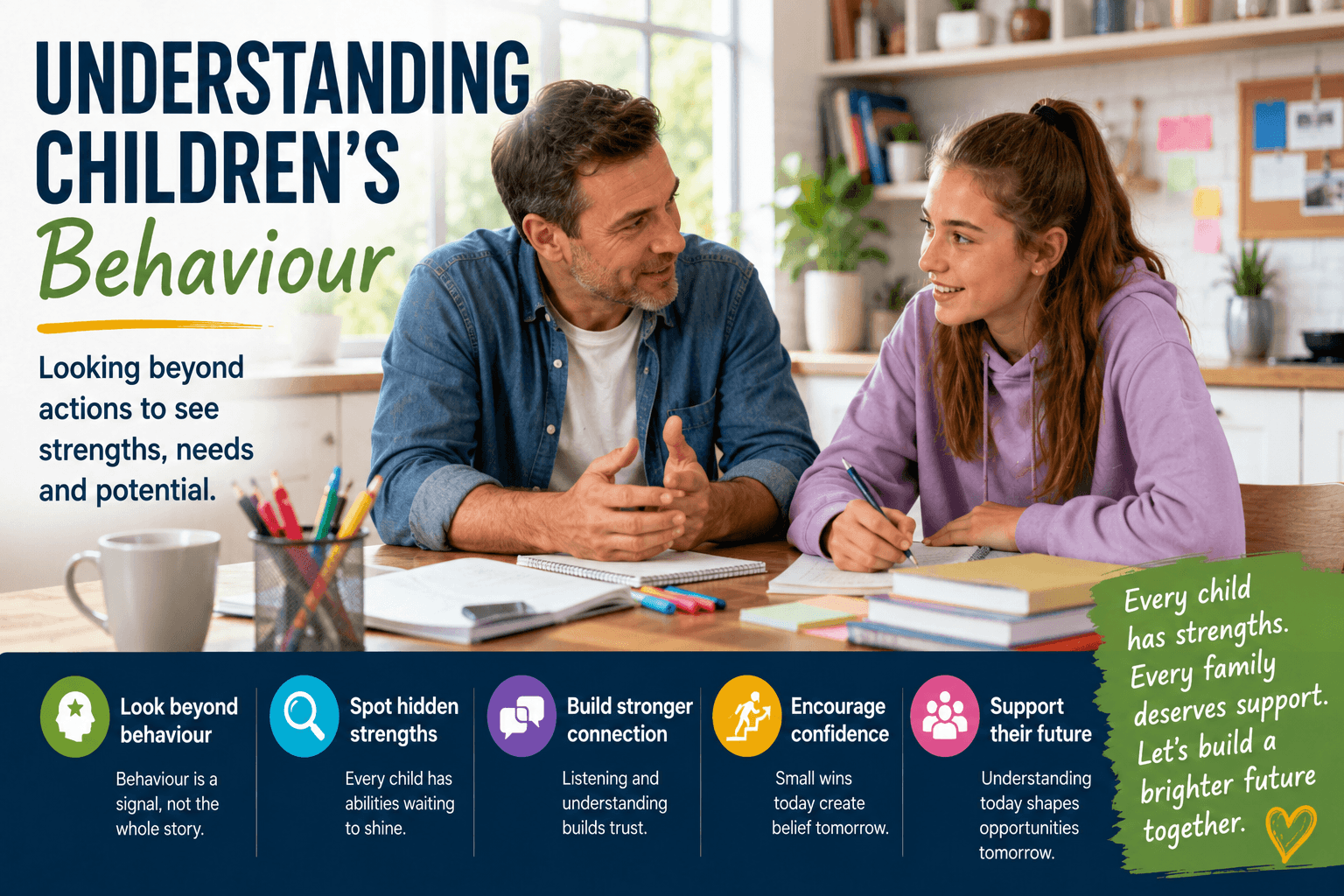
Understanding children’s behaviour begins with one important idea: behaviour is often a signal, not the whole story.
Many parents have experienced a moment where their child reacts in a way that feels difficult to understand. One day, a young person may seem focused, creative and full of energy. Another day, the same young person may appear withdrawn, distracted or unable to engage with something that seems simple.
Naturally, this can leave parents asking important questions.
Why does this happen?
What is going on beneath the surface?
How can adults respond in a way that helps rather than harms confidence?
There is rarely one simple answer. However, when we begin looking beyond behaviour alone, we often discover a fuller picture of a child’s needs, strengths, environment and experiences.
Quick Thought For Parents
Before asking, “How do I stop this behaviour?” it may be more helpful to ask, “What could this behaviour be telling me?”
That simple shift can change the whole conversation.
Why Understanding Children’s Behaviour Matters
Children and young people communicate in many ways. Sometimes they use words. However, at other times, they communicate through actions, energy levels, silence, frustration, avoidance or intense focus.
Behaviour is often the part adults notice first.
Schools may notice it.
Parents may worry about it.
Other people may comment on it.
Yet behaviour is usually the visible result of something deeper. For example, it may be shaped by tiredness, confidence, learning style, environment, friendship issues, sensory experience, boredom, pressure or a need for greater connection.
Therefore, understanding children’s behaviour is not about making quick judgements. Instead, it is about becoming curious enough to look at the whole child.
Behaviour Is A Clue, Not A Label
One of the risks in childhood is that behaviour can quickly become a label.
A child may be described as difficult, lazy, distracted, dramatic or unmotivated. However, these descriptions rarely help anyone understand what is really happening.
A strengths-based approach looks at behaviour differently.
Rather than asking, “What is wrong with this child?” it asks, “What does this child need, and what strengths might we be missing?”
This matters because many children show their abilities in unexpected ways.
A child who moves constantly may have high physical energy and a strong need for active learning.
A child who asks endless questions may have powerful curiosity.
A child who resists routine tasks may become highly engaged when given a real-world challenge.
A child who appears quiet may be deeply observant and thoughtful.
When adults pause before judging, they often begin to see possibilities that were hidden before.
The Hidden Factors Behind Behaviour
Every child lives inside a wider context.
Behaviour can be influenced by what happened earlier in the day, how safe the child feels, whether the task feels meaningful, how confident they are, and whether they believe adults understand them.
For parents and teachers, this means behaviour should not be viewed in isolation.
Helpful Areas To Consider
Environment
Does the child respond better in calm spaces, active spaces, structured settings or creative environments?
Confidence
Does the behaviour change when the child feels capable and encouraged?
Connection
Does the child engage more positively when they feel listened to?
Strengths
Where does the child naturally show energy, interest or ability?
Learning style
Does the child understand better through movement, discussion, visuals, practical tasks or hands-on experience?
These questions do not diagnose. Instead, they help adults understand the child more fully.
Understanding Children’s Behaviour Through Strengths
A powerful part of understanding children’s behaviour is learning to notice strengths that may sit beneath the surface.
Many young people are measured mainly by school performance, classroom behaviour or how well they follow instructions. While these areas can be important, they do not capture the whole person.
Some young people show strengths through creativity. Others show them through practical problem-solving, sport, empathy, humour, leadership, memory, design, music, storytelling, technology or physical skill.
The challenge is that strengths are not always obvious in traditional settings.
A young person may seem disengaged in one environment but highly capable in another. For example, they may dislike written work but spend hours building, designing or organising. Similarly, they may find classroom discussion difficult but show deep understanding through action.
When adults notice these patterns, behaviour starts to make more sense.
Parent Reflection Box
Ask yourself:
Where does my child seem most alive?
What do they return to without being asked?
What do they talk about with energy?
When do they show focus naturally?
What do other people notice positively about them?
The answers may point towards hidden strengths.
Why Some Children Behave Differently In Different Settings
Many parents notice that their child behaves differently at school, at home, with friends or during activities.
This can be confusing. However, it is also very common.
Children respond to environments. They may feel confident in one setting and uncertain in another. They may feel energised by one type of task and drained by another. Additionally, they may behave differently depending on how much control, choice or connection they experience.
For example, a teenager may appear uninterested in schoolwork but become focused during a practical project. Another young person may seem restless indoors but calm and engaged during sport or outdoor activity.
This does not mean the child is being inconsistent on purpose. Instead, it may show that environment plays a major role in confidence, attention and participation.
The Role Of Confidence
Confidence is closely linked to behaviour.
When young people feel capable, they are often more willing to try. When they feel judged or compared, they may avoid, withdraw or react strongly.
Therefore, supporting confidence can improve engagement.
This does not require false praise. In fact, young people usually respond better to specific recognition.
Instead of saying, “Well done, you are amazing,” try saying:
“I noticed how carefully you thought that through.”
“You kept going even when it was difficult.”
“You explained that idea clearly.”
“You found a different way to solve the problem.”
Specific feedback helps children understand what they did well. Over time, this builds self-awareness and self-belief.
Practical Ways Parents Can Respond
Understanding is only useful if it leads to better support.
Here are practical ways parents can respond when behaviour feels confusing.
1. Pause Before Reacting
A calm pause gives adults time to think. It also prevents the situation from becoming more emotional.
2. Look For The Pattern
One moment rarely tells the whole story. Instead, look for repeated patterns across time, places and activities.
3. Ask Better Questions
Try asking:
“What happened before this?”
“What might they be finding difficult?”
“What strength could be hidden here?”
“What support would make this easier?”
4. Create Small Wins
Small successes matter. They help young people experience progress without pressure.
5. Offer Choices
Age-appropriate choices can improve cooperation and confidence. For example, “Would you rather start with the writing or the drawing?”
6. Recognise Effort
Effort, persistence and improvement should be noticed, not only final outcomes.
7. Build Connection First
Children often respond better when they feel understood. Connection can make guidance easier to accept.
When Behaviour Is Actually Communication
Sometimes behaviour is the only language a child has available in that moment.
A young person may not know how to explain frustration, embarrassment, boredom, anxiety, tiredness or confusion. Therefore, the feeling may appear as behaviour instead.
This does not mean every behaviour should be accepted without boundaries. Boundaries are important. However, boundaries work best when combined with understanding.
A helpful approach is:
First, calm the situation.
Next, understand what may be happening.
Then, guide the child towards a better response.
This approach protects both connection and responsibility.
How Schools And Parents Can Work Together
Parents and teachers often see different sides of the same young person.
Therefore, communication between home and school can be valuable.
Rather than focusing only on what went wrong, conversations can also explore:
What helps the child engage?
When do they show confidence?
Which activities bring out their strengths?
What environments support better participation?
What small adjustments could help?
This creates a more balanced picture. Additionally, it helps adults support the young person consistently.
A Strengths-Based Future
The goal is not to ignore difficult behaviour. Nor is it to pretend that every situation is easy.
Instead, the goal is to understand more deeply.
When adults look beyond behaviour, they often discover strengths, needs and possibilities that were previously hidden. As a result, children and young people may feel more understood, more confident and more able to participate positively.
Understanding children’s behaviour is not about finding a quick answer. It is about building a better relationship with the child behind the behaviour.
Every young person has more to them than one difficult moment.
Every child deserves to be seen fully.
And sometimes, the first step is simply choosing to look again.
Continue Exploring
You may also find these Kids Fitness First resources helpful:
- Strengths Based Parenting: Helping Children Build Confidence
- Recognising Hidden Strengths in Children
- 10 Early Signs Your Child May Have ADHD
Disclaimer
This article is provided for educational and informational purposes only. It does not provide medical, psychological, diagnostic or professional advice. Every child is unique, and individual experiences may vary. If you have concerns about a child’s development, learning or wellbeing, please seek guidance from an appropriately qualified professional.