
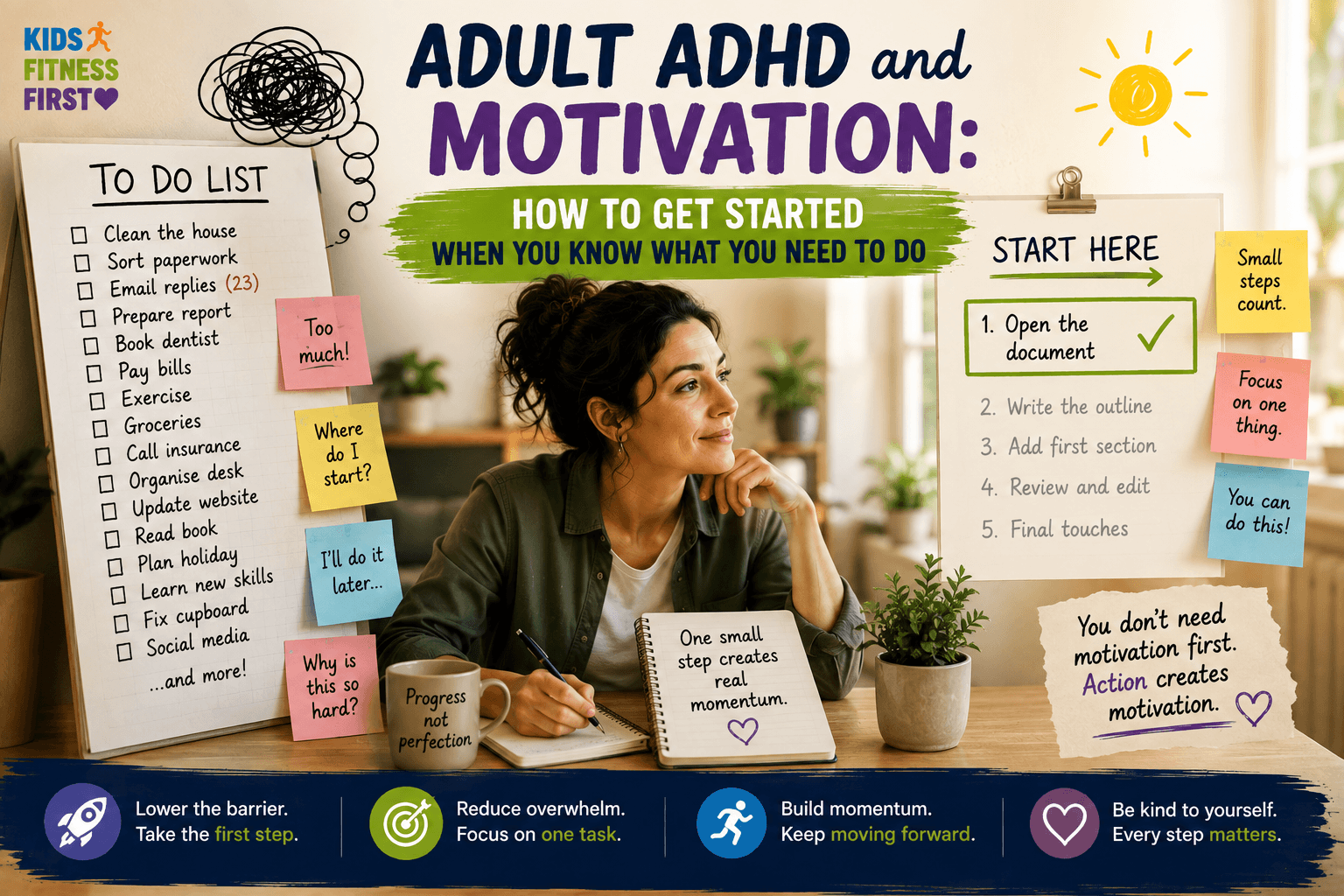
Adult ADHD and Motivation: How to Get Started When You Know What You Need to Do
Adult ADHD and motivation can be confusing.
You may know exactly what needs doing.
You may even want to do it.
However, getting started can still feel surprisingly difficult.
Perhaps the task sits in front of you all morning.
You think about it.
You plan it.
You tell yourself to begin.
Yet somehow, you still do not start.
Then frustration appears.
Why am I doing this again?
Why can I not just get on with it?
Why does something so simple feel so difficult?
For many adults, this can become one of the most frustrating parts of ADHD.
Fortunately, the answer is not always to push harder.
Instead, it can help to understand what makes a task easier to begin.
Once you reduce the friction, action often becomes more achievable.
Why Adult ADHD and Motivation Can Feel So Unpredictable
Motivation is often treated as if it should appear on demand.
People say:
“Just do it.”
“Be more disciplined.”
“Get yourself motivated.”
However, motivation is not always that simple.
Some tasks naturally create interest.
Others create urgency.
Certain activities feel rewarding straight away.
Meanwhile, repetitive or unclear tasks may feel much harder to begin.
As a result, motivation can appear inconsistent.
You may work intensely on something interesting for hours.
Yet a five-minute admin task may remain unfinished for days.
That difference can be confusing.
However, it does not automatically mean you are lazy.
Instead, it may mean the task does not provide enough stimulation, clarity or immediate reward to create momentum.
Stop Waiting to Feel Motivated
One of the biggest traps is waiting for the right feeling before starting.
You think:
“I’ll do it when I feel ready.”
“I’ll start when I have more energy.”
“I’ll begin when I can concentrate properly.”
Unfortunately, that moment may not arrive.
Therefore, try reversing the process.
Do not wait for motivation.
Create action first.
For example, instead of saying:
“I need to finish the report.”
say:
“I will open the document.”
That is all.
Once the document is open, the next step might become easier.
Motivation often follows movement.
It does not always come before it.
Make the First Step Almost Too Easy
Large tasks create resistance.
Small steps create movement.
Therefore, reduce the first step.
Instead of:
“Clean the kitchen.”
try:
“Put five things away.”
Instead of:
“Sort my finances.”
try:
“Open the banking app.”
Rather than:
“Exercise for an hour.”
try:
“Put on my trainers.”
The aim is not to make the goal meaningless.
Instead, you are lowering the barrier to entry.
Once you begin, continuing may become easier.
Use the Five-Minute Rule
A task may feel unbearable when you imagine doing the whole thing.
Therefore, reduce the commitment.
Tell yourself:
“I only need to do this for five minutes.”
Set a timer.
Then begin.
After five minutes, you can stop.
Sometimes, you will stop.
That is fine.
However, you may also discover that starting was the hardest part.
Once you are moving, continuing often feels much easier.
This can work particularly well for:
- paperwork
- cleaning
- emails
- studying
- admin
- exercise
- organising
The important point is that the commitment feels manageable.
Turn Vague Tasks Into Clear Actions
A vague task can create hesitation.
For example:
“Sort the house.”
What does that actually mean?
Where do you start?
How long will it take?
What counts as finished?
Instead, make the task specific.
Try:
“Clear the kitchen table.”
“Put laundry in the machine.”
“Reply to Sarah’s email.”
“Book the dentist appointment.”
“Find the insurance document.”
Clear tasks are easier to begin because they remove uncertainty.
Therefore, when you feel stuck, ask:
“What exactly am I supposed to do next?”
If the answer is unclear, the task probably needs to be broken down further.
Reduce the Number of Steps
Sometimes a task feels difficult because too many small steps come before the real action.
For example, going for a walk might require:
Find trainers.
Find socks.
Find headphones.
Charge phone.
Find keys.
Choose a route.
By the time you think through all of this, the task feels bigger.
Therefore, reduce preparation where possible.
Keep trainers near the door.
Charge headphones regularly.
Put keys in one place.
Prepare clothes the night before.
The fewer steps between intention and action, the easier starting can become.
Make the Task More Interesting
Interest can make a significant difference.
Therefore, if a task is boring, ask how you can make it more engaging.
You might:
Play music.
Listen to a podcast.
Work somewhere different.
Use a timer.
Turn it into a challenge.
Work alongside someone else.
Reward yourself afterwards.
For example, instead of simply cleaning for twenty minutes, challenge yourself to see how much you can complete before the timer ends.
The task has not changed.
However, the experience has.
Use Urgency Carefully
Urgency can create powerful motivation.
You may notice that a task suddenly becomes easy to start when the deadline is tomorrow.
This can feel useful.
However, relying on last-minute pressure all the time can create unnecessary stress.
Therefore, try creating smaller deadlines earlier.
For example:
Instead of:
“Report due Friday.”
create:
Monday — outline.
Tuesday — first section.
Wednesday — second section.
Thursday — review.
Friday — submit.
This creates several smaller moments of urgency rather than one large crisis.
Try Body Doubling
Some people find it easier to begin when another person is nearby.
This is sometimes called body doubling.
The other person does not need to help.
They may simply work on their own task while you work on yours.
For example:
You answer emails.
They complete paperwork.
You both work quietly for thirty minutes.
The presence of another person can make it easier to stay engaged.
This can work:
In person.
On a video call.
At a library.
In a shared workspace.
The important part is having some gentle accountability.
Create External Accountability
Private goals are easy to postpone.
Therefore, consider telling someone what you plan to do.
For example:
“I’ll send you the draft by 3 pm.”
“I’ll call you after I finish the application.”
“I’ll complete the form before lunch.”
This creates a clear external deadline.
However, accountability should feel supportive rather than punishing.
Choose someone who encourages progress without creating unnecessary pressure.
Use Visible Reminders
Out of sight can quickly become out of mind.
Therefore, make important tasks visible.
Use:
Sticky notes.
Whiteboards.
Phone reminders.
Calendar alerts.
Open checklists.
Objects placed where you will see them.
For example, if you need to return something tomorrow, place it beside the front door.
If you need to make a phone call, put a reminder where you normally sit in the morning.
Your environment can support memory.
You do not need to rely on remembering everything internally.
Make Starting More Important Than Finishing
Sometimes the pressure to complete everything makes starting harder.
Therefore, change the goal.
The goal today may simply be:
Start.
Not finish.
For example:
Write the first paragraph.
Read the first page.
Complete the first form section.
Wash the first five dishes.
Once you begin, you may continue.
If not, you have still created progress.
This approach can reduce all-or-nothing thinking.
Use Momentum From One Task to Start Another
Starting can become easier once you are already active.
Therefore, use momentum.
For example:
After washing the dishes, answer one email.
After your morning coffee, review today’s priorities.
After returning from a walk, make one phone call.
After dinner, prepare tomorrow’s clothes.
This creates a natural chain.
You are attaching a difficult task to something already happening.
As a result, the transition may feel easier.
Avoid Overloading Your Daily List
A long list can destroy motivation before you begin.
Twenty tasks feel impossible.
Therefore, identify what actually matters.
Try choosing:
One main task.
Two secondary tasks.
A few optional tasks.
This creates a clearer priority.
You can always do more.
However, beginning with a realistic list reduces overwhelm.
Choose Your Most Important Task Early
Some days disappear because you spend hours completing small tasks while avoiding the important one.
Emails.
Messages.
Tidying.
Searching online.
Minor admin.
These activities create the feeling of productivity.
However, the important task remains untouched.
Therefore, identify one priority.
Ask:
“If I only complete one important thing today, what should it be?”
Then try to begin that task before the day becomes crowded with smaller demands.
Understand the Difference Between Low Motivation and Low Energy
Sometimes the problem is not motivation.
You may simply be tired.
Poor sleep.
Stress.
Long working hours.
Too many responsibilities.
Physical exhaustion.
All of these can reduce your ability to begin tasks.
Therefore, ask:
“Am I unmotivated, or am I exhausted?”
The answer matters.
If you are genuinely tired, rest may be more useful than forcing yourself through another hour of work.
Stop Using Shame as Motivation
Shame can create short-term pressure.
You tell yourself:
“You’re useless.”
“You’ve wasted the whole day.”
“Everyone else would have done this already.”
Occasionally, this may force action.
However, it usually creates more stress.
Instead, use practical language.
Try:
“I haven’t started yet. What would make starting easier?”
That question leads somewhere.
Shame rarely does.
Reward Progress Quickly
Long-term rewards can feel too distant.
For example:
“If I work hard all month, I’ll feel proud.”
That may not create enough motivation today.
Therefore, use smaller rewards.
After twenty minutes of focused work:
Make a coffee.
Watch a short video.
Go outside.
Listen to music.
Take a break.
Rewards do not need to be large.
The aim is to create a more immediate connection between effort and something positive.
Work With Your Best Time of Day
Not everyone performs equally well at the same time.
Some people think clearly in the morning.
Others become more productive later.
Therefore, notice when difficult tasks feel easiest.
If possible, protect that time.
For example, if your concentration is strongest between 9 am and 11 am, avoid filling those hours with low-value admin.
Use them for work that actually requires attention.
Then complete easier tasks later.
Use Environment to Create Momentum
Where you work can influence how easily you begin.
If the television is on, notifications keep appearing and your phone is beside you, starting may become harder.
Therefore, adjust the environment.
You might:
Move to a quieter room.
Put your phone out of reach.
Close unnecessary browser tabs.
Clear one small area of your desk.
Use headphones.
Go to a library or café.
The aim is not perfection.
You simply want fewer obstacles between you and the task.
Keep the Tools Ready
Starting becomes harder when you need to find everything first.
Therefore, prepare tools in advance.
For example:
Keep paperwork together.
Leave your notebook on the desk.
Charge your laptop.
Prepare exercise clothes.
Keep frequently used documents organised.
Each small preparation reduces friction.
Then, when you are ready to begin, the task is already waiting.
Use a Starting Ritual
A repeated starting routine can help signal that it is time to focus.
For example:
Make a drink.
Clear the desk.
Put headphones on.
Set a timer.
Open the document.
Then begin.
The ritual does not need to be complicated.
In fact, shorter is better.
Over time, the sequence may become associated with starting work.
Be Careful With Planning Instead of Doing
Planning can feel productive.
You create lists.
You reorganise your calendar.
You research new apps.
You design a better routine.
However, sometimes planning becomes a substitute for action.
Therefore, ask:
“Am I planning because I need a plan, or because starting feels uncomfortable?”
If you already know the next step, more planning may not help.
At that point, the best strategy may simply be to begin.
Adult ADHD and Motivation at Work
Work can create a difficult mix of interesting and repetitive tasks.
You may enjoy problem-solving, meetings or creative projects.
Meanwhile, admin, reports or routine follow-ups may feel harder to start.
Therefore, structure the day around both.
For example:
Complete one boring task.
Then work on something interesting.
Return to another routine task later.
This can create balance.
You are not expecting yourself to spend hours doing only low-interest work.
Adult ADHD and Motivation at Home
Home tasks can be particularly difficult because deadlines are often flexible.
Nobody is waiting for you to clean the cupboard.
There may be no immediate consequence if you postpone the laundry.
Therefore, create your own structure.
You might:
Use a twenty-minute timer.
Choose one room.
Play music.
Ask someone else to join you.
Set a finish time.
Then stop.
The aim is progress, not perfection.
Motivation Can Change From Day to Day
Some days will feel easy.
Other days will not.
Therefore, avoid building a system that only works when you feel energetic.
Create a minimum version of important habits.
For example:
Full workout: forty minutes.
Minimum version: ten-minute walk.
Full cleaning session: one hour.
Minimum version: clear one surface.
Full planning session: thirty minutes.
Minimum version: write tomorrow’s top three tasks.
This helps maintain continuity without demanding the same performance every day.
Learn Your Personal Motivation Triggers
Different people respond to different things.
Perhaps you are motivated by:
Interest.
Competition.
Deadlines.
Responsibility.
Curiosity.
Helping others.
Visible progress.
Rewards.
Novelty.
Therefore, notice what naturally gets you moving.
Then use it deliberately.
For example, if visible progress helps, use a checklist.
If competition helps, challenge yourself against a timer.
If responsibility helps, tell someone what you plan to complete.
You are not cheating.
You are learning how your motivation works.
Do Not Mistake Difficulty Starting for Lack of Ability
This is important.
You may be highly capable once you begin.
The problem may simply be crossing the starting line.
Therefore, avoid turning a starting difficulty into a judgement about your ability.
Instead of:
“I can’t do this.”
try:
“Starting this is difficult. What would help me begin?”
That is a much more accurate question.
It also creates solutions.
Adult ADHD and Motivation After a Late Diagnosis
A late diagnosis can change how you interpret years of unfinished tasks, abandoned plans and inconsistent productivity.
Perhaps you previously believed you simply lacked discipline.
Now, you may recognise that motivation has always depended heavily on how interesting, urgent, clear or rewarding something felt.
That understanding can be useful.
However, the aim is not to excuse everything.
Instead, it allows you to build more effective strategies.
You can reduce friction.
Create structure.
Use external reminders.
Build accountability.
Make tasks more interesting.
Most importantly, you can stop expecting motivation to behave exactly the same way every day.
Reflection Questions
- Which types of tasks are hardest for you to start?
- What usually helps you create momentum?
- Do you wait until you feel motivated before beginning?
- Which task could you reduce to a five-minute version?
- What could you prepare in advance to make starting easier?
- Which part of your environment creates the most distraction?
- Does accountability help you?
- What time of day do you usually concentrate best?
- Which tasks could you make more interesting?
- What is one small task you could start immediately after reading this?
Conclusion
Adult ADHD and motivation can feel unpredictable.
You may genuinely want to complete something and still find it difficult to begin.
However, difficulty starting does not automatically mean lack of ability or lack of effort.
Often, the key is reducing the gap between intention and action.
Make the first step smaller.
Create clear tasks.
Use timers.
Prepare your environment.
Reduce unnecessary choices.
Add accountability.
Reward progress.
Most importantly, stop waiting for perfect motivation.
Sometimes motivation appears after you begin.
Therefore, when a task feels too large, ask:
“What is the smallest useful action I can take right now?”
Then take that step.
The goal is not to create perfect productivity.
It is to create enough momentum to move forward.
Suggested Internal Links
- Adult ADHD and Overthinking: How to Quiet the Mental Noise
- How to Stop Comparing Yourself to Others After an Adult ADHD Diagnosis
Disclaimer
This article is provided for general educational and informational purposes only. It does not provide medical, psychological, diagnostic or therapeutic advice. Therefore, it should not be used as a substitute for individual advice from an appropriately qualified healthcare professional.
ADHD experiences vary considerably between individuals. If you have concerns about ADHD, mental health, medication, diagnosis or treatment, please speak with an appropriately qualified healthcare professional.