
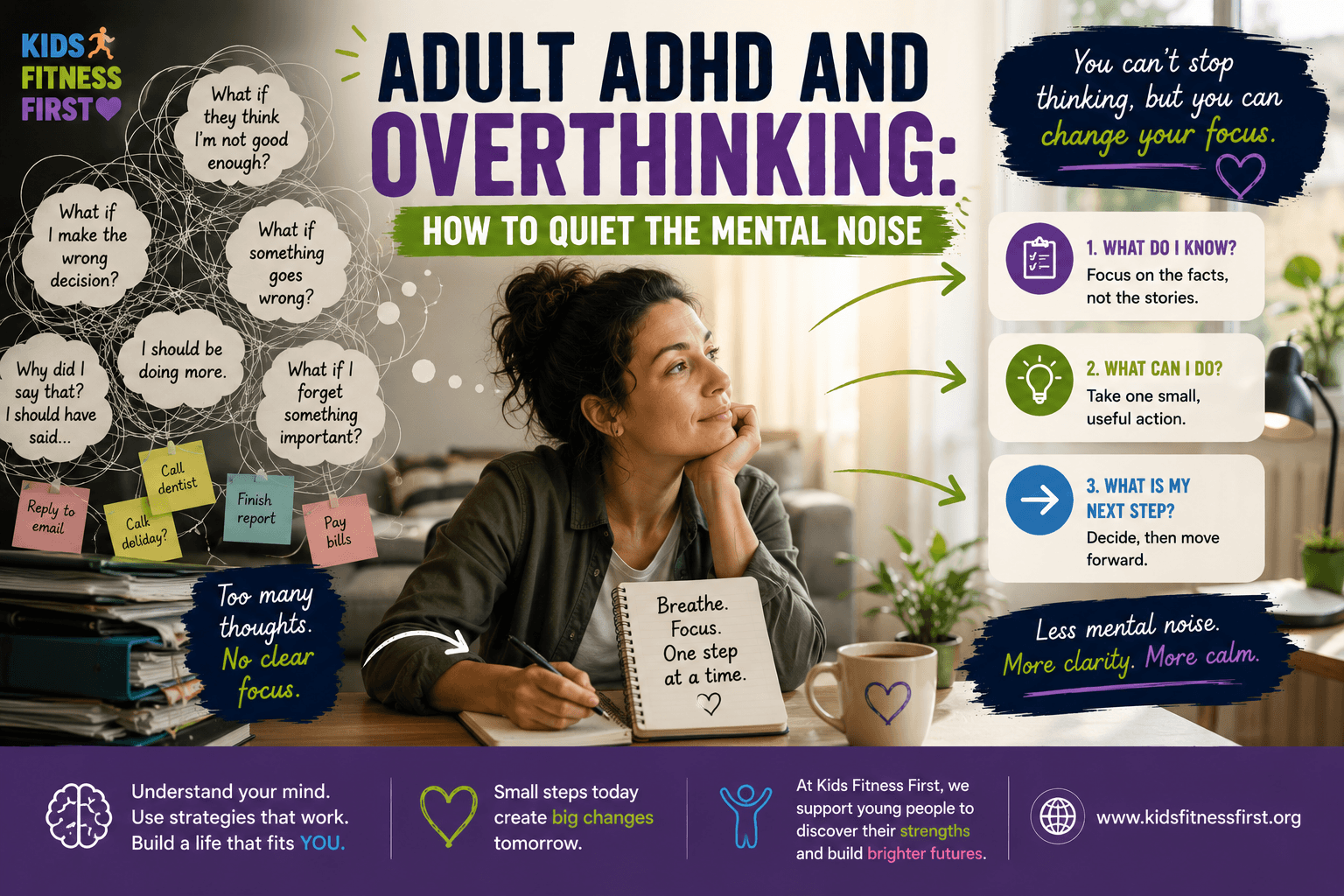
Adult ADHD and Overthinking: How to Quiet the Mental Noise
Adult ADHD and overthinking can sometimes make an ordinary day feel mentally exhausting.
You may replay a conversation long after it has ended.
Perhaps you analyse a decision from every possible angle.
You might start planning tomorrow, then next week, then everything that could possibly go wrong.
Meanwhile, another thought appears.
Then another.
Before long, one small issue has become ten different problems in your head.
For some adults with ADHD, this constant mental activity can feel familiar. However, it may be particularly noticeable after a late diagnosis because you are paying closer attention to how your mind works.
The aim is not to stop thinking.
Thinking is useful.
Instead, the goal is to recognise when thinking has stopped helping and started keeping you stuck.
Fortunately, there are practical ways to reduce that mental noise.
What Does Overthinking Actually Look Like?
Overthinking is more than simply thinking deeply about something.
Useful thinking usually leads somewhere.
For example, you identify a problem, consider your options and make a decision.
Overthinking often works differently.
You consider the problem.
Then you reconsider it.
Next, you imagine another possibility.
After that, you question your original conclusion.
Finally, you return to the beginning.
Nothing has changed, but you are mentally exhausted.
This cycle can affect:
- decisions
- relationships
- work
- sleep
- confidence
- everyday planning
- difficult conversations
Therefore, recognising the pattern is an important first step. When the loop is being driven by too many open choices, our guide to ADHD decision fatigue addresses that specific problem; when multiple responsibilities are competing at once, see ADHD and overwhelm.
Overthinking Can Disguise Itself as Problem-Solving
This is one of the hardest patterns to recognise.
Overthinking can feel productive.
After all, you are trying to solve something.
However, there is an important difference between problem-solving and repeatedly circling the same problem.
Ask yourself:
“Am I discovering anything new?”
If the answer is yes, continue.
If the answer is no, you may have reached the point where more thinking is no longer useful.
For example, imagine you need to send an important email.
Useful thinking might involve checking the facts, writing the message and reading it once before sending it.
Overthinking might involve rewriting it twelve times because you are trying to predict every possible reaction.
Eventually, more analysis may not improve the email.
It may simply delay sending it.
Notice Your Personal Overthinking Triggers
Overthinking rarely happens completely at random.
Certain situations may trigger it more often.
For example:
- making an important decision
- receiving criticism
- waiting for a reply
- having an uncomfortable conversation
- making a mistake
- facing uncertainty
- starting something unfamiliar
- worrying about disappointing someone
Therefore, begin noticing when your mind becomes particularly busy.
Do not judge yourself.
Simply observe the pattern.
You might ask:
What happened immediately before this started?
What am I trying to work out?
Is there actually an answer available right now?
That final question can be especially useful.
Sometimes, you are trying to solve something that cannot yet be solved.
Separate What You Know From What You Imagine
Overthinking often mixes facts with possibilities.
For example:
Fact:
“My manager asked to speak with me tomorrow.”
Thought:
“I’ve probably done something wrong.”
Further thought:
“Maybe I’m going to lose my job.”
Further thought:
“What will I do if I can’t find another job?”
Within minutes, one meeting has become an imagined crisis.
Therefore, separate the facts from the story.
Write down:
What do I actually know?
Then write:
What am I assuming?
This simple exercise can make the situation clearer.
You may still feel uncertain. However, uncertainty is different from evidence that something bad is about to happen.
Put the Thought Somewhere Outside Your Head
Trying to remember everything can increase mental pressure.
Instead, write things down.
Use:
- a notebook
- a phone note
- a calendar
- a whiteboard
- a simple task list
The method does not need to be sophisticated.
In fact, simpler is often better.
For example, if you suddenly remember something while trying to sleep, write it down.
Your brain no longer needs to keep repeating:
“Don’t forget this.”
The information now has somewhere to live.
As a result, it may become easier to let the thought go.
Give Yourself a Decision Deadline
Some decisions deserve careful thought.
However, unlimited thinking time can make even small choices difficult.
Therefore, give yourself a deadline.
For a small decision, you might allow five minutes.
For something more important, perhaps you need a day or a week.
The exact time depends on the decision.
What matters is creating an end point.
You can say:
“I will consider this until Friday. Then I will decide.”
This approach gives you permission to think without allowing the decision to remain open forever.
Ask Whether the Decision Is Reversible
Not every decision carries the same level of risk.
Some choices are difficult to reverse.
Others can easily be changed.
Therefore, ask:
“If I choose incorrectly, can I adjust later?”
Suppose you are trying a new morning routine.
You do not need to analyse every possible version before starting.
Try one.
If it does not work, change it.
Likewise, you do not need the perfect planning system before you begin planning.
Choose something simple.
Test it.
Then adjust.
Sometimes action provides information that thinking cannot.
Use the Next-Step Question
Large problems can create large amounts of mental noise.
You may think:
“How am I going to sort all of this out?”
That question is so broad that your mind may generate dozens of possible answers.
Instead, ask:
“What is the next useful step?”
Perhaps the answer is:
Send one email.
Make one phone call.
Find one document.
Write three bullet points.
Book one appointment.
Complete one form.
The next step does not need to solve everything.
It simply needs to move you forward.
Stop Trying to Solve Tomorrow Today
Planning is useful.
However, trying to predict every future problem is exhausting.
You may find yourself thinking:
What if this happens?
What if that happens?
What if they say no?
What if I make the wrong decision?
What if the plan changes?
Some preparation is sensible. Nevertheless, there comes a point where planning becomes prediction.
And nobody can predict every outcome.
Therefore, ask:
“Is there anything useful I can do about this today?”
If yes, do it.
If not, make a note and return to it when more information becomes available.
Use Movement to Break the Thinking Cycle
Sometimes sitting still while trying to “think your way out” of overthinking makes the cycle stronger.
Instead, change your physical state.
Go for a short walk.
Stretch.
Make a drink.
Step outside.
Tidy something small.
Move to another room.
Physical movement does not magically solve a difficult problem.
However, it can create a break in the mental loop.
Moreover, returning to the issue after a short pause may give you a clearer perspective.
Reduce Unnecessary Decisions
Modern life requires an enormous number of small choices.
What should I wear?
What should I eat?
When should I exercise?
Which task should I do first?
Should I answer this message now?
Should I check that again?
Individually, these decisions seem small.
Together, however, they can become tiring.
Therefore, simplify where possible.
You might:
Prepare clothes the night before.
Keep a few reliable breakfast choices.
Use one calendar.
Create a regular shopping list.
Keep important items in consistent places.
Decide tomorrow’s priority before finishing work.
Reducing minor decisions leaves more mental energy for the decisions that genuinely matter.
Be Careful With Too Much Information
When uncertain, it is natural to look for more information.
You search online.
Then you watch a video.
Next, you read reviews.
Afterwards, you find another opinion.
Soon, you have twenty different answers.
More information does not always create more clarity.
Sometimes it creates more decisions.
Therefore, decide what information you actually need before you start searching.
For example:
“I need three reliable options.”
Once you have them, stop researching and compare those three.
This creates a boundary around the search.
Adult ADHD and Overthinking Conversations
Conversations can become another source of mental replay.
Perhaps you think:
Why did I say that?
Did they misunderstand me?
Should I have answered differently?
Did I talk too much?
Were they annoyed?
Most people occasionally replay conversations. However, repeated analysis can become exhausting.
When this happens, ask:
“Do I have evidence that there is a problem?”
If yes, perhaps a follow-up conversation is useful.
If no, remind yourself that you do not need to investigate every pause, facial expression or sentence.
Sometimes a conversation was simply a conversation.
Do Not Assume Silence Means Something Negative
Waiting can be particularly difficult when your mind wants an answer.
Perhaps someone has not replied to your message.
Immediately, several explanations appear.
Maybe they’re annoyed.
Perhaps I said something wrong.
Maybe they’ve changed their mind.
However, there may be dozens of ordinary explanations.
They could be busy.
They may have forgotten.
They might be driving.
Perhaps they simply have not seen the message.
Therefore, avoid treating uncertainty as evidence.
Until you know more, you simply do not know.
That can be uncomfortable, but it is also accurate.
Set a Limit on Rechecking
Checking can sometimes be useful.
You should check an important document before sending it.
You may need to check travel arrangements.
Financial information deserves careful attention.
However, repeated checking can become another form of overthinking.
Therefore, create a simple rule.
For example:
“I will check this twice.”
First, check for accuracy.
Second, check for obvious mistakes.
Then finish.
Of course, some high-risk situations require more care. Nevertheless, everyday tasks rarely need endless checking.
Create a “Not Now” List
Not every thought needs immediate attention.
This is especially important when you are already working on something else.
Keep a small “Not Now” list.
When another thought appears, write it down.
For example:
Call dentist.
Check insurance.
Look at holiday dates.
Research new laptop.
Reply to John.
Then return to your current task.
The thought has not been ignored.
Instead, it has been stored for later.
This can reduce the urge to immediately follow every new idea.
Give Your Mind Fewer Open Loops
Unfinished tasks can continue occupying mental space.
You may repeatedly remember:
“I need to deal with that.”
Therefore, try to close small loops when practical.
If something takes two minutes, you may choose to complete it.
If it takes longer, schedule it.
For example:
Instead of thinking, “I need to book the dentist,” put “Call dentist — Tuesday 10 am” in your calendar.
Now the task has a place.
As a result, your mind does not need to keep reminding you.
Adult ADHD and Overthinking at Night
Night-time can make mental noise feel louder.
During the day, distractions and responsibilities occupy your attention.
At night, everything becomes quieter.
Suddenly, your brain remembers every unfinished task from the previous six months.
Therefore, create a simple evening reset.
Before bed:
Write down tomorrow’s main tasks.
Record anything you are worried about forgetting.
Prepare anything you need for the morning.
Then remind yourself:
“I have written it down. I do not need to solve it tonight.”
This routine will not stop every thought.
However, it can reduce the number of things your brain feels responsible for remembering.
Perfection Can Feed Overthinking
Sometimes overthinking is really an attempt to avoid making a mistake.
You want the perfect answer.
The perfect email.
The perfect plan.
The perfect decision.
Unfortunately, perfection creates an impossible standard.
Instead, ask:
“Is this good enough to move forward?”
Good enough does not mean careless.
It means recognising when additional effort is no longer adding meaningful value.
This can be especially helpful for everyday decisions where the consequences are small.
Replace “What If?” With “What Would I Do?”
“What if?” questions can multiply quickly.
What if the plan fails?
What if they say no?
What if I make a mistake?
What if something changes?
Instead, turn the question into:
“If that happens, what would I do?”
Now you are creating a response rather than simply imagining a problem.
For example:
“What if they reject my application?”
becomes:
“If they reject it, I will ask for feedback and consider the next option.”
The future is still uncertain.
However, you have reminded yourself that you can respond.
Recognise When Thinking Has Become Avoidance
Sometimes overthinking delays action.
You tell yourself:
“I just need to think about it a little more.”
However, you may already have enough information.
At that point, thinking can become a way of avoiding uncertainty.
Ask:
“What information am I genuinely waiting for?”
If you can identify something important, obtain it.
If you cannot, you may already be ready to act.
The next step might feel uncomfortable.
Nevertheless, discomfort does not automatically mean the decision is wrong.
Talk It Through — But Choose the Right Person
Talking can help organise thoughts.
However, speaking to too many people may create even more confusion.
One person says yes.
Another says no.
A third suggests something completely different.
Now you have three new problems.
Therefore, choose carefully.
Speak with someone who:
- listens without immediately judging
- understands the situation
- helps you clarify your own thoughts
- does not make every decision for you
The goal is not to hand over responsibility.
Instead, the conversation should help you understand what you already think.
Build Quiet Into Your Day
A busy mind does not always need more stimulation.
Sometimes it needs fewer inputs.
Therefore, consider creating short periods without:
Social media.
News.
Messages.
Television.
Podcasts.
Constant notifications.
Even ten quiet minutes can create space.
You might walk.
Sit outside.
Make a drink.
Stretch.
Write.
The aim is not to force your mind to become completely empty.
Instead, you are reducing the amount of new information arriving.
Use a Simple Three-Question Reset
When you notice yourself overthinking, try these three questions:
1. What do I actually know?
Separate facts from assumptions.
2. Is there anything useful I can do now?
If yes, identify one action.
3. If there is nothing I can do now, when will I return to it?
Schedule it if necessary.
This gives your mind somewhere to go.
Instead of endlessly circling the issue, you either act or deliberately postpone it.
Your Busy Mind Can Also Have Strengths
A mind that makes many connections is not automatically a problem.
It may contribute to:
Creativity.
Curiosity.
Problem-solving.
Idea generation.
Seeing possibilities.
Connecting information.
Thinking differently.
The aim, therefore, is not to eliminate your thinking style.
It is to gain more control over where your attention goes.
There may be times when deep thinking is extremely valuable.
At other times, you need to recognise when enough thinking has been done.
That balance matters.
Adult ADHD and Overthinking After a Late Diagnosis
A late diagnosis can lead to a period of intense reflection.
You may revisit school.
Work.
Relationships.
Decisions.
Missed opportunities.
Past mistakes.
You might suddenly view decades of experiences through a new lens.
Some reflection can be valuable.
It can create understanding.
However, you do not need to solve your entire past.
Your diagnosis can help explain previous experiences without requiring you to analyse every moment again.
Eventually, the most useful question becomes:
“What can I do differently now?”
That moves your attention from the past towards the future.
Reflection Questions
- What situations trigger your overthinking most often?
- Do you tend to replay the past or worry about the future?
- How do you know when useful thinking has turned into overthinking?
- Which decisions do you spend too much time analysing?
- What information could you write down instead of trying to remember?
- Which small decisions could you simplify?
- What is one open task you could schedule today?
- Which source of unnecessary information could you reduce?
- What helps you interrupt a mental loop?
- What is one situation where you could ask, “What is the next useful step?”
Conclusion
Adult ADHD and overthinking can make simple decisions and everyday situations feel much larger than they need to be.
However, the solution is not to stop thinking.
Instead, learn to recognise when thinking is helping and when it is simply repeating itself.
Separate facts from assumptions.
Write things down.
Reduce unnecessary decisions.
Set limits on research and rechecking.
Move your body when your thoughts become stuck.
Most importantly, focus on the next useful step.
You do not need to predict every outcome before moving forward.
You do not need to find the perfect answer.
And you do not need to solve tomorrow’s problems today.
Sometimes the most useful thing you can tell yourself is:
“I have thought about this enough. Now I can take the next step.”
That does not mean ignoring important decisions.
It means giving yourself permission to move forward.
Suggested Internal Links
Disclaimer
This article is provided for general educational and informational purposes only. It does not provide medical, psychological, diagnostic or therapeutic advice. Therefore, it should not be used as a substitute for individual advice from an appropriately qualified healthcare professional.
ADHD experiences vary considerably between individuals. If you have concerns about ADHD, mental health, medication, diagnosis or treatment, please speak with an appropriately qualified healthcare professional.