
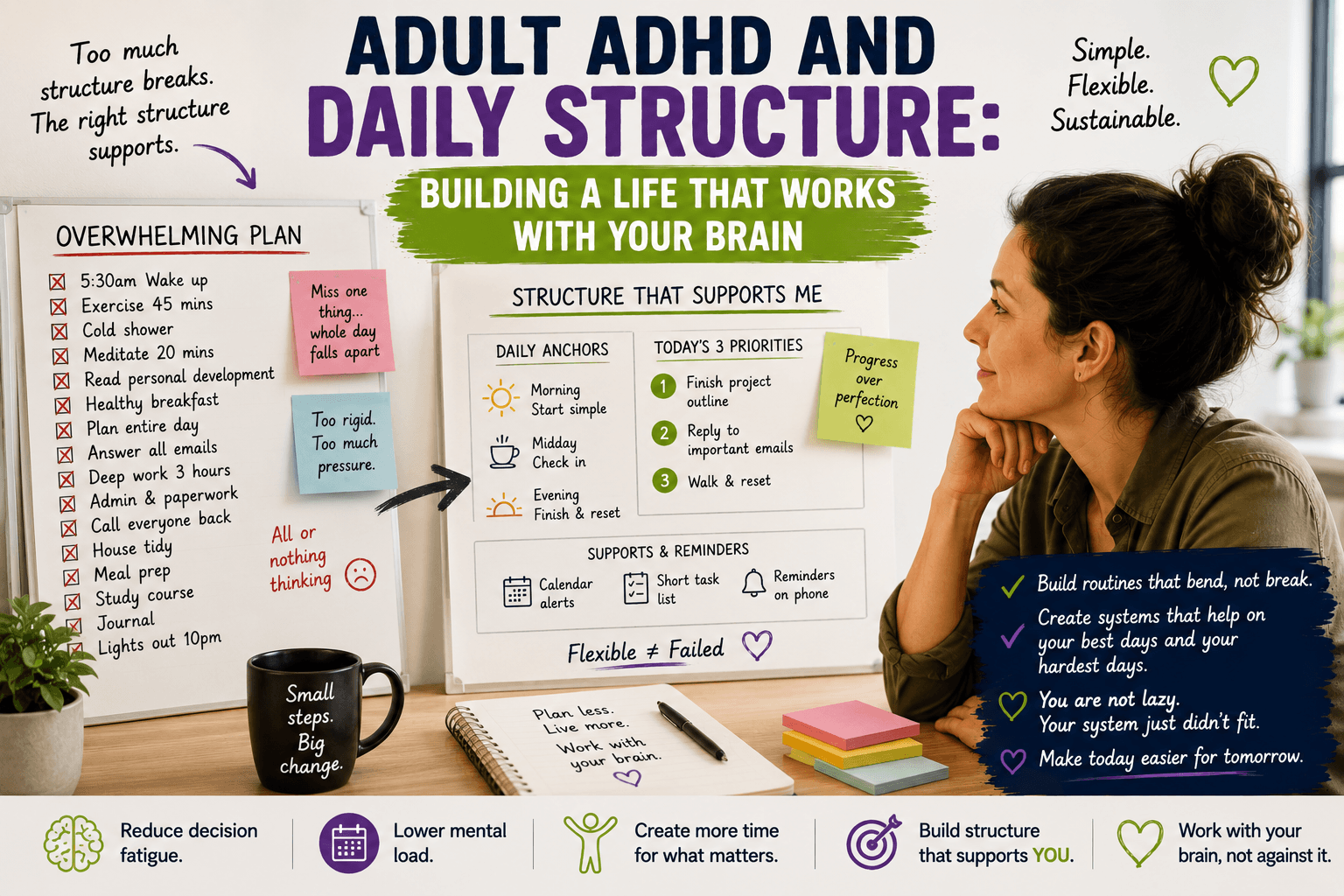
Adult ADHD and Daily Structure: How to Build a Life That Works With Your Brain
Adult ADHD and daily structure can sometimes feel like opposites.
Structure often helps. However, maintaining it can be much harder.
You may have bought planners, downloaded apps or created detailed routines. At first, everything may have worked well. Appointments were remembered, tasks were completed and the week felt more organised.
Then life changed.
Perhaps you slept badly. Maybe work became unusually busy. An unexpected problem might have appeared.
Suddenly, the routine stopped working.
When this happens, it is easy to think:
“Why can’t I stick to anything?”
However, there is another question worth asking:
“Was this system designed for the life I actually live?”
That question is much more useful.
A good routine should not work only when you feel focused, rested and motivated. Instead, it should continue supporting you when energy is lower and life becomes less predictable.
Why Adult ADHD and Daily Structure Can Be Difficult
Structure can reduce uncertainty. It can also remove many small decisions from the day.
However, too much structure may create another problem.
Imagine a morning routine with twelve steps.
You wake up early, exercise, shower, prepare breakfast, meditate, check your calendar, answer emails, plan the day and tidy the kitchen before leaving home.
On paper, this may look excellent.
In real life, one interruption can disrupt the entire plan.
As a result, the routine may start feeling like another responsibility rather than a source of support.
Therefore, the goal is not to create as much structure as possible.
The goal is to create enough useful structure to make life easier.
Build for Your Difficult Days, Not Only Your Best Ones
People often design new routines when motivation is high.
At that moment, everything seems possible.
You may imagine exercising every morning, preparing meals in advance and keeping your home completely organised.
However, your best days are not usually the days that need the most support.
Your harder days do.
For that reason, ask:
“Could I still follow some version of this routine when I am tired or stressed?”
If the answer is no, make the routine smaller.
For example, your ideal morning might include breakfast, exercise, planning and twenty minutes of quiet time.
On a difficult morning, the minimum version might simply be:
- get dressed;
- eat something;
- check the calendar;
- identify the day’s most important task.
Both versions count.
Consequently, one difficult morning does not destroy the entire system.
Create a Minimum Version of Important Routines
Flexible routines have more than one setting.
There is the full version for good days and a smaller version for low-energy days.
For instance:
Normal exercise: 30-minute workout.
Minimum version: 10-minute walk.
Normal house reset: 30 minutes.
Minimum version: clear one surface.
Normal weekly planning: review the whole week.
Minimum version: check tomorrow’s appointments.
This approach changes the meaning of a difficult day.
Rather than thinking, “I failed the routine,” you can say, “I used the smaller version today.”
That is a much easier system to return to.
Use Daily Anchors Instead of Controlling Every Hour
You do not need to schedule every minute.
Instead, build around events that already happen.
These events can act as anchors.
Common anchors include:
- waking up;
- breakfast;
- starting work;
- lunch;
- finishing work;
- dinner;
- bedtime.
Once an anchor exists, attach one small action to it.
For example:
After breakfast → check today’s calendar.
After lunch → take a short walk.
Before finishing work → write tomorrow’s top three tasks.
Before bed → put keys, wallet and phone in their usual places.
Because the anchor already exists, you are not building the new habit from nothing.
As a result, the routine can feel much easier to remember.
Reduce Everyday Decisions
Small decisions can use surprising amounts of mental energy.
What should I wear?
What should I eat?
Which task should I start?
Where are my keys?
Should I answer this message now?
One decision is small. However, hundreds of small decisions across a day can become exhausting.
Therefore, remove repeated decisions wherever possible.
You might:
- keep several reliable breakfast choices;
- choose tomorrow’s clothes the night before;
- use one main calendar;
- keep important items in permanent places;
- choose tomorrow’s priority before finishing today;
- keep one main task list rather than several.
Each change appears minor.
Together, however, they can reduce a large amount of mental load.
Give Important Items One Permanent Home
Searching for lost items creates unnecessary stress.
Keys, glasses, chargers, documents and wallets are common examples.
Rather than trying harder to remember where you placed something, create one obvious home for it.
Keys might live on a hook beside the door.
Your wallet could sit in a bowl on the hallway table.
Chargers might stay in one charging area.
The exact location does not matter.
What matters is consistency.
Once the environment remembers where something belongs, your brain has one less thing to track.
Make Important Information Visible
Sometimes traditional tidiness can work against memory.
You put something away neatly and then forget about it.
For that reason, important information may need to remain visible.
A whiteboard can display weekly priorities.
Tomorrow’s paperwork might sit beside your bag.
An item that needs returning could stay near the front door.
Exercise shoes may remain somewhere you naturally see them.
Similarly, phone reminders can support appointments and deadlines.
The aim is not to cover the house in notes.
Instead, use visibility deliberately.
Your environment can remind you of things before memory has to.
Keep One Main Calendar
Appointments stored in several places create confusion.
One may be in an email. Another sits in your phone. Perhaps someone tells you about a third while you are cooking.
Eventually, keeping track of everything becomes difficult.
Therefore, choose one main calendar.
Whenever possible, add new appointments immediately.
Then use reminders.
For example:
- one reminder the day before;
- another reminder one hour before.
This simple system reduces the amount of information you have to hold mentally.
Make Your Task List Smaller
Long task lists can create more overwhelm than direction.
A list containing twenty-five tasks makes everything look equally important.
Instead, separate tasks into levels.
Must Do
Choose one important task.
Should Do
Choose two useful tasks.
Could Do
Everything else can wait if necessary.
This structure gives the day a clear centre.
Moreover, anything completed beyond those priorities feels like additional progress rather than another requirement.
Turn Projects Into Next Actions
Large tasks often feel difficult because the first step is unclear.
Consider these examples:
“Sort finances.”
“Organise the house.”
“Plan the holiday.”
“Deal with insurance.”
None of these tells you what to physically do next.
Therefore, convert them into actions.
“Sort finances” might become:
Open the latest bank statement.
“Deal with insurance” could become:
Find the policy number.
“Plan the holiday” might become:
Check possible dates.
Once the first action becomes clear, starting often becomes easier.
Reduce Friction Before You Need Motivation
Imagine that you want to exercise tomorrow morning.
You could wait until morning and then find your clothes, trainers and headphones.
Alternatively, prepare everything tonight.
Now tomorrow’s task contains fewer steps.
The same principle applies elsewhere.
If paperwork needs completing, put the document and pen together beforehand.
If you need to leave early, prepare the bag the evening before.
If you want to work on a report first thing, leave the correct document ready on your computer.
In other words, make tomorrow’s useful action easier today.
Add Friction to Distractions
The opposite strategy also helps.
Rather than relying completely on willpower, make distracting activities slightly less convenient.
For instance:
Move the phone away from your desk.
Turn off unnecessary notifications.
Remove social media apps from the home screen.
Close unrelated browser tabs.
Log out of websites that regularly interrupt work.
These barriers are small.
Nevertheless, they create a useful pause between impulse and action.
Use Visual Progress
Progress can feel more real when you can see it.
Therefore, consider:
- checklists;
- simple calendars;
- progress bars;
- whiteboards;
- visible task cards.
Instead of thinking:
“I still have loads left to do.”
you may see:
“Three out of five tasks are complete.”
That change in perspective can make progress easier to recognise.
Do Not Turn Organisation Into Another Project
Productivity systems can become strangely attractive.
You start looking for the perfect planner.
Then you compare apps.
Next, you redesign your calendar.
After that, you create categories, colours and complicated tracking systems.
Several hours later, the original work has still not started.
Therefore, remember one rule:
The system is supposed to support the work. The system is not the work.
If maintaining your organisation takes too much effort, simplify it.
Adult ADHD and Daily Structure at Work
Work often provides some external structure.
Meetings have times.
Projects have deadlines.
Customers expect replies.
Nevertheless, unstructured parts of the day can still become difficult.
For that reason, create several simple reference points.
For example:
Start of day: review priorities.
First work block: begin the most important task.
After lunch: handle routine administration.
End of day: identify tomorrow’s main priority.
These are not rigid rules.
Instead, they give the day a shape.
When circumstances change, the structure can change with them.
Create an End-of-Day Reset
Morning routines receive a lot of attention.
However, tomorrow often becomes easier because of what you do tonight.
A simple evening reset could include:
- checking tomorrow’s calendar;
- writing tomorrow’s main task;
- putting essential items beside the door;
- charging devices;
- clearing one small workspace.
This process reduces uncertainty before the next day begins.
As a result, mornings can require fewer decisions.
Adult ADHD and Daily Structure at Home
Home life often contains fewer external deadlines.
Laundry can wait.
Paperwork can wait.
Cleaning can wait.
Unfortunately, several postponed tasks may eventually become urgent at the same time.
One solution is to give repeated jobs a loose place in the week.
For example:
Monday — laundry.
Tuesday — paperwork.
Wednesday — shopping.
Thursday — household admin.
Friday — simple reset.
You do not need to follow this perfectly.
The purpose is simply to create a default.
Therefore, when you wonder when a task should happen, the decision has already been partly made.
Use Zones to Simplify Your Environment
Instead of trying to organise every room perfectly, create practical zones.
For example:
Leaving-home zone: keys, wallet and bag.
Paperwork zone: letters, bills and forms.
Charging zone: phone, tablet and headphones.
Work zone: laptop, notebook and current documents.
Exercise zone: trainers, clothes and equipment.
Zones reduce the number of choices involved in putting something away.
Moreover, they help important items remain easier to find.
Build a Recovery Point Into Every Routine
No routine works perfectly forever.
Sooner or later, something will interrupt it.
You may become tired.
A child may become ill.
Work may become unusually demanding.
Perhaps you travel or simply have a difficult week.
Therefore, every system needs a restart point.
For example:
“When everything falls apart, I restart by checking tomorrow’s calendar and choosing one priority.”
Nothing more is required.
You do not need to catch up on every missed habit.
Instead, return to the first useful step.
Returning Matters More Than Perfection
Many people measure success through uninterrupted streaks.
However, one missed day does not remove previous progress.
A more useful goal is:
Return quickly.
If today does not work, restart tomorrow.
This changes consistency from an all-or-nothing test into a recovery skill.
In the long term, that ability may make routines much more sustainable.
Use Technology as Support
Technology can reduce mental load when used carefully.
Useful tools may include:
- calendar reminders;
- timers;
- automatic payments;
- digital notes;
- shared family lists;
- recurring alerts.
However, too many tools can create another problem.
Every additional app becomes another place to check.
Therefore, keep your digital system simple.
One calendar.
One main task list.
One place for notes.
A few useful reminders.
That may be enough.
Match Tasks to Your Energy
Not every hour feels the same.
Some people think clearly in the morning.
Others work better later.
Therefore, notice when demanding tasks feel easiest.
Where possible, use your stronger periods for activities such as:
- writing;
- problem-solving;
- planning;
- difficult decisions.
Meanwhile, lower-energy periods may be better suited to routine emails, filing or simple administration.
The clock matters.
However, your available energy matters too.
Adult ADHD and Daily Structure Should Remain Flexible
A useful system needs to survive real life.
That includes:
poor sleep;
unexpected calls;
work pressure;
children;
travel;
illness;
changes of plan.
For this reason, avoid scheduling every minute.
Leave space.
Keep some routines optional.
Allow the minimum version to count.
Adult ADHD and daily structure can work well together when routines remain simple enough to adapt.
The aim is stability, not rigidity.
Let Your Environment Remember for You
One of the most useful ideas is to stop expecting yourself to remember everything internally.
Instead, share the responsibility with your surroundings.
The calendar remembers appointments.
The bowl remembers where your keys belong.
The phone remembers when you need to leave.
The whiteboard remembers weekly priorities.
The checklist remembers the sequence.
Your environment becomes part of the system.
That is not avoiding responsibility.
It is using practical support wisely.
Start With One Repeated Problem
Do not try to redesign your whole life this weekend.
Choose one problem.
Maybe you lose your keys.
Perhaps mornings regularly become chaotic.
Paperwork might accumulate.
Appointments may be forgotten.
Whatever the problem, ask:
“What could make this easier next time?”
Then change one thing.
Test it.
Notice whether it helps.
If necessary, adjust it.
Small improvements are easier to maintain than complete reinvention.
Reflection Questions
- Which part of your day currently feels most chaotic?
- Which routine works well for you already?
- What important item do you regularly lose?
- Which repeated decision could you remove?
- What could become an anchor in your morning or evening?
- What does your minimum version of a productive day look like?
- Which task could you make easier by preparing in advance?
- Which distraction could you make slightly harder to access?
- What would your restart point be after a difficult day?
- What is one change you could make today to reduce tomorrow’s friction?
Conclusion
Adult ADHD and daily structure do not have to work against each other.
In fact, the right amount of structure can reduce mental load, simplify decisions and make everyday life easier.
However, the goal is not to create a perfect routine.
Instead, create a system that can bend without breaking.
Use anchors.
Reduce unnecessary decisions.
Give important items permanent homes.
Make useful actions easier.
Prepare in advance.
Create low-energy alternatives.
Most importantly, build a clear way back when the routine breaks.
You do not need a system that proves how disciplined you can be.
You need one that supports you when discipline, motivation and energy are limited.
Therefore, when creating your next routine, do not ask:
“Would this work on my perfect day?”
Ask:
“Could this still help me on my difficult day?”
If the
Suggested Internal Links
- AAdult ADHD and Overthinking: How to Quiet the Mental Noisedult ADHD and Motivation: How to
- Adult ADHD and Overthinking: How to Quiet the Mental Noise
Disclaimer
This article is provided for general educational and informational purposes only. It does not provide medical, psychological, diagnostic or therapeutic advice. Therefore, it should not be used as a substitute for individual advice from an appropriately qualified healthcare professional.
ADHD experiences vary considerably between individuals. If you have concerns about ADHD, mental health, medication, diagnosis or treatment, please speak with an appropriately qualified healthcare professional.