
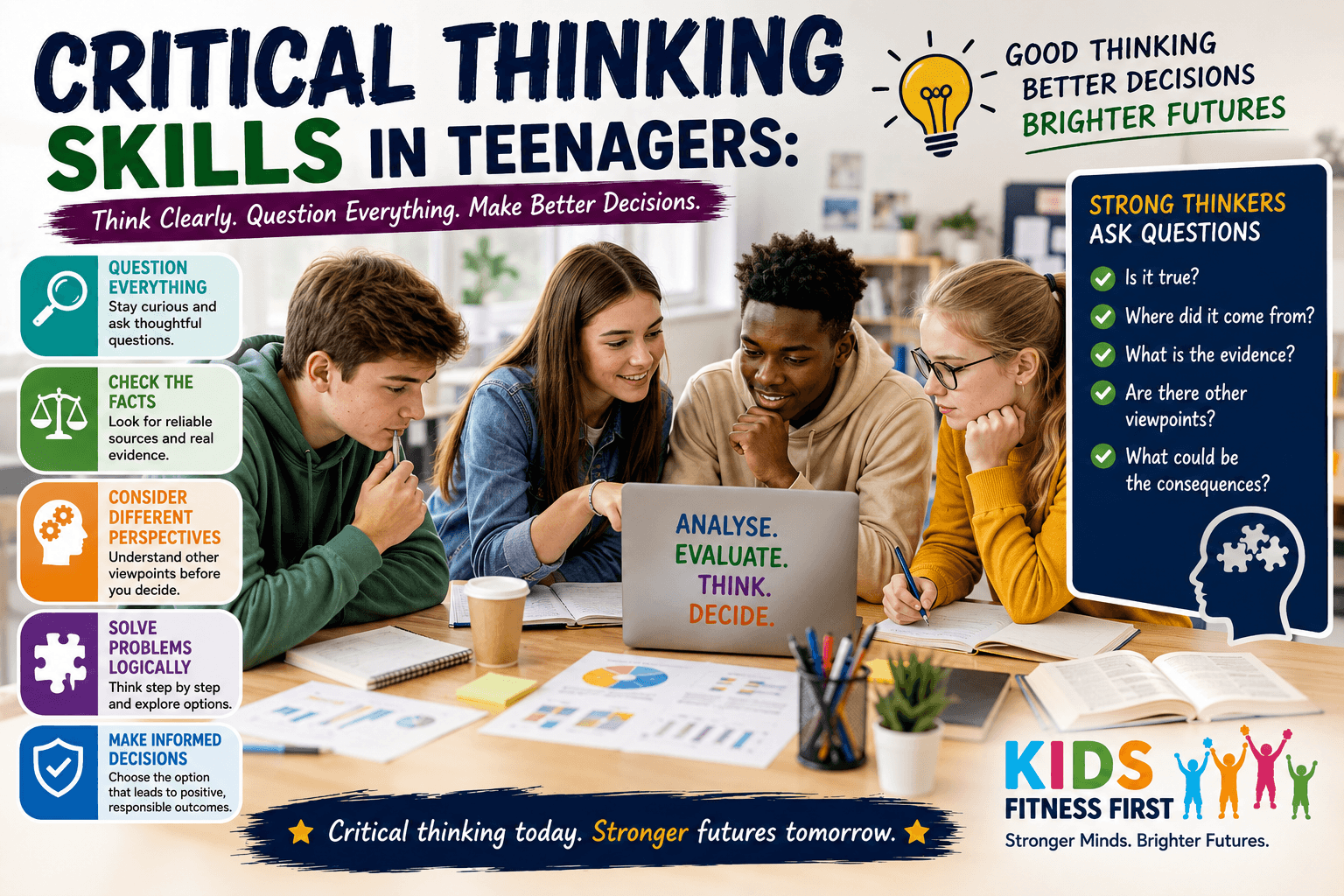
Critical Thinking Skills in Teenagers: Helping Young People Think Clearly and Make Better Decisions
The world today provides teenagers with more information than any previous generation has experienced. News, social media, videos, artificial intelligence, advertising and online opinions compete for their attention every day. Consequently, learning how to think critically has become one of the most valuable life skills a young person can develop.
Critical thinking skills in teenagers involve much more than simply remembering facts. Instead, they help young people analyse information, ask thoughtful questions, recognise reliable evidence and make sensible decisions. These skills also encourage teenagers to remain curious while avoiding the habit of believing everything they see or hear.
At Kids Fitness First, we believe every young person has unique strengths. Developing critical thinking is not about teaching teenagers what to think. Rather, it is about helping them learn how to think, so they can become confident, responsible and independent adults. It forms part of our broader Teen Life Skills and Development framework alongside problem-solving, communication and independent thinking.
Why Critical Thinking Skills in Teenagers Matter
Every day, teenagers make decisions that influence their education, friendships, health and future opportunities.
For example, they regularly decide:
- which information to believe;
- how to solve problems;
- who to trust;
- how to spend their time;
- how to respond to challenges;
- which opportunities to pursue;
- how to plan for future goals.
Some decisions may seem small. However, each one helps shape habits, confidence and future success.
Therefore, developing critical thinking skills in teenagers gives young people practical tools they can use throughout their lives.
These skills help teenagers become:
- more independent;
- better decision-makers;
- stronger problem-solvers;
- thoughtful communicators;
- responsible digital citizens;
- confident learners;
- adaptable individuals.
Furthermore, critical thinking encourages teenagers to pause before reacting. Instead of making quick assumptions, they learn to gather information, consider different viewpoints and choose the most appropriate response.
What Is Critical Thinking?
Critical thinking means carefully examining information before accepting it as true.
Rather than jumping to conclusions, teenagers learn to ask questions such as:
- Is this information accurate?
- Where did it come from?
- Can I trust the source?
- Is there evidence to support it?
- Could there be another explanation?
- What information might be missing?
These questions encourage thoughtful decision-making instead of automatic reactions.
Importantly, critical thinking does not mean being negative or argumentative. Instead, it means being curious, open-minded and willing to explore different ideas before making a judgement.
Asking Good Questions
Strong critical thinkers are usually strong questioners.
Instead of accepting the first answer they hear, they remain curious.
Parents and teachers can encourage this by welcoming questions such as:
- Why does this happen?
- What evidence supports this idea?
- Could there be another solution?
- What are the advantages and disadvantages?
- How might someone else see this situation?
- What information is still missing?
Consequently, teenagers begin to understand that asking thoughtful questions often leads to better understanding.
Curiosity becomes one of their greatest strengths.
Separating Facts from Opinions
One of the most important critical thinking skills in teenagers is recognising the difference between facts and opinions.
A fact can usually be checked or verified.
For example:
- Water freezes at 0°C.
- London is the capital of England.
- Exercise benefits physical health.
An opinion, however, reflects someone’s personal belief or preference.
For example:
- Football is the best sport.
- Summer is better than winter.
- This film is exciting.
Opinions are valuable because they encourage discussion. Nevertheless, opinions should not be confused with facts.
Helping teenagers recognise this difference improves their judgement in many situations.
Evaluating Information Online
The internet provides enormous opportunities for learning.
However, it also contains misinformation, misleading headlines and inaccurate advice.
Therefore, teenagers benefit from learning how to evaluate online information carefully.
Useful questions include:
- Who created this information?
- Is the website trustworthy?
- Is the information current?
- Does another reliable source say the same thing?
- Is someone trying to sell something?
- Is there evidence supporting the claim?
Parents and teachers should encourage teenagers to compare several reliable sources before accepting important information as true.
Developing this habit prepares young people for responsible digital citizenship.
Recognising Bias
Every person sees the world through their own experiences.
As a result, bias can influence how information is presented.
Critical thinkers understand that different people may describe the same event differently.
For example:
- newspapers may present the same story from different viewpoints;
- advertisements highlight benefits while minimising disadvantages;
- social media posts often show only part of a situation;
- online influencers may receive payment to promote products.
Recognising possible bias helps teenagers consider information more fairly.
Rather than accepting one viewpoint immediately, they learn to compare different perspectives before making a judgement.
Thinking Before Reacting
Teenagers sometimes face situations where emotions develop quickly.
For example:
- disagreements with friends;
- comments on social media;
- disappointing exam results;
- misunderstandings at school;
- family disagreements.
Strong critical thinkers learn to pause before reacting.
Instead of responding immediately, they ask themselves:
- What actually happened?
- What assumptions am I making?
- Do I have all the information?
- What response would improve this situation?
- How might my actions affect others?
Taking even a short pause often leads to better decisions.
Furthermore, this habit supports emotional resilience and stronger relationships.
Considering Different Solutions
Many problems have more than one possible answer.
Critical thinking encourages teenagers to explore several options before deciding.
For example, if a school project is not progressing well, possible solutions might include:
- reorganising responsibilities;
- improving communication;
- asking the teacher for guidance;
- changing the timetable;
- dividing larger tasks into smaller steps.
Instead of choosing the first solution, teenagers learn to compare the advantages and disadvantages of each option.
As a result, they become more confident when solving future problems.
Making Better Decisions
One of the greatest benefits of developing critical thinking skills in teenagers is improved decision-making.
Every choice has consequences. Therefore, teenagers benefit from learning a simple process that helps them make thoughtful decisions rather than rushed ones.
A useful approach includes five steps:
1. Identify the Situation
Clearly understand the problem or opportunity.
2. Gather Information
Collect reliable facts before deciding.
3. Consider Different Options
Think about several possible solutions instead of choosing the first one.
4. Think About the Consequences
Ask:
- How could this affect me?
- How could it affect other people?
- What might happen in the future?
5. Make the Best Decision
Choose the option that is most responsible, practical and beneficial.
Following these steps helps teenagers become more confident when facing unfamiliar situations.
Critical Thinking Skills in Teenagers at School
Schools provide excellent opportunities for teenagers to develop critical thinking every day.
Teachers encourage these skills when students:
- investigate research questions;
- compare different viewpoints;
- explain their reasoning;
- solve mathematical problems;
- analyse historical events;
- evaluate scientific evidence;
- participate in debates;
- complete project-based learning.
Rather than simply memorising information, students learn how knowledge is created, tested and improved.
Furthermore, classroom discussions help young people appreciate that reasonable people can sometimes reach different conclusions based on the evidence available.
Critical Thinking at Home
Parents play an equally important role.
Critical thinking does not require formal lessons. Instead, it develops naturally through everyday conversations.
Families can encourage critical thinking by asking questions such as:
- What do you think about that?
- Why do you believe that?
- What evidence supports your opinion?
- Could there be another explanation?
- How would someone else see this situation?
- What would happen if we chose a different solution?
Importantly, parents do not need to provide every answer.
Instead, allowing teenagers time to think independently helps build confidence and responsibility.
Over time, these conversations strengthen communication while encouraging thoughtful decision-making.
Critical Thinking and Social Media
Social media has become a significant part of many teenagers’ lives.
Although it provides opportunities for learning and connection, it also exposes young people to misinformation, edited images, exaggerated stories and persuasive advertising.
Consequently, critical thinking becomes essential.
Teenagers should learn to ask:
- Is this information accurate?
- Has it been edited?
- Who benefits from sharing this?
- Is there reliable evidence?
- Have I checked another source?
Likewise, they should think carefully before sharing information with others.
A few moments of reflection can prevent misunderstandings and reduce the spread of false information.
Digital responsibility is now an important part of critical thinking.
Learning From Different Perspectives
Strong critical thinkers understand that different people often see situations differently.
Listening respectfully does not mean automatically agreeing.
Instead, it allows teenagers to understand:
- different experiences;
- different cultures;
- different priorities;
- different solutions.
Consequently, young people become better communicators and more effective problem-solvers.
Schools, sports teams and community groups all provide opportunities to practise respectful discussion.
These experiences prepare teenagers for future workplaces where collaboration is essential.
Learning From Mistakes
Critical thinkers recognise that mistakes provide valuable learning opportunities.
Rather than becoming discouraged, they ask:
- What happened?
- What did I learn?
- What would I change?
- Which strength helped me continue?
This approach encourages resilience.
Furthermore, it helps teenagers understand that success often develops through reflection and continuous improvement rather than perfection.
Learning from mistakes is therefore an important part of becoming an independent thinker.
Preparing Teenagers for Adult Life
The future will continue to change rapidly.
New technology, artificial intelligence, changing careers and global challenges mean today’s teenagers will regularly face situations that previous generations never experienced.
Fortunately, critical thinking prepares young people for this changing world.
Employers consistently value people who can:
- solve problems;
- analyse information;
- communicate effectively;
- adapt to change;
- evaluate evidence;
- work collaboratively;
- make responsible decisions.
Consequently, developing critical thinking skills in teenagers supports both personal wellbeing and future employability.
These skills remain valuable throughout life.
How Adults Can Encourage Critical Thinking
Parents, teachers and mentors can strengthen critical thinking by creating environments where curiosity is encouraged.
Helpful approaches include:
- welcoming thoughtful questions;
- praising effort and reasoning;
- encouraging respectful discussion;
- allowing teenagers to solve suitable problems independently;
- discussing current events together;
- exploring several possible solutions;
- recognising good judgement;
- encouraging reflection after decisions.
Importantly, adults should avoid giving every answer immediately.
Instead, asking guiding questions often produces deeper learning.
As teenagers gain experience, they become increasingly confident in their own ability to think independently.
Critical Thinking Builds Confidence
Confidence grows when teenagers realise they can think through difficult situations for themselves.
Each successful decision provides evidence that they can:
- analyse information;
- solve challenges;
- learn from experience;
- adapt when necessary;
- make responsible choices.
Consequently, confidence develops naturally through experience rather than simply receiving praise.
This confidence supports education, employment, relationships and lifelong learning.
Reflection Questions
- Looking back, when did careful thinking help you solve a problem?
- Which question helped you understand a situation better?
- How did considering different viewpoints improve your decision?
- Looking ahead, how could you use critical thinking during your next challenge?
Conclusion
Critical thinking skills in teenagers help young people become thoughtful, confident and responsible decision-makers.
Rather than accepting information without question, teenagers learn to evaluate evidence, consider different viewpoints and make informed choices.
Parents, teachers and communities all have opportunities to encourage curiosity, thoughtful discussion and independent thinking.
At Kids Fitness First, we believe every young person has the potential to become a confident thinker. By developing critical thinking skills alongside communication, resilience, adaptability and leadership, teenagers become better prepared for education, employment and the many opportunities life will present.
The goal is not simply to know more. Instead, it is to help young people think more clearly, make wiser decisions and contribute positively to the world around them.
Suggested Internal Links
- Understanding Children’s Behaviour: Looking Beyond What You See
- Why Purpose in Young People Matters More Than Ever
Disclaimer
This article is provided for educational and informational purposes only. It is not intended as medical, psychological or professional advice. Every teenager develops at their own pace. If you have concerns about a young person’s wellbeing or development, please seek guidance from an appropriately qualified professional.