Learning From Mistakes in Teenagers: Turning Experience Into Growth
Learning from mistakes in teenagers is an important part of developing confidence, responsibility and independence. Every young person will make choices that do not produce the result they expected. They may misunderstand instructions, forget an important detail, choose an ineffective approach or react too quickly in a difficult situation.
Although mistakes can feel disappointing, they also provide useful information. A teenager can review what happened, identify what needs to change and make a stronger decision next time. Therefore, the aim should not be to prevent every mistake. Instead, adults can help young people respond to mistakes in a calm, thoughtful and constructive way.
Parents and teachers play an important role in this process. When adults react with patience and curiosity, teenagers are more likely to reflect honestly. However, when mistakes lead to ridicule, anger or repeated criticism, young people may hide problems or avoid new challenges.
A strengths-based approach treats mistakes as part of development. It encourages accountability while also recognising effort, courage and progress. For the wider framework connecting this process with resilience, adaptability, confidence and growth mindset, see our Teen Life Skills and Development guide.
Why Learning From Mistakes in Teenagers Matters
Learning from mistakes in teenagers helps young people understand that progress rarely happens in a perfect straight line.
Many valuable skills develop through repeated attempts. For example, learning to communicate clearly, organise schoolwork, lead a team or manage time often involves trial and adjustment.
Mistakes can help teenagers develop:
- self-awareness;
- responsibility;
- resilience;
- problem-solving;
- emotional control;
- patience;
- adaptability;
- decision-making;
- honesty;
- confidence.
These qualities are useful across education, employment, relationships and everyday life.
Furthermore, mistakes often reveal where support or clearer information is needed. A missed deadline may show that a teenager needs a better planning method. Likewise, a disagreement may highlight the need for calmer communication.
The mistake itself is not the final lesson. The real value comes from the reflection that follows.
Mistakes Are Different From Carelessness
Not every mistake has the same cause.
Sometimes a teenager makes an error despite careful effort. At other times, the mistake may result from rushing, avoiding responsibility or ignoring clear instructions.
Adults should therefore look beyond the outcome and ask what contributed to it.
Useful questions include:
- Was the task understood?
- Were the expectations clear?
- Did the teenager have enough time?
- Was the plan realistic?
- Did they ask for help when needed?
- Was the decision rushed?
- Did they understand the possible consequences?
This approach does not remove responsibility. Instead, it helps identify the most useful response.
For example, a teenager who misunderstood a task may need clearer guidance. By contrast, someone who repeatedly ignores an agreed deadline may need stronger boundaries and a more structured plan.
Learning From Mistakes in Teenagers Begins With Reflection
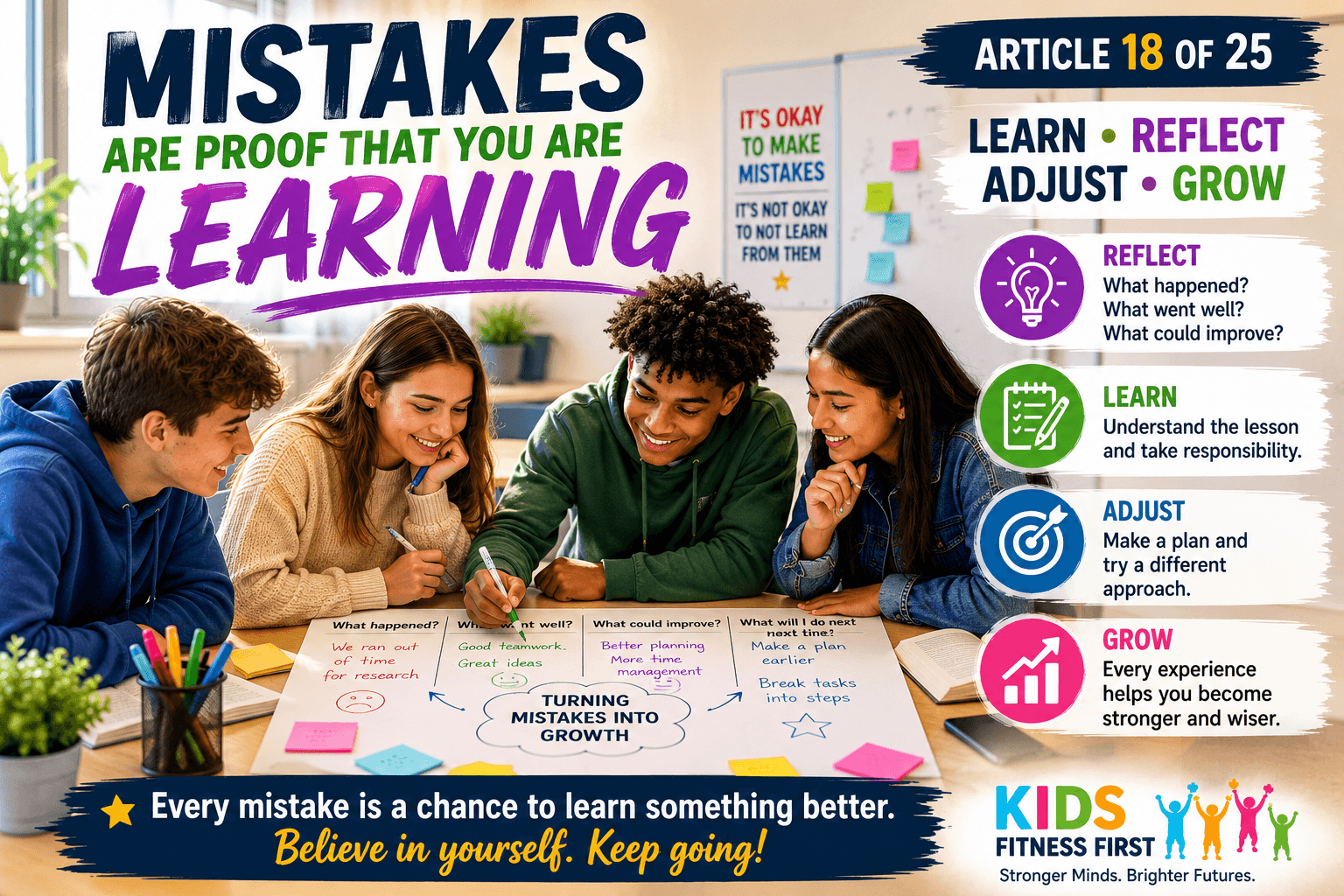
Reflection turns experience into learning.
Without reflection, a teenager may only remember that something went wrong. However, a few calm questions can help them understand the event more clearly.
Parents and teachers can ask:
- What happened?
- What were you trying to achieve?
- Which part worked well?
- Where did the situation begin to change?
- What information was missing?
- What would you do differently next time?
- What support would help?
These questions should not feel like an interrogation. Instead, they should encourage honest thinking.
Timing also matters. If emotions are still high, immediate discussion may not be productive. Therefore, it can be helpful to pause and return to the conversation later.
The Importance of a Calm Response
Adults strongly influence how teenagers view mistakes.
If every error receives an angry response, young people may begin to associate mistakes with shame. As a result, they may avoid asking questions, taking responsibility or trying unfamiliar activities.
A calm response creates a better opportunity for learning.
This does not mean ignoring consequences. Instead, adults can separate the behaviour from the person.
For example, rather than saying:
“You are careless.”
try:
“This part was missed. Let us look at how that happened and what would help next time.”
The first statement labels the teenager. The second focuses on the situation and the next step.
Consequently, the young person is more likely to stay engaged in the conversation.
Accountability and Encouragement Can Work Together
A strengths-based approach does not mean removing accountability.
Teenagers still need to understand how their choices affect themselves and others. However, accountability works best when it is clear, fair and connected to the situation.
For instance, if a teenager forgets to complete their part of a group project, they may need to:
- apologise to the team;
- complete the missing work;
- explain how they will manage the next deadline;
- use a reminder or planning tool;
- review progress with the teacher.
These actions connect responsibility with improvement.
At the same time, adults can recognise positive steps. If the teenager admits the mistake, makes a plan and follows through, that deserves acknowledgment.
Specific feedback may include:
- “You took responsibility without blaming someone else.”
- “You made a clear plan to correct the problem.”
- “You asked for help before the next deadline.”
- “You stayed with the task until it was completed.”
This feedback reinforces the behaviour that supports growth.
Fear of Mistakes Can Limit Participation
Some teenagers avoid challenges because they fear getting things wrong.
They may stay silent in class, choose only familiar tasks or avoid contributing ideas. Although this can appear like a lack of interest, it may actually reflect a desire to protect themselves from embarrassment.
Adults can reduce this fear by creating environments where:
- questions are welcomed;
- first attempts do not need to be perfect;
- different approaches are explored;
- feedback remains respectful;
- improvement is recognised;
- asking for help is normal.
Teachers can also model this attitude by correcting their own errors openly.
For example:
“I explained that too quickly. Let me try again more clearly.”
This shows students that mistakes can be acknowledged without shame.
Learning From Mistakes in Teenagers at School
Schools provide many opportunities for teenagers to learn through reflection.
A student may make mistakes in:
- written work;
- examinations;
- practical activities;
- presentations;
- group projects;
- time management;
- communication;
- planning.
Instead of focusing only on the mark or final result, teachers can help students examine the process.
Useful classroom strategies include:
- allowing corrections;
- comparing first and final drafts;
- discussing common errors anonymously;
- using self-assessment;
- encouraging peer feedback;
- reviewing how a group worked together;
- asking students to explain what they changed.
For example, after a presentation, students might reflect on:
- which section was clearest;
- where preparation helped;
- what they would shorten;
- how the group divided responsibilities;
- which communication skill they would practise next.
As a result, feedback becomes more useful and less personal.
The Difference Between Feedback and Criticism
Feedback should help a young person improve.
Criticism often focuses on what is wrong without showing a way forward.
Helpful feedback is:
- specific;
- calm;
- balanced;
- linked to the task;
- focused on improvement;
- given at an appropriate time.
For example:
“The introduction was clear. However, the final section moved too quickly. Next time, pause after each main point.”
This comment identifies both a strength and a practical improvement.
By contrast, a statement such as “That presentation was poor” gives little guidance.
Teenagers benefit most when feedback shows what to continue, what to adjust and why it matters.
Small Mistakes Can Prevent Bigger Ones
When teenagers learn from small mistakes, they become better prepared for larger responsibilities.
For example, forgetting equipment for a low-risk school activity may encourage better preparation next time. Similarly, misjudging the time needed for homework may lead to a more realistic schedule.
Natural consequences can be useful when they are safe and proportionate.
Adults do not always need to remove every inconvenience. Sometimes the experience itself provides the clearest lesson.
However, the goal should not be punishment. Instead, it should be understanding and better judgement.
Helping Teenagers Create a Better Plan
Reflection should lead to action.
Once a teenager understands what happened, the next step is to decide what will change.
A simple improvement plan may include:
- Identify the main issue.
- Choose one practical change.
- Decide when to use it.
- Ask for support if needed.
- Review whether it worked.
For example, if a teenager repeatedly forgets deadlines, the new plan might be:
- write every deadline in one calendar;
- check the calendar each evening;
- divide larger tasks into smaller steps;
- set a reminder two days before;
- review progress every Friday.
A clear plan turns regret into useful action.
Avoiding Perfectionism
High standards can encourage effort. However, perfectionism can make learning more difficult.
A teenager who believes every result must be perfect may spend too long on minor details, avoid finishing tasks or become discouraged by small errors.
Adults can help by emphasising progress and purpose.
Useful reminders include:
- “A first draft is meant to be improved.”
- “The goal is progress, not perfection.”
- “A useful attempt teaches more than avoiding the task.”
- “You can improve this one step at a time.”
These messages encourage continued participation.
Moreover, they help young people understand that quality often develops through revision.
Mistakes in Friendships and Communication
Not all mistakes happen in schoolwork.
Teenagers may also say something unhelpful, misunderstand another person or react before listening.
These situations require responsibility and empathy.
A constructive response may involve:
- recognising what happened;
- listening to the other person;
- apologising clearly;
- avoiding excuses;
- deciding how to respond differently;
- allowing time to rebuild trust.
A useful apology might be:
“I interrupted and did not listen properly. I understand why that was frustrating. Next time, I will let you finish before responding.”
This is more meaningful than simply saying “Sorry” without reflection.
Teamwork and Shared Learning
Group activities make mistakes visible because one person’s actions may affect the whole team.
However, teams can also learn together.
After a project, the group can discuss:
- what worked well;
- where communication became unclear;
- whether responsibilities were fair;
- which decisions helped;
- what should change next time.
Importantly, the discussion should avoid blaming one person.
Instead, the group should focus on systems and shared responsibility.
For example, rather than saying:
“You forgot everything.”
the team might say:
“We did not have a clear method for checking materials.”
This change in language encourages improvement.
Recognising Strengths During Difficult Experiences
Mistakes do not erase strengths.
In fact, difficult experiences often reveal valuable qualities.
A teenager may show:
- honesty by admitting an error;
- courage by trying again;
- patience during correction;
- creativity in finding a new solution;
- responsibility by making amends;
- resilience by continuing;
- empathy by considering another person’s feelings.
Adults should recognise these behaviours.
For example:
“You were disappointed, but you stayed calm and worked out what to do next.”
This feedback helps teenagers see that growth is already happening.
When Repeated Mistakes Need More Support
Sometimes the same mistake continues despite discussion.
In that case, adults should avoid assuming that the teenager does not care. Instead, they can examine whether the current strategy is practical.
Possible questions include:
- Is the task too large?
- Are instructions being remembered?
- Is the teenager using an effective planning system?
- Are expectations realistic?
- Does the environment create distractions?
- Is more frequent support needed?
The solution may involve smaller steps, clearer routines or more regular check-ins.
A repeated mistake often signals that the system needs adjustment, not simply more criticism.
Digital Mistakes and Online Responsibility
Teenagers also make decisions online.
They may post too quickly, misunderstand tone or share information without checking it.
Digital mistakes can spread quickly. Therefore, young people benefit from learning to pause before acting.
Helpful questions include:
- Is this accurate?
- Is it respectful?
- Does it reveal private information?
- Could it affect another person?
- Would I be comfortable saying this face to face?
- Should I wait before posting?
If a mistake happens, teenagers may need to remove the content, apologise, report harmful material or ask a trusted adult for help.
Digital responsibility develops through guidance and practice.
How Adults Can Model Learning From Mistakes
Teenagers notice how adults respond to their own errors.
A parent or teacher who refuses to admit mistakes may unintentionally suggest that mistakes must be hidden.
By contrast, adults can model healthy reflection.
For example:
“I forgot to send that message. I will set a reminder next time.”
or:
“I misunderstood what you meant. Thank you for explaining it again.”
These responses show honesty, responsibility and calm problem-solving.
As a result, teenagers are more likely to use the same approach.
Reflection Questions
- Looking back, what did the experience teach you?
- Which part would you approach differently next time?
- What strength helped you continue after the mistake?
- Looking ahead, what practical change will you make?
Conclusion
Learning from mistakes in teenagers is not about ignoring poor choices or removing responsibility. Instead, it is about helping young people understand what happened, make amends where necessary and choose a stronger approach next time.
Parents and teachers can support this process through calm questions, clear boundaries and practical feedback.
Mistakes will always be part of learning. However, when teenagers receive the right guidance, those experiences can strengthen resilience, judgement and confidence.
The goal is not perfection. Rather, it is helping young people become honest, responsible and adaptable individuals who know how to reflect, adjust and move forward.
Suggested Internal Links
- Read Understanding Emotional Reactions in Children
- Explore Strengths Based Parenting: Helping Children Build Confidence
Disclaimer
This article is provided for general educational and informational purposes only. It does not offer medical, psychological, diagnostic or therapeutic advice. Every young person develops differently. Anyone with specific concerns about a teenager’s learning, development or wellbeing should seek guidance from an appropriately qualified professional.