
When Both of You Need Different Things: The Two-Need Method for Neurodivergent Relationships
Neurodivergent relationship needs do not always fit neatly together.
Sometimes one partner needs quiet.
Meanwhile, the other needs conversation.
One person needs a plan.
However, the other feels trapped by too much structure.
One partner wants to leave the party after an hour.
Meanwhile, the other has been looking forward to staying all evening.
Perhaps one person needs reassurance immediately after an argument.
However, the other needs thirty minutes alone before they can speak safely.
Neither person is necessarily wrong.
Yet the relationship can still become stuck.
Why?
Because couples often treat conflicting needs as though they are competing arguments.
The conversation becomes:
“My need is reasonable.”
“Yes, but mine is reasonable too.”
Then each person explains their position more strongly.
Consequently, both may feel increasingly unseen.
The problem, however, may not be that one person’s need must defeat the other person’s.
Instead, the couple may need to ask:
“How do we design around two legitimate needs at the same time?”
That is the purpose of Article 24.
The Two-Need Method addresses one specific problem: two legitimate needs that appear to conflict. If the issue is primarily unequal workload or capacity, see capacity-based relationship fairness. If the difficulty is how the conversation itself is being processed, see neurodivergent relationship communication.
Two Valid Needs Can Still Collide
Imagine a Saturday evening.
One partner has had a demanding week.
Therefore, they desperately need a quiet night at home.
However, the other partner has spent most of the week alone and desperately needs contact, stimulation and time together.
Both statements are real:
“I need rest.”
“I need connection.”
Unfortunately, couples may turn these into accusations.
The person needing rest says:
“Why can’t you understand how exhausted I am?”
Meanwhile, the person needing connection says:
“Why don’t you ever want to spend time with me?”
Now the nervous-system needs have been translated into character judgements.
Rest becomes selfishness.
Connection becomes neediness.
Consequently, the actual problem becomes harder to solve.
Therefore, the first principle is simple:
A need can be valid without making the other person’s need invalid.
The Difference Between a Need and a Preferred Solution
This distinction changes many conversations.
Suppose one partner says:
“I need you to come to the family party.”
That sounds like a need.
However, the underlying need may actually be:
“I need to feel supported around my family.”
Coming to the party is one possible solution.
Likewise:
“I need to stay home.”
may actually mean:
“I need enough sensory and social recovery to function tomorrow.”
Now the conversation has more possibilities.
Perhaps the neurodivergent partner attends for ninety minutes and leaves separately.
Or perhaps they skip this event but join a quieter family lunch the following week.
Therefore, before negotiating the solution, identify the deeper need.
That creates flexibility.
Solutions Are Often Rigid; Needs Are Usually Broader
Compare these two statements:
Solution: “You must text me every hour.”
Need: “I need enough contact to know we’re okay.”
Likewise:
Solution: “Nobody can talk to me when I get home.”
Need: “I need a predictable decompression period after work.”
Once the need becomes visible, the couple can design several possible solutions.
Therefore, if a conflict feels impossible, ask:
“Are we arguing about needs — or are we arguing about two preferred solutions?”
Often, it is the second.
Common Need Collisions in Neurodivergent Relationships
Different nervous systems can produce recurring collisions.
For example:
Connection versus solitude
One partner regulates through closeness.
Meanwhile, the other regulates through space.
Predictability versus spontaneity
One person feels safer with a clear plan.
However, the other feels energised by flexibility.
Speed versus processing time
One wants to decide now.
Meanwhile, the other needs time before responding.
Social contact versus recovery
One wants to see friends.
However, the other is already socially depleted.
Verbal processing versus quiet processing
One thinks by talking.
Meanwhile, the other cannot think while someone is still talking.
Order versus low-demand living
One partner feels calmer when everything is organised.
However, the other becomes overwhelmed by constant task pressure.
Again, neither nervous system automatically outranks the other.
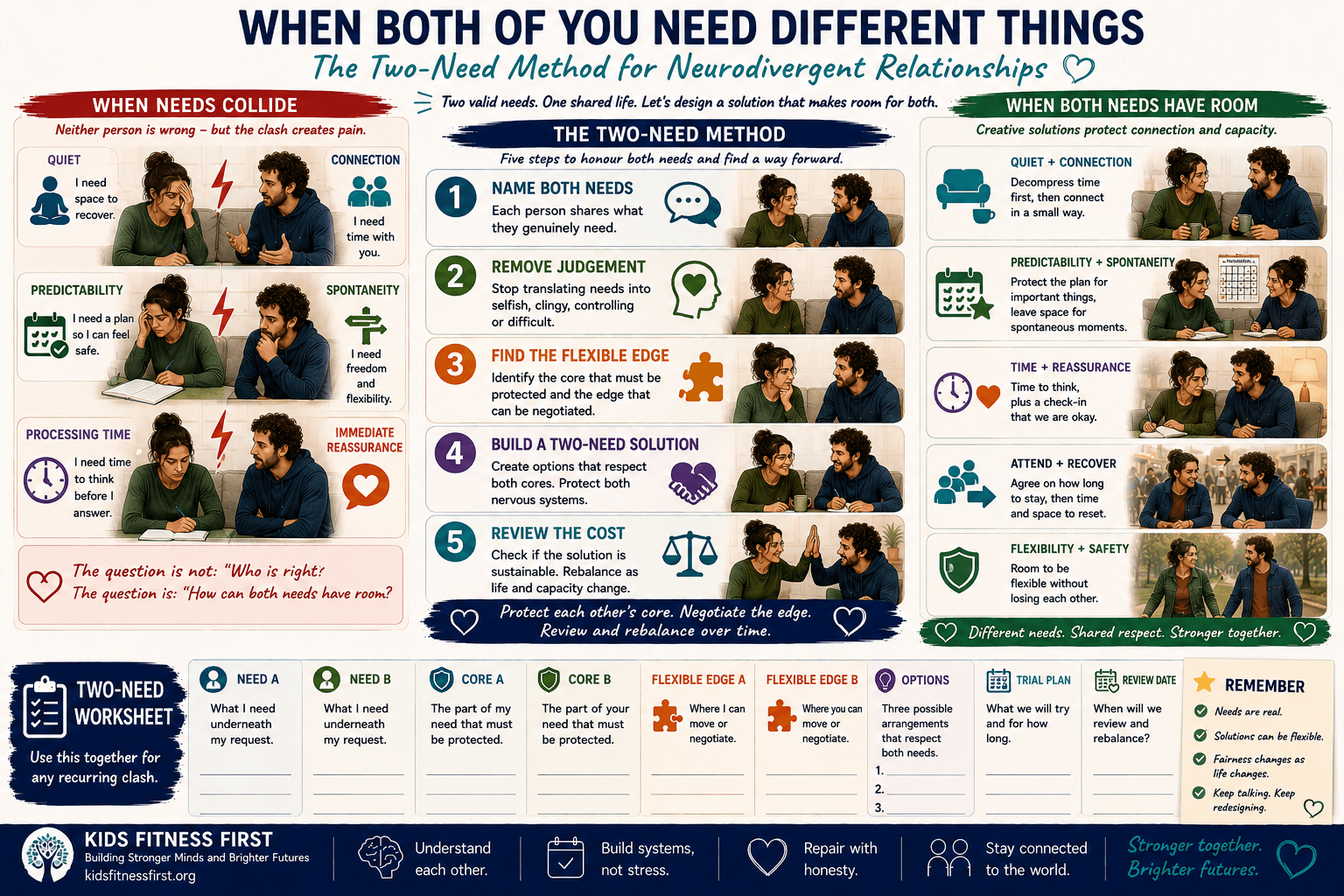
The Two-Need Method
Article 24 introduces The Two-Need Method.
It has five steps:
- Name Both Needs
- Remove the Character Judgement
- Find the Flexible Edge
- Build a Two-Need Solution
- Review the Cost
The goal is not perfect compromise.
Instead, the goal is a solution in which neither person’s legitimate need disappears completely.
Step 1: Name Both Needs
First, state each need in one sentence.
For example:
Partner A: “I need quiet after work.”
Partner B: “I need some connection with you before the evening disappears.”
That is already better than:
“You ignore me every night.”
and:
“You never leave me alone.”
The first version contains information.
The second contains accusation.
Therefore, begin with the nervous-system or relational need rather than the criticism.
Use “I Need” Carefully
“I need” can become manipulative if it simply means:
“You must do exactly what I want.”
Therefore, keep the sentence focused on your experience.
For example:
“I need some reassurance after conflict.”
is different from:
“I need you to admit I’m right before you take space.”
Likewise:
“I need predictability around weekends.”
is different from:
“I need you never to change plans.”
The first leaves room for design.
The second removes the other person’s autonomy.
Step 2: Remove the Character Judgement
Next, identify what you have been telling yourself about the other person’s need.
Perhaps:
“They are selfish.”
“They are clingy.”
“They are controlling.”
“They are lazy.”
“They are impossible.”
Now separate interpretation from need.
For example:
Need: quiet after social overload.
Judgement: “You are antisocial.”
Or:
Need: advance notice.
Judgement: “You are controlling.”
The judgement may contain genuine frustration.
However, it rarely helps design the solution.
Therefore, temporarily remove it.
Ask:
“If I believed this need was real rather than malicious, what would I understand differently?”
That question restores curiosity.
Understanding Does Not Mean Automatic Agreement
Perhaps your partner genuinely needs more predictability.
You can understand that.
However, you may still be unable to guarantee every detail of every weekend.
Likewise, perhaps you need substantial recovery time.
Your partner can understand that while still saying:
“I also need some reliable time with you.”
Therefore, understanding does not end negotiation.
It improves negotiation.
Both needs remain in the room.
Step 3: Find the Flexible Edge
Most needs contain a core and an edge.
The core is difficult to compromise without causing real strain.
The edge has more flexibility.
For example:
Need: decompression after work.
Core:
“I need uninterrupted quiet when I first arrive home.”
Flexible edge:
Is it 20 minutes?
30?
45?
Can there be a quick hello first?
Likewise:
Need: weekend predictability.
Core:
“I need to know the major plan in advance.”
Flexible edge:
Does every hour need scheduling?
Probably not.
Therefore, ask:
“What part of this need is essential, and what part is negotiable?”
That is where compromise becomes possible.
Do Not Negotiate Away the Core
If sensory overload is genuine, saying:
“Can you just tolerate the loud party for six hours to make me happy?”
may not be compromise.
It may simply sacrifice one nervous system.
Likewise, if one partner genuinely needs some emotional connection, saying:
“You should simply become comfortable with almost no contact”
may also be unsustainable.
Therefore, the goal is not equal discomfort.
It is intelligent design.
Protect each person’s core.
Negotiate around the edges.
Step 4: Build a Two-Need Solution
Now ask:
“What option gives both needs some real space?”
For example:
Quiet + Connection
Solution: 30 minutes of quiet after work, followed by 10 minutes together over tea.
Social Event + Recovery
Solution: attend together for 90 minutes, then one partner leaves while the other stays.
Predictability + Spontaneity
Solution: protect one planned weekend block and leave another block unscheduled.
Immediate Reassurance + Processing Time
Solution: “We’re okay. I need 30 minutes, and I’ll come back at 8.”
Verbal Processing + Quiet Thinking
Solution: one partner gets ten minutes to explain; then the other gets twenty minutes alone before responding.
Notice what happened.
Nobody got everything.
However, nobody disappeared either.
That is a two-need solution.
The Best Compromise Is Not Always 50/50
Suppose one person needs two hours of recovery after a major social event.
Meanwhile, the other wants some connection that evening.
A 50/50 compromise might be one hour of recovery.
However, perhaps one hour is not enough to regulate.
Therefore, splitting the difference mathematically may satisfy neither nervous system.
A better solution may be:
Two hours of recovery.
Then fifteen minutes of calm contact.
The quantities are unequal.
However, both core needs are respected.
Therefore, fairness and compromise should not be confused with arithmetic.
Article 23’s Capacity Balance applies here too.
Step 5: Review the Cost
Finally, ask:
“Is this solution actually sustainable?”
Sometimes a compromise works once but becomes exhausting if repeated.
For example:
One partner attends every family gathering for one hour.
That sounds reasonable.
However, if there are three gatherings every weekend, the total cost may still be too high.
Likewise, one partner may agree to provide reassurance after every difficult moment.
However, if the other person requires constant reassurance throughout the day, the arrangement may become unsustainable.
Therefore, review the pattern, not only the individual compromise.
A solution needs to work over time.
The Two-Need Method at a Glance
| Step | Question |
|---|---|
| 1. Name Both Needs | What does each person genuinely need? |
| 2. Remove Judgement | What negative story have we attached to the need? |
| 3. Find the Flexible Edge | What is core and what is negotiable? |
| 4. Build the Solution | What arrangement protects both cores? |
| 5. Review the Cost | Is this sustainable for both people? |
The aim is not to erase difference.
Instead, it is to give difference architecture.
Connection and Solitude
This may be one of the most common collisions.
One partner thinks:
“If we’re close, why don’t you want to spend more time with me?”
Meanwhile, the other thinks:
“If you love me, why can’t you let me recover alone?”
Both may be using the same word:
love
to defend opposite regulation needs.
Therefore, separate love from regulation.
Try:
“My need to be alone is not evidence that I love you less.”
Likewise:
“My need for connection is not an attempt to control you.”
Once those meanings are separated, the practical negotiation becomes easier.
Predictability and Spontaneity
One partner may love:
“Let’s just see what happens.”
Meanwhile, the other experiences that sentence as:
“I have no idea what demands are coming.”
Again, neither is wrong.
Therefore, use partial structure.
For example:
Saturday morning: planned.
Saturday afternoon: flexible.
Saturday evening: known by midday.
This creates both predictability and room.
The solution is not perfect for either extreme.
However, it can work for both.
Talking and Thinking
Some people discover what they think by speaking.
Therefore, silence feels unproductive.
Meanwhile, another person cannot know what they think until the talking stops.
Consequently, a live conversation can unintentionally privilege the verbal processor.
They fill the space.
The quiet processor becomes increasingly overwhelmed.
Therefore, deliberately alternate.
For example:
10 minutes talking
then
15 minutes processing
then
return.
That is not artificial.
It is accessible communication.
Social Life and Recovery
Article 14 explored the Inward Drift.
Therefore, simply saying:
“I am neurodivergent, so I never have to socialise”
may create other relationship costs.
However, forcing constant social participation can cause genuine depletion.
The solution may involve different participation levels.
For example:
- some events together;
- some separately;
- shorter attendance;
- smaller gatherings;
- quieter settings;
- planned recovery afterwards.
Again, the goal is not:
social versus antisocial.
Instead:
connection designed around capacity.
Order and Low-Demand Living
Another collision may occur around household standards.
One partner feels calm when the environment is organised.
Meanwhile, the other feels permanently pressured by a long list of tasks.
Therefore, saying:
“You are messy”
and:
“You are obsessive”
will probably fail.
Instead, identify the core needs.
Perhaps:
Partner A: “I need the kitchen and shared living area reasonably clear.”
Partner B: “I need some areas where everything does not have to be perfect.”
Now create zones.
For example:
Shared areas: agreed baseline.
Personal areas: more autonomy.
Again, two needs.
One design.
When Compromise Becomes Self-Abandonment
This is important.
Some people become extremely skilled at accommodating their partner.
Therefore, every negotiation ends with:
“It’s fine. I’ll adjust.”
At first, this may look generous.
However, over time, resentment appears.
Why?
Because accommodation was not actually mutual.
Therefore, before agreeing, ask:
“Am I choosing this freely, or am I afraid of what happens if I say no?”
Healthy compromise includes agency.
Self-erasure does not.
When “My Needs” Become Control
The opposite problem also exists.
A person may use therapeutic language to demand compliance.
For example:
“I need you to answer immediately.”
“I need you never to go out without me.”
“I need you to manage all my appointments.”
A need is real.
However, another adult is not automatically obligated to meet it in exactly the requested form.
Therefore, distinguish:
Need: reassurance.
from:
Demand: constant access.
Likewise:
Need: support.
from:
Demand: permanent responsibility transfer.
Healthy relationships negotiate.
They do not use “need” as a command word.
Some Needs Must Be Met Outside the Relationship
This may be one of the most important principles.
Your partner cannot meet every need.
Perhaps you need:
- more social contact;
- intellectual stimulation;
- exercise;
- friendship;
- professional support;
- creative activity;
- or community.
Therefore, the answer may not always be:
“My partner needs to provide more.”
Sometimes it is:
“I need a wider life.”
This connects directly to the Breathable Ecology from the Relationship Blueprint. The Blueprint specifically warns against placing too much weight on one relationship and instead emphasises friends, family and community around the couple.
Reflection: Which Needs Keep Colliding in Your Relationship?
Do this separately first.
Then compare answers.
What Do You Ask for Repeatedly?
Complete:
“I repeatedly ask my partner for…”
Perhaps:
- quiet;
- more affection;
- advance notice;
- help;
- space;
- conversation;
- social participation;
- reliability;
- or reassurance.
Now ask:
“What is the deeper need underneath that request?”
Do not stop at the solution.
What Does Your Partner Ask for Repeatedly?
Write what you hear.
Then check with them.
Perhaps you think they want:
“control over weekends.”
However, they may say:
“No. I need enough notice that I can mentally prepare.”
That distinction changes everything.
What Negative Story Have You Attached to Their Need?
Complete:
“When my partner needs __________, I sometimes tell myself that they are __________.”
For example:
“When they need space, I tell myself they are rejecting.”
Or:
“When they need a plan, I tell myself they are controlling.”
Then ask:
“What is a more accurate possibility?”
This removes unnecessary character judgement.
What Is the Core of Your Need?
Take one recurring issue.
Then divide it into:
CORE — I genuinely need this
and
FLEXIBLE EDGE — I could negotiate this
For example:
Need: sleep.
Core: eight hours uninterrupted most nights.
Flexible edge: exact bedtime.
Do the same for your partner’s need.
Now the negotiation becomes clearer.
Where Could Both Needs Fit?
Ask:
“If neither need had to disappear, what might the arrangement look like?”
Generate three options.
Do not judge immediately.
For example:
Need A: social contact.
Need B: quiet recovery.
Options:
- One social event together, one separately.
- Shorter shared event.
- Quiet couple activity plus independent social time.
Now choose the most sustainable option.
Reflection Takeaway
Complete:
“We do not need to decide whose need is more legitimate. Instead, we need to…”
Perhaps:
identify the core.
remove judgement.
design around both.
use outside support.
review the cost.
That sentence is the heart of Article 24.
Try This: The Two-Need Conversation
Choose one recurring moderate conflict.
Not your most painful issue.
Then follow five short stages.
Minutes 0–5: Name Need A and Need B
Each person gets one sentence.
For example:
A: “I need decompression after work.”
B: “I need some reliable connection in the evening.”
Do not debate yet.
Minutes 5–10: Translate the Judgements
Each person completes:
“The story I sometimes tell myself about your need is…”
Then:
“A more generous interpretation might be…”
This can dramatically soften the conversation.
Minutes 10–15: Identify Core and Flexible Edge
Each person says:
My core need is…
The part I can negotiate is…
Keep it practical.
Minutes 15–20: Build Three Options
Create three possible arrangements.
Do not stop after the first.
Sometimes the obvious compromise is not the best one.
Minutes 20–25: Choose a Trial
Pick one option.
Then agree:
How long will we try this?
Perhaps two weeks.
Four weeks.
A month.
Trial periods reduce pressure.
Minutes 25–30: Review the Cost
Set a date.
Then ask later:
- Did Need A receive enough?
- Did Need B receive enough?
- Who carried the greater cost?
- What needs adjusting?
The solution is allowed to evolve.
The Two-Need Worksheet
Use this simple template:
NEED A:
What is underneath my preferred solution?
NEED B:
What is underneath yours?
MY NEGATIVE STORY ABOUT YOUR NEED:
What have I been assuming?
YOUR NEGATIVE STORY ABOUT MINE:
What have you been assuming?
CORE A:
What cannot reasonably disappear?
CORE B:
What cannot reasonably disappear?
FLEXIBLE EDGE A:
Where can I move?
FLEXIBLE EDGE B:
Where can you move?
THREE POSSIBLE DESIGNS:
1.
2.
3.
TRIAL:
What are we trying?
REVIEW DATE:
When will we reassess?
This makes the conflict visible on paper rather than keeping it entirely inside emotion.
Do Not Negotiate at Peak Overload
Timing still matters.
If one partner is already at breaking point, a careful needs negotiation may not be possible.
Therefore, first use Article 21’s Safe Pause Protocol if necessary.
Then return later.
Likewise, if both people are depleted, Article 17’s Low-Capacity Plan may need to come before a more complex negotiation.
The Book Five frameworks are designed to work together rather than compete.
Temporary Needs and Permanent Needs Are Different
Some needs belong to a season.
For example:
A partner recovering from burnout may temporarily need much more quiet.
Likewise, someone grieving may temporarily need far more reassurance or practical support.
Therefore, do not automatically redesign the entire permanent relationship around a temporary state.
Ask:
“Is this a stable need, or a current capacity need?”
Then set a review date.
That protects flexibility.
Needs Can Change
Perhaps you once needed constant predictability.
However, after building better systems, you now tolerate more spontaneity.
Likewise, perhaps your partner once wanted a busy social calendar but now values more quiet.
Therefore, do not keep negotiating with old versions of each other.
Article 16’s maintenance principle applies here:
update the relationship as the people change.
You Do Not Need Perfect Satisfaction
No long-term partnership meets every need perfectly.
Sometimes one person will be disappointed.
That is not automatically evidence of an unhealthy relationship.
The more useful question is:
“Can disappointment exist without one person becoming chronically erased?”
For example:
You may wish your partner enjoyed large parties.
They may never enjoy them.
That may remain disappointing.
However, perhaps you attend with friends while sharing smaller gatherings together.
That may be enough.
Mature relationships sometimes contain differences that are managed rather than eliminated.
When Needs Reveal Incompatibility
Occasionally, two core needs may genuinely conflict in ways that are difficult to reconcile.
For example:
One partner deeply wants children.
The other definitively does not.
Or one person requires a lifestyle that the other cannot sustainably live.
No framework should pretend every difference has a clever compromise.
Therefore, the Two-Need Method can sometimes reveal:
“This is not a communication problem. This is a genuine values or life-direction difference.”
That clarity may be painful.
However, clarity is still useful.
Appropriately qualified relationship support may help couples work through major incompatibilities.
The Goal Is Mutual Consideration, Not Mutual Exhaustion
A bad compromise can leave both people miserable.
For example:
One partner wants four social events.
The other wants none.
So they attend two while both resent the arrangement.
That is technically the middle.
However, it may not solve either need.
Therefore, compromise should not simply divide the numbers.
Ask:
“What design actually protects the purpose underneath each request?”
Perhaps one shared quiet dinner and one independent social event work better than two large joint gatherings.
Again, design beats arithmetic.
Conclusion: Both Needs Can Belong in the Relationship
Neurodivergent relationship needs can be different.
Sometimes very different.
One nervous system may need space.
Meanwhile, another needs reassurance.
One may need predictability.
The other may need flexibility.
One may need more social contact.
The other may need more recovery.
The answer is not automatically:
“Who is right?”
Instead:
First, name both needs.
Next, remove the character judgement.
Then, find each need’s flexible edge.
Afterwards, build a solution that protects both cores.
Finally, review the real cost over time.
Most importantly, remember:
Your partner’s need does not become illegitimate simply because it inconveniences you.
Likewise:
Your need does not automatically give you control over how another adult must meet it.
Between those two truths is the work of partnership.
Not perfect accommodation.
Not constant sacrifice.
Instead, negotiation.
Creativity.
Respect.
And enough curiosity to ask:
“How can both of us exist here?”
That may be one of the most important questions in any long-term neurodivergent relationship.
Because the strongest relationships are not those in which two people need exactly the same things.
They are the ones that keep finding ways to make room for two different people.
SUGGESTED INTERNAL LINKS
Article 9: When One Partner Changes Faster: The Growth Gap in Neurodivergent Relationships
Article 12: Fairness Is Not Always 50/50: Building a Capacity-Based Neurodivergent Relationship
DISCLAIMER
This article is provided for general educational and informational purposes only. It is not medical, psychological, diagnostic, legal, relationship or couples-therapy advice.
Neurodivergent people differ substantially in their needs, sensory profiles, social capacity, communication preferences and relationship expectations. Therefore, this framework should not be used to assume why another person behaves in a particular way.
A legitimate need does not automatically entitle one person to control another person’s behaviour, access, time, body, finances or relationships.
Likewise, compromise should not require chronic self-erasure, coercion or unsafe accommodation. Where partners face serious incompatibilities, persistent high conflict, coercion, abuse or significant mental-health concerns, appropriately qualified professional support may be necessary.