
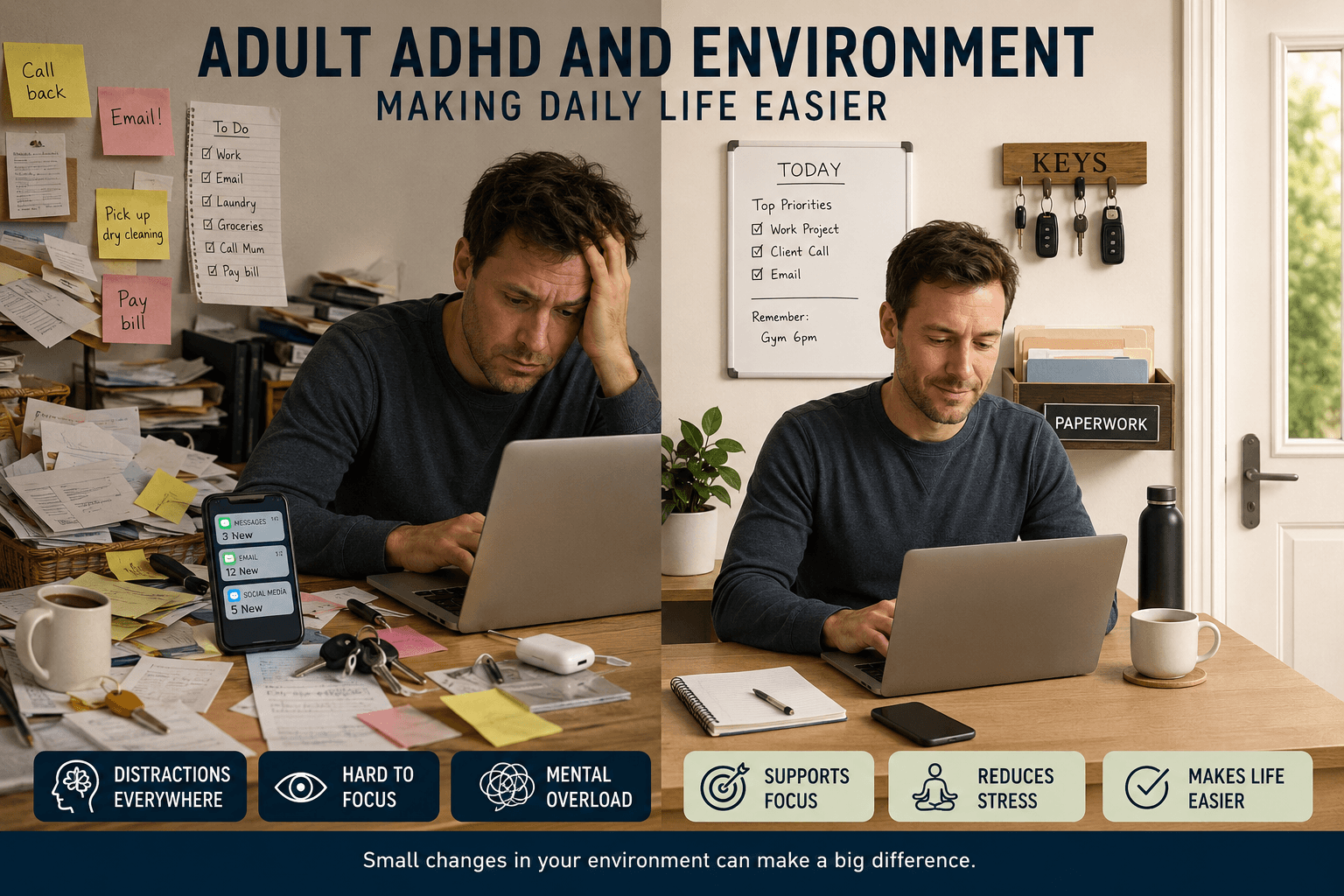
Adult ADHD and Environment: How to Make Daily Life Easier
Adult ADHD and environment can have a bigger connection than many people realise.
Think about an ordinary morning.
You are ready to leave the house, but your keys are missing.
The letter reminds you about an appointment.
While looking for them, you notice a letter that needs answering.
That simple question can turn the environment from something you constantly manage into something that begins supporting you.
You pick up your phone to check the date. However, a message appears on the screen.
Five minutes later, you are reading something completely unrelated.
Meanwhile, you still have not found the keys.
What began as one simple task has become several competing demands for your attention.
It is easy to respond by thinking:
“I need to become more organised.”
However, there is another possibility.
Perhaps part of the problem is not you.
Perhaps the environment is asking your brain to do too much.
If important things are hidden, distractions are everywhere and simple tasks require several steps, everyday life becomes harder.
Therefore, instead of relying entirely on memory, motivation and willpower, you can begin changing the surroundings themselves.
The goal is simple:
Make useful actions easier and unnecessary distractions harder.
Why Adult ADHD and Environment Matter
We often think of our surroundings as passive.
A room is simply a room.
A desk is simply a desk.
A phone is simply a phone.
However, each one affects what happens next.
For example, imagine trying to complete an important piece of work.
Your phone is beside you.
Email notifications appear on the computer.
Several browser tabs are open.
Paperwork covers the desk.
The television is playing in the background.
Every one of these things competes for attention.
Therefore, concentration is not only about trying harder.
Sometimes the easier solution is to remove some of the competition.
A supportive environment does not force you to focus.
Instead, it makes focusing easier.
Start With Friction
Before changing anything, notice where everyday life repeatedly becomes difficult.
This is friction.
Friction is anything that makes a useful action harder than it needs to be.
For instance:
You want to exercise, but your equipment is stored upstairs.
You need to pay a bill, but you cannot find the letter.
You want to work, but your desk has become a storage area.
You need to leave the house, but your keys could be in five different places.
Individually, these problems appear small.
However, repeated every day, they consume time and energy.
Therefore, ask:
“Which simple tasks regularly become more difficult than they should be?”
Those are good places to start.
Do Not Redesign the Whole House
Once you recognise that the environment matters, it can be tempting to change everything.
New storage.
New furniture.
New labels.
New planners.
New filing systems.
However, a complete redesign may create another overwhelming project.
Instead, begin with one repeated problem.
Perhaps mornings are difficult because you cannot find what you need.
Start there.
Maybe paperwork is the main problem.
Focus on that.
Small changes are easier to test.
Moreover, if they work, you can build on them.
Give Important Items Obvious Homes
Frequently used objects should be easy to find.
Think about the things you regularly search for:
- keys;
- wallet;
- glasses;
- headphones;
- chargers;
- important documents;
- work passes;
- bags.
Now ask:
“Where do I naturally use or look for this?”
That location may be the best home for it.
For example, keys might belong beside the front door rather than inside a drawer in another room.
Chargers might stay beside the places where devices are normally used.
Important work items might remain together in one bag.
The best location is not necessarily the tidiest one.
Instead, it is the one you are most likely to use consistently.
Adult ADHD and Environment: Make Memory Visible
One difficulty with putting everything away is that important things can disappear from attention.
Once they are out of sight, they may also be out of mind.
Therefore, some information needs to remain visible.
You could use:
- a whiteboard;
- a calendar;
- a simple checklist;
- a tray for paperwork;
- a reminder beside the door;
- a visible place for tomorrow’s bag.
For example, if a parcel needs returning tomorrow, putting it beside the front door may be more effective than writing “return parcel” on a long task list.
The environment itself becomes the reminder.
As a result, your brain has less to remember.
Create a Leaving-the-House Zone
Leaving home can involve many small tasks.
Where are the keys?
Where is the wallet?
Did I remember the paperwork?
Where are my glasses?
Do I need an umbrella?
Instead of answering these questions every morning, create one simple area near the door.
It might contain:
Keys.
Wallet.
Bag.
Work pass.
Items that need taking out tomorrow.
Now there is one place to check before leaving.
This does not guarantee that you will never forget anything.
However, it reduces the number of places you need to search.
Create a Paperwork Zone
Paperwork can easily spread through the home.
A letter sits on the kitchen table.
Another document is beside the sofa.
A bill remains in a bag.
Later, you remember that something needs attention but cannot remember where it is.
Therefore, create one place for paperwork that requires action.
It could be a tray, folder or box.
The rule is simple:
If the paperwork needs action, it goes there.
Now you have one place to look.
Furthermore, you can choose a regular time to review it.
For example:
Tuesday evening → paperwork tray.
The environment stores the information until you are ready to deal with it.
Make Starting Work Easier
Starting a task can become harder when preparation takes too long.
Imagine sitting down to work.
First, you clear the desk.
Then you search for the correct document.
Next, you find the charger.
After that, you open several files.
By the time everything is ready, the original intention has lost momentum.
Therefore, prepare the starting point.
At the end of the day, leave tomorrow’s first task ready.
Open the relevant document.
Put the notebook where you need it.
Clear enough space to begin.
Consequently, tomorrow’s first action becomes easier.
Reduce Visual Noise
Some people work well in busy spaces.
Others find that every visible object competes for attention.
If your environment feels distracting, experiment with reducing what you can see.
You do not need a completely empty room.
Instead, begin with the area directly around the task.
For example, clear one section of your desk rather than reorganising the whole office.
Put unrelated paperwork somewhere else.
Close unnecessary browser windows.
Move objects that repeatedly attract your attention.
Then notice whether focusing becomes easier.
The aim is not minimalism.
The aim is reducing unnecessary competition.
Your Phone Is Part of Your Environment
The environment is not only physical.
Your digital surroundings matter too.
A smartphone can contain:
Messages.
News.
Social media.
Email.
Videos.
Games.
Shopping.
Work.
Entertainment.
All of them compete for attention through the same screen.
Therefore, small digital changes can make a significant difference.
You might:
- turn off non-essential notifications;
- move distracting apps away from the home screen;
- use silent mode during focused work;
- leave the phone in another room;
- set specific times for checking email;
- remove apps you rarely need.
You do not have to give up technology.
Instead, decide which parts deserve immediate access to your attention.
Make Distractions Slightly Less Convenient
A distraction does not always need to disappear.
Sometimes adding one extra step is enough.
For example, if social media is one tap away, you may open it automatically.
Move the app into a folder.
Now there is an extra step.
Alternatively, log out after each use.
Perhaps keep the television remote away from your work area.
These are small barriers.
However, they create a moment to reconsider what you are doing.
That moment can be useful.
Make Useful Actions More Convenient
If friction can discourage useful behaviour, the opposite is also true.
Convenience can encourage it.
Suppose you want to drink more water.
Keep water visible.
If you want to walk in the morning, leave your trainers ready.
Need to remember a document tomorrow?
Put it with your keys.
Want to write first thing?
Leave the document open on your computer.
Therefore, ask:
“How can I make the action I want easier to begin?”
Often, a small environmental change can help more than another promise to try harder.
Use Point-of-Performance Reminders
A reminder is most useful when it appears where the action needs to happen.
Imagine writing:
“Remember shopping bags.”
If the reminder sits on your desk, you may see it hours before leaving.
Later, you forget.
Instead, keep the bags beside the door or in the car.
Similarly, if you need to take medication at breakfast, a suitable reminder may be connected to the breakfast routine rather than hidden inside a general task list.
The closer the reminder is to the action, the more useful it may become.
Adult ADHD and Environment at Work
Workspaces often contain distractions you cannot completely control.
Colleagues talk.
Phones ring.
Messages arrive.
Meetings interrupt.
However, there may still be changes you can make.
For example:
Use headphones where appropriate.
Close email during focused work.
Keep only the current project on the desk.
Schedule uninterrupted work periods where possible.
Use a visible list of the day’s main priorities.
Prepare tomorrow’s first task before leaving.
Not every workplace allows the same flexibility.
Nevertheless, even small adjustments may reduce unnecessary interruptions.
Create Different Spaces for Different Activities
When possible, give activities clear locations.
Work happens at the desk.
Relaxing happens on the sofa.
Paperwork goes in one place.
Keys stay beside the door.
Exercise equipment stays together.
These boundaries do not need to be perfect.
However, they reduce uncertainty.
When you sit at the desk, the environment signals work.
When you leave the desk, you can mentally step away from it.
This can be especially useful when working from home.
Be Careful With the “I’ll Put It Somewhere Safe” Problem
A very safe place can become a very difficult place to remember.
You put an important document somewhere unusual because you do not want to lose it.
Three weeks later, you cannot remember where the safe place was.
Therefore, important items need consistent, rather than clever, storage.
Use the same location whenever possible.
For instance:
Passport → document drawer.
Bills → action tray.
Keys → door hook.
Chargers → charging station.
Consistency reduces searching.
Build the Environment Around Your Natural Behaviour
This is important.
Suppose dirty clothes always end up beside the bed.
You could repeatedly tell yourself:
“I should carry these to the laundry basket.”
Alternatively, move a laundry basket closer to where the clothes naturally accumulate.
The second solution may look almost too simple.
However, that is the point.
Your environment should work with your behaviour where possible.
Instead of continually fighting the pattern, change what surrounds it.
Stop Designing for Appearance Alone
An attractive home or workspace can feel good.
However, appearance and function are not always the same thing.
A beautiful storage box may hide something you need to remember.
A perfectly clear desk may mean essential items are stored too far away.
Therefore, ask two questions:
“Does this look good?”
and
“Does this make everyday life easier?”
Ideally, you can achieve both.
However, function should not be sacrificed simply because a system looks more organised.
Create a Reset Rather Than Expecting Permanent Tidiness
No environment stays organised forever.
Things move.
Paperwork arrives.
Laundry accumulates.
People become busy.
Therefore, instead of expecting permanent order, create a simple reset.
For example:
Ten minutes at the end of the day.
Return keys to their place.
Put paperwork into the tray.
Clear one work surface.
Charge essential devices.
Prepare anything needed tomorrow.
This reset prevents small amounts of disorder from becoming a much larger task.
Keep the Reset Small
Be careful.
A “ten-minute reset” can easily turn into:
Clean the kitchen.
Organise the office.
Sort the laundry.
Vacuum the house.
Answer emails.
Prepare tomorrow.
Suddenly, the reset has become another exhausting routine.
Therefore, keep it limited.
The purpose is not to finish everything.
Instead, prepare the environment for the next part of the day.
Use Fewer Systems
One system for tasks.
Another for work.
Another for shopping.
Three different calendars.
Several note-taking apps.
A paper planner.
Sticky notes everywhere.
Eventually, the systems themselves become difficult to manage.
Therefore, simplify.
One main calendar may be enough.
Likewise, one main task list can be easier than several.
A single paperwork tray may work better than multiple filing categories.
The fewer places you need to check, the easier it becomes to know where information belongs.
Adult ADHD and Environment on Low-Energy Days
A supportive environment becomes particularly valuable when energy is low.
On a good day, you may remember what needs doing.
You may search for the missing document.
You might overcome distractions.
However, difficult days provide less room for extra effort.
That is why adult ADHD and environment deserve to be considered together.
The environment can carry some of the work when attention, motivation or energy is limited.
Your calendar remembers the appointment.
The door area holds the keys.
The tray stores the paperwork.
The phone gives the reminder.
The environment becomes part of the support system.
Your Environment Does Not Need to Look Like Anyone Else’s
Advice about organisation often assumes there is one correct system.
There is not.
One person may prefer clear surfaces.
Another may need important things visible.
Someone might use digital reminders.
Another person may prefer a physical whiteboard.
Therefore, do not judge your system by how conventional it looks.
Judge it by whether it works.
Ask:
Do I lose things less often?
Can I begin tasks more easily?
Am I forgetting fewer appointments?
Does this space help me focus?
Can I reset it without becoming overwhelmed?
Those questions matter more than whether your system looks perfect.
Experiment Instead of Committing Forever
You do not need to know immediately whether a system will work.
Try it.
For one week, keep the keys beside the door.
Test a paperwork tray.
Move your phone during focused work.
Prepare tomorrow’s first task the night before.
Then observe what happens.
If the change helps, keep it.
If not, adjust it.
This removes the pressure to find the perfect answer immediately.
Your environment can develop through experimentation.
Adult ADHD and Environment After a Late Diagnosis
A late ADHD diagnosis may change how you interpret years of difficulty with organisation, distraction and everyday routines.
Perhaps you previously believed you simply needed more discipline.
However, understanding your needs can lead to a different question:
“How can I make my surroundings support what I am trying to do?”
That shift matters.
It moves the focus away from constant self-correction.
Instead, you begin designing practical support into daily life.
This does not remove personal responsibility.
Rather, it gives responsibility a better system to work with.
Start With One Room — Or One Square Metre
Do not organise the whole house.
Choose one small area.
Your desk.
The space beside the front door.
One kitchen surface.
Your bedside table.
Then ask:
What happens here?
What regularly goes wrong?
What needs to be easy to see?
What needs a permanent home?
What creates distraction?
Make one or two changes.
Then live with them for a few days.
Small areas can teach you a great deal about what works.
Reflection Questions
- Where do you lose the most time looking for things?
- Which area of your home creates the most friction?
- What important item needs a permanent home?
- Which information needs to be more visible?
- What could you place beside the front door tonight?
- Which digital notification distracts you most often?
- What useful action could you make easier?
- Which distraction could you make slightly harder?
- What would a ten-minute environmental reset include?
- What is one small area you could improve today?
Conclusion
Adult ADHD and environment can influence each other every day.
A distracting or complicated environment may increase the amount of effort needed to remember, organise and complete ordinary tasks.
However, small changes can reduce that pressure.
Give important things permanent homes.
Keep useful reminders visible.
Reduce unnecessary steps.
Make distractions slightly harder to reach.
At the same time, make important actions easier to begin.
Most importantly, avoid trying to create the perfect environment.
Create one that works for you.
A successful system does not need to look impressive.
Instead, it should quietly make everyday life easier.
Therefore, when something repeatedly goes wrong, try replacing:
“Why do I keep doing this?”
with:
“What could I change around me so this becomes easier next time?”
Suggested Internal Links
- Adult ADHD and Overthinking: How to Quiet the Mental Noise
- Adult ADHD and Daily Structure: How to Build a Life That Works With Your Brain
Disclaimer
This article is provided for general educational and informational purposes only. It does not provide medical, psychological, diagnostic or therapeutic advice. Therefore, it should not be used as a substitute for individual guidance from an appropriately qualified healthcare professional.
ADHD experiences vary considerably between individuals. If you have concerns about ADHD, mental health, medication, diagnosis or treatment, please speak with an appropriately qualified healthcare professional.