
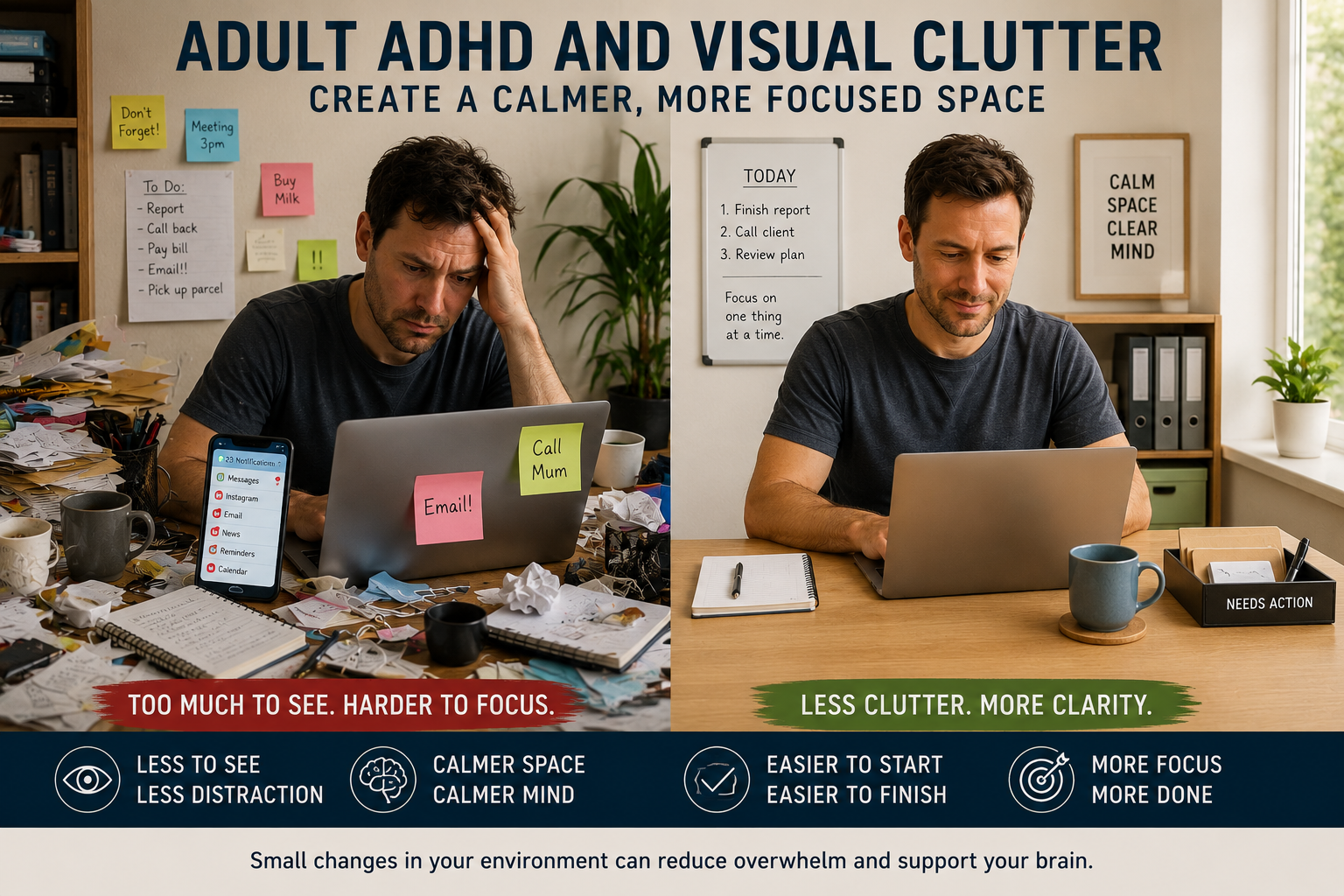
Adult ADHD and Visual Clutter: How to Create a Calmer, More Focused Space
Adult ADHD and visual clutter can sometimes create an exhausting combination.
Imagine sitting down to answer one important email.
Your laptop is open.
However, beside it sits yesterday’s post.
A half-finished form reminds you that something needs completing.
Across the room, a bag needs unpacking.
Meanwhile, three sticky notes are attached to the wall.
Your phone lights up.
Then you notice the washing.
None of these things is particularly serious.
Together, however, they create a constant stream of competing information.
Instead of focusing only on the email, your attention keeps being pulled towards everything else around you.
Eventually, you may become frustrated and think:
“Why can’t I concentrate?”
However, concentration does not happen in isolation.
Your surroundings matter.
Therefore, reducing some of the visual competition around you may make focusing easier.
The aim is not to create a perfectly tidy home.
Instead, it is to create spaces that ask less of your attention.
Why Adult ADHD and Visual Clutter Can Matter
Everything you can see provides information.
A pile of letters might say:
“Deal with me.”
Laundry might say:
“Don’t forget me.”
An unfinished project can say:
“You still haven’t finished this.”
Meanwhile, your phone may offer messages, news, emails and entertainment.
Your brain has to decide what deserves attention and what can be ignored.
Usually, this happens automatically.
However, when too many things compete at once, the environment can begin to feel mentally noisy.
As a result, even a simple task may require more effort.
Therefore, changing what is visible can sometimes change how easy it feels to concentrate.
Clutter Is Not a Character Flaw
Before going further, one point matters.
Having clutter does not mean you are lazy, careless or incapable.
Homes are lived in.
Work creates paperwork.
Families create belongings.
Busy periods create unfinished jobs.
Furthermore, organisation can be difficult when attention and energy are already being used elsewhere.
Therefore, avoid turning clutter into a judgement about yourself.
Instead, treat it as information.
Ask:
“Which parts of this space are making everyday life harder?”
That question leads towards practical solutions.
Do Not Start by Decluttering the Whole House
When clutter becomes frustrating, there is often a temptation to fix everything.
You decide:
Today, I am organising the entire house.
Several hours later, every cupboard is open.
Boxes cover the floor.
You have discovered items you forgot existed.
Meanwhile, the room looks worse than when you started.
Eventually, energy disappears.
Therefore, avoid beginning with the entire house.
Start with one useful space.
Your desk.
The kitchen table.
The area beside the front door.
Your bedside table.
One shelf.
One square metre is enough.
A small completed area is more useful than five unfinished rooms.
Start With the Space You Use Most
Not every cluttered area deserves equal attention.
Therefore, begin where improvement would make the biggest difference.
Perhaps your desk affects your ability to work.
Maybe the kitchen table becomes a dumping ground for paperwork.
Alternatively, the front door area may create stressful mornings because everything disappears there.
Ask:
“Which space causes me the most repeated frustration?”
Start there.
This gives your effort a clear purpose.
You are not tidying simply because you think you should.
Instead, you are solving a specific problem.
Create One Clear Surface
A completely clear home may be unrealistic.
However, one clear surface can create a useful sense of order.
For example, choose:
- one section of your desk;
- one kitchen worktop;
- one bedside table;
- one part of the dining table.
Keep that area relatively clear.
Then use it for a specific purpose.
Your desk might become the place where focused work happens.
A section of the kitchen counter might remain available for preparing food.
As a result, you always have somewhere ready to begin.
Adult ADHD and Visual Clutter at Your Desk
A desk can easily become a collection point.
Letters arrive.
Receipts appear.
Cables accumulate.
Coffee cups remain.
Old notebooks stay open.
Eventually, the workspace itself becomes another task.
Therefore, try a simple rule:
Only keep what you need for the current activity within immediate reach.
Everything else can move slightly further away.
You do not need an empty desk.
Instead, you need enough visual space to make the current task obvious.
For instance, if you are writing, perhaps you need only:
Your computer.
A notebook.
A pen.
A drink.
That may be enough.
Use Containers to Reduce Visual Noise
Sometimes you need items nearby, but you do not need to see every individual object.
Containers can help.
For example:
Pens can go into one holder.
Chargers can go into one box.
Paperwork can go into one tray.
Remote controls can share one basket.
Frequently used toiletries can stay together.
The items still exist.
However, visually, several separate objects become one group.
As a result, the room may feel calmer without requiring you to remove everything.
Avoid Creating Too Many Categories
Organisation can become too complicated.
You begin with one paperwork tray.
Then you create separate folders for:
Bills.
Insurance.
Receipts.
School.
Work.
Medical letters.
Banking.
Household documents.
Soon, filing one piece of paper requires a decision about exactly where it belongs.
That extra decision creates friction.
Therefore, use broad categories where possible.
For example:
Action.
Keep.
Recycle.
That may be enough for everyday paperwork.
You can organise important long-term documents more carefully later.
Keep Important Things Visible — But Deliberately
There is a difficulty here.
Reducing visual clutter can help concentration.
However, hiding everything may make important things easier to forget.
Therefore, the goal is not:
“Put everything away.”
Instead, ask:
“What deserves to remain visible?”
Perhaps today’s three priorities belong on a whiteboard.
Tomorrow’s parcel may need to sit beside the front door.
Your water bottle might stay on the desk.
The important difference is intention.
Useful visibility supports you.
Random visibility competes for attention.
Create a “Needs Action” Area
Unfinished tasks often become clutter because you are afraid you will forget them.
Therefore, you leave everything visible.
The letter stays on the table.
The parcel remains beside the sofa.
The form sits beside your laptop.
Soon, every surface becomes a reminder system.
Instead, create one Needs Action area.
It could be a tray, basket or shelf.
Anything requiring attention goes there.
Then review it regularly.
For example:
Tuesday and Friday → check Needs Action tray.
Now unfinished items remain visible enough to remember, but they do not need to occupy the entire room.
Use a “Belongs Somewhere Else” Basket
Tidying can become distracting.
You pick up an item that belongs upstairs.
Then you take it upstairs.
While there, you notice something else.
Ten minutes later, you have started another task and forgotten the original room.
Therefore, try keeping a temporary basket.
When something belongs elsewhere, put it into the basket.
Continue tidying the current area.
Later, carry the basket around the house and return the items.
This keeps you focused on one space at a time.
Reduce Duplicate Items in Busy Areas
Sometimes clutter grows because too many similar items are available.
Six pens.
Four charging cables.
Three notebooks.
Several pairs of headphones.
Multiple water bottles.
You may genuinely need duplicates.
However, not all of them need to remain visible.
Therefore, keep the most useful version accessible.
Store the others elsewhere.
Fewer visible choices can make the space easier to understand.
Give Clutter a Boundary
Some clutter is inevitable.
Therefore, contain it.
For example:
One basket for children’s toys.
One tray for incoming post.
One box for chargers.
One shelf for current projects.
Once the container becomes full, that is your signal to review it.
This creates a physical boundary.
Without a boundary, clutter can continue spreading.
With one, you know when the system needs attention.
Make Putting Things Away Easy
A storage system will fail if using it requires too much effort.
Imagine a frequently used item stored:
Inside a box.
Inside a cupboard.
Behind another box.
Technically, it is organised.
Practically, putting it away requires several steps.
Eventually, it may stop being put away.
Therefore, frequently used items should have easy storage.
Hooks.
Open baskets.
Simple trays.
Accessible shelves.
The easier something is to put away, the more likely the system is to survive.
Store Things Where You Actually Use Them
Traditional organisation sometimes asks:
“Where should this item belong?”
A better question may be:
“Where do I actually use this?”
Suppose you always use scissors in the kitchen.
Keeping them in an office drawer may be logical, but inconvenient.
Perhaps you charge your phone beside the sofa.
Then a charger there may make more sense than one stored elsewhere.
The environment should support real behaviour.
Therefore, design around what you actually do rather than what an ideal household might do.
Adult ADHD and Visual Clutter in the Bedroom
Bedrooms can become particularly busy.
Clothes accumulate.
Devices remain beside the bed.
Work follows you into the room.
Unfinished tasks stay visible.
As a result, the space intended for rest may continue reminding you about everything else.
Therefore, consider reducing the amount of unfinished work visible from the bed.
For example:
Put work documents somewhere else.
Use one basket for clothes that need attention.
Charge unnecessary devices outside the immediate sleeping area where practical.
Keep the bedside area simple.
The goal is not a magazine-perfect bedroom.
Instead, create a clearer signal:
This is where the day slows down.
Adult ADHD and Visual Clutter in the Kitchen
Kitchens naturally contain many objects.
Food.
Appliances.
Post.
Shopping.
Containers.
Cleaning products.
Therefore, surfaces can quickly become crowded.
One useful approach is to protect a single preparation area.
Keep that section relatively clear.
Then, when you need to prepare food, you do not first need to move ten unrelated objects.
Similarly, give incoming post somewhere other than the kitchen counter if possible.
Small boundaries can prevent one area from becoming responsible for everything.
Be Careful With Open Storage
Open shelves can look attractive.
However, they also display everything they contain.
For some people, this is useful because objects remain visible.
For others, it creates too much visual information.
Therefore, experiment.
Perhaps frequently used items stay visible while less important objects go behind doors or into simple containers.
There is no universal answer.
The question is:
“Does seeing this help me or distract me?”
Use the answer to guide the system.
Digital Clutter Counts Too
Visual clutter does not stop at the edge of your desk.
Your phone and computer can become crowded as well.
Consider:
Hundreds of unread emails.
Dozens of browser tabs.
Apps covering several screens.
Notifications.
Files scattered across the desktop.
Each one represents information waiting for attention.
Therefore, digital spaces may also benefit from simplification.
Start small.
Close tabs you no longer need.
Remove unused apps from the home screen.
Turn off unnecessary notifications.
Create one folder for files requiring action.
Again, the aim is not perfection.
It is reducing unnecessary visual competition.
Close Tabs When the Task Changes
Browser tabs are easy to accumulate.
One article leads to another.
Then you open an email.
A product page remains open.
A document sits beside it.
Eventually, thirty tabs represent thirty unfinished thoughts.
Therefore, when one task ends, close what you no longer need.
If something matters later, bookmark it or save it.
This creates a clearer digital workspace for the next activity.
Use a Short Reset Instead of a Huge Clean
Waiting until the environment becomes overwhelming creates a much larger job.
Instead, try a short reset.
Set a timer for five or ten minutes.
During that time:
Return obvious items.
Clear one surface.
Put paperwork in the correct tray.
Throw away rubbish.
Prepare the space for its next use.
Then stop.
A small reset repeated regularly can prevent clutter from reaching the point where it feels impossible to tackle.
Make Resetting Part of an Existing Routine
Remembering another task can be difficult.
Therefore, connect the reset to something that already happens.
For example:
After dinner → five-minute kitchen reset.
Before finishing work → clear the desk.
Before bed → return items from the living room.
Before leaving the house → check the door area.
The existing event becomes a reminder.
Consequently, the reset requires less planning.
Do Not Aim for Perfect Tidiness
Perfection creates fragile systems.
If everything has to remain perfectly organised, one busy day can feel like failure.
Instead, aim for functional order.
Can you find important things?
Can you use the workspace?
Can you see what needs attention?
Can you reset the area reasonably quickly?
If yes, the system may already be doing its job.
Adult ADHD and Visual Clutter on Difficult Days
The real test of an organisation system is not what happens on your best day.
It is what happens when energy is low.
On difficult days, complicated systems require more effort.
Therefore, simplify the recovery process.
Perhaps your minimum reset is:
Throw away rubbish.
Put paperwork into one tray.
Return keys to their hook.
Clear enough space on the desk for tomorrow.
That is enough.
You can do more later.
The goal is to prevent one difficult day from turning into an impossible restart.
Use Before-and-After Evidence
Sometimes gradual improvement is difficult to notice.
Therefore, take a photograph before changing a small area.
Then take another afterwards.
This is not about creating a perfect social-media image.
Instead, it provides visible evidence of progress.
You may realise that ten minutes created a bigger difference than expected.
That can make restarting easier next time.
Your Space Should Support Your Priorities
Every visible object competes, at least slightly, for attention.
Therefore, consider what deserves the most visibility.
If work is the priority, make the work area clear.
If leaving home on time is difficult, organise the doorway.
If sleep needs support, simplify the bedroom.
If paperwork creates stress, create one obvious place for it.
The environment should reflect what matters most.
Adult ADHD and Visual Clutter After a Late Diagnosis
After a late ADHD diagnosis, you may begin viewing years of organisation difficulties differently.
Perhaps you were repeatedly told to:
“Just tidy up.”
“Put things away.”
“Be more organised.”
However, those instructions do not explain how to create a system that remains usable.
Understanding adult ADHD and visual clutter can lead to a more practical approach.
Instead of asking yourself to become naturally tidy, you can make the environment easier to reset.
Instead of hiding everything, you can decide what genuinely needs to remain visible.
Rather than creating complicated storage, you can reduce the number of steps required.
The aim is not to become a different person.
Instead, create surroundings that demand less unnecessary effort.
Start With One Square Metre
You do not need a weekend.
You do not need new furniture.
You do not need twenty storage boxes.
Choose one square metre.
Perhaps it is the desk in front of you.
Remove what does not belong there.
Group what needs to remain.
Create a place for unfinished items.
Then stop.
Use the space.
Notice what works.
Afterwards, you can improve another small area.
That is how a calmer environment can develop — one useful space at a time.
Reflection Questions
- Which space creates the most visual distraction for you?
- Which surface would make the biggest difference if it stayed relatively clear?
- What do you leave visible because you are afraid you will forget it?
- Could those items go into one Needs Action area?
- Which objects need easier storage?
- Are you using too many organisation categories?
- Which digital notifications create unnecessary visual noise?
- What could you remove from your immediate workspace?
- What would your five-minute reset include?
- Which one-square-metre area could you improve today?
Conclusion
Adult ADHD and visual clutter can make ordinary environments feel much more demanding than they appear.
Every visible object carries information.
Some objects remind you of unfinished tasks.
Others compete for attention.
Meanwhile, digital screens add even more information.
However, the solution does not need to be a perfectly tidy home.
Instead, reduce unnecessary visual competition.
Keep one useful surface clear.
Give unfinished tasks one place to live.
Use simple containers.
Store frequently used items where you actually use them.
Reduce digital clutter.
Most importantly, make resetting the space easy.
A supportive environment does not need to look perfect.
It needs to help you find what matters, begin what matters and ignore what does not matter right now.
Therefore, when a room feels overwhelming, do not immediately ask:
“How do I organise all of this?”
Ask:
“What could I remove from my attention right now?”
Sometimes creating a little visual space can also create a little more mental space.
Suggested External Links
- Adult ADHD and Daily Structure: How to Build a Life That Works With Your Brain
Adult ADHD and Environment: How to Make Daily Life Easier
Disclaimer
This article is provided for general educational and informational purposes only. It does not provide medical, psychological, diagnostic or therapeutic advice. Therefore, it should not be used as a substitute for individual guidance from an appropriately qualified healthcare professional.
ADHD experiences vary considerably between individuals. If you have concerns about ADHD, mental health, medication, diagnosis or treatment, please speak with an appropriately qualified healthcare professional.