Adult ADHD and the Depth Economy: Why Deep Thinking May Matter More Than Busy Work
Adult ADHD and the Depth Economy challenges a common assumption about working life.
That assumption is simple:
More activity means more value.
You answer more emails.
You attend more meetings.
Likewise, you complete more small tasks.
Therefore, you look busy.
However, visible activity and valuable contribution are not always the same thing.
One person may spend six hours reacting to messages.
Meanwhile, another person may spend two quiet hours identifying a problem that could save an organisation months of wasted effort.
Both people worked.
However, the economic value of the work may be completely different.
Therefore, instead of asking only:
“How much work did I do?”
ask:
“How much useful value did my thinking create?”
That question sits at the heart of the Depth Economy.
What Is the Depth Economy?
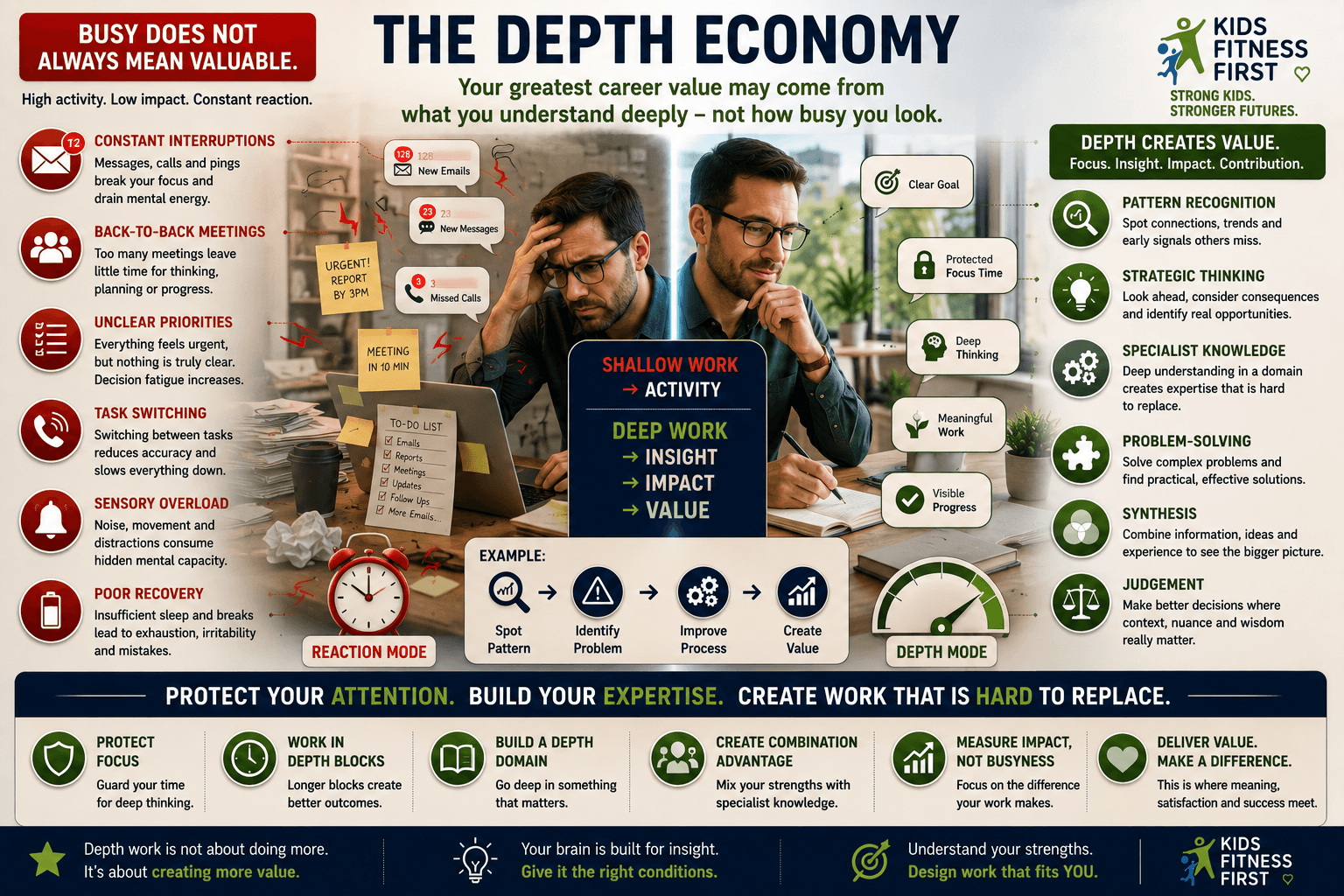
The Depth Economy describes a working world in which value increasingly comes from depth rather than sheer volume.
For example, depth may involve:
understanding complex information;
identifying patterns;
making difficult judgements;
solving unusual problems;
connecting ideas;
developing strategy;
creating specialist knowledge;
explaining complexity.
Therefore, the Depth Economy rewards work that is harder to reproduce through simple repetition.
Instead of measuring contribution only by activity, it asks:
“What can this person understand, create or solve that is genuinely useful?”
Adult ADHD and the Depth Economy: Busy Is Not the Same as Valuable
Modern workplaces can reward visible busyness.
For example:
instant email replies;
full calendars;
constant online presence;
back-to-back meetings.
As a result, somebody can appear highly productive.
However, very little deep thinking may be happening.
Therefore, it is useful to distinguish two types of work.
Shallow Work
Routine, repeatable or reactive activity.
Depth Work
Work requiring judgement, insight, synthesis or sustained thinking.
Both types can be necessary.
However, they do not always create the same level of value.
Shallow Work Still Matters
The purpose of the Depth Economy is not to dismiss routine work.
Emails still need answering.
Administration still matters.
Likewise, systems need maintaining.
However, problems arise when shallow work consumes almost all available attention.
For example, if your entire day is spent reacting, there may be no room left to think.
Therefore, the issue is not:
“Shallow work is bad.”
Instead, ask:
“How much of my working life is consumed by shallow work that prevents higher-value thinking?”
Adult ADHD and the Depth Economy: The Cost of Constant Reaction
Imagine beginning work at 9:00.
First, you check email.
Then a message appears.
Afterwards, somebody asks for a quick call.
Next, you attend a meeting.
By lunchtime, you have responded to dozens of demands.
However, you may not have progressed the one task requiring serious thought.
As a result, the day feels busy but strategically empty.
Therefore, constant reaction can create an illusion of productivity while preventing depth.
The Difference Between Output and Impact
Output asks:
“What did I produce?”
Impact asks:
“What changed because of it?”
For example:
Output:
Created a 30-page report.
Impact:
Identified the decision the organisation needed to make.
Likewise:
Output:
Attended ten meetings.
Impact:
Resolved the underlying issue in one of them.
Therefore, depth is often connected more closely to impact than to volume.
Adult ADHD and the Depth Economy: Insight Can Be More Valuable Than Speed
Imagine two analysts.
The first processes information very quickly.
The second takes longer.
However, the second notices a pattern that changes the decision.
Which contribution was more valuable?
The answer depends on the situation.
Nevertheless, speed alone does not determine value.
Therefore, if your strongest work involves careful analysis, pattern recognition or unusual insight, do not automatically assume that slower means worse.
Sometimes depth requires time.
Pattern Recognition Creates Depth
Article 13 explored pattern recognition as a possible workplace strength.
In the Depth Economy, that ability can become particularly valuable.
For example, you may notice:
a repeated customer problem;
an emerging risk;
an unusual market pattern;
a flaw in a process;
a connection between two separate issues.
As a result, you may identify something before it becomes obvious.
Therefore, pattern recognition can transform scattered information into useful insight.
Adult ADHD and the Depth Economy: Synthesis Creates Value
Synthesis means bringing different pieces of information together.
For example, you may combine:
customer feedback;
financial data;
operational problems;
market changes.
Individually, each piece may tell only part of the story.
However, together they may reveal a much larger pattern.
Therefore, somebody who can synthesise information may produce more value than somebody who simply processes each item separately.
Deep Thinking Is Often Invisible
One difficulty with depth work is that it may not look impressive while it is happening.
Somebody sitting quietly for an hour may appear less productive than somebody answering fifty messages.
However, the quiet person may be solving the problem that matters most.
Therefore, organisations that measure only visible activity can undervalue deep thinking.
Likewise, individuals may undervalue their own thinking because it does not look busy enough.
Adult ADHD and the Depth Economy: Your Best Work May Need Space
Deep work usually needs space.
For example:
time without constant interruption;
clear priorities;
enough energy;
a meaningful problem;
freedom to think.
Therefore, Article 11’s Peak Performance Formula becomes directly relevant.
If your strongest contribution depends on depth, then protecting the conditions that support depth becomes economically important.
It is not simply a comfort preference.
Instead, it may directly affect the quality of your contribution.
Interruption Destroys More Than Time
Suppose you are analysing a complex problem.
You have several ideas in working memory.
Then somebody interrupts you.
The interruption lasts only two minutes.
However, the structure of your thinking may disappear.
Therefore, the real cost is not merely two minutes.
Instead, it includes reconstructing the mental context.
As a result, repeated interruptions can disproportionately damage depth work.
Adult ADHD and the Depth Economy: Depth Requires Attention Protection
If depth creates value, attention becomes an economic resource.
Therefore, protect it where realistically possible.
For example:
silence non-essential notifications;
schedule communication windows;
protect focused blocks;
cluster meetings;
use written priorities.
These adjustments may appear small.
However, together they can create the space required for deeper work.
Deep Work Is Not the Same as Working Longer
A ten-hour day does not automatically contain more depth than a six-hour day.
In fact, exhaustion can reduce the quality of judgement.
Therefore, depth should not be confused with overwork.
Instead, deep work may involve shorter periods of highly focused thinking followed by recovery.
For example:
90 minutes of concentrated analysis
may create more value than:
four fragmented hours of constant switching.
Adult ADHD and the Depth Economy: Deep Work Has an Energy Cost
Depth can be rewarding.
However, it can also be mentally demanding.
Therefore, ask:
“How much deep work can I realistically sustain?”
Perhaps two focused hours are highly productive.
Afterwards, however, your concentration falls.
That information matters.
The goal is not maximum depth.
Instead, it is sustainable depth.
The Depth-to-Recovery Ratio
A useful question is:
“How much recovery do I need after intense thinking?”
For example:
90 minutes of deep analysis
Recovery required: 20 minutes.
That may be sustainable.
Alternatively:
Four hours of intense analysis
Recovery required: entire evening.
That may be less sustainable if repeated daily.
Therefore, career design should consider both value and recovery.
Adult ADHD and the Depth Economy: Meaning Can Increase Depth
Deep thinking becomes easier when the problem feels meaningful.
For example, you may struggle to concentrate on an abstract exercise.
However, if the same thinking is connected to a real problem with real consequences, attention may improve.
Therefore, meaning can act as an amplifier.
This may explain why some people perform brilliantly on difficult real-world problems while struggling with routine exercises.
Specificity Creates Value
General knowledge is useful.
However, highly specific knowledge can become especially valuable.
For example:
understanding a particular industry;
knowing a specialist process;
recognising unusual patterns in one market;
understanding a particular customer group.
Therefore, depth often grows through specificity.
The more deeply you understand a meaningful area, the more difficult your contribution may be to replace.
Adult ADHD and the Depth Economy: Develop a Depth Domain
A Depth Domain is an area in which you deliberately build unusually strong understanding.
For example:
renewable-energy finance;
special educational needs;
construction systems;
cybersecurity;
market behaviour;
customer psychology.
Your Depth Domain does not need to be permanent.
However, it gives your curiosity somewhere to accumulate.
Therefore, instead of repeatedly starting from zero, knowledge begins compounding.
Curiosity Plus Time Creates Expertise
Curiosity can lead you into a subject.
However, expertise requires staying long enough for the knowledge to deepen.
Therefore, the question becomes:
“What subject am I interested enough to keep returning to?”
This matters because novelty alone can produce wide but shallow knowledge.
By contrast, repeated curiosity within one domain can create genuine depth.
Adult ADHD and the Depth Economy: Go Wide, Then Go Deep
Some people naturally explore many areas.
That can be useful.
For example, broad exploration can help you discover connections.
However, eventually, value may increase when some areas receive deeper attention.
Therefore, a useful career strategy may be:
Explore Widely
Find what interests you.
Identify Patterns
Notice what keeps pulling you back.
Choose a Depth Domain
Build deeper knowledge there.
As a result, curiosity becomes accumulated expertise.
Generalist and Specialist Do Not Have to Be Opposites
You may have broad interests.
Likewise, you may still develop specialist depth.
For example, perhaps you understand several industries.
However, your deep specialist ability is:
identifying operational problems.
Or:
explaining complex technical issues.
Therefore, your speciality may be a type of thinking rather than one narrow subject.
Adult ADHD and the Depth Economy: The T-Shaped Career
One useful model is a T-shaped career.
The horizontal line represents broad understanding across several areas.
Meanwhile, the vertical line represents deep expertise in one important area.
Therefore, you can retain breadth while still developing depth.
This can be particularly useful for people whose curiosity naturally crosses several subjects.
Deep Work Can Make You More Distinctive
Routine skills are often widely available.
However, distinctive combinations are rarer.
For example:
finance + communication;
construction + systems thinking;
technology + education;
psychology + data analysis.
Therefore, combining depth across two areas can create unusual professional value.
This can become your Depth Combination.
Adult ADHD and the Depth Economy: Build a Depth Stack
Article 13 introduced a Strength Stack.
Now add domain knowledge.
For example:
Strength Stack
Pattern recognition + strategic thinking + communication
Depth Domain
Financial markets
Together:
Market analysis + strategic interpretation + clear communication
That combination is more distinctive than any one element by itself.
Therefore, think in combinations.
AI Makes Depth More Important, Not Less
Technology can increasingly automate routine tasks.
For example:
summarising;
formatting;
basic drafting;
simple analysis;
administrative processing.
However, this can increase the relative importance of:
judgement;
context;
specialist knowledge;
original insight;
responsibility;
human relationships.
Therefore, the Depth Economy becomes especially relevant as routine knowledge work becomes easier to automate.
Adult ADHD and the Depth Economy: Do Not Compete With Automation at Its Strengths
Machines are excellent at speed, repetition and scale.
Therefore, building a career entirely around repetitive information processing may become more vulnerable to automation.
Instead, human value may increasingly sit in:
knowing which question matters;
understanding context;
challenging assumptions;
making nuanced judgements;
building trust.
Therefore, career development should consider what is difficult to reduce to routine processing.
Human Judgement Creates Depth
Imagine an AI system produces ten possible recommendations.
Somebody still needs to decide:
Which one fits the actual situation?
What risk is being overlooked?
What ethical issue matters?
What does the customer really need?
Therefore, output generation and judgement are different activities.
As routine output becomes cheaper, good judgement may become more valuable.
Adult ADHD and the Depth Economy: Ask Better Questions
Deep thinkers often create value by asking better questions.
For example:
“Why are we solving this problem?”
“What assumption are we making?”
“What happens if this trend continues?”
“What are we missing?”
Therefore, questioning itself can be a professional skill when it produces clarity.
The goal is not to challenge everything.
Instead, it is to identify the questions that materially improve decisions.
The Problem Behind the Problem
Many workplace tasks address symptoms.
For example:
customers complain → respond faster.
However, deeper analysis might ask:
“Why are customers complaining in the first place?”
That shift can change the solution entirely.
Therefore, depth often involves moving from:
surface problem
to:
underlying cause.
Adult ADHD and the Depth Economy: Use Your Invisible Work
Article 3 explored invisible work.
Much of your depth contribution may already be happening invisibly.
Perhaps people ask you to:
make sense of complexity;
identify what is wrong;
think through unusual problems;
challenge a plan.
However, these contributions may not appear in your formal job description.
Therefore, review your invisible work for evidence of depth.
Where Do People Ask for Your Judgement?
This is a powerful question.
Perhaps colleagues ask:
“What do you think is really happening here?”
Or:
“Can you look over this before we decide?”
Likewise:
“What have we missed?”
These requests suggest people may value your judgement rather than only your output.
Therefore, record them.
They may reveal where your Depth Economy value already exists.
Adult ADHD and the Depth Economy: The Depth Audit
Take your normal working week.
Then divide your activities into three categories.
REACTIVE
Email, messages, interruptions.
ROUTINE
Administration, standard processing, recurring maintenance.
DEPTH
Analysis, strategy, problem-solving, creation, judgement.
Then estimate the percentage of your week in each.
For example:
Reactive — 45%
Routine — 35%
Depth — 20%
Therefore, only one fifth of your week may be using your highest-value thinking.
That can be an important discovery.
Increase Depth Gradually
Do not immediately try to remove all routine work.
Instead, ask:
“Could I move from 20% depth to 25%?”
Perhaps one additional focus block per week is enough to begin.
Then observe the result.
As a result, career redesign becomes manageable rather than extreme.
Adult ADHD and the Depth Economy: Protect Your Highest-Value Hours
Identify your strongest mental period.
For example:
9:00–11:00.
Then ask:
“Am I spending these hours on my highest-value thinking?”
If the answer is:
“I usually answer email,”
you may be spending your best cognitive resources on low-depth work.
Therefore, where possible, move reactive tasks to lower-energy periods.
A £10 Task and a £1,000 Question
Imagine your expertise can solve a problem worth thousands.
However, you spend your strongest hour dealing with minor administrative tasks.
This does not mean routine work is beneath you.
Instead, it means opportunity cost matters.
Therefore, ask:
“What work genuinely requires my highest level of thinking?”
Then protect some time for it.
Adult ADHD and the Depth Economy: Build a Depth Portfolio
Create four sections.
THE PROBLEMS I SOLVE DEEPLY
THE SUBJECTS I UNDERSTAND DEEPLY
THE JUDGEMENTS PEOPLE TRUST ME TO MAKE
THE WORK I PRODUCE THAT IS HARD TO REPLACE
Then ask:
“Where does my depth create the greatest value?”
This becomes your Depth Portfolio.
The Depth Value Test
For each important piece of work, ask four questions.
1. Does It Require Real Judgement?
Yes / No
2. Does Specialist Knowledge Matter?
Yes / No
3. Would the Outcome Change If the Thinking Were Better?
Yes / No
4. Is the Contribution Difficult to Replace With Routine Automation?
Yes / No
The more yes answers, the more likely the work contains depth.
Adult ADHD and the Depth Economy: Your 7-Day Depth Audit
For seven working days, record:
1. Deepest Work Period
When did you think most deeply?
2. What Problem Were You Solving?
Be specific.
3. Which Strengths Did You Use?
Pattern recognition?
Strategy?
Synthesis?
Communication?
4. What Value Did the Work Create?
What improved?
5. What Conditions Helped?
Quiet?
Autonomy?
Meaning?
Time?
6. What Interrupted Depth?
Meetings?
Messages?
Fatigue?
At the end of the week, compare your strongest periods.
Green, Amber and Red Depth Work
GREEN — High-Value Depth
The work uses strong judgement.
Likewise, it creates meaningful impact.
Therefore, protect and develop it.
AMBER — Useful but Shallow
The task is necessary.
However, it is repeatable or low judgement.
Therefore, simplify, systemise or schedule it efficiently.
RED — Low-Value Noise
The activity consumes substantial time without producing much useful value.
Therefore, question whether it can be reduced, delegated, automated or removed.
Do Not Eliminate Human Connection
Depth does not mean sitting alone all day.
In fact, conversations can create depth.
For example:
a difficult client conversation;
a strategic discussion;
a collaborative problem-solving session.
Therefore, the distinction is not:
people versus solitude.
Instead, it is:
meaningful interaction versus constant reactive interruption.
Adult ADHD and the Depth Economy: Protect Thinking, Not Isolation
You may need collaboration to generate ideas.
Then you may need solitude to develop them.
Therefore, a good working pattern might look like:
discuss;
think;
create;
review.
This alternation can support both connection and depth.
Depth Creates Career Capital
Repeated deep work can build career capital.
That may include:
expertise;
reputation;
specialist judgement;
trusted relationships;
intellectual property;
unique methods.
Therefore, depth can compound.
One good project creates knowledge.
Then that knowledge improves the next project.
Over time, your value becomes increasingly difficult to replicate.
Adult ADHD and the Depth Economy: Stop Resetting to Zero
If you frequently change subjects, roles or industries, you may repeatedly restart the learning curve.
Sometimes that is necessary.
However, if you can identify an underlying Depth Domain, you may carry accumulated knowledge forward.
For example, you may change employers while remaining inside the same specialist problem area.
Therefore, career variety does not always require abandoning depth.
Build a Career Around Questions You Want to Keep Answering
A powerful career question is:
“What problem could I remain interested in solving for years?”
Perhaps:
How do we build better systems?
How do people learn?
How do organisations make better decisions?
How do we reduce construction waste?
Therefore, a long-term career may be built around a question rather than a job title.
That can provide both continuity and variety.
Adult ADHD and the Depth Economy: Your Depth Statement
Use this template:
“I create the most value when I use __________ to understand or solve __________, particularly when I have __________ conditions.”
For example:
“I create the most value when I use pattern recognition and systems thinking to solve complex operational problems, particularly when I have autonomy and protected focus time.”
This statement connects:
strength;
problem;
conditions;
value.
Therefore, it brings together much of Book Four so far.
Reflection Questions
- How much of your working week is reactive?
- How much is routine?
- How much involves genuine depth?
- Which work requires your strongest judgement?
- What subjects have you developed unusually deep knowledge in?
- What problems do people trust you to think through?
- When does your pattern recognition create value?
- Which shallow tasks consume your strongest mental hours?
- What could be systemised or reduced?
- What is your strongest potential Depth Domain?
- Which combinations of expertise make you distinctive?
- What kind of work would be difficult to replace with simple automation?
Conclusion: Your Value Is Not Measured by How Busy You Look
Adult ADHD and the Depth Economy invites you to reconsider what productivity really means.
You may answer one hundred emails.
However, one strong decision may create more value.
Likewise, you may attend twenty meetings.
Yet one hour of uninterrupted thinking may solve the problem those meetings have been discussing.
Therefore, do not measure your professional worth only by visible activity.
Instead, ask:
What do I understand deeply?
What problems can I solve?
What patterns can I see?
What judgement do people trust?
First, identify your Cognitive Signature.
Then understand your Peak Performance Formula.
Afterwards, reduce the Collapse Conditions that block your thinking.
Finally, identify where your strengths create valuable depth.
As a result, your career can move away from simply processing more work.
Instead, it can move towards producing more meaningful contribution.
The future of work may contain more automation, more information and more speed.
However, that makes genuinely thoughtful human judgement even more important.
Therefore, stop asking only:
“How much did I get done?”
Start asking:
“What did my thinking make better?”
Because in the Depth Economy, the most valuable worker may not be the person doing the most visible tasks.
It may be the person who understands what actually matters.
SUGGESTED INTERNAL LINKS
- Adult ADHD Strengths at Work: Turn What You Naturally Do Well Into Career Value
- Adult ADHD and Exercise: How Movement Can Support Focus, Energy and Wellbeing
DISCLAIMER
This article is provided for general educational and informational purposes only. It does not provide medical, psychological, diagnostic, occupational-health, employment, financial or career advice.
ADHD experiences vary considerably between individuals. Therefore, the possible work patterns and strengths discussed here should not be assumed to apply to every adult with ADHD.
Likewise, the future impact of automation and artificial intelligence on particular occupations is uncertain and will vary across industries, employers and jurisdictions.
Therefore, major career decisions should take account of individual qualifications, experience, financial circumstances, employment opportunities, health and professional advice where appropriate.