Adult ADHD Strengths at Work: Turn What You Naturally Do Well Into Career Value
Adult ADHD strengths at work can easily remain hidden.
Perhaps you know that you are good at solving difficult problems.
However, you may never have considered problem-solving to be a professional strength.
Likewise, you may notice patterns quickly, explain complicated information clearly or generate ideas when other people feel stuck.
Yet, because these abilities come naturally, you may underestimate them.
Therefore, identifying a strength is only the beginning.
The next question is:
“Where does this strength create value?”
That distinction matters.
A personal ability becomes much more useful when you can connect it to:
a problem;
an outcome;
a team;
a customer;
an organisation.
Therefore, this article moves from strength identification towards strength application.
Article 10 introduced your Cognitive Signature.
Then Article 11 explored your Peak Performance Formula.
Afterwards, Article 12 identified your Collapse Conditions.
Now we can bring those pieces together. This article focuses specifically on translating demonstrated strengths into career value. For the broader question of combining strengths with values, practical needs and sustainability, continue to Adult ADHD and Meaningful Work.
Strength Is Not the Same as a Stereotype
Before going further, one point is essential.
There is no single list of strengths that applies to every adult with ADHD.
Some people may be highly creative.
Others may not identify with creativity at all.
Likewise, one person may enjoy fast-moving environments, while another may perform best with calm, predictable routines.
Therefore, statements such as:
“People with ADHD are naturally creative”
are too broad.
Instead, the useful question is:
“Which strengths repeatedly appear in my own working life?”
That keeps the focus on evidence rather than stereotypes.
Adult ADHD Strengths at Work: Start With Evidence
A strength should have evidence behind it.
For example, perhaps you believe you are good at problem-solving.
Ask:
When have I demonstrated it?
What problem did I solve?
What changed because of my contribution?
Did other people recognise the result?
Therefore, move from:
“I think I am good at problem-solving.”
to:
“I repeatedly identify problems, find workable solutions and improve outcomes.”
The second statement is much stronger because it can be tested against experience.
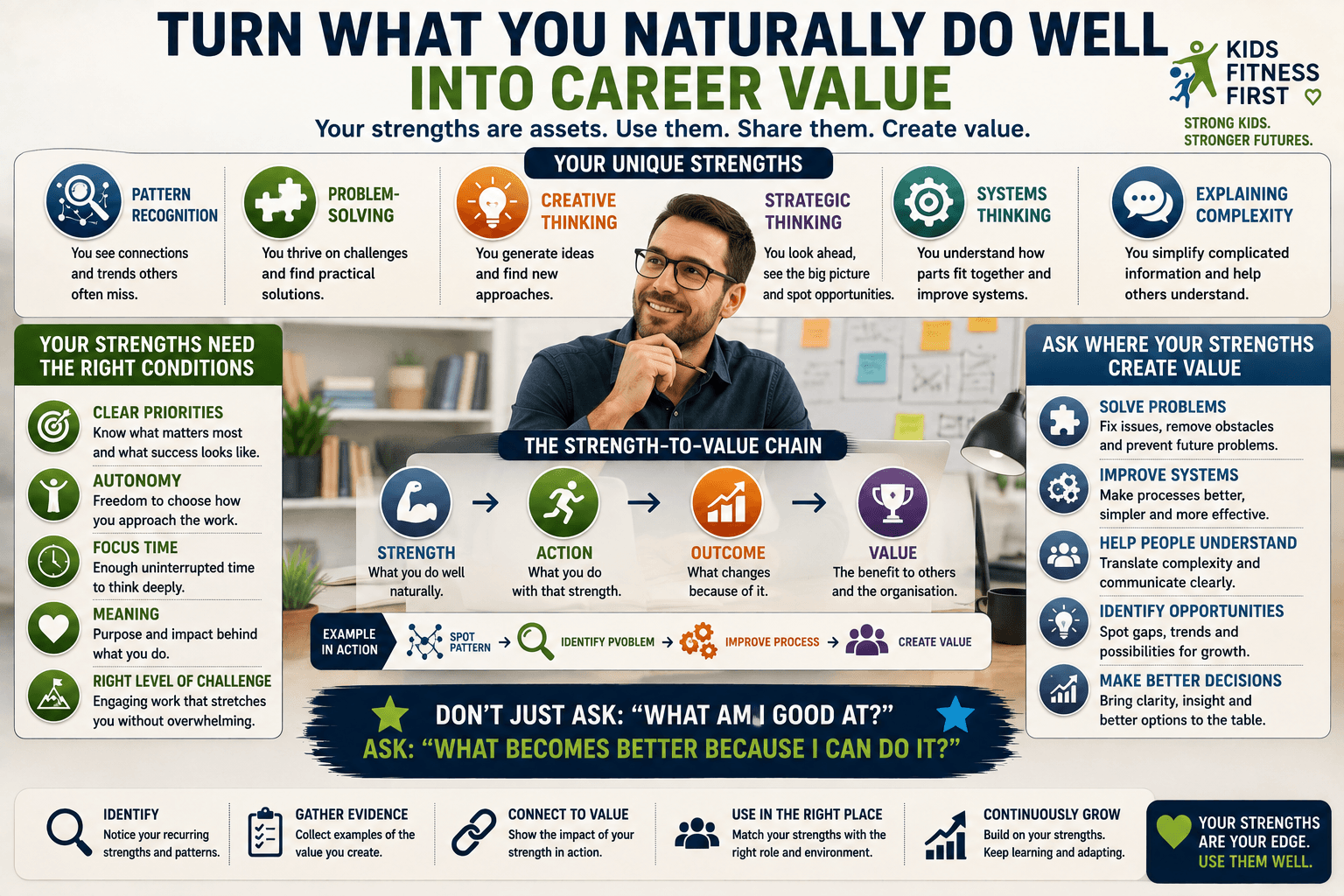
The Strength-to-Value Chain
A useful way to think about workplace strengths is:
STRENGTH → ACTION → OUTCOME → VALUE
For example:
Pattern recognition → spotted recurring customer issue → process changed → fewer complaints
Or:
Clear communication → simplified technical information → customer understood options → faster decision
Likewise:
Creative thinking → developed alternative approach → project continued → delay avoided
Therefore, do not stop at naming the strength.
Follow it through to the value it created.
Adult ADHD Strengths at Work: Pattern Recognition
Perhaps one of your recurring strengths is pattern recognition.
You may notice:
repeated problems;
connections between information;
inconsistencies;
early warning signs;
emerging trends.
However, simply noticing a pattern is not yet the full workplace value.
The value may appear when you use that observation.
For example:
Pattern noticed → problem identified earlier → action taken sooner → cost or time reduced.
Therefore, when describing pattern recognition, explain what happened because you noticed the pattern.
Problem-Solving
Problem-solving can be valuable across almost every industry.
However, the phrase itself is extremely broad.
Therefore, make it specific.
Perhaps you are particularly good at:
diagnosing why something failed;
finding practical workarounds;
simplifying complicated systems;
responding calmly when plans change;
combining information from several sources.
As a result, you begin defining the type of problem-solving you actually offer.
That detail can help you identify better-fitting roles.
Adult ADHD Strengths at Work: Creative Thinking
Creativity at work does not have to involve design, writing or art.
Instead, it may appear as:
finding a different route;
questioning an inefficient process;
combining existing ideas in a new way;
seeing an opportunity others overlooked.
For example, a standard process may stop working.
However, rather than simply repeating it, you may develop an alternative.
Therefore, the workplace value is not merely:
“I am creative.”
Instead:
“I generate useful alternatives when conventional approaches stop working.”
That is far more practical.
Strategic Thinking
Strategic thinkers often look beyond the immediate task.
For example, they may ask:
Where is this heading?
What happens if we continue?
What opportunity are we missing?
What risk is developing?
Therefore, strategic thinking can create value by improving decisions before consequences become obvious.
However, strategic ability may be underused in roles dominated by routine execution.
Therefore, if this is one of your recurring strengths, look for work where thinking ahead is genuinely valued.
Adult ADHD Strengths at Work: Systems Thinking
Systems thinking involves understanding how separate parts affect one another.
For example, you may see that:
a customer problem begins in administration;
a delivery delay originates in purchasing;
a staffing problem is actually a scheduling problem.
As a result, you may identify root causes rather than repeatedly treating symptoms.
Therefore, systems thinking can be particularly valuable in:
operations;
project management;
process improvement;
business analysis;
service design;
technology.
Again, the exact role matters less than the recurring contribution.
Explaining Complexity
Perhaps people frequently come to you when something is difficult to understand.
You may naturally translate:
technical language;
complicated procedures;
large amounts of information;
conflicting options.
Therefore, your strength may involve more than communication.
It may combine understanding, synthesis and explanation.
For example:
Complex information → simplified explanation → clearer understanding → better decision.
That is workplace value.
Adult ADHD Strengths at Work: Rapid Idea Generation
Some people generate possibilities very quickly.
A problem appears.
Then one idea appears.
Afterwards, another follows.
Soon, several possible routes exist.
This can be valuable during:
brainstorming;
product development;
business development;
problem-solving;
planning.
However, idea generation and implementation are different abilities.
Therefore, if generating ideas is a strength, ask whether you also enjoy executing them.
If not, the right team may pair strong ideation with strong implementation.
Curiosity
Curiosity can also create professional value.
Perhaps you naturally ask:
Why?
How?
What happens if?
Is there another way?
As a result, you may uncover information that would otherwise remain hidden.
However, curiosity becomes most useful when it is directed towards a meaningful problem.
Therefore, consider where your curiosity produces useful outcomes.
For example:
research;
investigation;
technical work;
journalism;
analysis;
consulting;
innovation.
Adult ADHD Strengths at Work: Learning Quickly When Interested
Perhaps you absorb information quickly when a subject genuinely engages you.
You read extensively.
Then you connect different sources.
Afterwards, you may become highly knowledgeable in a relatively short period.
However, this may not happen equally across every subject.
Therefore, the useful question is not:
“Am I a fast learner?”
Instead, ask:
“Under what conditions do I learn quickly?”
Interest, relevance and immediate application may be important ingredients.
Hyperfocus: Use the Term Carefully
The word hyperfocus is commonly used when discussing ADHD.
However, it can be oversimplified.
Intense concentration may sometimes be useful.
Yet difficulty shifting away from a task can also create problems.
Therefore, avoid treating hyperfocus as an automatic workplace advantage.
Instead, ask:
“When does deep concentration help me, and when does it create a cost?”
For example, several uninterrupted hours may produce excellent work.
However, the same concentration could also lead to missed meetings, delayed meals or neglected priorities.
Context matters.
Adult ADHD Strengths at Work: Crisis Performance
Some people notice that they become extremely focused during urgent situations.
Suddenly:
the priority is obvious;
distractions disappear;
decisions become immediate.
As a result, performance may temporarily improve.
However, Article 11 raised an important warning.
Do not build your entire working life around emergencies simply because urgency activates focus.
Instead, ask what the crisis provides.
Perhaps it creates:
clarity;
importance;
challenge;
immediate feedback.
Therefore, try to reproduce those useful ingredients without reproducing constant crisis.
Resilience
You may have adapted repeatedly throughout your career.
Perhaps you have:
changed jobs;
learned new systems;
recovered from setbacks;
developed workarounds;
found alternative routes.
That experience may contribute to resilience.
However, resilience should not become an excuse for tolerating damaging conditions indefinitely.
Therefore, distinguish:
“I can adapt.”
from:
“I should have to adapt to everything.”
A strength should support you, not justify unnecessary hardship.
Adult ADHD Strengths at Work: Energy and Enthusiasm
Enthusiasm can influence teams.
For example, genuine excitement about an idea may:
increase momentum;
encourage participation;
help others see possibilities;
create confidence.
However, enthusiasm alone is not enough.
Therefore, connect energy to outcomes.
Ask:
“When does my enthusiasm help move something forward?”
That makes the strength more concrete.
Connecting People and Ideas
Some people naturally connect:
one person with another;
one idea with another;
one opportunity with another.
For example, you may think:
“Sarah knows exactly the person we need.”
Or:
“We solved something similar in another department.”
As a result, you may create value through connection.
Therefore, networking is not only about collecting contacts.
It can also involve recognising useful relationships between people, information and opportunities.
Adult ADHD Strengths at Work: Big-Picture Thinking
Some people naturally zoom out.
They may quickly understand:
the overall objective;
the major risks;
the broad direction;
how several activities fit together.
However, they may find highly detailed maintenance work less engaging.
Therefore, recognising big-picture thinking can help with role design.
A strong big-picture thinker may perform particularly well when paired with systems or colleagues that support detailed follow-through.
Strengths Often Work in Combinations
A major mistake is looking at strengths individually.
In reality, your strongest value may come from combinations.
For example:
Pattern Recognition + Communication
You see the issue and explain it clearly.
Creativity + Problem-Solving
You generate alternatives and apply them to real problems.
Strategic Thinking + Systems Thinking
You understand both direction and consequences.
Curiosity + Rapid Learning
You investigate deeply and build knowledge quickly.
Therefore, your strongest professional value may sit between several abilities rather than inside one.
Adult ADHD Strengths at Work: Find Your Strength Stack
Create a list of your five strongest recurring abilities.
For example:
- Pattern recognition
- Problem-solving
- Communication
- Strategic thinking
- Creative thinking
Then ask:
“Which two or three work particularly well together?”
Perhaps your real strength stack is:
Pattern Recognition + Strategic Thinking + Communication
That combination may describe your value more accurately than any single skill.
Strength Without the Right Environment Can Disappear
Article 12 explored collapse conditions.
Suppose creative problem-solving is one of your strengths.
However, your day contains:
constant interruptions;
micromanagement;
unclear priorities;
six meetings.
As a result, you may have little opportunity to use that strength.
Therefore, poor conditions can make genuine strengths look absent.
That is why workplace fit matters.
Adult ADHD Strengths at Work: Strengths Need Opportunity
Being good at something does not automatically mean your job allows you to use it.
For example, you may be excellent at:
strategy;
analysis;
problem-solving.
However, perhaps 90% of your role involves repetitive administration.
Therefore, ask:
“What percentage of my working week actually uses my strongest abilities?”
The answer may be revealing.
The Strength Utilisation Score
Choose your five strongest abilities.
Then estimate how often your current role uses each one.
| Strength | Importance to Me | Used in Current Role |
|---|---|---|
| Problem-solving | 5/5 | 4/5 |
| Creativity | 4/5 | 1/5 |
| Strategic thinking | 5/5 | 2/5 |
| Communication | 3/5 | 4/5 |
| Systems thinking | 5/5 | 2/5 |
As a result, you can see where strong abilities may be underused.
Adult ADHD Strengths at Work: Underused Strengths Can Feel Like Boredom
Sometimes dissatisfaction does not come from being incapable of the work.
Instead, the work may be using too little of what you do best.
You can complete the tasks.
However, the role rarely challenges your strongest abilities.
As a result, you may feel:
bored;
disconnected;
restless;
underused.
Therefore, ask:
“Am I struggling because this work is too difficult, or because too little of it uses my strengths?”
Those are very different problems.
Do Not Turn Every Strength Into a Career
Perhaps you are excellent at organising holidays.
That does not automatically mean you should become a travel planner.
Likewise, being good at giving advice does not automatically mean you should become a consultant.
Therefore, ability alone is not enough.
Also consider:
interest;
energy;
market value;
qualifications;
working conditions;
sustainability.
A career strength sits at the intersection of several factors.
Adult ADHD Strengths at Work: The Four-Part Career Strength Test
For each suspected strength, ask four questions.
1. AM I GOOD AT IT?
Look for evidence.
2. DO I ENJOY USING IT?
Not necessarily every time, but generally.
3. CAN I USE IT SUSTAINABLY?
Consider energy and recovery.
4. DOES IT CREATE VALUE?
Would an employer, customer, organisation or community benefit?
Therefore, a strong career asset usually performs reasonably well across all four areas.
The Strength-to-Role Test
Now choose one strength.
For example:
Problem-solving.
Then ask where that ability is valuable.
Perhaps:
operations;
technical support;
engineering;
consulting;
project management;
business analysis;
entrepreneurship.
However, do not assume the first role is automatically right.
Instead, compare each role with your Peak Performance Formula and Collapse Conditions.
Therefore, strength fit and environment fit should be considered together.
Adult ADHD Strengths at Work: Turn Strengths Into CV Evidence
Avoid writing vague claims such as:
“Excellent problem solver.”
Almost anyone can write that.
Instead, provide evidence.
For example:
“Identified a recurring scheduling bottleneck and introduced a revised workflow that reduced delays.”
Or:
“Simplified complex technical information into client-facing guidance, helping customers understand available options.”
Therefore, show the strength through action and outcome.
Turn Strengths Into Interview Stories
The same principle applies during interviews.
Use a simple structure:
Situation
What was happening?
Strength
What ability did you use?
Action
What did you actually do?
Result
What changed?
For example:
“The team was repeatedly missing a project milestone. I noticed that every delay originated at the same approval stage. Therefore, I mapped the process, identified the bottleneck and proposed a simpler approval route. As a result, the team reduced repeated delays.”
This makes the strength believable.
Adult ADHD Strengths at Work: Ask What People Already Value
Sometimes other people can see your strengths before you can.
Ask trusted colleagues or former colleagues:
“What do you think I do particularly well?”
Then ask:
“When have you seen me at my best?”
Do not accept only general praise.
Instead, ask for examples.
Therefore, external feedback becomes another source of evidence.
Look at Repeated Requests
What do people repeatedly ask you to help with?
Perhaps:
“Can you explain this?”
“Can you look at why this isn’t working?”
“Can you come up with another idea?”
“Can you speak to the client?”
“Can you make sense of this data?”
Those repeated requests may reveal where other people already recognise value.
Therefore, pay attention to them.
Adult ADHD Strengths at Work: Build Your Strength Evidence Bank
Use this table:
| Strength | Evidence | Outcome | Conditions | Energy Cost |
|---|---|---|---|---|
| Pattern recognition | Spotted repeated process failure | Problem fixed earlier | Quiet analysis time | Low |
| Communication | Explained complex proposal | Client understood decision | One-to-one meeting | Medium |
| Creative thinking | Developed alternative solution | Project continued | Autonomy | Low |
| Crisis response | Managed urgent problem | Immediate issue resolved | Clear priority | High |
Therefore, your strength profile now includes both value and sustainability.
Your 7-Day Strength Utilisation Audit
For seven working days, record:
1. Which Strength Did I Use Today?
Be specific.
2. What Did I Do?
Describe the action.
3. What Value Did It Create?
What changed?
4. What Conditions Helped?
Consider your Peak Performance Formula.
5. What Was the Energy Cost?
Low / Medium / High.
6. Was This Strength Underused Today?
Yes / No.
At the end of the week, look for patterns.
Adult ADHD Strengths at Work: Green, Amber and Red Strength Utilisation
GREEN — Strength Used Well
The role regularly uses the ability.
Likewise, the environment supports it.
Moreover, the energy cost is sustainable.
Therefore, this is likely a positive part of your work.
AMBER — Strength Underused or Expensive
The ability creates value.
However, you either use it too rarely or the conditions make it unnecessarily draining.
Therefore, consider role or environment changes.
RED — Strength Blocked
A major ability is almost never used.
Alternatively, collapse conditions prevent you from accessing it consistently.
Therefore, the role may be wasting an important part of your capability.
The Strength Portfolio
By now, you can create a simple portfolio.
MY TOP FIVE STRENGTHS
MY STRONGEST COMBINATION
THE VALUE THIS CREATES
CONDITIONS THAT HELP
CONDITIONS THAT BLOCK IT
WHERE I WANT TO USE THESE STRENGTHS MORE
This becomes another part of your Work That Fits profile.
Adult ADHD Strengths at Work: The Framework So Far
You now have four connected tools.
COGNITIVE SIGNATURE
What you repeatedly do well.
PEAK PERFORMANCE FORMULA
The conditions that help you perform well.
COLLAPSE CONDITIONS
The conditions that make your strengths harder to access.
STRENGTH PORTFOLIO
How your abilities create practical value.
Together, these tools begin replacing vague career advice with personal evidence.
Use the Framework Before Your Next Career Move
Before applying for a job, ask:
Will this role use my strongest abilities?
How frequently?
Under what conditions?
What value could I create?
Which collapse conditions might be present?
Therefore, you can assess more than salary and title.
You can begin assessing whether the work is likely to use your actual strengths.
Adult ADHD Strengths at Work: Better Questions for Employers
During an interview, you might ask:
“What problems would you most like the successful candidate to solve?”
Likewise:
“What distinguishes somebody who performs exceptionally well in this role?”
Or:
“What would you hope this person has improved after twelve months?”
These questions reveal where the organisation actually needs value.
Therefore, you can compare their needs with your Strength Portfolio.
Strengths Do Not Remove Support Needs
You can be highly capable and still need support.
For example, somebody may be excellent at strategic thinking but struggle with constant interruption.
Likewise, somebody may communicate brilliantly but find meeting-heavy days exhausting.
Therefore, strengths and difficulties can exist together.
Recognising one does not invalidate the other.
That balanced view is essential.
Adult ADHD Strengths at Work: Stop Asking Whether You Are Good Enough
A more useful career question may be:
“Where is what I already do well genuinely useful?”
That changes the focus.
Instead of trying to prove that you can survive any job, you begin looking for places where your abilities solve real problems.
As a result, career planning becomes less about fitting yourself into every available role.
Instead, it becomes about finding a better match between:
ability + environment + value.
Reflection Questions
- What do you repeatedly do well at work?
- What evidence supports each strength?
- What changes because you use that ability?
- Which strengths appear across several jobs?
- Which abilities do other people repeatedly rely on?
- Which strengths work particularly well together?
- What percentage of your current role uses your strongest abilities?
- Which strengths are underused?
- Which strengths carry a high energy cost?
- What conditions help your strengths appear?
- What conditions block them?
- Where could your strongest combination create more value?
Conclusion: Turn Ability Into Value
Adult ADHD strengths at work should not be reduced to generic claims about creativity, energy or hyperfocus.
Instead, begin with your own evidence.
First, identify what you repeatedly do well.
Then determine what actions those strengths produce.
Afterwards, look at the outcomes.
Finally, identify the value.
Remember:
STRENGTH → ACTION → OUTCOME → VALUE
Perhaps your strength is pattern recognition.
Therefore, ask what you notice before other people do.
Perhaps it is problem-solving.
Then ask what kinds of problems you solve particularly well.
Alternatively, your strength may be communication, strategic thinking, creativity or systems thinking.
However, the label alone is not enough.
The important question is:
“What becomes better because I can do this?”
That is where a personal strength becomes a career asset.
Most importantly, do not assume that struggling in one environment means you have little to offer.
Article 12 showed how collapse conditions can block access to genuine ability.
Therefore, consider the whole picture.
What do you do well?
What conditions unlock it?
What conditions block it?
Where does it create value?
When those four questions begin to line up, work can start to fit much more intelligently.
SUGGESTED INTERNAL LINKS
- Adult ADHD and Workplace Struggles: Identify the Conditions That Make Your Brain Shut Down
- Adult ADHD and Peak Performance: Discover the Conditions That Bring Out Your Best Work
DISCLAIMER
This article is provided for general educational and informational purposes only. It does not provide medical, psychological, diagnostic, occupational-health, employment, recruitment or career advice.
ADHD experiences vary considerably between individuals. Therefore, the possible strengths discussed here should not be assumed to apply to every adult with ADHD.
Likewise, abilities such as creativity, problem-solving, pattern recognition, strategic thinking or intense concentration are not unique to ADHD.
Instead, the purpose of this article is to encourage readers to examine their own work history and identify individual patterns supported by evidence.
Furthermore, career suitability depends on many factors, including experience, qualifications, interests, environment, opportunity, health, financial circumstances and personal preferences.
Therefore, where significant career, workplace or health decisions are involved, consider obtaining appropriate professional advice.