
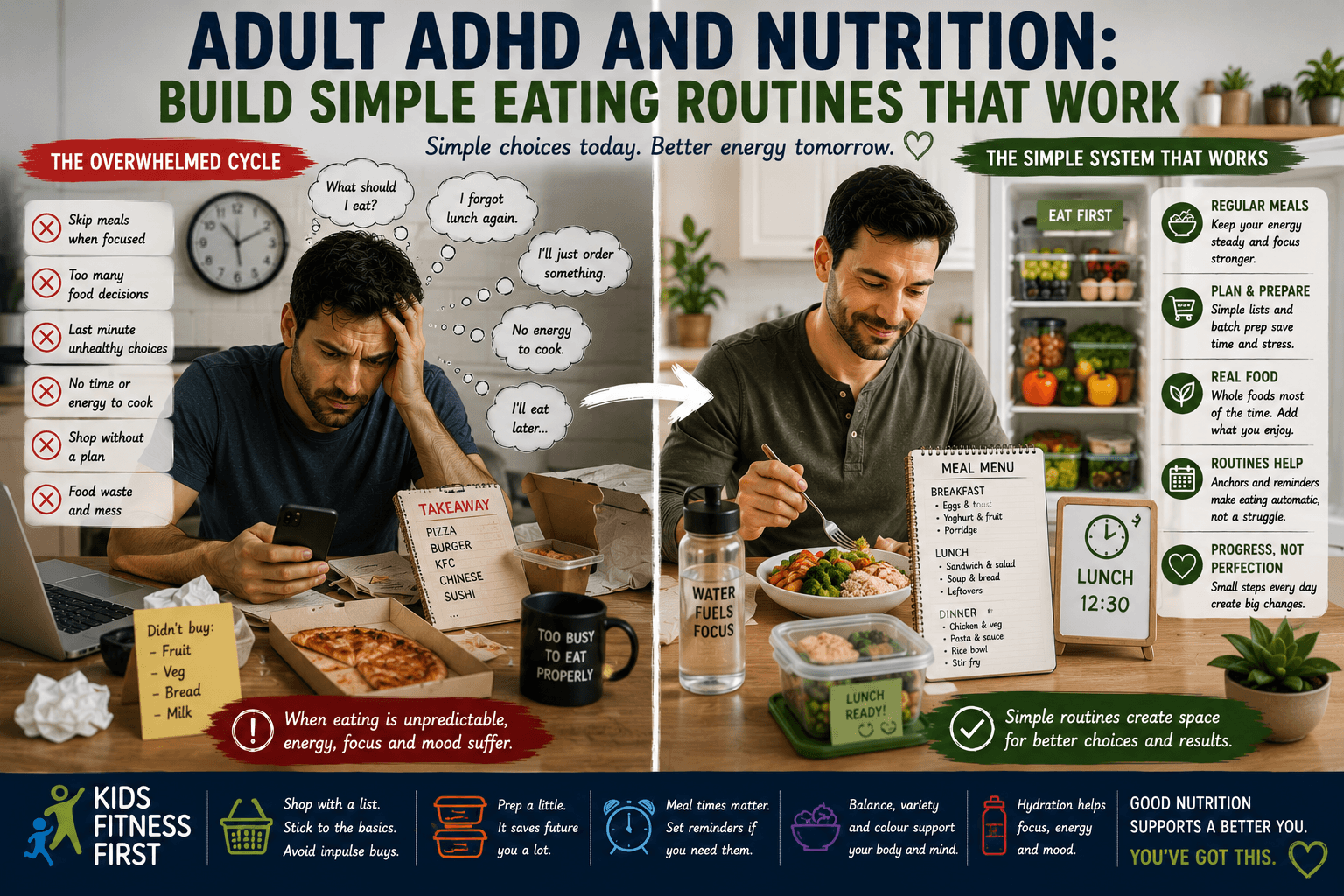
Adult ADHD and Nutrition: How to Build Simple Eating Routines That Work
Adult ADHD and nutrition can become complicated surprisingly quickly.
The problem is not always knowing what food is.
Instead, everyday eating requires a series of small actions and decisions.
What will I eat?
Do I have the ingredients?
When will I prepare it?
Did I remember to eat?
What can I make quickly?
Suddenly, it is late afternoon and lunch never happened.
Alternatively, you may reach the evening tired and hungry, with very little energy left for deciding what to cook.
At that point, convenience usually wins.
This does not necessarily mean you lack knowledge or motivation.
Instead, the system around eating may simply require too many decisions at the wrong times.
Therefore, rather than trying to create a perfect diet, it can be more useful to ask:
“How can I make regular, suitable food easier to remember, choose and prepare?”
That is the approach we will use throughout this article.
Why Adult ADHD and Nutrition Can Become Difficult
Eating may look simple from the outside.
However, consider everything involved in one evening meal.
You need to:
notice that you are hungry;
decide what to eat;
check what food is available;
prepare ingredients;
cook;
remember timings;
clean afterwards.
If you also need to shop first, the process becomes even longer.
Meanwhile, work, family responsibilities and other demands continue competing for attention.
As a result, food can become something dealt with only when hunger becomes impossible to ignore.
That is one reason adult ADHD and nutrition may benefit from practical systems rather than relying on remembering and deciding everything in the moment.
Start With Regular Eating, Not Perfection
Nutrition advice can become overwhelming.
Protein.
Carbohydrates.
Fats.
Vitamins.
Meal timing.
Recipes.
Tracking.
Supplements.
However, trying to optimise everything at once may create another complicated project.
Instead, begin with the basics.
Are you eating regularly enough for your individual needs?
Do you have suitable food available?
Can you prepare something without a large amount of effort?
Those questions may be a more useful starting point.
Adult ADHD and Nutrition: Reduce Food Decisions
Article 9 explored adult ADHD and decision fatigue.
Food creates repeated decisions every day.
Breakfast.
Lunch.
Dinner.
Snacks.
Shopping.
Therefore, reducing unnecessary food decisions can make everyday life easier.
For example, you might have:
two usual breakfasts;
three easy lunches;
four or five familiar dinners.
You can still eat other things.
However, having defaults means you do not need to invent every meal from nothing.
Create Default Meals
A default meal is simply an easy option you already know.
For example:
Breakfast
Eggs and toast.
Yoghurt with fruit.
Porridge.
Lunch
Sandwich and salad.
Soup and bread.
Leftovers from dinner.
Dinner
Chicken, vegetables and potatoes.
Pasta with a familiar sauce.
Rice with vegetables and a suitable protein source.
The exact foods will depend on your needs, preferences, culture and circumstances.
The important part is the system.
When you cannot decide, use a default.
Use a Meal Menu
Instead of asking:
“What do I want to eat?”
look at a short menu.
For example:
QUICK
Sandwich.
Soup.
Eggs.
NORMAL
Pasta.
Chicken and vegetables.
Rice bowl.
MORE TIME
Favourite cooked meal.
New recipe.
Batch cooking.
Now the decision becomes smaller.
As a result, you are choosing from options rather than searching through every possible meal.
Adult ADHD and Nutrition When You Forget to Eat
Some people become absorbed in work or another activity and realise much later that they have not eaten.
If this happens regularly, relying on hunger alone may not be enough.
Therefore, external reminders can help.
For example:
12:30 — lunch
Put it in your calendar.
Set an alarm.
Link lunch to another event.
As a result, eating becomes visible rather than depending entirely on noticing time and hunger.
Link Meals to Existing Anchors
Article 14 explored adult ADHD and routine.
The same principle can support eating.
For example:
Breakfast → after getting dressed.
Lunch → after the morning work block.
Dinner → after finishing work.
The exact times can remain flexible.
However, connecting meals with existing parts of the day creates useful anchors.
Make Food Visible
Article 8 explored adult ADHD and external memory.
Food can also disappear mentally when it disappears physically.
You buy fruit.
Then it goes into a drawer.
Several days later, you rediscover it.
Therefore, where food safety and storage requirements allow, make useful options easier to see.
For example:
place appropriate ready-to-eat foods somewhere visible;
use clear containers;
keep frequently used items in consistent locations;
organise the fridge so useful options are easy to notice.
As a result, the environment helps remind you what is available.
Create an “Eat First” Area
You might designate part of the fridge for food that needs using soon.
Label it:
EAT FIRST
Put leftovers and suitable short-life items there.
Therefore, when you open the fridge, you do not need to search every shelf.
This can also help reduce unnecessary food waste.
Adult ADHD and Nutrition With Shopping
Shopping can become another executive-function task.
You need to remember what has run out.
Then create a list.
Then remember the list.
Then buy the right things.
Therefore, make the system simpler.
Keep one shopping list.
Paper, phone or shared household app can all work.
When something runs low, add it immediately.
As a result, you do not need to reconstruct the entire shopping list before every trip.
Keep a Core Shopping List
Many households buy similar basics repeatedly.
Therefore, create a reusable list.
For example:
eggs;
bread;
milk or preferred alternative;
fruit;
vegetables;
rice;
pasta;
familiar protein options;
freezer basics.
Then add any special items needed that week.
This is much easier than beginning with a blank page.
Do Not Shop Only for Your Ideal Self
It is easy to buy ingredients for the person you imagine you will be next week.
You picture yourself preparing elaborate meals every evening.
However, Thursday arrives and you are exhausted.
Now the ingredients remain untouched.
Therefore, shop for your real week.
Include food for:
busy days;
low-energy days;
normal days.
This is practical planning, not failure.
Create Low-Energy Meals
Article 7 explored adult ADHD and energy management.
Food routines should also account for changing energy.
A meal that works on Saturday may be unrealistic after a demanding Wednesday.
Therefore, keep a few low-effort options available.
For example:
a suitable prepared meal;
eggs;
soup;
frozen vegetables;
pre-cooked or easy-to-prepare ingredients;
a simple sandwich.
The exact choices depend on your individual needs.
However, the principle is universal:
Low-energy days need low-friction options.
Convenience Can Be Part of the System
Convenience is sometimes treated as automatically negative.
However, convenient food preparation can reduce barriers.
For example:
pre-cut vegetables;
frozen vegetables;
microwaveable ingredients;
pre-portioned options;
batch-cooked meals.
These may make a balanced meal more realistic on a demanding day.
Therefore, consider the whole outcome rather than judging individual shortcuts.
Adult ADHD and Nutrition With Meal Preparation
Meal preparation does not need to mean cooking twenty identical containers on Sunday.
Instead, preparation can be small.
For example:
cook extra rice;
prepare extra vegetables;
make two portions instead of one;
wash fruit;
portion snacks;
prepare tomorrow’s lunch while making dinner.
As a result, future meals require fewer steps.
Use “Cook Once, Eat Twice”
Suppose you are already cooking dinner.
Making a second portion may require relatively little extra effort.
Put it in the fridge or freezer appropriately.
Now tomorrow’s lunch is partly solved.
Therefore, one cooking session can reduce a future decision.
Prepare Components Rather Than Complete Meals
If you dislike eating identical meals repeatedly, prepare components.
For example:
cooked chicken or another suitable protein;
rice;
vegetables;
salad ingredients;
potatoes.
Then combine them differently.
This keeps some variety while reducing preparation.
Adult ADHD and Nutrition With Time Blindness
Article 10 explored adult ADHD and time blindness.
You may think:
“I will eat in a minute.”
Then an hour disappears.
Therefore, use external time.
A lunch alarm.
Calendar block.
Visible clock.
Regular meal anchor.
As a result, time becomes harder to lose completely.
Protect Enough Time to Eat
If your calendar contains meetings from morning until late afternoon, simply remembering lunch may not solve the problem.
You also need space.
Therefore, consider protecting a meal break where your circumstances allow.
For example:
12:30–1:00 — lunch
That block is not empty time.
It has a purpose.
Adult ADHD and Nutrition During Busy Workdays
Busy days often create reactive eating.
You suddenly realise you are extremely hungry.
Then you choose whatever is fastest.
Therefore, prepare before the hunger becomes urgent.
For example:
bring lunch;
keep suitable food available;
know when the break is;
prepare something the night before.
As a result, the decision is made while you have more capacity.
Keep an Emergency Food Option
Sometimes the day does not go according to plan.
Meetings run late.
Travel takes longer.
Your prepared lunch stays at home.
Therefore, having a suitable backup option can help.
The exact choice depends on your circumstances and dietary requirements.
The principle is simply:
Have a Plan B.
Adult ADHD and Nutrition With Procrastination
Article 11 explored adult ADHD and procrastination.
Food preparation can also be postponed.
You know you need to make lunch.
However, starting feels like effort.
Therefore, reduce the first step.
Instead of:
“Prepare lunch.”
try:
“Take the ingredients out.”
Then continue.
The smaller starting point can make the task easier to enter.
Use a Five-Minute Food Reset
If the kitchen feels overwhelming, set a five-minute timer.
During those five minutes:
clear one surface;
check what food is available;
prepare one thing for later.
Then stop if needed.
As a result, you reduce some of tomorrow’s friction without creating a large project.
Adult ADHD and Nutrition With Overwhelm
Article 12 explored adult ADHD and overwhelm.
Nutrition can become overwhelming when you try to control everything.
Calories.
Macros.
Meal timing.
Shopping.
Cooking.
Supplements.
Tracking.
Therefore, if the system becomes too large, simplify it.
Return to:
regular meals;
suitable food available;
easy defaults;
basic preparation.
Then build from there only if useful.
Do Not Let Tracking Become the Whole Job
Some people find food tracking useful.
Others find it demanding.
If you choose to track something, make sure the information has a purpose.
For example:
Are you trying to understand a pattern?
Has a qualified professional asked you to record something?
If not, complicated tracking may create unnecessary mental load.
The system should help you.
You should not spend the whole day serving the system.
Adult ADHD and Nutrition With Boundaries
Article 20 explored adult ADHD and boundaries.
Eating sometimes needs boundaries too.
For example:
Do not routinely schedule calls through lunch.
Protect enough time to shop.
Avoid allowing every other responsibility to replace meals.
Therefore, eating becomes part of the day rather than something squeezed into whatever time remains.
Protect the Basics
A useful question is:
“What basic needs disappear first when I become busy?”
For some people, it is food.
For others, movement or sleep.
If meals regularly disappear, treat them as actual commitments.
A lunch break is not necessarily wasted time.
It can be part of maintaining your capacity for the rest of the day.
Adult ADHD, Exercise and Nutrition
Article 22 explored adult ADHD and exercise.
Movement and eating routines can support each other practically.
For example:
prepare lunch before leaving for the gym;
shop after a regular activity;
keep suitable food ready for busy days.
However, avoid turning both into one enormous lifestyle overhaul.
Instead, build one manageable routine at a time.
Adult ADHD, Sleep and Nutrition
Article 21 explored adult ADHD and sleep.
Late nights can make the following day harder to organise.
Likewise, a disorganised evening may lead to skipping preparation for tomorrow.
Therefore, one small evening step can help.
For example:
prepare breakfast items;
pack lunch;
check tomorrow’s schedule.
Then stop.
The goal is preparation, not a second working day.
Self-Criticism Does Not Improve Eating Routines
Article 18 explored adult ADHD and self-criticism.
Suppose your planned meals disappear and you order something convenient.
The harsh response might be:
“I have failed again.”
However, that does not help you understand the system.
Instead, ask:
Was I too tired to cook?
Did I have ingredients?
Was the planned meal too complicated?
Did I leave the decision too late?
Therefore, use the experience as information.
Self-Trust Can Support Nutrition
Article 19 explored adult ADHD and self-trust.
Keep small promises.
For example:
“Tomorrow, I will take lunch with me.”
Prepare it.
Take it.
That is evidence.
You do not need to transform your entire diet to build a more reliable food routine.
Small follow-through counts.
Adult ADHD and Nutrition When Novelty Disappears
Eating the same food every day may become boring.
However, creating completely different meals every day requires more decisions.
Therefore, find the middle ground.
Keep the structure.
Change some details.
For example:
Base
Rice bowl.
Monday
Chicken and vegetables.
Wednesday
Beans and vegetables.
Friday
Another suitable combination.
The basic system remains familiar while the food changes.
Create a Food Rotation
A simple rotation might contain:
three breakfasts;
four lunches;
six dinners.
You do not need to follow it rigidly.
Instead, it becomes a menu of familiar options.
As a result, you have variety without needing unlimited choice.
Adult ADHD and Nutrition: Design the Kitchen to Help
Your environment can make eating easier or harder.
Therefore, consider the practical layout.
Are frequently used items easy to reach?
Can you see what needs using?
Are containers easy to find?
Do you know where lunch items belong?
Small organisational changes can reduce friction.
Give Important Things a Home
For example:
Lunch containers → one cupboard.
Water bottle → same place.
Shopping bags → by the door.
Breakfast items → grouped together.
As a result, fewer small searches interrupt the routine.
This connects directly with the broader principles of external organisation discussed throughout The X Blueprint.
Hydration Can Also Be Forgotten
Busy periods can make drinking easy to overlook.
Therefore, if this is a problem for you, use simple cues.
For example:
keep an appropriate drink visible;
refill it during a regular break;
attach drinking to meals.
There is no need to turn hydration into another complicated tracking project unless there is a specific reason to do so.
Adult ADHD and Nutrition After a Late Diagnosis
After a late ADHD diagnosis, you may recognise old patterns differently.
Perhaps you frequently forgot meals when absorbed in something.
Maybe shopping and cooking always felt disproportionately difficult.
Alternatively, you may have relied heavily on convenience because complex food preparation simply created too many steps.
Understanding adult ADHD and nutrition can help you look at these experiences through a practical lens.
The goal is not to blame ADHD for every food choice.
Instead, it is to notice where executive-function demands may be creating unnecessary barriers.
Then you can redesign those parts of the system.
Be Careful With ADHD Diet Claims
There is a large amount of nutrition information online.
Some claims suggest that particular foods, restrictive diets or supplements can “cure” ADHD.
Be cautious.
ADHD is a recognised neurodevelopmental condition, and nutrition advice should not replace appropriate medical assessment or evidence-based treatment.
Therefore, if you are considering major dietary restrictions, supplements or significant changes because of ADHD or another health condition, seek advice from an appropriately qualified healthcare professional or registered dietitian where appropriate.
Medication and Appetite
Some prescribed medications can affect appetite in some people.
If you notice significant appetite changes, weight changes or difficulties eating after starting or changing medication, discuss this with the healthcare professional responsible for your treatment.
Do not stop or alter prescribed medication based solely on general information online.
Individual medical advice matters.
Build a Personal Nutrition Toolkit
Your toolkit might include:
Default Meals
Keep familiar options for difficult days.
Core Shopping List
Reuse the same basic list.
Meal Anchors
Connect eating to existing routines.
Visible Food
Make suitable options easier to notice.
Eat-First Area
Keep food that needs using in one place.
Low-Energy Options
Prepare for demanding days.
Cook Once, Eat Twice
Reduce future preparation.
Emergency Option
Have a backup when the plan changes.
Use the tools that solve your actual problems.
A Simple Eating Routine
When adult ADHD and nutrition feel difficult, try this:
First: Choose two easy breakfasts.
Next: choose two or three easy lunches.
Then: identify four familiar dinners.
After that: create one reusable shopping list.
Next: decide when meals usually fit into your day.
Finally: keep at least one low-effort backup option available.
That is already a system.
You can improve it later.
Start With One Change This Week
Do not rebuild your whole diet.
Choose one repeated difficulty.
If you forget lunch:
Set a lunch reminder.
If you cannot decide what to cook:
Create five default dinners.
If food goes to waste:
Create an Eat First shelf.
If low-energy evenings cause problems:
Keep two easy meal options available.
If shopping is chaotic:
Create a reusable list.
Test one change first.
Then see whether it actually makes life easier.
Reflection Questions
- Which meal is hardest for you to manage consistently?
- Do you forget to eat when focused on something else?
- How many food decisions are you making every day?
- What could become a default meal?
- Do you have suitable low-energy food options available?
- Would a reusable shopping list help?
- Could you make useful food more visible?
- Which meal could you prepare partly in advance?
- Is your current food system too complicated?
- What one change could make eating easier this week?
Conclusion
Adult ADHD and nutrition can become difficult when eating depends on remembering, planning, shopping, choosing and preparing food at exactly the right moments.
However, the answer does not have to be a complicated diet.
Instead, simplify the system.
Use default meals.
Create a reusable shopping list.
Make useful options visible.
Prepare for low-energy days.
In addition, use meal reminders or routine anchors if time regularly disappears.
Most importantly, avoid making perfection the standard.
The aim is not to make every meal ideal.
The aim is to make regular, suitable food easier to access and prepare.
Therefore, instead of asking:
“Why can’t I organise my eating properly?”
try asking:
“Which part of eating currently requires too much remembering, deciding or preparation?”
Then simplify that part first.
Over time, adult ADHD and nutrition may become easier to manage when your food environment supports you, your options are simpler and eating becomes part of your routine rather than another daily problem to solve.
SUGGESTED INTERNAL LINKS
- Adult ADHD and Exercise: How Movement Can Support Focus, Energy and Wellbeing
- Adult ADHD and Self-Trust: How to Rebuild Confidence in Yourself
DISCLAIMER
This article is provided for general educational and informational purposes only. It does not provide medical, nutritional, diagnostic or therapeutic advice and should not be used as a substitute for individual guidance from an appropriately qualified healthcare professional or registered dietitian.
Nutritional needs vary according to age, health, medication, activity, allergies, medical conditions and many other individual factors. If you are considering significant dietary changes or supplements, have concerns about appetite or weight, or believe medication may be affecting your eating, please seek appropriate professional advice. Do not stop or change prescribed medication without discussing it with the healthcare professional responsible for your treatment.