
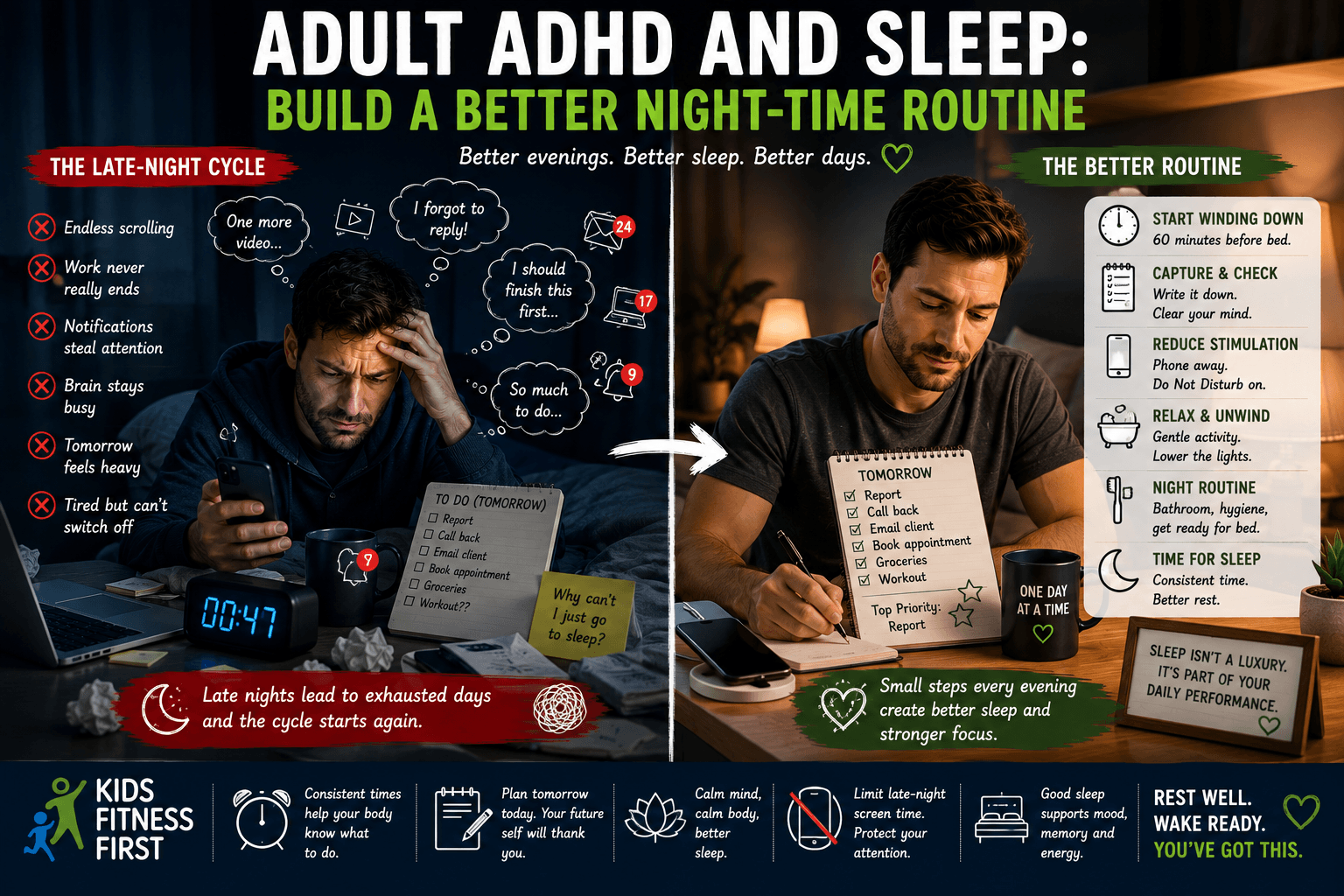
Adult ADHD and Sleep: How to Build a Better Night-Time Routine
Adult ADHD and sleep can become a frustrating cycle.
You feel tired during the day.
Therefore, you promise yourself:
“Tonight I am going to bed early.”
Evening arrives.
However, there is one more thing to finish.
Then you check your phone.
A video catches your attention.
Another follows.
Meanwhile, you remember something you forgot to do earlier.
So, you decide to deal with it quickly.
Suddenly, it is much later than you expected.
Now you are tired, but your mind feels active.
Eventually, you get into bed.
Yet, instead of switching off, your thoughts begin moving from one subject to another.
Tomorrow’s work.
Something you forgot.
A conversation from earlier.
An idea you do not want to lose.
As a result, bedtime becomes another part of the day that feels difficult to control.
The next morning, you wake up tired.
Then the cycle begins again.
Adult ADHD and sleep difficulties can have many causes. Therefore, this article is not suggesting that every sleep problem is caused by ADHD.
Instead, the aim is practical: to explore ways of making the transition from daytime activity to sleep more predictable and less dependent on willpower.
Why Can Adult ADHD and Sleep Become Difficult?
Sleep requires a transition.
During the day, your brain is responding to:
work;
messages;
conversations;
decisions;
entertainment;
responsibilities;
ideas.
Then bedtime arrives and you expect all of that activity to stop immediately.
For some people, that transition is difficult.
Furthermore, modern technology makes the problem easier to continue.
There is always another video.
Another message.
Another article.
Another notification.
Therefore, improving sleep often begins before you actually get into bed.
Do Not Make Bedtime the First Warning
Suppose you want to be in bed at 11 pm.
If your first reminder happens at 10:55 pm, you still need to:
finish what you are doing;
prepare for tomorrow;
wash;
brush your teeth;
change;
put things away;
settle down.
Consequently, 11 pm can quickly become midnight.
Instead, create a wind-down alarm.
For example:
9:45 pm — start slowing down
10:15 pm — prepare tomorrow
10:30 pm — bathroom routine
10:45 pm — quieter activity
11:00 pm — bed
Now bedtime is a process rather than a single event.
Adult ADHD and Sleep: Create a Bedtime Runway
Think of the final part of your evening as a runway.
You are gradually reducing activity rather than trying to stop instantly.
For example:
60 Minutes Before Bed
Finish demanding work where possible.
45 Minutes Before Bed
Prepare essential things for tomorrow.
30 Minutes Before Bed
Reduce stimulating activities.
15 Minutes Before Bed
Begin your final bathroom and bedroom routine.
Bedtime
Move into sleep rather than beginning another task.
This structure does not need to be perfect.
However, it creates direction.
Decide When the Day Is Finished
One major difficulty is that the day never seems completely done.
There is always another email.
Another household job.
Another task.
Therefore, create a stopping point.
For example:
“After 9:30 pm, I do not start new work.”
That does not mean everything is finished.
Instead, it means unfinished work moves to tomorrow.
This is important because without an endpoint, work can expand into the whole evening.
Use an Evening Shutdown Routine
A short shutdown routine can tell your brain that active work is ending.
For example:
- Check tomorrow’s calendar.
- Write down unfinished tasks.
- Choose tomorrow’s first priority.
- Close the laptop.
- Put work materials away.
Then say:
“Today’s work is finished.”
It may sound simple.
However, the physical act of closing the workday can reduce the urge to keep mentally rehearsing unfinished tasks.
Get Tomorrow Out of Your Head
One reason the mind stays active at night is fear of forgetting.
You suddenly remember:
Call dentist.
Send invoice.
Buy something.
Reply to message.
Instead of trying to hold the thought overnight, capture it.
Keep a notebook nearby.
Alternatively, use one simple digital capture system.
Write:
“Call dentist tomorrow.”
Then leave it there.
As a result, your brain does not need to keep repeating the reminder.
Adult ADHD and Sleep: Use a Brain-Dump List
Before bed, write down anything still competing for attention.
For example:
Tomorrow
- send report;
- make phone call;
- collect parcel.
Remember
- appointment Thursday;
- buy toothpaste.
Idea
- possible project idea.
Now those thoughts have somewhere to go.
Therefore, you can return to them tomorrow instead of trying to solve them in bed.
Do Not Turn the Brain Dump Into Work
There is an important difference between recording a task and doing it.
You remember an email at 10:45 pm.
Write:
“Send email tomorrow.”
Do not necessarily open the laptop and start writing it.
Otherwise, your brain dump becomes another work session.
Therefore, the rule can be:
Capture now. Act tomorrow.
Your Phone Can Extend the Day
Phones combine almost everything that can hold attention:
messages;
videos;
news;
social media;
games;
shopping;
work;
email.
Therefore, “just checking the phone” can easily become much longer than intended.
This can be especially relevant when considering adult ADHD and sleep.
The goal does not necessarily need to be removing the phone completely.
Instead, create friction between yourself and the most distracting activities.
Create a Phone Parking Place
Choose where your phone goes during the final part of the evening.
For example:
on a charger across the bedroom;
on a desk;
outside the bedroom;
in a designated charging area.
If you need the phone as an alarm, placing it further away may still help.
As a result, checking it requires a deliberate action rather than happening automatically.
Use Do Not Disturb
Set Do Not Disturb or another suitable focus setting during your wind-down period.
Allow important contacts through if necessary.
Meanwhile, silence non-essential notifications.
This creates a boundary.
Instead of other people and apps deciding when your attention moves, you regain more control over the final part of the evening.
Be Careful With “One More”
One more episode.
One more video.
One more email.
One more task.
These decisions seem small.
However, they accumulate.
Therefore, create an end rule.
For example:
“When this episode finishes, the television goes off.”
Or:
“At 10 pm, social media closes.”
A clear endpoint is often easier to follow than repeatedly deciding whether to continue.
Adult ADHD and Sleep: Make Time Visible
Article 10 explored adult ADHD and time blindness.
The same principle applies at night.
You may feel as though only a few minutes have passed.
However, 45 minutes may have disappeared.
Therefore, make time visible.
Use:
a clock in the room;
a bedtime alarm;
a wind-down alarm;
a timer;
a smart speaker reminder.
As a result, you receive external information about time instead of relying only on your internal sense of it.
Use Two Evening Alarms
One alarm may not be enough.
Try two.
Alarm 1 — Prepare
“Start winding down.”
Alarm 2 — Move
“Go to bed.”
The first creates preparation.
The second creates action.
Therefore, bedtime becomes a sequence.
Reduce Decisions Before Bed
Article 9 explored adult ADHD and decision fatigue.
By evening, you may already have made hundreds of small decisions.
Therefore, bedtime should contain as few choices as possible.
For example:
same place for night-time items;
same basic bathroom sequence;
same charging location;
same wind-down period.
As a result, you do not need to design the evening from scratch every night.
Create a Simple Night Station
Keep commonly needed items together.
For example:
medication, if prescribed for that time and stored appropriately;
water;
glasses;
book;
charger;
notebook;
pen.
This reduces unnecessary searching.
Consequently, the final part of the evening contains less friction.
Adult ADHD and Sleep When the Mind Feels Busy
You may be physically tired while your thoughts remain active.
Trying to force yourself to “stop thinking” can become frustrating.
Instead, give the mind somewhere quieter to go.
For example:
read something calming;
listen to gentle audio;
write down thoughts;
use a familiar relaxation routine.
The goal is not to make your mind completely blank.
Instead, reduce the level of stimulation.
Separate Planning From Bed
Bed can become a planning office.
You lie down.
Then you begin organising tomorrow.
What time should I leave?
What should I do first?
Did I reply to that message?
Therefore, move planning earlier.
Use the shutdown routine.
Check tomorrow before the wind-down period.
As a result, bed is less likely to become another workplace.
Adult ADHD and Sleep After an Intense Day
Some days are harder to leave behind.
Perhaps work was stressful.
Maybe you had an argument.
Alternatively, you may have spent the day solving difficult problems.
On these days, going directly from intense activity to bed may feel unrealistic.
Therefore, create a transition.
For example:
short walk;
warm shower;
quiet music;
simple reading;
calm conversation;
low-demand activity.
The aim is to signal:
“The demanding part of the day has ended.”
Use Movement Earlier in the Day
Regular physical activity can form part of a healthy routine.
However, individual responses and circumstances differ.
Therefore, the aim here is not to prescribe a specific exercise programme.
Instead, consider whether movement during the day helps create a clearer separation between active time and rest.
A walk, gym session or other suitable activity may also provide a useful mental reset.
Adult ADHD and Sleep on Low-Energy Days
A strange pattern can occur.
You are exhausted all day.
Then evening arrives and you suddenly want personal time.
You may think:
“I have finally got some time for myself.”
So, despite being tired, you stay awake.
This is understandable.
If the whole day belonged to work, family and responsibilities, bedtime may feel like giving away your only free time.
Therefore, the answer may not simply be “go to bed earlier.”
You may also need protected personal time earlier in the evening.
Protect Enjoyment Before Bedtime
Try creating intentional leisure time.
For example:
8:00–9:00 pm — my time
Watch something.
Read.
Play a game.
Enjoy a hobby.
Then the wind-down routine begins.
As a result, bedtime does not necessarily feel like it is stealing the only enjoyable part of the day.
Boundaries Can Protect Sleep
Article 20 explored adult ADHD and boundaries.
Sleep needs boundaries too.
For example:
No work after a certain time.
No non-urgent calls during wind-down.
No new household projects late at night.
No checking work email in bed.
These limits protect the transition into sleep.
Therefore, boundaries are not only about other people.
They can also protect you from your own tendency to keep the day going.
Self-Trust Can Support a Bedtime Routine
Article 19 explored adult ADHD and self-trust.
If you repeatedly tell yourself:
“I will go to bed after this.”
but continue for another hour, your own bedtime promises may stop feeling meaningful.
Therefore, start with a realistic commitment.
For example:
“At 10:30, I will put my phone on charge.”
Then follow through.
Small repeated actions can gradually make your own routines more trustworthy.
Self-Criticism Does Not Improve Sleep
Article 18 explored adult ADHD and self-criticism.
Suppose you stay awake too late.
The next morning, you think:
“I have done it again. I have no discipline.”
However, attacking yourself does not explain what happened.
Instead, investigate.
Did you lose track of time?
Was the phone too accessible?
Were you trying to reclaim personal time?
Did work continue too late?
Therefore, replace judgement with a design question:
“What would make tonight easier?”
Emotional Regulation Can Affect Bedtime
Article 16 explored adult ADHD and emotional regulation.
Strong emotions can keep the mind active.
A difficult conversation at 9 pm may still be replaying at midnight.
Therefore, if something upsetting happens, use a closure step.
Write:
What happened?
Is there anything I can do tonight?
What needs to wait until tomorrow?
Then, if possible, leave the issue for the next day.
This does not solve every emotional problem.
However, it can create a boundary around when the problem will be addressed.
Overwhelm Can Follow You Into Bed
Article 12 explored adult ADHD and overwhelm.
If twenty unfinished tasks remain active in your head, sleep can become another place where you think about them.
Therefore, use the brain dump.
Write everything down.
Then choose tomorrow’s top priority.
As a result, the list becomes external.
You do not need to mentally rehearse everything at once.
Follow-Through Can Make Evenings Calmer
Article 15 explored adult ADHD and follow-through.
Open loops create background noise.
Therefore, before the wind-down period, close one or two very small loops where practical.
For example:
put the document in your bag;
set the reminder;
place keys by the door;
confirm the appointment.
However, do not turn this into a major late-night productivity session.
The goal is preparation, not more work.
Prepare Tomorrow Before You Are Tired
Late evening is not always the best time to make complicated decisions.
Therefore, prepare earlier where possible.
For example:
choose clothes;
pack your bag;
prepare work materials;
check travel time;
set reminders.
As a result, you may feel less need to mentally plan everything once you are in bed.
Adult ADHD and Sleep: Keep the Routine Short
A bedtime routine with fifteen complicated steps may not last.
Therefore, keep the core routine simple.
For example:
My Night Routine
- Check tomorrow.
- Write down unfinished thoughts.
- Put phone on charge.
- Bathroom routine.
- Quiet activity.
- Bed.
That may be enough.
You can add details later if they genuinely help.
Use the Minimum Night Routine
Some evenings will not go according to plan.
You get home late.
You are exhausted.
Your normal routine feels impossible.
Therefore, create a minimum version.
For example:
check tomorrow’s alarm;
put phone away;
brush teeth;
write down anything important;
bed.
This keeps the structure alive without demanding perfection.
Consistency Is More Useful Than Complexity
A simple routine repeated regularly is usually more useful than an elaborate routine used twice.
Therefore, avoid trying to create the “perfect” evening.
Start with one or two changes.
For example:
Change 1: wind-down alarm.
Change 2: phone charging away from the bed.
Try them.
Then observe what happens.
Adult ADHD and Sleep After a Late Diagnosis
After a late ADHD diagnosis, sleep patterns may begin to look different.
Perhaps you spent years wondering why you repeatedly stayed awake later than intended.
Maybe your mind became busiest when everything finally went quiet.
Alternatively, you may have struggled to stop stimulating activities once they captured your attention.
Understanding adult ADHD and sleep can provide another way to examine those patterns.
However, it is important not to assume ADHD explains every sleep problem.
Sleep difficulties can have many possible causes.
Therefore, persistent or significant sleep problems deserve appropriate professional assessment.
Do Not Ignore Persistent Sleep Problems
Practical routines can be useful.
However, they are not a substitute for medical assessment.
If you regularly:
cannot fall asleep;
wake repeatedly;
feel extremely tired despite enough time in bed;
snore heavily;
wake gasping or choking;
experience unusual movements during sleep;
or have sleep difficulties significantly affecting daily life,
consider speaking with an appropriately qualified healthcare professional.
Similarly, if you think medication is affecting sleep, discuss this with the professional responsible for your treatment rather than changing prescribed medication yourself.
Build a Personal Sleep Toolkit
Your toolkit might include:
Wind-Down Alarm
Start preparing before bedtime.
Bedtime Alarm
Create a clear move-to-bed signal.
Brain Dump
Move tomorrow’s tasks out of your head.
Phone Parking Place
Reduce automatic late-night checking.
Evening Shutdown
Close the working day.
Do Not Disturb
Reduce incoming stimulation.
Minimum Routine
Keep the structure on difficult evenings.
Protected Personal Time
Enjoy part of the evening before the wind-down starts.
Use the tools that solve your actual problems.
A Simple Night-Time Routine
When adult ADHD and sleep feel difficult, try this sequence:
First: Set a realistic target bedtime.
Next: Work backwards to create a wind-down time.
Then: stop starting new demanding tasks.
After that: check tomorrow and capture unfinished thoughts.
Next: reduce phone and notification access.
Finally: move through the same simple bedtime sequence.
Do not aim for perfection.
Instead, aim to make the transition easier to repeat.
Start With One Change Tonight
Do not rebuild your entire evening at once.
Choose one problem.
If you lose track of time:
Set a wind-down alarm.
If your phone keeps you awake:
Create a charging place away from the bed.
If thoughts keep appearing:
Put a notebook beside the bed.
If tomorrow’s responsibilities keep running through your mind:
Do a five-minute brain dump before the wind-down period.
One useful change is better than an elaborate plan you cannot maintain.
Reflection Questions
- What usually keeps you awake later than intended?
- Do you have a clear time when the working day ends?
- Does your phone stay within easy reach in bed?
- Would a wind-down alarm help?
- Which thoughts most often appear when everything becomes quiet?
- Could you move tomorrow’s planning earlier?
- Do you have enough personal time before bedtime?
- Which part of your current night routine creates the most friction?
- What would your minimum night routine contain?
- What one change could you test tonight?
Conclusion
Adult ADHD and sleep can become difficult when time disappears, stimulating activities continue late into the evening and unfinished thoughts follow you into bed.
However, bedtime does not need to rely entirely on suddenly feeling ready to sleep.
Instead, create a runway.
Set a wind-down alarm.
Close the working day.
Capture unfinished thoughts.
Reduce unnecessary notifications.
In addition, protect some personal time earlier in the evening so bedtime does not feel like the end of your only opportunity to relax.
Most importantly, keep the routine realistic.
A complicated system is not necessarily a better system.
Therefore, instead of asking:
“Why can’t I just go to bed on time?”
try asking:
“What is keeping my day active, and how can I make the transition into night easier?”
Over time, adult ADHD and sleep may become easier to manage when evenings have clearer boundaries, tomorrow’s tasks are captured outside your head and bedtime becomes a predictable sequence rather than an abrupt stop.
SUGGESTED INTERNAL LINKS
- Adult ADHD and Boundaries: How to Protect Your Time, Energy and Attention
- Adult ADHD and Routine: How to Build Structure Without Feeling Trapped
DISCLAIMER
This article is provided for general educational and informational purposes only. It does not provide medical, psychological, diagnostic or therapeutic advice and should not be used as a substitute for individual guidance from an appropriately qualified healthcare professional.
Sleep difficulties can have many causes, including medical conditions, mental health factors, lifestyle, environment and medication. ADHD experiences also vary considerably between individuals. Therefore, if sleep problems are persistent, severe or significantly affecting your health or daily life, please speak with an appropriately qualified healthcare professional. If you take prescribed medication and have concerns about its effect on sleep, discuss this with the professional responsible for your treatment rather than changing the medication yourself.