
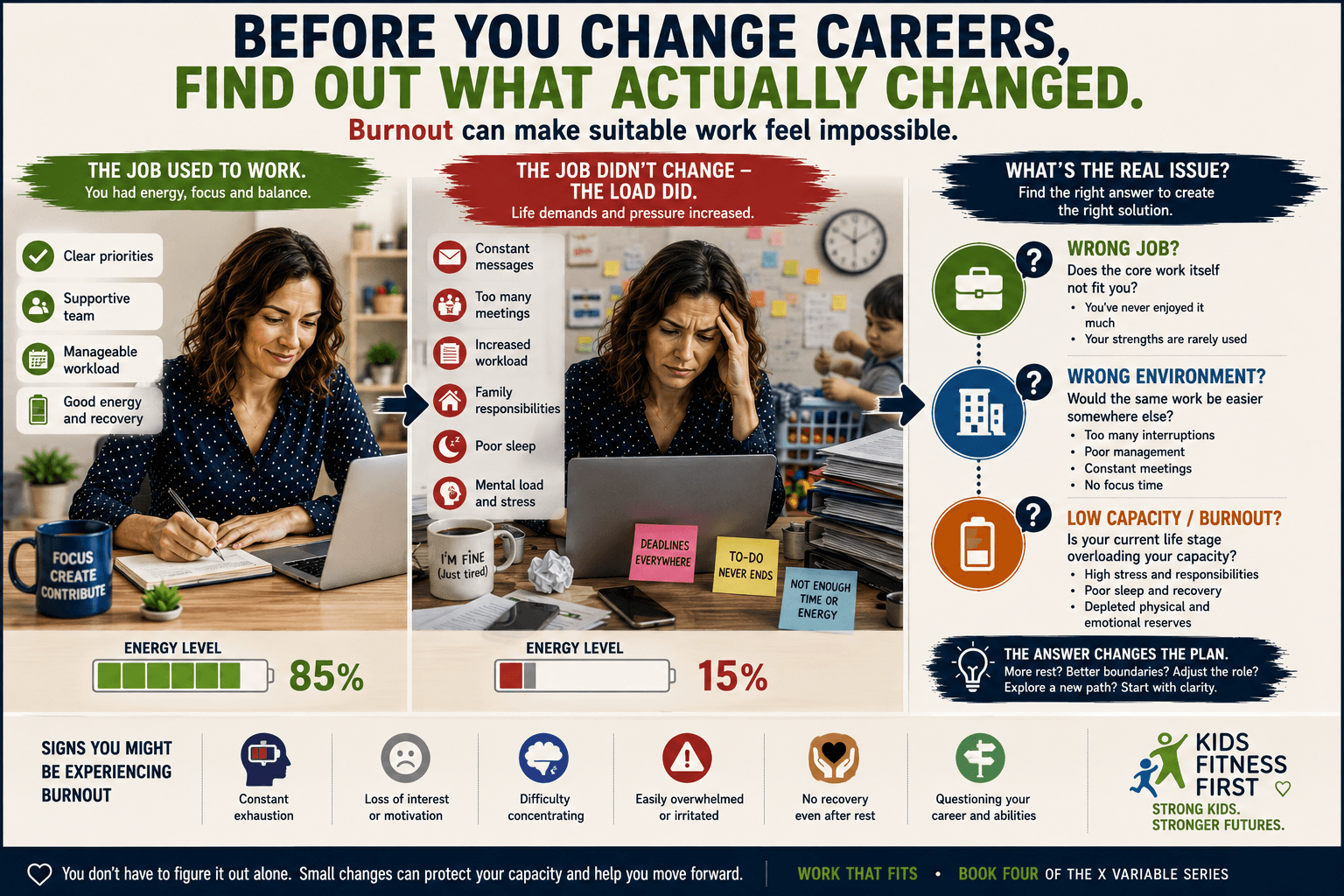
Adult ADHD and Career Burnout: Could the Problem Be Your Current Life Stage?
Adult ADHD and career burnout can create one of the hardest career questions to answer.
Perhaps the job used to feel manageable.
You may even have enjoyed it.
However, something has changed.
Tasks that once felt straightforward now feel difficult.
Meetings seem more draining.
Small problems feel larger.
Likewise, you may find yourself thinking:
“I cannot do this anymore.”
At that point, it is easy to conclude:
“I need a completely different career.”
However, before making that decision, there is another possibility worth examining.
The job may not have changed.
Your available capacity may have changed.
Therefore, this article explores the third part of the Work That Fits diagnosis:
- Is the job wrong?
- Is the environment wrong?
- Or are you currently depleted, making otherwise suitable work much harder to sustain?
That distinction matters because each problem requires a different solution. For the energy-cost warning signs that can appear before or alongside burnout, see Adult ADHD and Work Exhaustion. If sustained overload is already present, the next page in this branch focuses on recovery and changing the working pattern.
A Job Can Fit and Still Feel Impossible During Burnout
Article 6 explored adult ADHD and the wrong job.
Article 7 explored adult ADHD and the wrong work environment.
Now we need to consider a third possibility.
Perhaps the job fits reasonably well.
Likewise, the workplace may not be especially damaging.
However, your current reserves may be too low for the demands being placed on you.
For example, you may be dealing with:
poor sleep;
family responsibilities;
financial pressure;
health difficulties;
prolonged stress;
caregiving;
workload increases;
major life changes.
As a result, work that previously felt manageable can begin to feel overwhelming.
Therefore, career diagnosis should include your current life stage, not only the role itself.
Adult ADHD and Career Burnout: Capacity Is Not Fixed
People often think about professional ability as though it is constant.
You are either capable or incapable.
However, real life is more complicated.
Your capacity can change according to:
sleep;
stress;
physical health;
emotional load;
family demands;
work intensity;
recovery time.
Therefore, the same person may perform very differently at different stages of life.
This does not necessarily mean their underlying ability has disappeared.
Instead, it may mean that too much of their available capacity is being used elsewhere.
The Capacity Budget
A useful way to think about this is through a capacity budget.
Imagine that on a reasonably good week you have 100 units of usable energy and attention.
Perhaps work normally requires 60.
That leaves 40 for:
relationships;
household responsibilities;
exercise;
rest;
personal interests.
Now imagine a major life change.
Perhaps caregiving suddenly requires 25 units.
Poor sleep takes another 15.
The job still requires 60.
However, your total demand is now 100 before everyday life is even included.
Consequently, the job may begin to feel impossible even though the job itself has not changed.
Adult ADHD and Career Burnout: Look at What Changed
Before assuming the career is wrong, ask:
“What changed before the work became unbearable?”
Perhaps:
your workload increased;
your sleep deteriorated;
a family member needed more support;
your commute changed;
you stopped exercising;
your role expanded;
your team became understaffed;
you experienced prolonged stress.
This question is important because career dissatisfaction does not always begin inside the career.
Sometimes work becomes the place where depleted capacity finally becomes visible.
Burnout Can Change How You Interpret Everything
When you are deeply exhausted, your judgement can become more negative.
A task that once felt neutral now feels intolerable.
A small request feels intrusive.
A meeting feels unbearable.
Even work you previously enjoyed may feel pointless.
Therefore, be cautious about making permanent conclusions while severely depleted.
This does not mean dismissing your feelings.
Instead, it means asking:
“Would I feel differently about this role if I had more energy?”
That question can help separate depletion from poor fit.
Adult ADHD and Career Burnout: The Before-and-After Test
Think about the same role at two different points.
Before
How did the job feel six months or a year ago?
Now
How does it feel today?
Then ask:
“Did the core job change, or did my capacity change?”
If the role was always difficult, that may point towards poor fit.
However, if it once worked reasonably well and only recently became impossible, burnout or life-stage pressure deserves closer attention.
Was There Ever a Version of This Job That Worked?
This is one of the most useful questions in the article.
Ask:
“Was there ever a period when I could do this work without being destroyed by it?”
If the answer is yes, what was different?
Perhaps:
fewer responsibilities;
better sleep;
smaller workload;
supportive management;
less commuting;
more recovery time.
Therefore, the past can provide clues about whether the job itself is the problem or whether the conditions around your capacity changed.
Adult ADHD and Career Burnout: Burnout Can Mimic Poor Job Fit
Burnout can create symptoms that resemble a bad career match.
For example:
loss of motivation;
irritability;
difficulty concentrating;
avoidance;
reduced confidence;
emotional detachment;
constant fatigue.
These experiences can make you think:
“I hate this career.”
However, some of those feelings may be consequences of prolonged depletion.
Therefore, it is useful to ask whether the dislike is stable or appeared alongside exhaustion.
Do Not Assume All Exhaustion Is Burnout
This distinction is essential.
Persistent exhaustion can have many possible causes.
For example:
sleep disorders;
physical illness;
medication effects;
mental health difficulties;
nutritional issues;
prolonged stress.
Therefore, this article cannot diagnose burnout.
Likewise, significant or persistent fatigue should not automatically be attributed to ADHD.
If exhaustion is severe, worsening or affecting daily functioning, appropriate professional assessment is important.
Adult ADHD and Career Burnout: The Life-Load Audit
Career problems do not happen in isolation.
Therefore, review your whole life.
Ask how demanding each area currently feels.
Work
Low / Medium / High
Family Responsibilities
Low / Medium / High
Health
Low / Medium / High
Financial Pressure
Low / Medium / High
Sleep Problems
Low / Medium / High
Relationship Stress
Low / Medium / High
Caregiving
Low / Medium / High
If several areas are currently high, the problem may be cumulative load rather than one single job.
The Same Work Can Cost More During a Difficult Life Stage
Imagine a role that normally requires 70% of your available energy.
That may be sustainable when the rest of life is relatively stable.
However, if a major personal demand appears, the same 70% can become too much.
Therefore, sustainability is not only about the job.
It is about the relationship between the job and the rest of your life.
A role can fit one life stage and become temporarily unsuitable during another.
Adult ADHD and Career Burnout: Parenting and Care Responsibilities
Life stages can significantly change working capacity.
For example, parenting young children may introduce:
sleep disruption;
school logistics;
constant decisions;
emotional demands.
Likewise, caring for an ageing parent may create appointments, travel and responsibility outside work.
Therefore, if the job suddenly feels harder, look at what you are already carrying before you arrive.
The working day does not begin with an empty battery.
Financial Stress Also Uses Capacity
Financial pressure does not stay neatly outside work.
You may spend mental energy thinking about:
bills;
debt;
housing;
job security;
future income.
Consequently, concentration may become harder even when the work itself has not changed.
Therefore, burnout assessment should include hidden mental load, not only visible workload.
Adult ADHD and Career Burnout: Sleep Can Change Everything
Poor sleep can significantly affect attention, emotional regulation and energy.
Therefore, if work suddenly feels much harder, examine sleep alongside career fit.
Perhaps late-night catch-up work is shortening sleep.
Then reduced sleep makes the following workday harder.
Consequently, more catch-up becomes necessary.
This creates a cycle.
Therefore, fixing the career without addressing the sleep-work cycle may not solve the underlying problem.
The Burnout Spiral
A burnout spiral can look like this:
Work becomes harder.
Therefore, you work longer.
Working longer reduces recovery.
As a result, you have less energy tomorrow.
Then work becomes even harder.
So you work longer again.
Eventually, the system begins feeding itself.
Therefore, one goal is to interrupt the spiral rather than simply demanding more effort.
Adult ADHD and Career Burnout: Beware of Compensation
When performance drops, you may compensate.
For example:
starting earlier;
working later;
skipping lunch;
taking work home;
checking email at night;
working weekends.
Initially, this may protect performance.
However, it also removes recovery.
Consequently, the compensation can become part of the burnout.
Therefore, if you are maintaining results only by extending work into recovery time, the current system may not be sustainable.
Workplace Masking Can Make Burnout Harder to Spot
Article 4 explored workplace masking.
If you are skilled at appearing fine, colleagues may not realise how depleted you are.
Perhaps you remain:
polite;
productive;
responsive;
professional.
However, the effort required to maintain that appearance may be increasing.
Therefore, burnout can develop behind successful performance.
This is one reason external feedback alone may not tell the full story.
Adult ADHD and Career Burnout: Work Exhaustion Is a Warning Signal
Article 5 explored work exhaustion.
Now ask whether that exhaustion has changed over time.
For example:
Previously
Tired after work, but recovered by evening.
Now
Tired after work and still depleted the next morning.
That shift matters.
Likewise:
Previously
Weekend restored you.
Now
Weekend barely makes a difference.
Therefore, recovery failure may be more informative than simply feeling tired.
Recovery Is Part of the Diagnosis
Ask:
“Does rest still restore me?”
If one quiet evening helps considerably, you may be experiencing ordinary fatigue.
However, if several days off barely help, the problem deserves greater attention.
Again, this does not provide a diagnosis.
Instead, it tells you that the current level of exhaustion may be more significant than routine tiredness.
Adult ADHD and Career Burnout: The Recovery Test
For one or two weeks, where realistically possible, observe:
- sleep;
- workload;
- evenings;
- weekends;
- energy before work;
- energy after work.
Then ask:
“When I genuinely reduce demand, does my interest in the work return?”
If yes, capacity may be a major factor.
However, if better-rested periods still leave you strongly disengaged from the core job, poor role fit may remain part of the picture.
Burnout Can Reduce Access to Your Strengths
Article 3 explored invisible work and recurring strengths.
Perhaps you are usually excellent at problem-solving.
However, during severe exhaustion you cannot access that ability as easily.
Likewise, creativity may disappear.
Your thinking may feel slower.
Therefore, do not automatically conclude that your strengths were imagined.
They may simply be harder to access while depleted.
Adult ADHD and Career Burnout: When Everything Feels Like a Weakness
Burnout can alter how you interpret yourself.
Perhaps you think:
“I cannot organise anything anymore.”
“I have lost my ability.”
“I am becoming useless.”
However, global conclusions can be misleading during periods of severe strain.
Instead, ask:
“What could I do when I was better resourced?”
That comparison may help separate current capacity from long-term capability.
Is the Job Wrong or Is Your Life Overloaded?
Use this simple comparison.
Signs the Job Itself May Be Wrong
The core work has always drained you.
Your strongest skills are rarely used.
Even during rested periods, the work feels wrong.
The role would still feel wrong in a better environment.
Signs Capacity May Be the Bigger Problem
The job previously felt manageable or enjoyable.
Several parts of life became more demanding before work deteriorated.
You still recognise parts of the role you value.
Rest or reduced demand improves your relationship with the work.
These are not rigid rules.
However, they can help structure your thinking.
Adult ADHD and Career Burnout: It Can Be Both
Do not assume you must choose one explanation.
Sometimes the job is a poor fit and you are burnt out.
Likewise, the workplace may be difficult and your life load may be unusually high.
Therefore, career diagnosis is not always:
A or B or C.
It can be:
A + B + C.
For example:
slightly wrong job;
poor environment;
high family stress.
Together, these may create a much bigger problem than any single factor alone.
The Three-Part Wrong-Fit Diagnosis
Use these three questions.
1. Is the Work Wrong?
Would I want to do the core work under better conditions?
2. Is the Environment Wrong?
Would the same work feel substantially easier somewhere else?
3. Is My Current Capacity Too Low?
Would this role feel more manageable if the rest of my life and recovery improved?
These questions help prevent solving the wrong problem.
Adult ADHD and Career Burnout: Do Not Resign From Your Worst Week
A particularly difficult week can create strong urges to escape.
That is understandable.
However, where circumstances allow, avoid making irreversible decisions solely from the emotional peak of exhaustion.
Instead:
collect information;
rest where possible;
review finances;
consider adjustments;
seek appropriate support.
Then reassess.
This does not mean staying indefinitely in harmful work.
It means trying to make decisions with as much clarity as possible.
Stabilisation Before Reinvention
If you are deeply depleted, rebuilding your entire career may be too much.
Therefore, first consider stabilisation.
That may involve:
reducing unnecessary workload;
protecting sleep;
taking appropriate leave;
seeking healthcare support;
reducing after-hours work;
using clearer boundaries;
asking for practical adjustments.
Then, once capacity improves, career questions may become easier to answer.
Adult ADHD and Career Burnout: Reduce the Load Before Judging the Career
Suppose you are carrying:
five major work projects;
poor sleep;
care responsibilities;
constant overtime.
Then you decide:
“I hate my profession.”
Maybe you do.
However, first ask whether any part of the load can be reduced.
If conditions improve and the work still feels fundamentally wrong, that gives you stronger evidence.
Therefore, reduction can become part of the diagnosis.
Use the 20% Reduction Question
Ask:
“If I could reduce my total demand by 20%, what would I change first?”
Perhaps:
one project;
one meeting;
late-night email;
weekend work;
a household responsibility;
unnecessary social commitments.
This question is useful because complete life redesign may be impossible.
However, a meaningful reduction may still create valuable breathing room.
Adult ADHD and Career Burnout: Protect Recovery Deliberately
Recovery rarely happens automatically when every available hour is filled.
Therefore, protect it.
For example:
finish work at a defined time;
avoid non-essential evening email;
keep part of the weekend work-free;
take a genuine lunch break where possible;
schedule quiet time.
These actions do not solve every cause of burnout.
However, they can help reveal whether inadequate recovery is part of the problem.
A Career Has to Fit Your Current Life
The ideal job at age 25 may not be the ideal job at 45.
Likewise, the ideal role before having children may not fit a period of heavy family responsibility.
Therefore, career fit is not a permanent answer.
It can evolve.
The question is not only:
“What career fits my brain?”
Also ask:
“What kind of work fits my life right now?”
That can lead to a more realistic answer.
Adult ADHD and Career Burnout: Temporary Downshifting
Sometimes sustainability may require a temporary downshift.
For example:
reduced responsibilities;
shorter hours;
fewer projects;
less travel;
different role emphasis.
This does not automatically mean permanent career regression.
Instead, it may create room to recover.
Therefore, do not assume every career decision must always move towards more responsibility.
Sometimes preserving capacity is the more strategic choice.
The Status Trap
Career culture often equates progress with:
larger team;
bigger title;
more responsibility;
longer hours.
However, more responsibility is not automatically better.
If additional status destroys sustainability, the trade-off deserves examination.
Therefore, ask:
“Is this progression improving my working life, or simply increasing the load?”
Adult ADHD and Career Burnout: When Promotion Becomes Too Much
Perhaps the work suited you until promotion.
Then your responsibilities changed.
You gained:
people management;
administration;
meetings;
conflict;
constant decision-making.
At the same time, your life outside work also became more demanding.
Consequently, the promotion may have collided with a lower-capacity life stage.
Therefore, the solution may not require leaving the profession entirely.
Instead, it may involve changing the level or shape of responsibility.
Protect Against Self-Criticism
Burnout often creates self-criticism.
You may think:
“I used to manage this. Why can’t I now?”
However, the answer may simply be:
because the total load is different now.
Therefore, compare conditions, not just output.
What were you carrying then?
What are you carrying now?
A fair comparison requires context.
Adult ADHD and Career Burnout: The Capacity Timeline
Draw a timeline of the past 12–24 months.
Mark:
job changes;
workload increases;
manager changes;
health issues;
family events;
sleep problems;
major stress.
Then mark when your work exhaustion became significantly worse.
Look for relationships.
For example:
Work felt manageable → family care increased → sleep reduced → exhaustion rose.
This does not prove cause.
However, it can help you identify what deserves investigation.
Your 7-Day Capacity Audit
For seven days, record:
1. Energy Before Work
Rate 1–10.
2. Energy After Work
Rate 1–10.
3. Non-Work Load
Rate Low / Medium / High.
4. Core Job Enjoyment
Rate 1–10.
5. Recovery
Did you feel better after rest?
At the end of the week, look for patterns.
For example, does job enjoyment fall mainly on high-life-load days?
That information can be revealing.
The Green, Amber and Red Capacity Test
GREEN
You are tired at times, but recovery generally works.
You can still access interest and strengths.
The current role feels broadly sustainable.
AMBER
You are regularly depleted.
Recovery takes longer.
However, some interest and engagement remain.
Targeted reductions and support may help.
RED
You are persistently exhausted.
Recovery is poor.
Daily functioning outside work is significantly affected.
Therefore, appropriate professional support and more substantial changes may need consideration.
This is not a clinical test.
Instead, it is a reflection tool.
Reflection Questions
- Did your job always feel this difficult?
- What changed before your exhaustion increased?
- How demanding is your life outside work right now?
- Does rest meaningfully restore you?
- Do you still enjoy any of the core work?
- Would a 20% reduction in demand change how the role feels?
- Has a promotion or workload increase changed the job?
- Are you working longer to compensate for reduced capacity?
- Are you judging your current performance against a different stage of your life?
- Is the problem the job, the environment, your current capacity — or a combination of all three?
Conclusion: Do Not Confuse Depletion With Identity
Adult ADHD and career burnout can make you question everything.
Your competence.
Your career.
Your motivation.
Perhaps even your identity.
However, severe depletion can distort the picture.
Therefore, before deciding that you have chosen the wrong career, ask:
“What has changed in my total capacity?”
Perhaps the job is wrong.
Perhaps the environment is wrong.
However, perhaps the work once fitted and your current life is simply asking more from you than before.
That distinction matters.
Because a depleted person does not necessarily need an entirely new identity.
They may first need:
less load;
better recovery;
clearer boundaries;
appropriate support;
a temporary change in responsibility.
Then, from a more stable position, the career question can be reviewed again.
Most importantly, remember:
A job should be assessed against the life you actually have — not the amount of capacity you wish you had.
Sometimes career design means moving towards bigger opportunities.
However, sometimes it means creating enough space to become yourself again.
SUGGESTED INTERNAL LINKS
- Adult ADHD and the Wrong Work Environment: When the Job Is Right but the Workplace Is Wrong
- Adult ADHD and the Wrong Job: How to Know When the Work Itself Does Not Fit
DISCLAIMER
This article is provided for general educational and informational purposes only. It does not provide medical, psychological, diagnostic, occupational-health, employment or legal advice.
Burnout, fatigue, concentration difficulties and reduced functioning can have many causes, including physical health conditions, mental health factors, sleep difficulties, medication, stress and life circumstances. Therefore, persistent or severe exhaustion should not automatically be attributed to ADHD, career burnout or neurodivergence.
If fatigue, distress or reduced functioning are persistent, worsening or significantly affecting your health, work or daily life, please seek appropriate professional advice. Likewise, decisions about medical leave, reduced hours, workplace adjustments or employment changes should take account of individual circumstances and applicable professional or legal guidance.