Adult ADHD and Career Decisions: How to Tell Whether to Stay, Change Roles or Change Employers
Adult ADHD and career decisions can become difficult because the real problem is not always obvious.
You may know that something is wrong.
However, you may not know exactly what needs to change.
Perhaps the work itself feels wrong.
Alternatively, you may like the job but dislike the environment.
Likewise, the job and workplace may both be reasonably suitable, but your current life stage may have left you too depleted to cope well.
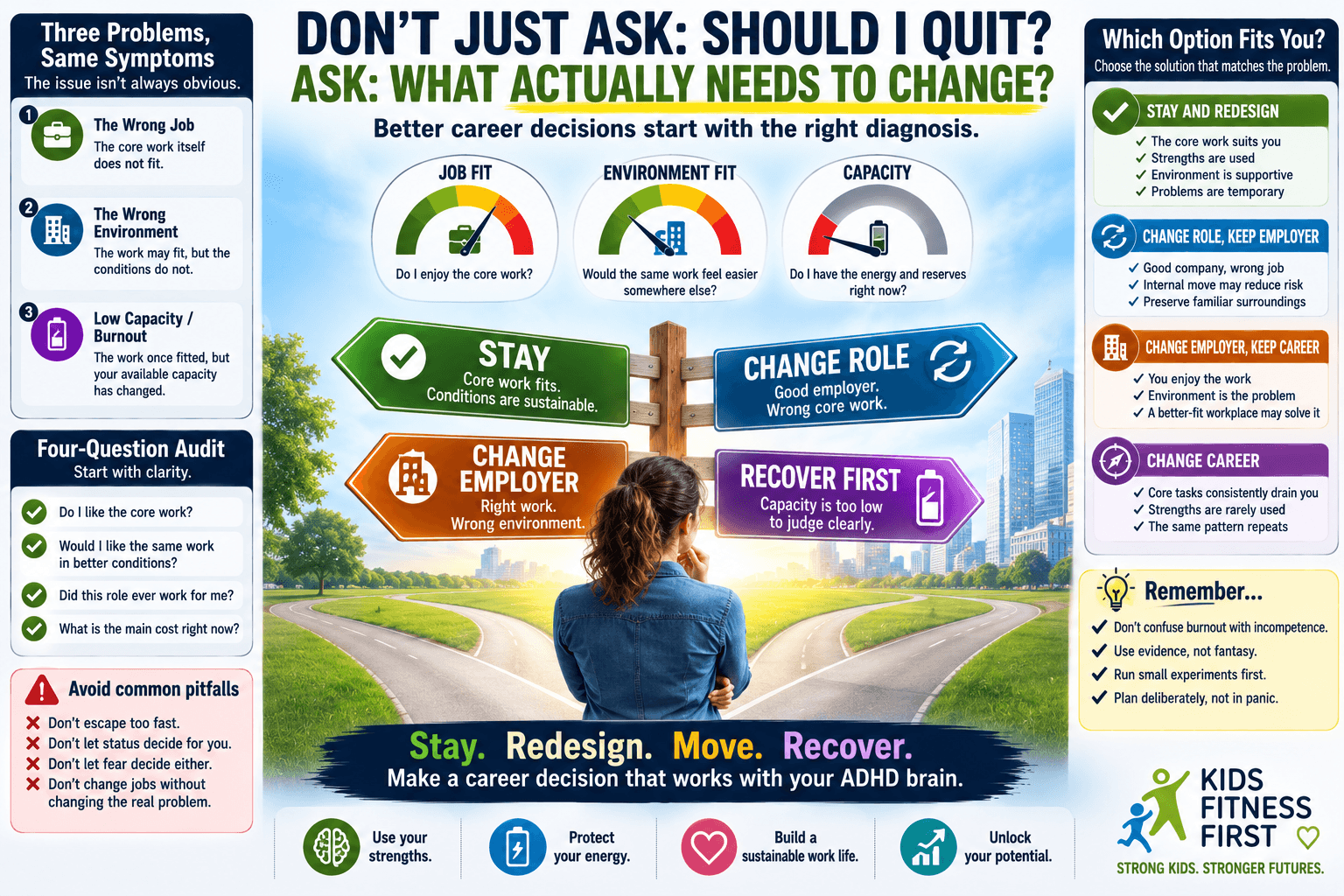
Therefore, a career decision should begin with diagnosis rather than escape.
Instead of immediately asking:
“Should I quit?”
ask:
“What exactly needs to change?”
That single question can prevent you from solving the wrong problem. Use the more specific guides on the wrong job, the wrong work environment and career burnout and depleted capacity to identify which issue is dominant before deciding what to change.
As a result, you can make a more deliberate career decision rather than reacting only to frustration.
The Three Problems That Can Look the Same
The previous three articles examined three different problems.
1. The Wrong Job
The core work itself does not fit.
2. The Wrong Environment
The work may fit, but the conditions do not.
3. Low Capacity or Burnout
The work and environment may once have worked, but your available capacity has changed.
These three situations can feel remarkably similar.
For example, all three can produce exhaustion, avoidance, low motivation, Sunday dread, difficulty concentrating and the desire to escape.
However, they do not require the same solution.
Therefore, before changing careers, identify which problem is dominant.
In other words, the first task is not deciding what to do next.
The first task is understanding what is actually wrong.
Adult ADHD and Career Decisions: Why Escaping Fast Can Backfire
When work feels unbearable, relief can become the immediate priority.
You may think:
“Anything would be better than this.”
That reaction is understandable.
However, if you do not understand what made the current situation difficult, you may recreate the same problem somewhere else.
For example, you may leave a noisy workplace.
Then, without realising it, you accept another open-plan role.
Likewise, you may leave a repetitive job.
However, your next role may contain the same core tasks under a different title.
Consequently, the scenery changes while the underlying problem remains.
Therefore, clarity before movement can save considerable time, money and energy.
Start With the Four-Question Audit
A practical way to organise the decision is to ask four questions.
1. Do I Like the Core Work?
Not the salary.
Not the title.
Not the employer.
Instead, think about the work itself.
2. Would I Like the Same Work in Better Conditions?
If yes, the environment may be the bigger issue.
3. Did This Role Ever Work for Me?
If yes, current capacity or recent changes may matter.
4. What Is the Main Cost Right Now?
Is it:
the task;
the environment;
masking;
life load;
or a combination?
Together, these questions create a much clearer starting point.
Adult ADHD and Career Decisions: Stay When the Core Is Good
Sometimes the best decision is to stay.
That may be appropriate when the core work suits you, your strengths are used, the environment is broadly supportive and the role remains sustainable.
For example, a difficult project may be ending soon.
Likewise, a temporary workload spike may not justify abandoning a role that otherwise fits well.
Therefore, staying should not automatically be interpreted as fear or lack of ambition.
Sometimes staying is the rational decision.
In fact, preserving a good fit can be more sensible than chasing change simply because change feels more dramatic.
Stay and Redesign
There is also a middle option between staying exactly as things are and leaving completely.
You may be able to redesign parts of the role.
For example, you might:
reduce unnecessary meetings;
protect focus time;
clarify priorities;
change communication methods;
shift some responsibilities;
use external systems;
adjust working location.
As a result, the same job may become substantially more sustainable.
Therefore, before making a major move, ask:
“What could be changed without changing employer?”
If the answer includes several realistic options, redesign may deserve a serious trial.
Adult ADHD and Career Decisions: Change Role, Keep Employer
A good company can contain the wrong job.
Perhaps you like the organisation, the people, the values, the benefits and the location.
However, your current role may not use your strongest abilities.
In that case, an internal move may be worth exploring.
For example:
operations → project work;
people management → specialist work;
general administration → analysis;
routine delivery → process improvement.
Therefore, do not assume career change always requires employer change.
Instead, ask whether the right work may already exist somewhere else inside the same organisation.
Internal Moves Can Reduce Risk
Changing employers involves uncertainty.
There may be a new manager, new culture, new expectations, new commute and new systems.
By contrast, an internal move may allow you to change the work while preserving familiar surroundings.
Therefore, when the employer is good but the role is poor, internal mobility can provide a lower-risk experiment.
Moreover, it can give you evidence about whether the problem was truly the job rather than the organisation.
Adult ADHD and Career Decisions: Change Employer, Keep Career
Sometimes the work suits you, but the environment does not.
Article 7 explored this directly.
For example, you may enjoy analysis.
However, the workplace may be noisy and fragmented.
Likewise, you may enjoy client work.
However, the manager may micromanage every interaction.
Similarly, you may enjoy your profession.
However, the culture may demand constant availability.
In these situations, changing employer may solve more than changing profession.
Therefore, ask:
“Would I still want to do this work somewhere else?”
If the answer is yes, do not abandon the career too quickly.
Change the Environment Before Changing Identity
A poor environment can make you doubt your entire professional identity.
You may think:
“I am not suited to this field.”
However, a better question may be:
“Am I unsuited to this field, or unsuited to this workplace?”
That distinction matters.
As a result, you may preserve a career you still genuinely value while changing the conditions that are undermining it.
Adult ADHD and Career Decisions: Change Career When the Core Is Wrong
A larger career change may become more reasonable when:
the core tasks consistently drain you;
your strongest skills are rarely used;
the role would still feel wrong in a better environment;
the same pattern repeats across employers;
you have strong evidence of better-fitting work elsewhere.
That does not mean you need a dramatic overnight reinvention.
Instead, career change can be gradual.
For example, you might use retraining, side projects, part-time transition, an internal secondment, freelance testing or professional development.
Therefore, career change can be treated as an experiment rather than a leap.
Do Not Confuse Boredom With Burnout
Boredom and burnout can look similar.
Both may cause avoidance, low motivation, poor concentration and frustration.
However, the underlying pattern may differ.
Boredom
You may regain energy when the work becomes challenging or novel.
Burnout
Even interesting tasks may feel difficult.
Therefore, notice whether stimulation restores you.
If it does, poor role fit may be more relevant.
However, if even engaging work feels exhausting, the issue may be broader than the job itself.
Adult ADHD and Career Decisions: Do Not Confuse Burnout With Incompetence
During severe exhaustion, you may feel less capable.
You may make more mistakes.
Likewise, starting tasks may become harder.
However, a temporary loss of capacity does not necessarily mean your long-term ability disappeared.
Therefore, compare yourself with periods when you were better resourced.
Ask:
“What could I do before the exhaustion became severe?”
That provides a fairer comparison.
As a result, you are less likely to mistake depletion for permanent loss of ability.
Financial Reality Matters
Career advice can become unrealistic when it ignores money.
You may know a job is wrong.
However, you may still need the income.
Therefore, career decisions should include:
salary;
savings;
dependants;
benefits;
debt;
notice periods;
alternative opportunities.
Recognising poor fit does not mean you must leave immediately.
Instead, it allows you to plan deliberately.
Adult ADHD and Career Decisions: Use a Transition Plan
If change appears necessary, create a bridge.
For example:
Month 1
Understand the problem.
Month 2
Research alternative roles.
Month 3
Update your CV and build evidence.
Month 4
Begin applications or internal conversations.
As a result, movement becomes structured rather than panicked.
Therefore, even a major career change can begin with small, controlled steps.
The Cost of Staying Matters Too
Financial caution is important.
However, there is also a cost to staying indefinitely in work that is severely damaging.
That cost may include lost health, lost confidence, damaged relationships, reduced career development and chronic exhaustion.
Therefore, the decision is not simply:
“Can I afford to leave?”
Also ask:
“What is staying costing me?”
Both sides belong in the calculation.
Adult ADHD and Career Decisions: Use the Two-Column Test
Create two columns.
Cost of Staying
For example:
exhaustion;
lack of growth;
poor environment;
unused strengths.
Cost of Changing
For example:
lower income;
uncertainty;
training;
new commute;
loss of benefits.
Then, compare the two honestly.
This does not produce an automatic answer.
However, it makes the trade-offs visible.
As a result, the decision becomes less abstract.
Use the Reversibility Test
Not every career decision is permanent.
Ask:
“How reversible is this?”
For example, trying a secondment may be reversible.
Likewise, applying for jobs is reversible.
Taking a short course is usually reversible too.
However, quitting without another plan may be much less reversible.
Therefore, where possible, test lower-risk options first.
Adult ADHD and Career Decisions: Run Small Experiments
Before committing to a major change, test assumptions.
For example, perhaps you think remote work would suit you better.
If possible, try more home-working days.
Likewise, if you think project work fits better than maintenance, volunteer for a project.
Similarly, if you think specialist work suits you better than management, explore an internal specialist responsibility.
As a result, the career decision becomes evidence-based.
Therefore, small experiments can reduce the risk of large assumptions.
Evidence Is Better Than Fantasy
It is easy to romanticise alternative careers.
You may imagine freedom, interest, autonomy and meaning.
However, every career contains trade-offs.
Therefore, investigate actual daily tasks, income, working hours, administration, social demands and training requirements.
A role can sound perfect from the outside.
Nevertheless, it may still contain the same problems you are trying to escape.
Adult ADHD and Career Decisions: Compare Real Days
Do not compare your worst current day with an imagined perfect future career.
Instead, compare a realistic current week with a realistic future week.
Ask:
What would I actually do each day?
What would the energy cost be?
What would the income look like?
How much autonomy would I have?
As a result, you get a much more useful comparison.
Your Career History Already Contains Evidence
Article 1 explored career history.
Use it now.
Which roles felt best?
Which lasted longest without severe cost?
Which used your strengths?
Which allowed recovery?
Then, ask what those roles had in common.
Likewise, examine the roles that failed.
What repeatedly went wrong?
Therefore, your career history can help prevent you from repeating old patterns.
Adult ADHD and Career Decisions: Use Invisible Work
Article 3 explored invisible work.
Perhaps your official job has never reflected your strongest contribution.
For example:
formal role → administrator.
invisible work → process improvement.
Likewise:
formal role → customer service.
invisible work → complex problem-solving.
Therefore, future career decisions should consider what people repeatedly relied on you for, not just what your job titles say.
Use the Masking Tax
Article 4 explored workplace masking.
Ask:
“How much of my exhaustion comes from doing the job, and how much comes from managing how I appear while doing it?”
If reducing masking would substantially improve the role, you may not need a completely different career.
However, if the core work remains wrong even without masking, a larger change may be warranted.
Therefore, include masking inside the diagnosis rather than treating exhaustion as one single problem.
Adult ADHD and Career Decisions: Use Energy as Evidence
Article 5 explored work exhaustion.
Track not only whether you can perform a task.
Also, ask:
“What happens afterwards?”
A sustainable career should not require continuous recovery from ordinary working days.
Therefore, energy is career information.
In addition, recovery time may reveal problems that performance data alone hides.
The Decision Matrix
Use this simple matrix:
| Core Work | Environment | Capacity | Likely Next Step |
|---|---|---|---|
| Good | Good | Good | Stay |
| Good | Poor | Good | Change environment or employer |
| Poor | Good | Good | Change role or career direction |
| Good | Good | Low | Stabilise and recover |
| Poor | Poor | Good | Consider larger career change |
| Good | Poor | Low | Reduce load and improve environment |
| Poor | Good | Low | Stabilise first, then reassess |
| Poor | Poor | Low | Recovery first, then major review |
This is not a clinical or professional assessment.
Instead, it is a practical thinking tool.
Therefore, use it to organise information rather than to force an automatic answer.
Adult ADHD and Career Decisions: The Stay Question
Ask:
“What would need to change for staying to become a good decision?”
If the answer is realistic, staying may deserve a trial.
For example:
one remote day;
fewer meetings;
new manager;
different responsibilities.
However, if your answer is:
“The entire job would need to become something else,”
that tells you something important.
The Leave Question
Now ask:
“What am I hoping leaving will solve?”
Be specific.
Noise?
Repetition?
Manager?
Exhaustion?
Lack of meaning?
Then, make sure the next option actually addresses those problems.
Otherwise, you may change jobs without changing the underlying pattern.
Adult ADHD and Career Decisions: The One-Year Question
Ask:
“If nothing changed for the next twelve months, how would I feel?”
Would the situation be manageable, disappointing or intolerable?
As a result, this question can clarify the cost of inaction.
Therefore, do not assess only the risk of changing.
Also assess the risk of remaining where you are.
The Five-Year Question
Then ask:
“If I stayed on this exact path for five years, where would it lead?”
Consider:
skills;
income;
energy;
health;
career options;
personal life.
A decision that feels safe for one month may look very different over five years.
Therefore, use both short-term and long-term perspectives.
Adult ADHD and Career Decisions: Do Not Let Status Decide for You
A prestigious role can be difficult to leave.
Perhaps you worked hard to earn the title.
Likewise, family or colleagues may admire the position.
However, status does not automatically equal fit.
Therefore, ask:
“If nobody knew my job title, would I still want this work?”
That can be a revealing question.
Do Not Let Fear Decide Either
Fear is understandable.
A new role may involve uncertainty.
However, fear alone should not determine the decision.
Likewise, relief alone should not determine it.
Instead, combine evidence, risk, finances, energy, fit and future direction.
As a result, the decision becomes more balanced.
Adult ADHD and Career Decisions: Create Decision Criteria
Before evaluating options, decide what matters most.
For example:
Essential
reasonable energy cost;
clear priorities;
enough autonomy;
minimum salary.
Preferred
hybrid working;
small team;
meaningful work.
Bonus
short commute;
particular industry.
Therefore, when an opportunity appears, you already know what matters most.
As a result, you are less likely to be distracted by one attractive feature while ignoring a major mismatch.
Use a Weighted Score
You can also score opportunities.
For example:
| Factor | Importance | Current Job | New Option |
|---|---|---|---|
| Core work fit | 5 | 2 | 4 |
| Environment | 5 | 2 | 4 |
| Salary | 4 | 5 | 3 |
| Autonomy | 4 | 2 | 5 |
| Energy cost | 5 | 1 | 4 |
Then, compare the results.
This does not make the decision for you.
However, it can reduce emotional noise.
Therefore, use the score as another source of information, not as a final verdict.
Adult ADHD and Career Decisions: Avoid Endless Research
Career decisions can become another form of procrastination.
More articles.
More job boards.
More personality tests.
More opinions.
Eventually, you may know more but still remain stuck.
Therefore, set a decision point.
For example:
“I will research for two weeks, then choose the next experiment.”
As a result, analysis remains useful rather than endless.
Ask Better People
Advice quality matters.
Someone may say:
“Just stay. Every job is hard.”
Another may say:
“Quit immediately.”
Both responses may reflect their own experiences more than yours.
Therefore, seek input from people who understand your work, your circumstances, your finances and your strengths.
Then, make the final judgement yourself.
Adult ADHD and Career Decisions: Separate Advice From Permission
Sometimes you are not really asking:
“What should I do?”
Instead, you may be asking:
“Am I allowed to want something different?”
That is a different question.
You do not need to prove that your current job is terrible before exploring better fit.
However, exploration and immediate resignation are not the same thing.
Therefore, give yourself permission to investigate without forcing an instant decision.
Your 7-Day Career Decision Audit
For seven working days, record:
1. Core Work Fit
Rate 1–10.
2. Environment Fit
Rate 1–10.
3. Capacity
Rate 1–10.
4. Biggest Positive
What helped today?
5. Biggest Negative
What hurt most?
At the end of the week, review the broad pattern.
Do not rely only on your worst hour.
Instead, look for repeated evidence across several days.
The 30-Day Decision Plan
If no immediate safety or health issue requires urgent action, try this structure.
Week 1 — Diagnose
Is the main issue the job, the environment or your capacity?
Week 2 — Test
Make one realistic improvement.
Week 3 — Explore
Research internal and external alternatives.
Week 4 — Decide the Next Step
Stay and redesign?
Move internally?
Change employer?
Begin career transition?
As a result, the decision becomes a process rather than a single emotional moment.
The Green, Amber and Red Career Decision Test
GREEN — Stay and Strengthen
The core job fits.
The environment is workable.
Capacity is reasonable.
Therefore, focus on improving what already works.
AMBER — Modify or Explore
Something important is wrong.
However, targeted change may fix it.
Therefore, test internal or environmental changes before making a larger move.
RED — Plan Significant Change
The core work is consistently wrong, the environment is damaging or the overall cost is no longer sustainable.
Therefore, a larger transition may deserve serious consideration.
Again, this is a practical framework, not professional advice.
Reflection Questions
- Do you dislike the core work or mainly the environment?
- Did this job ever work well for you?
- How much is current capacity affecting your judgement?
- What would need to change for staying to become attractive?
- What exactly are you hoping a new job would solve?
- Could an internal move address the problem?
- What has your career history already taught you?
- Which of your strongest skills are underused now?
- What is the cost of staying for another year?
- What is the smallest useful career experiment you could run next?
Conclusion: Solve the Right Career Problem
Adult ADHD and career decisions become easier when you stop treating every form of career distress as the same problem.
Sometimes the job is wrong.
Sometimes the environment is wrong.
Alternatively, your capacity may simply be too depleted.
Likewise, sometimes all three are contributing.
Therefore, the goal is not to escape quickly.
Instead, the goal is to identify what actually needs changing.
If the work fits but the workplace does not, change the conditions or employer.
If the employer is good but the role is wrong, explore an internal move.
If the core work repeatedly fights your strengths, consider a different direction.
If exhaustion is dominating everything, stabilise first and reassess from a stronger position.
Most importantly, remember:
You do not need to know your entire future before taking the next useful step.
A career decision can begin with one experiment.
Then one conversation.
After that, perhaps one application.
Likewise, it may begin with one boundary or one internal enquiry.
Therefore, rather than asking:
“What should I do with the rest of my working life?”
try asking:
“What is the next decision that would give me better information?”
That question is smaller.
However, it can move you much further.
SUGGESTED INTERNAL LINKS
- Adult ADHD and the Wrong Work Environment: When the Job Is Right but the Workplace Is Wrong
- Adult ADHD and Career Burnout: Could the Problem Be Your Current Life Stage?
DISCLAIMER
This article is provided for general educational and informational purposes only. It does not provide medical, psychological, diagnostic, employment, financial, recruitment or legal advice.
Career decisions depend on individual circumstances, including income, savings, dependants, benefits, health, employment rights, labour-market conditions and personal priorities. Therefore, a general career-fit framework should not be used as the sole basis for significant employment or financial decisions.
Likewise, persistent exhaustion, reduced concentration or distress can have many causes and should not automatically be attributed to ADHD, burnout or work. Where appropriate, seek qualified healthcare, career, financial, employment or legal advice before making major changes.