
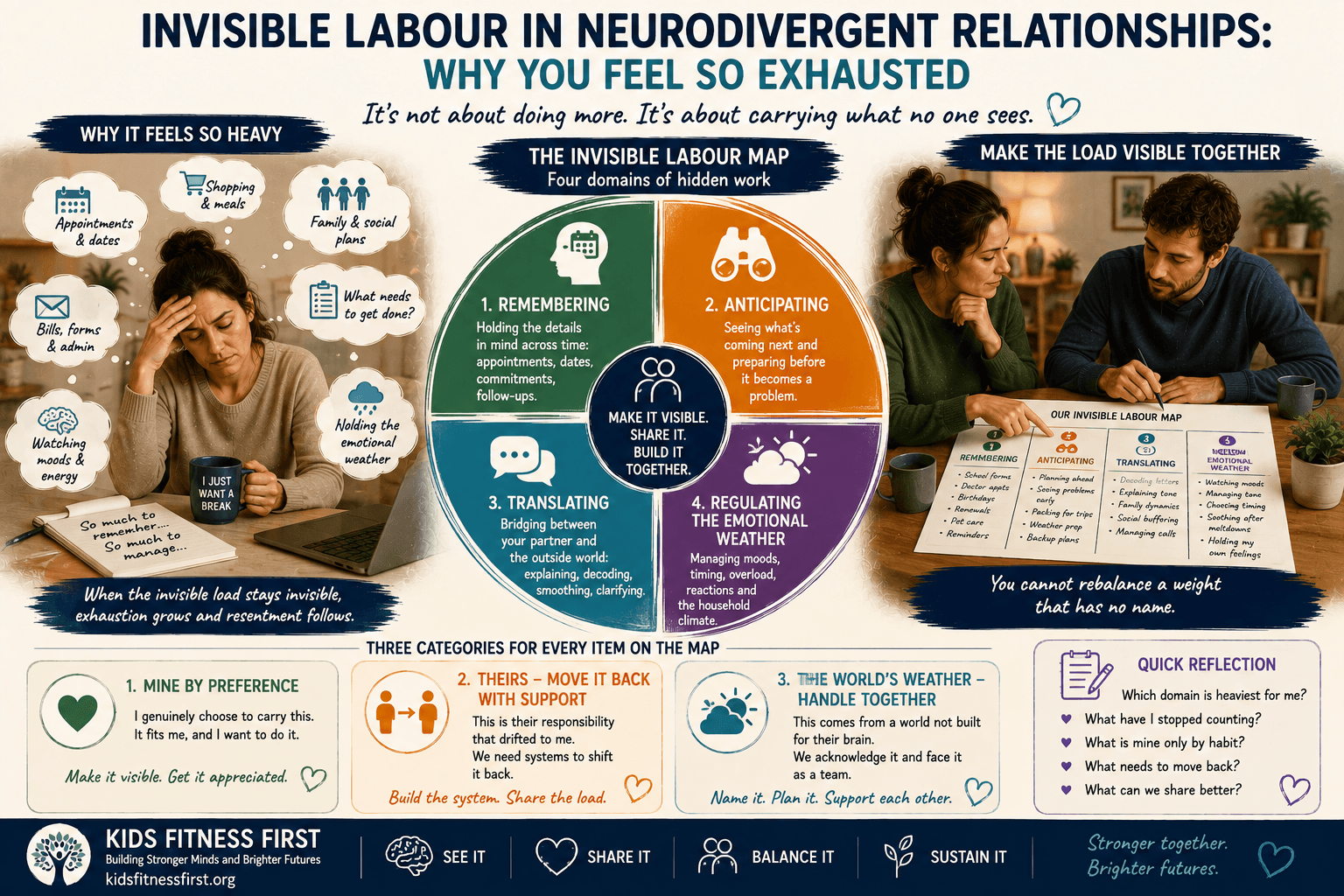
Invisible Labour in Neurodivergent Relationships: Why You Feel So Exhausted
Invisible labour in neurodivergent relationships can make a person tired in a way that sleep does not completely fix.
You may be doing the shopping.
However, you are also remembering what needs replacing next week.
You may be taking your child to an appointment.
Meanwhile, you are also remembering when the next appointment needs booking.
Perhaps your partner completes a household task.
Nevertheless, you were the person who noticed the task, remembered it, asked for it to be done, checked whether it happened and created the backup plan when it did not.
None of that appears on a normal chore chart.
Yet it is work.
In fact, this hidden layer can become some of the heaviest work inside a relationship.
Over time, therefore, a partner may begin saying:
“I am exhausted, but I cannot even explain exactly what I am exhausted from.”
That sentence matters.
Because the exhaustion may not be a mystery.
It may be a ledger.
And the ledger may contain years of work that nobody has properly counted.
Why Ordinary Chore Lists Miss the Real Work
Imagine two partners discussing whether household responsibilities are fair.
One says:
“I cook three nights a week.”
The other replies:
“I do the laundry.”
Then both begin listing visible jobs.
At first, this sounds reasonable.
However, the conversation may miss the most important part.
Who noticed that food was running low?
Who remembered that the school uniform would soon be too small?
Who knew the insurance needed renewing?
Who anticipated that Sunday’s family gathering might become overwhelming?
Who remembered which household conversation had to wait because their partner had already reached capacity?
Likewise, who knows which birthday is next, when the prescription runs out and which problem will become urgent next month if nobody acts now?
This is why a simple 50/50 chore division can sometimes fail to create a 50/50 experience.
The visible work may look equal.
However, the thinking behind the work may still be concentrated in one person’s head.
Therefore, if couples only divide tasks, they may leave the deeper mental load untouched.
The Invisible Labour Map
Book Five calls this hidden work The Invisible Labour Map.
The framework divides the load into four domains:
- The Labour of Remembering
- The Labour of Anticipating
- The Labour of Translating
- The Labour of Regulating the Emotional Weather
These domains overlap.
However, separating them makes something important possible.
Instead of saying:
“I do everything.”
you can begin saying:
“This is the specific work I am actually carrying.”
That is a much more useful starting point.
Because you cannot redistribute a weight that nobody can see.
Domain 1: The Labour of Remembering
The first domain is probably the easiest to recognise.
It is the continuous work of remembering what needs to happen across time.
For example:
- medical appointments;
- school events;
- family birthdays;
- social commitments;
- prescriptions;
- MOT dates;
- insurance renewals;
- household repairs;
- forms;
- bills;
- shopping needs;
- and commitments made several weeks earlier.
Each item may appear small.
However, the weight comes from the number of items running simultaneously.
Imagine forty open tabs in a browser.
No single tab destroys the computer.
Nevertheless, enough open tabs can make the entire system struggle.
The same can happen mentally.
You may be washing your hair when you suddenly remember the dentist.
Likewise, you may be in a work meeting while part of your mind remembers that the car needs servicing.
Later, you wake at night because you suddenly remember the plumber.
Therefore, the task is not simply:
“Book the plumber.”
The hidden task is:
“Keep the need for the plumber alive in your mind until somebody finally books the plumber.”
That second job is invisible.
Yet it may run for days.
When Remembering Becomes Monitoring
There is another layer.
Perhaps your partner has agreed to complete the task.
Technically, therefore, the responsibility has been transferred.
However, you still carry this question:
Will it actually happen?
So you monitor.
You remember that they need to remember.
Then you decide whether to remind them.
You calculate how long you can wait.
Afterwards, if nothing happens, you step in.
Consequently, the task may belong to somebody else on paper while still occupying your mental space.
That is why ownership matters more than simply assigning jobs.
A task is not fully transferred if one partner must continue mentally supervising it.
Domain 2: The Labour of Anticipating
The second domain is more difficult to see.
Anticipating is the future-facing version of remembering.
It is the continuous background scan that asks:
What problem is coming next?
For example:
The children’s shoes still fit today.
However, you know they probably will not fit in six weeks.
The car tyre is legal today.
Nevertheless, you have noticed it will soon need replacing.
The family event is three weeks away.
Meanwhile, you are already considering which social dynamics may cause difficulty.
Perhaps your partner has an important work deadline next month.
Therefore, you already know that the week beforehand may become chaotic unless something is organised now.
This is anticipatory labour.
Nothing has happened yet.
However, your brain is already working on it.
Why Simply Dividing Tasks May Not Fix Anticipation
Suppose a couple divides household tasks equally.
That sounds fair.
However, one person may still be the person who:
- notices what will need doing;
- decides when action should begin;
- reminds the other person;
- monitors progress;
- and checks the result.
Therefore, the visible task may have moved while the anticipatory labour stayed exactly where it was.
For example:
Your partner now “handles the car.”
However, you still notice when the MOT is due.
You still mention the tyre.
You still remind them about the service.
Consequently, you are no longer doing the visible job, but you are still operating the car-management system.
That is not full redistribution.
Instead, it is task delegation with continued mental supervision.
Domain 3: The Labour of Translating
The third domain is particularly important in neurodivergent relationships.
Sometimes one partner gradually becomes the translator between the neurodivergent person and the outside world.
For example, you may:
- explain the tone of a formal letter;
- help interpret an ambiguous message;
- manage a difficult telephone call;
- explain family behaviour to your partner;
- explain your partner to family;
- smooth over misunderstandings;
- help decode bureaucratic language;
- carry a social conversation when your partner becomes overloaded;
- or prepare other people before an interaction so they understand what to expect.
At first, these acts may simply feel loving.
And often they are.
However, love can still involve labour.
The fact that you willingly do something does not mean it costs nothing.
Therefore, translation needs to be counted.
When You Become the Bridge
Imagine a family gathering.
You already know that one relative may interpret your partner’s quietness as rudeness.
Therefore, before the event, you prepare the relative:
“They’ve had a difficult week, so don’t worry if they’re quiet.”
Meanwhile, you prepare your partner:
“Uncle John may talk a lot about work. Don’t take it personally if he asks too many questions.”
During the gathering, you monitor both sides.
Then, when tension appears, you intervene.
Afterwards, you explain one person to the other.
Everybody else may simply remember a successful Sunday lunch.
However, you experienced a three-hour translation assignment.
That is why this domain can be particularly exhausting.
The better you become at it, the less visible it becomes.
Domain 4: The Labour of Regulating the Emotional Weather
The fourth domain may be the hardest to explain.
It is the work of monitoring and adjusting the emotional climate of the household so that daily life keeps functioning.
For example, you may know:
“Tonight is not the night to raise this.”
Therefore, you postpone the conversation.
Perhaps your partner appears close to overload.
Consequently, you soften how you phrase something.
Maybe they react strongly to a small problem.
Meanwhile, you regulate your own reaction because two highly activated nervous systems would make the evening worse.
Sometimes you hold your own frustration privately because the household does not appear capable of carrying both people’s emotions at the same time.
That is emotional weather-regulation.
Some amount of this exists in every caring relationship.
However, the problem appears when it becomes consistently one-directional.
When Your Feelings Keep Waiting
Perhaps you have something important to discuss.
However, Monday was a difficult day for your partner.
Tuesday they were exhausted.
Wednesday they had an important meeting.
Thursday the children were difficult.
Therefore, you decide to wait until the weekend.
Then Saturday becomes busy.
Sunday they need recovery time.
Consequently, your own issue waits another week.
At first, this looks like kindness.
However, repeated over years, something else can happen.
Your own emotional life begins living at the bottom of the household priority list.
Eventually, you may stop knowing what you feel until it emerges as resentment.
That is why emotional weather-regulation can become particularly costly.
The problem is not that you care about your partner’s capacity.
The problem is when only one person’s emotional capacity consistently determines when both people are allowed to exist.
The Four Domains at a Glance
| Invisible Labour Domain | What It Includes | Typical Hidden Thought |
|---|---|---|
| Remembering | Dates, appointments, commitments, tasks and follow-up | “I have to keep this alive in my head.” |
| Anticipating | Seeing future problems and acting before they arrive | “If I don’t think ahead, this will become a crisis.” |
| Translating | Bridging your partner and the outside world | “I need to help both sides understand each other.” |
| Regulating the Weather | Managing timing, tone and emotional capacity | “I need to keep everything calm enough to function.” |
The purpose of this table is not to assign blame.
Instead, it turns vague exhaustion into specific information.
Different Neurodivergence Can Create Different Hidden Loads
The exact shape of the Invisible Labour Map will vary.
Therefore, no couple should assume that all four domains look identical in every neurodivergent relationship.
ADHD
In ADHD relationships, anticipating may become particularly important.
For example, one partner may carry more of the forward planning, reminders and future scanning.
Therefore, simply dividing today’s tasks may not solve tomorrow’s mental load.
Dyslexia
In relationships involving dyslexia, translating may become particularly visible around written information.
For example, one partner may gradually become the household’s main reader of formal letters, contracts, school information or bureaucratic paperwork.
However, that arrangement should still be recognised as work rather than treated as automatic.
Autism
In some relationships involving autism, emotional or environmental regulation may become particularly significant.
For example, a partner may spend substantial energy managing social commitments, transitions, sensory demands or household unpredictability.
Again, this is not universal.
However, if it is happening, it deserves to be named.
The Next Question: Whose Labour Is It?
Once the work becomes visible, another question appears:
Should I actually be carrying all of this?
Book Five suggests dividing items into three categories.
Category 1: Yours by Preference
Some things genuinely suit you.
Perhaps you enjoy managing family birthdays.
Likewise, you may prefer dealing with finances or planning holidays.
If the work is willingly chosen and does not create resentment, it may remain yours.
However, the important change is acknowledgement.
Instead of:
“This just magically happens.”
the relationship says:
“You carry this, and we recognise that contribution.”
Recognition matters.
Category 2: Theirs, But Drifted to You
Other responsibilities originally belonged to your partner.
However, over time they drifted across.
Perhaps because something was forgotten.
Then you stepped in.
Afterwards, it became easier for you to continue doing it.
Years later, nobody remembers how the arrangement started.
These items may need to migrate back.
However, simply saying:
“You do this from now on.”
may not be enough.
Instead, the responsibility may need practical support.
For example:
- automatic reminders;
- shared calendars;
- written ownership;
- recurring alarms;
- checklists;
- direct debit;
- or other external systems.
The aim is not merely to move the visible task.
Instead, the aim is to move the remembering, anticipating and monitoring as well.
Category 3: The World’s Weather
Finally, some labour belongs to neither partner.
It comes from the friction between a neurodivergent nervous system and an environment not designed around it.
For example:
- inaccessible paperwork;
- socially ambiguous systems;
- sensory-hostile environments;
- bureaucratic complexity;
- or communication structures that create unnecessary difficulty.
This labour may not be completely redistributable.
Therefore, the goal may be shared acknowledgement rather than pretending one partner should magically make it disappear.
The couple can say:
“This is difficult because the system itself is difficult for us. How do we face it together?”
That is different from silently assigning one person permanent responsibility for absorbing the world’s friction.
The Three Categories Table
| Category | Meaning | Next Question |
| Mine by preference | I genuinely choose to carry this | Is my contribution recognised and sustainable? |
| Theirs, drifted to me | Their responsibility gradually became mine | What system would let ownership genuinely move back? |
| The world’s weather | The difficulty comes from outside both of us | How can we acknowledge and handle it together? |
This classification prevents an important mistake.
Not every item needs to be split 50/50.
Instead, every item needs to be seen clearly and owned consciously.
Why “50/50” Is Often the Wrong Target
Relationships are not spreadsheets.
Therefore, fairness does not necessarily mean every individual job is divided precisely in half.
One partner may cook more.
The other may manage the finances.
One may handle social arrangements.
Meanwhile, the other manages household repairs.
The real question is:
Does the total architecture feel sustainable and adult for both people?
If one partner is permanently carrying all the remembering, anticipating and monitoring while the other completes occasional visible tasks, the answer may be no.
Therefore, aim for conscious ownership rather than mathematical equality.
When Resentment Is Information
Resentment is uncomfortable.
However, it can contain useful information.
Sometimes resentment says:
“I have been carrying something for too long without acknowledgement.”
Or:
“I am responsible for something that should not belong solely to me.”
Likewise:
“I have stopped having room for my own needs.”
Therefore, rather than judging yourself for resentment, become curious about it.
Ask:
What uncounted labour is sitting underneath this feeling?
The answer may be more practical than you expect.
Reflection: What Are You Carrying That Nobody Sees?
Pause here.
Do not immediately think about chores.
Instead, think about the work that happens before, around and after the chores.
Now answer these questions.
1. What am I remembering for the household?
List the things currently living in your head.
For example:
- appointments;
- deadlines;
- family commitments;
- repairs;
- birthdays;
- forms;
- renewals;
- prescriptions;
- or follow-ups.
2. What am I anticipating?
What problems are you already scanning for?
Perhaps:
- upcoming costs;
- family events;
- school needs;
- household maintenance;
- your partner’s workload;
- emotional flashpoints;
- or future deadlines.
3. What am I translating?
Ask:
Where am I acting as the bridge?
Perhaps between your partner and:
- relatives;
- employers;
- schools;
- doctors;
- written information;
- bureaucracy;
- or social situations.
4. What emotional weather am I regulating?
Think carefully.
Do you regularly:
- delay your own difficult conversations;
- monitor your partner’s mood;
- soften your tone;
- hide frustration;
- intervene before conflict;
- or carry your own feelings alone because there never seems to be a good time?
5. Which domain feels heaviest?
Do not rationalise immediately.
Which answer appeared first?
Remembering?
Anticipating?
Translating?
Weather-regulation?
The first answer may be useful.
6. Which items have I stopped counting because they feel normal?
This question matters.
Sometimes the most expensive labour is the labour you have become so accustomed to carrying that you no longer recognise it as work.
7. What do I want my partner to understand?
Complete:
“I am not asking you to feel guilty. I need you to see that I have been carrying…”
Then finish the sentence.
Reflection Takeaway
Your exhaustion does not need to become an accusation before it becomes legitimate.
First, it can simply become visible.
You cannot rebalance a weight that neither person has named.
Therefore, naming is not complaining.
Naming is the beginning of design.
Try This: Create Your Own Invisible Labour Map
The Book Five manuscript proposes a practical exercise across two sittings.
Sitting One: Alone
Set aside around 45 minutes.
Take four pages.
Label them:
REMEMBERING
ANTICIPATING
TRANSLATING
WEATHER-REGULATION
Then list examples from your actual life over the last month.
Do not filter.
If something cost thought, attention or emotional energy and would not appear on a normal chore chart, include it.
Afterwards, look across the four pages.
Which is longest?
More importantly, which items did you hesitate to write because part of you said:
“That doesn’t really count.”
Those may be particularly important.
Sitting Two: Together
At a calm time, show the map to your partner.
However, introduce it carefully.
Try:
“I made this because I want us to see the load more clearly, not because I want to prove that you are doing nothing.”
Then invite them to add their invisible labour too.
This matters.
Your partner may be carrying things you do not see.
Therefore, the map should become a shared object rather than a prosecution document.
For every agreed item, use the three categories:
- Mine, and staying that way
- Yours, and we need a system to move it back
- The world’s weather, and we need to acknowledge it together
Do not try to solve everything immediately.
First, make the map exist.
The solving can come afterwards.
Do Not Turn the Map Into a Weapon
There is a risk once hidden labour becomes visible.
You may finally have a list proving everything you have been carrying.
Consequently, you may want to use it during the next argument.
For example:
“Look at this! I do all of this and you do nothing.”
However, that will probably push the relationship back into defence and shame.
The purpose of the Invisible Labour Map is not to build a case against your partner.
Instead, it is to create a shared view of the system.
If the map becomes ammunition, pause.
There may be years of legitimate resentment behind that urge.
However, those years may need their own repair rather than being unloaded through one spreadsheet of household labour.
Recognition Before Redistribution
Sometimes the first change is simply being seen.
Imagine carrying years of mental load while believing your partner does not realise it exists.
Then imagine them looking at the map and saying:
“I did not realise how much of this was running in your head.”
That sentence does not fix everything.
However, it may change the emotional ground on which the fixing occurs.
Recognition reduces loneliness.
Therefore, do not rush immediately from:
“Now I see it”
to:
“Now let’s optimise it.”
Sometimes the person carrying the load first needs the load acknowledged.
External Systems Can Carry What People Should Not
One of the most important practical lessons from Book Five is that relationships should not rely entirely on willpower.
If memory is unreliable, use systems.
If future scanning is uneven, schedule planning.
If tasks keep drifting, assign full ownership.
For example:
- shared digital calendars;
- automatic renewals;
- recurring reminders;
- weekly planning meetings;
- written responsibility lists;
- shared task software;
- designated administrative times;
- and clear rules for urgent communication.
The purpose of these systems is not to infantilise anyone.
Instead, it is to stop one partner’s brain from becoming the household infrastructure.
Your relationship needs systems precisely so that neither person has to be the system.
What Fairness Might Actually Look Like
Fairness might mean one person carries more in one domain and less in another.
For example, perhaps one partner struggles with written bureaucracy.
However, they take full responsibility for cooking, transport and household repairs.
Likewise, perhaps one partner carries more future planning.
Meanwhile, the other takes complete ownership of several practical domains so they no longer require monitoring.
The aim is not identical brains performing identical work.
Instead, it is two adults building an arrangement in which both contributions are real, visible and sustainable.
That is a more useful definition of equality.
Your Exhaustion Deserves a Name Before It Needs a Solution
There is pressure, especially in self-help material, to immediately fix everything.
However, Article 10 asks for something slightly different.
First, name the weight.
If you are exhausted, ask:
From what?
Not generally.
Specifically.
What are you remembering?
What are you anticipating?
What are you translating?
What emotional weather are you managing?
Then ask:
Which parts are consciously mine?
Which parts drifted?
Which parts belong to the world we are navigating together?
Only then does rebalancing become practical.
Conclusion: Make the Invisible Visible
Invisible labour in neurodivergent relationships becomes dangerous partly because it disappears into ordinary life.
Nobody announces:
“You are now responsible for remembering everything.”
Nobody formally assigns:
“You will manage the emotional climate from now on.”
Instead, responsibility drifts.
One task moves.
Then another.
A reminder becomes monitoring.
A helpful explanation becomes permanent translation.
A considerate pause becomes years of postponing your own feelings.
Eventually, therefore, one partner is exhausted while neither person can clearly describe why.
The Invisible Labour Map changes that.
First, name the four domains:
Remembering.
Anticipating.
Translating.
Regulating the emotional weather.
Then decide what kind of labour each item represents:
Yours by preference.
Theirs, drifted to you.
Or the world’s weather.
Most importantly, do not use the map to prove who is the better partner.
Use it to build a better system.
Because the goal is not:
“Look at everything you failed to do.”
The goal is:
“Look at everything our relationship has been carrying. How do we carry it more consciously from here?”
That is where exhaustion begins to become information.
And information can finally become change.
SUGGESTED INTERNAL LINKS
Article 1: Understanding Your Neurodivergent Partner: 4 Behaviours You May Be Misreading
Article 2: Neurodivergent Relationship Communication: Two Brains, One Relationship
DISCLAIMER
This article is provided for general educational and informational purposes only. It is not medical, psychological, diagnostic, legal, relationship or therapeutic advice.
Neurodivergent people and relationships are highly individual. Therefore, ADHD, autism, dyslexia or another form of neurodivergence should not automatically be assumed to create a particular household division of labour.
Likewise, the Invisible Labour Map should be used as a tool for shared understanding and practical discussion rather than as evidence for blame or character judgement. Where exhaustion, resentment or relationship conflict has become severe or persistent, appropriately qualified professional support may be helpful.