
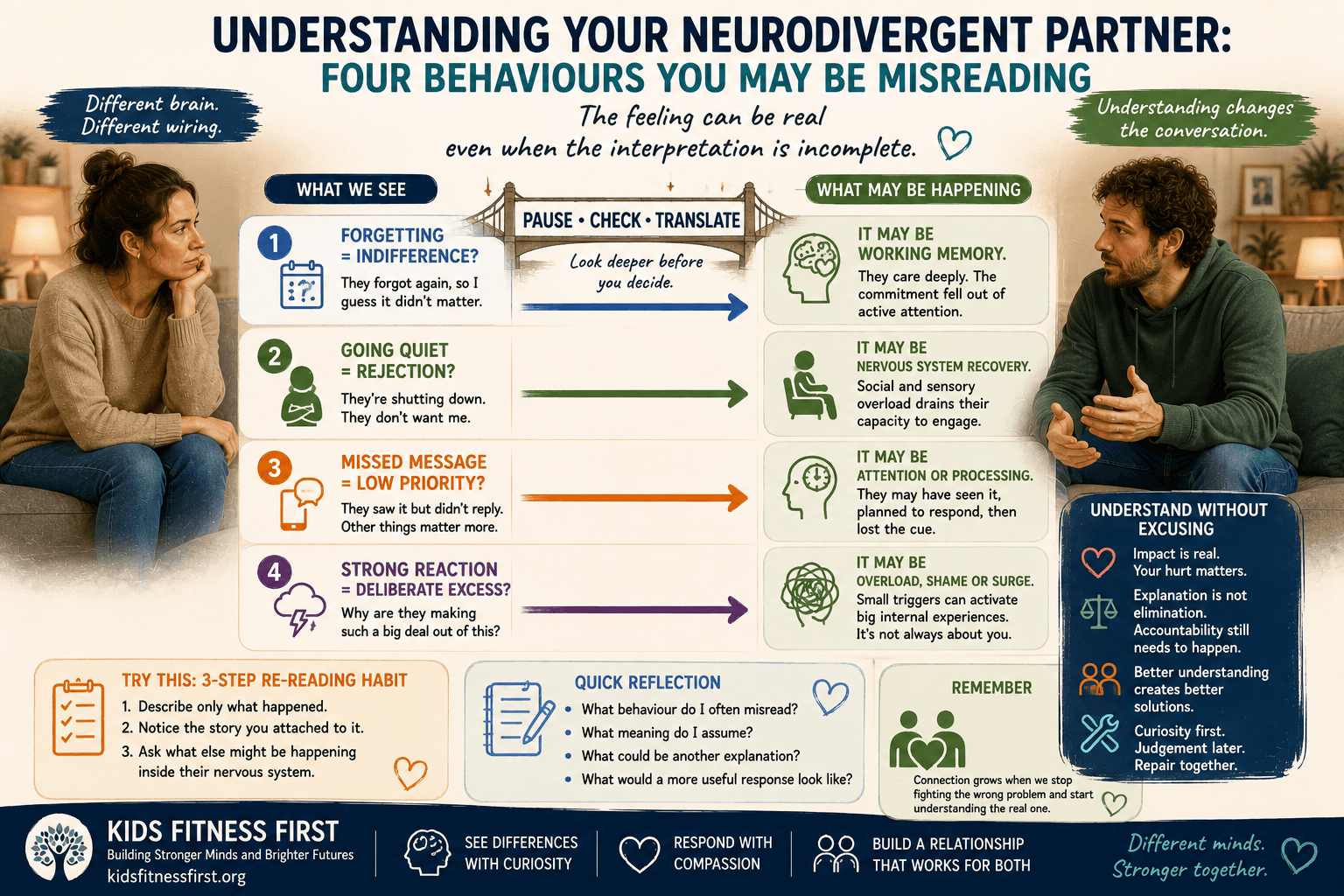
Understanding Your Neurodivergent Partner: 4 Behaviours You May Be Misreading
Understanding your neurodivergent partner does not solve every relationship problem.
However, it can stop some problems from becoming unnecessarily bigger.
For years, you may have watched behaviours that seemed to carry an obvious meaning.
Your partner forgot something important.
Therefore, you assumed it did not matter enough to them.
They went quiet during a difficult conversation.
Consequently, you assumed they were withdrawing from you.
They failed to answer a message.
As a result, you concluded that other things mattered more.
Or perhaps they reacted strongly to what seemed like a small comment.
Therefore, you thought they were being dramatic, unreasonable or deliberately difficult.
Those interpretations are understandable.
After all, you have been reading another person’s behaviour using the rules your own nervous system understands.
However, a neurodivergent brain may be producing the same behaviour for a very different reason.
That distinction matters.
Because if the behaviour is misread, the response to it may also be wrong.
And, over years, hundreds of small misreadings can become a much larger story:
They do not care.
They do not prioritise me.
They do not see how much I do.
I cannot rely on them.
Sometimes those concerns genuinely need addressing.
Nevertheless, in many individual moments, the neurological explanation is more specific than the character judgement.
Therefore, this article is about learning to tell the difference.
Understanding Does Not Mean Excusing
Before going further, one point needs to be clear.
Understanding somebody’s neurology does not mean pretending their behaviour has no effect.
If an appointment is forgotten, the appointment is still forgotten.
If you were hurt by a sharp response, the hurt is still real.
Likewise, if you have carried an unfair amount of responsibility for years, understanding executive dysfunction does not suddenly make that workload fair.
Therefore, the goal is not:
“They are neurodivergent, so I should accept everything.”
Instead, the goal is:
“What actually caused this behaviour, and what response gives us the best chance of changing what happens next?”
That is a much stronger question.
Explanation tells you what mechanism may be operating.
Meanwhile, accountability still deals with the impact.
Healthy relationships need both.
Why Behaviour and Intention Can Become Confused
Most people naturally assume that behaviour reflects intention.
For example:
If somebody remembers something important, we assume they cared enough to remember it.
If somebody looks at us while we speak, we assume they are engaged.
If somebody replies quickly, we assume we matter to them.
Likewise, if they fail to do those things, we may assume the opposite.
However, neurodivergence can interrupt that simple equation.
An ADHD person may care deeply and still forget.
An autistic person may care deeply and need to withdraw.
A dyslexic person may care deeply about a household document while avoiding reading it because the task carries a much higher cognitive cost.
Therefore:
behaviour still matters, but behaviour does not always reveal intention as clearly as we think it does.
That is where the Four Misreadings become useful.
The Four Misreadings
Misreading 1: Forgetting Means Indifference
Your partner forgets things.
Perhaps:
- an appointment;
- something you asked them to buy;
- a conversation from Tuesday;
- an anniversary;
- an agreed household job;
- or a message you asked them to send.
After this happens repeatedly, a natural thought appears:
“If this mattered enough, they would remember.”
However, that interpretation can be misleading, particularly with ADHD.
Working memory is not the same as caring.
An intention can be completely sincere when it is formed.
For example:
“I will call the dentist tomorrow.”
At that moment, the intention is real.
However, new information arrives.
Work happens.
The phone rings.
Another task becomes urgent.
Consequently, the original intention leaves active mental space.
The emotional importance may still exist.
Yet the active reminder does not.
That does not make the missed task harmless.
Nevertheless, it means the solution should target memory rather than love.
A more useful reading
Instead of:
“You forgot because I don’t matter.”
try:
“The current system is not reliably carrying this commitment.”
Then ask:
What external system would make remembering less dependent on working memory?
For example:
- a shared calendar;
- an immediate reminder;
- a visible checklist;
- assigning one person full ownership;
- or completing the task while discussing it.
The aim is not to excuse forgetting.
Instead, it is to solve the correct problem.
Misreading 2: Going Quiet Means Rejection
Imagine a difficult social event.
Your partner has spoken to people for several hours.
There has been noise, movement, bright lighting and constant conversation.
Then you get home.
Suddenly, your partner says very little.
They do not want to talk.
Perhaps they sit alone.
Or they disappear into another room.
From your side, the contrast can feel personal.
You may think:
“They managed to talk to everyone else. Why can’t they talk to me?”
That feeling is understandable.
However, for some autistic, ADHD or otherwise neurodivergent people, home is where regulation finally becomes possible.
During the event, they were using capacity.
Afterwards, there may be very little capacity left.
Therefore, silence can sometimes mean:
“I am safe enough here to stop performing.”
rather than:
“I do not want you.”
That is a significant difference.
A more useful response
Instead of:
“Why are you shutting me out?”
try:
“Do you need recovery time, or is something wrong between us?”
That question separates two possibilities.
If they need recovery, the relationship is not automatically in danger.
However, if something relational is wrong, there is still room for them to say so.
Clarity protects both people.
Misreading 3: A Missed Message Means You Are Not a Priority
Few things create modern relationship tension as quickly as an unanswered phone message.
You send:
“Can you call me when you’re free?”
Hours pass.
Meanwhile, you can see that your partner has been online.
Perhaps they posted something.
Maybe they answered a work message.
Therefore, the conclusion seems obvious:
“They saw other things. They chose not to answer me.”
However, attention does not always work according to emotional importance.
For some ADHD people, a message can be noticed and mentally answered without being physically answered.
They think:
“I’ll reply in a minute.”
Then another stimulus arrives.
Consequently, the message disappears from active attention.
Likewise, some autistic people may delay replying because the message requires a form of emotional or social processing they do not currently have capacity for.
Meanwhile, a simple factual work message may be easier to answer.
Therefore, message speed and relationship importance are not always measuring the same thing.
Again, impact still matters.
If being unreachable creates practical or emotional problems, a system may be needed.
However, the solution may be different once you stop assuming the delay was a statement about your value.
Try a communication rule
For example:
Routine message: answer when capacity allows.
Important message: begin with “IMPORTANT”.
Urgent message: call twice.
Now the communication system carries the priority.
You no longer have to expect nervous-system attention to organise priorities perfectly on its own.
Misreading 4: A Strong Reaction Means Deliberate Excess
Sometimes the response is much bigger than the trigger.
You ask:
“Did you send the form?”
Suddenly, your partner becomes defensive.
Or upset.
Perhaps they snap.
Maybe they leave.
From your perspective, the question was small.
Therefore, you may think:
“Why are they making this into such a huge issue?”
However, earlier articles in Book Five have already shown why the present trigger may not be the whole event.
The comment may activate:
- shame;
- working-memory overload;
- emotional dysregulation;
- sensory depletion;
- earlier criticism;
- or fear of disappointing you again.
Consequently, the reaction may be larger than the current sentence.
Nevertheless, this does not mean every reaction is acceptable.
Someone being neurologically overwhelmed does not give them permission to insult, intimidate or frighten you.
Therefore, two things can be true:
“I understand why your nervous system reacted strongly.”
and:
“The way you spoke to me still needs repair.”
That is understanding without surrendering accountability.
The Four Misreadings at a Glance
| What You See | The Automatic Reading | A More Accurate Question |
|---|---|---|
| Forgetting | “They don’t care.” | “Is working memory or the system failing?” |
| Going quiet | “They are rejecting me.” | “Do they need nervous-system recovery?” |
| Missed message | “I am not a priority.” | “Was attention or processing capacity the issue?” |
| Strong reaction | “They are deliberately overreacting.” | “What happened inside their nervous system before the reaction?” |
This table does not tell you that the second explanation is always correct.
Instead, it reminds you not to jump directly from behaviour to character.
ADHD: Caring and Remembering Are Different Processes
This distinction may be particularly important in ADHD relationships.
A person can care intensely about something that repeatedly falls out of active attention.
At first, that seems contradictory.
However, caring is emotional.
Remembering is cognitive.
The two interact, but they are not identical.
Therefore, saying:
“If you cared, you would remember”
can unintentionally turn a cognitive difficulty into a moral judgement.
A more productive statement might be:
“I believe you care. However, the current way we are handling this is not reliable enough. We need a system.”
Notice what that does.
First, it protects the emotional relationship.
Then, it addresses the practical failure.
Both matter.
Dyslexia: Avoidance Does Not Automatically Mean Lack of Effort
Consider a household document.
Perhaps it is:
- insurance paperwork;
- a school letter;
- a legal document;
- financial information;
- instructions;
- or a long email.
A non-dyslexic partner may think:
“It would take ten minutes. Why won’t they just read it?”
However, the cognitive cost may be much higher for the dyslexic partner.
They may already have spent the entire working day compensating around reading and written information.
Therefore, home becomes the place where the compensation finally stops.
From outside, that can look like laziness.
However, internally it may be exhaustion.
Again, the answer is not necessarily:
“Fine, I will read everything forever.”
Instead, ask:
“What is the best way for this information to be processed without one person automatically carrying everything?”
Perhaps one partner reads while the other handles another responsibility.
Alternatively, text-to-speech or summaries may help.
The goal is shared adult responsibility, designed around actual cognitive differences.
Autism: Withdrawal May Be Regulation
For some autistic adults, withdrawal is not a rejection of connection.
Instead, withdrawal may be how enough capacity is recovered to reconnect later.
For example, after a social event, the person may need:
- quiet;
- lower lighting;
- no conversation;
- familiar activity;
- or time alone.
Therefore, demanding emotional conversation during that recovery period may actually extend the shutdown.
However, the partner also deserves reassurance.
A useful sentence from the neurodivergent partner might be:
“I need an hour alone. Nothing is wrong between us. I will come back at eight.”
That transforms silence from ambiguous rejection into communicated regulation.
Understanding works best when both people participate.
Reinterpretation Is Not Self-Gaslighting
This point is especially important for the partner reading this article.
You should not use neurological understanding to tell yourself:
“I am not allowed to be hurt.”
You are.
Likewise, you should not tell yourself:
“Nothing they do can mean anything because it is all neurodivergence.”
That is not healthy either.
Instead, reinterpretation means delaying the character judgement.
You can say:
“This hurt me.”
Then ask:
“Before I decide what it means about their feelings or character, what neurological mechanism might also be involved?”
Afterwards, you can still ask for repair.
That is not denial.
It is more accurate investigation.
A Three-Step Re-Reading Habit
When a familiar behaviour appears, try these three steps.
Step 1: Describe only what happened
For example:
“They did not answer my message for five hours.”
Not:
“They ignored me.”
The first is observable.
The second contains an interpretation.
Step 2: Identify the story you immediately told yourself
Perhaps:
“Work is more important than I am.”
Or:
“They don’t care how worried I get.”
Then recognise:
This is my interpretation, not yet a confirmed fact.
Step 3: Ask for the missing information
For example:
“What happened with my message earlier?”
Then listen to the answer before deciding what the behaviour meant.
This habit sounds simple.
However, over time, it can remove a remarkable amount of unnecessary conflict.
Reflection: What Have You Been Reading as Character?
Pause here.
Think about one behaviour from the person you love that repeatedly hurts or frustrates you.
Do not choose the biggest issue in the relationship.
Instead, choose something frequent and specific.
Perhaps:
- forgetting;
- withdrawing;
- answering late;
- avoiding paperwork;
- seeming distracted;
- needing recovery time;
- or reacting strongly.
Now answer the following questions.
1. What is the observable behaviour?
Write only what happened.
For example:
“They went into another room and did not speak for an hour after we returned from dinner.”
2. What meaning do I automatically attach to it?
Perhaps:
“They don’t want to be around me.”
3. What feeling does that interpretation create?
Maybe:
- rejection;
- anger;
- loneliness;
- resentment;
- fear;
- or disappointment.
4. Is there another plausible neurological explanation?
For example:
“They may have been socially and sensory depleted.”
5. Does the alternative explanation change the impact?
Perhaps not.
You may still have felt lonely.
However, does it change what you need to ask for?
Instead of:
“Stop shutting me out.”
perhaps the request becomes:
“When you need recovery after social events, please tell me that nothing is wrong between us and when you expect to reconnect.”
That request is more specific.
Therefore, it has a better chance of producing change.
6. What behaviour genuinely still needs accountability?
Understanding the mechanism does not make every outcome acceptable.
Write down what remains.
For example:
“I can understand the need for quiet. However, disappearing without explanation leaves me anxious.”
7. What would a more accurate reading sound like?
Complete:
“Instead of automatically telling myself __________, I will first ask whether __________ may also be happening.”
Reflection Takeaway
You are not being asked to stop trusting your feelings.
Instead, you are being asked to become more careful about the story attached to them.
The feeling may be completely real even when the interpretation is incomplete.
That is one of the most useful distinctions a neurodivergent relationship can learn.
Try This: Seven Days of Re-Reading
For one week, choose one recurring behaviour.
Each time it happens, make four short notes:
Behaviour: What actually happened?
Automatic interpretation: What did I assume it meant?
Alternative explanation: What neurological factor might also fit?
Better question: What could I ask instead of assuming?
For example:
Behaviour: Partner did not answer text for three hours.
Interpretation: I am not important.
Alternative: Hyperfocus or missed working-memory cue.
Question: “Did you see my message earlier?”
Do not use the exercise to excuse everything.
Instead, use it to slow the jump from behaviour to character.
At the end of the week, ask:
Did any conflict become smaller simply because I checked the meaning first?
If yes, that is valuable information.
Your Exhaustion Still Matters
There is another reason this article needs balance.
Partners of neurodivergent adults may already be carrying considerable practical and emotional work.
Therefore, being told:
“You just need to understand their brain better”
can feel like one more job.
That reaction is reasonable.
Understanding cannot become a request for endless patience while nothing changes.
Instead, understanding should make the relationship more efficient.
For example:
If you know memory is the issue, stop having the same moral argument about forgetting and create an external system.
If you know sensory recovery is the issue, stop interpreting every period of silence as rejection and agree a recovery protocol.
If written material is expensive for a dyslexic partner, stop debating whether they “should” find it easy and design a fair division of responsibility.
Therefore, useful understanding should reduce wasted conflict.
It should not increase one partner’s workload indefinitely.
Understanding Changes the Question
Before understanding, you may ask:
“Why are you doing this to me?”
Afterwards, you may ask:
“What is happening here, and what system would work better?”
That does not sound dramatic.
However, it is a profound shift.
One question assumes intention.
The other investigates mechanism.
Then, once the mechanism is understood, both people can decide what responsibility looks like.
That is how neurological understanding becomes practical rather than theoretical.
When the Behaviour Really Is About You
Not every difficult behaviour should be reinterpreted neurologically.
Sometimes somebody is angry with you.
Sometimes they are avoiding responsibility.
Likewise, sometimes a repeated promise has not been honoured because there has been insufficient effort to create change.
Neurodivergence does not remove ordinary human behaviour.
Therefore, the aim is not to explain everything away.
Instead, ask:
Is this neurological difficulty, relationship difficulty, individual behaviour — or some combination of all three?
Often the answer will be a combination.
That is acceptable.
Real relationships are complicated.
What Your Neurodivergent Partner Needs You to Understand
They need you to understand that:
Forgetting is not always evidence of indifference.
Silence is not always rejection.
A delayed reply is not always a ranking of your importance.
A strong reaction is not always a deliberate attempt to create drama.
However, they also need to understand something about you.
Your hurt is real.
Your exhaustion is real.
Your need for reliability is real.
Therefore, understanding cannot run in only one direction.
The point of Book Five is both sides of the sofa.
One person learns to be read more accurately.
The other learns to make their effort and accountability more visible.
That is how the gap begins to close.
Conclusion: Read the Brain Before You Judge the Character
Understanding your neurodivergent partner requires a different kind of curiosity.
Not endless tolerance.
Not self-sacrifice.
And certainly not pretending difficult behaviour does not matter.
Instead, it means pausing before turning a behaviour into a verdict about the person.
First, describe what happened.
Then notice the story you attached to it.
Next, ask whether a neurological mechanism may also explain the behaviour.
Afterwards, communicate clearly about the impact.
Finally, build a practical response around what is actually happening.
Sometimes you will discover that the behaviour was not about you.
Other times, you will discover that it still needs genuine repair.
Both outcomes are useful.
Most importantly, remember:
Understanding does not erase impact.
However, understanding can stop you from fighting the wrong problem.
And when two people stop fighting the wrong problem, they finally have more energy available for solving the real one.
SUGGESTED INTERNAL LINKS
Article 1:
Neurodivergent Relationship Repair: When You Hurt the People You Love
Article 2: Neurodivergent Self-Advocacy: How to Ask for What You Need
DISCLAIMER
This article is provided for general educational and informational purposes only. It is not medical, psychological, diagnostic, relationship or therapeutic advice.
Neurodivergent people are individuals. Therefore, ADHD, autism, dyslexia and other neurodivergent experiences should not be assumed to produce the same behaviour in every person.
Likewise, neurological explanations should never be used to excuse abuse, intimidation, coercive behaviour, repeated harmful conduct or refusal to take responsibility. Understanding a mechanism and requiring appropriate accountability can coexist.