
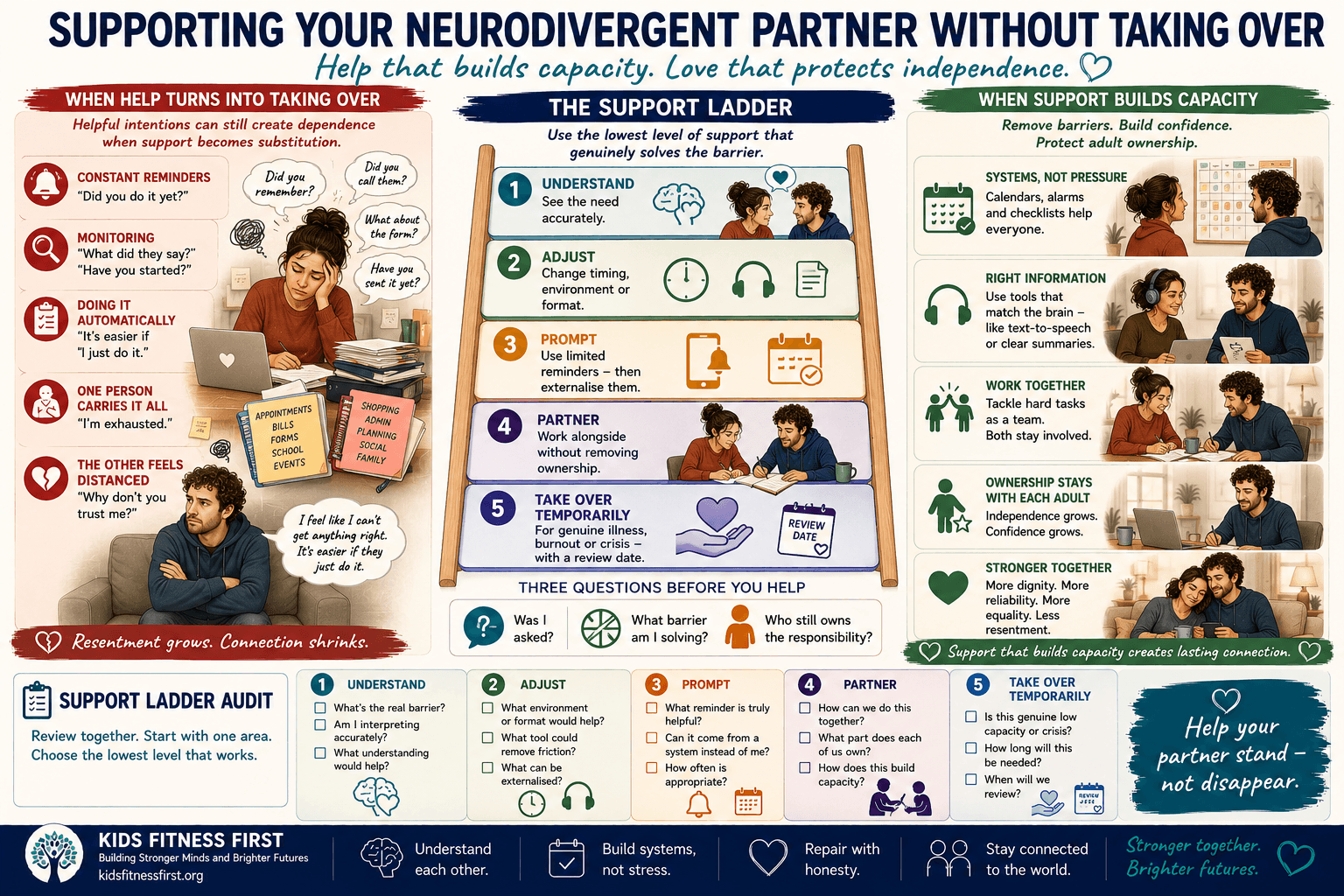
Supporting Your Neurodivergent Partner Without Taking Over: The Support Ladder
Supporting your neurodivergent partner can be one of the most loving things you do.
Perhaps you remind them about something important.
You help interpret a complicated document.
Likewise, you step in during an overwhelming social situation.
Maybe you take over dinner because their nervous system has reached capacity.
These actions can be generous, practical and deeply caring.
However, something can happen slowly.
One reminder becomes three.
Then you begin checking whether the task was completed.
Afterwards, because checking is exhausting, you simply do the task yourself.
Meanwhile, your partner becomes accustomed to you carrying it.
Eventually, the relationship reaches a difficult place.
One person thinks:
“Why do I have to do everything?”
The other thinks:
“Why don’t you trust me to do anything?”
Neither person intended this outcome.
Nevertheless, support has gradually become substitution.
That distinction matters.
Because healthy support should usually help another adult function more effectively.
Instead, unhealthy over-support can quietly replace their functioning altogether.
Article 20 is therefore about a delicate question:
How do you help somebody you love without slowly becoming responsible for their life?
This page focuses on the boundary between support and substitution. If that pattern has already developed into a manager-and-managed dynamic, see the Parent Trap in neurodivergent relationships. For the wider structure of shared responsibility, return to the Relationship Blueprint.
Help and Taking Over Are Not the Same Thing
Consider two situations.
In the first, your partner says:
“I am struggling to understand this insurance letter. Can you read it with me?”
You sit together.
Then you help identify the important points.
Afterwards, your partner decides what to do next.
That is support.
Now consider a second version.
You see the insurance letter.
You already know your partner dislikes paperwork.
Therefore, you open it.
Then you read it.
You call the insurer.
You make the decision.
Finally, you tell your partner what happened.
The problem has been solved.
However, something else has also happened.
Your partner was removed from the process.
That may occasionally be necessary during illness or severe overload.
Nevertheless, if it becomes the normal pattern, support begins changing the relationship structure.
The question is therefore not:
“Did the task get done?”
Instead, ask:
“Did the way we got it done protect adult ownership?”
Why Taking Over Can Feel So Sensible
Taking over is rarely irrational.
In fact, it often makes excellent short-term sense.
Perhaps you can complete the task in ten minutes.
Meanwhile, your partner may take forty minutes.
Maybe the task has already been forgotten twice.
Therefore, you think:
“It is easier if I just do it.”
And, for today, perhaps it is.
However, efficiency is not the only goal inside a relationship.
There is also:
- dignity;
- competence;
- autonomy;
- learning;
- responsibility;
- and equality.
Therefore, the fastest solution may not always be the healthiest long-term solution.
Sometimes allowing somebody to use their own system, even if it looks slower than yours, protects something important.
Support Should Solve the Barrier, Not Replace the Person
This is the central principle.
Suppose ADHD working memory is the problem.
The support should ideally help with memory.
For example:
- calendar;
- alarm;
- checklist;
- visible reminder;
- or written plan.
The support should not automatically become:
another adult permanently remembering for them.
Likewise, if dyslexia makes a long written document difficult, support might mean:
- text-to-speech;
- reading key sections together;
- summarising important points;
- or requesting information in a clearer format.
However, the default should not necessarily become:
“You never deal with paperwork again.”
Similarly, if an autistic partner finds a particular social environment overwhelming, support might mean:
- advance information;
- clear exit plans;
- sensory accommodations;
- shorter attendance;
- or choosing a different setting.
Therefore, support works best when it asks:
“What barrier are we solving?”
rather than:
“What part of your life should I take over?”
The Support Ladder
Article 20 introduces The Support Ladder.
It has five levels:
- Understand
- Adjust
- Prompt
- Partner
- Take Over Temporarily
The important idea is that you begin as low on the ladder as the situation reasonably allows.
Only move upward when more support is genuinely necessary.
Therefore, the goal is not:
“Give as little help as possible.”
Instead, it is:
“Give the amount of help that solves the problem without unnecessarily removing adult ownership.”
Level 1: Understand
The first level requires no practical intervention.
Instead, it requires accurate recognition.
For example:
Your partner comes home after a noisy day and becomes quiet.
Previously, you might have asked:
“What’s wrong with you?”
Now, however, you recognise social and sensory depletion.
Therefore, the support may simply be:
not misreading the behaviour.
Perhaps you say:
“You look overloaded. Do you need some quiet?”
Nothing has been taken over.
Yet the relationship has become more supportive.
This is why understanding itself belongs on the Support Ladder.
Sometimes the most helpful thing you can do is stop turning a neurological need into a character judgement.
Understanding Can Remove Unnecessary Conflict
For example:
Behaviour: A message is answered late.
Old interpretation: “You ignored me.”
More accurate possibility: Attention moved elsewhere and the message fell out of active awareness.
Now you can still address the problem.
However, you do not need to begin with accusation.
Instead:
“Important messages are still getting missed. We need a better urgent-message system.”
Therefore, understanding does not remove accountability.
It simply improves the accuracy of the problem you are solving.
Level 2: Adjust
At Level 2, the environment or communication method changes.
However, responsibility remains with the person.
For example:
Instead of giving five verbal instructions, write them down.
Likewise, instead of discussing something in a crowded room, move somewhere quieter.
Perhaps an important conversation is scheduled for the morning rather than late at night.
Or a long document is converted into text-to-speech.
This is adjustment.
The person is still doing the task.
However, unnecessary barriers have been reduced.
That is often the ideal form of support.
Adjustment Is Not Preferential Treatment
Sometimes people resist adjustments because they think:
“Everybody else manages this normally.”
However, the point of an adjustment is not to create unfair advantage.
Instead, it is to reduce irrelevant friction.
For example, if information is remembered better when written down, writing it down does not reduce adult responsibility.
In fact, it may increase reliability.
Therefore, good adjustments often make accountability easier rather than weaker.
Level 3: Prompt
Sometimes a reminder is useful.
For example:
“Your appointment is at two.”
Or:
“The form needs sending today.”
A prompt can be perfectly reasonable.
However, prompts become dangerous when they quietly multiply.
One reminder becomes:
“Have you done it?”
Then:
“Are you going to do it?”
Then:
“You still haven’t done it.”
Eventually, the partner giving reminders becomes a human notification system.
That is exhausting.
Therefore, Level 3 requires a rule:
A prompt should support a system, not replace a missing system forever.
Ask Whether the Reminder Can Be Externalised
If the same reminder is required repeatedly, ask:
“Why is this living in my brain?”
Perhaps it belongs in:
- a phone alarm;
- shared calendar;
- whiteboard;
- automated notification;
- task app;
- or recurring checklist.
For example, rather than reminding your partner every Thursday that the bin needs going out, create a Thursday alarm.
Now the reminder exists.
However, it does not come from the relationship.
That protects both people.
Prompts Should Not Become Continuous Monitoring
There is also a difference between:
reminding
and:
monitoring.
A reminder says:
“This is due today.”
Monitoring says:
“Have you started? How far are you? Did you call? What did they say? Have you written it down?”
Once monitoring begins, the relationship can quickly move towards manager and managed.
Therefore, if monitoring feels necessary, something deeper may need redesign.
Perhaps ownership is unclear.
Maybe the task is too difficult in its current form.
Alternatively, the agreed system may not actually work.
Solve that.
Do not simply increase the surveillance.
Level 4: Partner
Sometimes a task is genuinely easier when done together.
This is Level 4.
For example:
Your partner needs to make a difficult telephone call.
They are capable of making it.
However, the task creates significant anxiety or processing demand.
Therefore, you sit beside them.
They make the call.
Meanwhile, you help take notes.
That is partnering.
Likewise, perhaps you both complete a complicated form together.
Or you jointly plan a difficult family event.
The key distinction is:
both adults remain present in the task.
One person is supported.
However, they are not erased.
Partnering Can Build Capacity
Done well, Level 4 support can help somebody become more independent later.
For example:
First time: you sit beside them throughout the call.
Second time: you help prepare the questions beforehand.
Third time: they make the call alone but ask you to review the outcome.
Eventually, perhaps no support is needed.
Therefore, partnering can function as a bridge.
It says:
“We can do this together until your system becomes strong enough to carry more of it.”
That is very different from permanent rescue.
Level 5: Take Over Temporarily
Sometimes taking over is absolutely appropriate.
For example:
Your partner is:
- seriously ill;
- grieving;
- in severe burnout;
- recovering from surgery;
- experiencing an acute crisis;
- or temporarily unable to carry ordinary responsibility.
Then love may look like:
“I’ve got this.”
That is not unhealthy.
In fact, it may be exactly what partnership is for.
However, Level 5 contains one essential word:
temporarily.
Therefore, when capacity returns, responsibility should be reviewed.
Otherwise, emergency support may quietly become permanent architecture.
Temporary Takeover Needs an Exit Plan
For example:
“I will manage the school communication while you’re recovering. Let’s review it in three weeks.”
That sentence protects both people.
One partner knows the responsibility is currently covered.
Meanwhile, the other knows that the arrangement is not silently becoming permanent.
Therefore, Level 5 should ideally include:
- what is being taken over;
- why;
- for how long;
- and when ownership will be reviewed.
This creates clarity.
The Support Ladder at a Glance
| Level | What Support Looks Like | Who Still Owns the Responsibility? |
|---|---|---|
| 1. Understand | Interpret the need accurately | Partner |
| 2. Adjust | Change environment, timing or format | Partner |
| 3. Prompt | Give limited reminders where useful | Partner |
| 4. Partner | Work alongside them | Shared during the task |
| 5. Take Over Temporarily | Carry the task during genuine low capacity | Supporter temporarily |
The goal is not to stay permanently at Level 1.
Instead, match support to need.
However, always ask whether you are using a higher level than necessary.
Three Questions Before You Help
Before stepping in, ask three questions.
1. Was I asked?
Sometimes the answer is no.
Perhaps you are helping automatically.
2. What barrier am I solving?
Memory?
Processing?
Sensory overload?
Physical exhaustion?
Uncertainty?
3. What is the lowest level of support that would genuinely help?
These three questions can prevent reflexive over-functioning.
Unasked Help Can Feel Like a Judgement
Imagine someone repeatedly taking tasks from you without asking.
Eventually, you may hear an unspoken message:
“I do not believe you can handle this.”
That may not be the helper’s intention.
However, it can become the impact.
Therefore, when possible, ask:
“Would support help here?”
Then:
“What kind?”
Perhaps your partner says:
“Just remind me at six.”
Or:
“Can you sit with me while I do it?”
Or:
“No thanks. I want to handle this myself.”
That answer deserves respect unless there is a genuine shared consequence that requires discussion.
Shared Consequences Change the Conversation
Some tasks do not belong only to one person.
For example:
- joint finances;
- children’s care;
- mortgage payments;
- critical household safety;
- or shared legal obligations.
Therefore, if one person’s failure would seriously affect both people, simply saying:
“It’s their responsibility, so I will stay out of it”
may not be realistic.
However, that still does not mean one partner should permanently supervise everything.
Instead, build shared architecture.
For example:
- automatic payments;
- joint visibility;
- calendar systems;
- agreed review dates;
- or division of ownership.
The system protects the shared consequence.
Meanwhile, the relationship avoids continuous monitoring.
The Difference Between Support and Rescue
Support says:
“I believe you can carry this, and I will help where the barrier is real.”
Rescue says:
“I will carry this so you do not have to experience the difficulty.”
Sometimes rescue feels loving.
However, difficulty is not always harmful.
For example, forgetting a non-critical appointment and having to rearrange it may be frustrating.
Nevertheless, the experience may reveal that a better reminder system is needed.
If the partner is always rescued before consequences appear, the system never improves.
Therefore, small recoverable consequences can sometimes be useful information.
Do Not Manufacture Consequences Either
There is an important balance.
The answer is not:
“I’ll deliberately let you fail so you learn.”
That can become punitive.
Instead, ask:
“Is this consequence naturally occurring, safe and recoverable?”
For example:
Forgetting milk?
Recoverable.
Missing a non-urgent personal appointment?
Probably recoverable.
Failing to give a child critical medication?
Not a reasonable learning experiment.
Therefore, use judgement.
Equality does not require irresponsibility.
When Helping Has Become Resentful
One of the clearest warning signs is resentment.
Perhaps you hear yourself thinking:
“Why am I doing this again?”
That thought deserves attention.
Instead of silently continuing, pause.
Ask:
“Did I consciously agree to own this?”
If not, perhaps the responsibility drifted.
Likewise, ask:
“Am I helping because help is genuinely needed, or because I do not trust how my partner will do it?”
Those are different.
Sometimes resentment is telling you:
the support level has become too high for too long.
When Receiving Help Has Become Passive
The receiving partner also has responsibility.
Support should not become:
“You are better at this, so you do it.”
That may feel practical.
However, if applied widely, one partner gradually becomes responsible for every difficult area.
Therefore, the neurodivergent partner should also ask:
“What can I do to make this task more manageable without automatically transferring it?”
Perhaps:
- use technology;
- ask for clearer information;
- create routines;
- break the task into steps;
- or request a specific limited form of help.
That preserves adult agency.
Support Is a Two-Way Conversation
A healthy support conversation might sound like:
Partner A: “This form is overwhelming me.”
Partner B: “What would help?”
Partner A: “Could you read the first section with me? After that I think I can finish it.”
That is clear.
Alternatively:
Partner A: “I’m completely red today. Can you handle dinner?”
Partner B: “Yes. Could you do breakfast tomorrow if you’ve recovered?”
Again, clear.
The relationship is not guessing.
Instead, support becomes negotiated.
Different Brains May Need Different Types of Support
Support should match the actual neurology and person.
For example, some ADHD adults may benefit from:
- external reminders;
- body doubling;
- visual plans;
- or task breakdown.
Some dyslexic adults may benefit from:
- spoken explanation;
- text-to-speech;
- simplified documents;
- or help identifying key information.
Meanwhile, some autistic adults may benefit from:
- advance notice;
- predictable plans;
- sensory adjustments;
- written communication;
- or recovery time.
However, no strategy should be assumed automatically.
Therefore, ask the individual.
“What helps you?”
That question remains more accurate than diagnosis-based guessing.
Support Should Make the Relationship More Adult, Not Less
This is perhaps the best test.
After receiving support, does the person have:
- more clarity;
- more confidence;
- more ownership;
- better systems;
- and greater capacity?
Or do they have:
- less involvement;
- less responsibility;
- less confidence;
- and greater dependence on their partner?
If the second pattern keeps appearing, the support architecture needs review.
Love should not quietly make another adult smaller.
Instead, ideally, it should help them stand more securely in their own life.
Reflection: Where Are You on the Support Ladder?
Do this reflection separately.
Then compare answers.
Which Tasks Does One Partner Regularly Help With?
List five.
For example:
- appointments;
- paperwork;
- finances;
- social events;
- household jobs;
- children’s administration;
- travel;
- communication;
- or family obligations.
Then identify the current Support Ladder level for each.
Is it:
Understand?
Adjust?
Prompt?
Partner?
Take Over?
Simply making the pattern visible may reveal a lot.
Where Has Support Drifted Up the Ladder?
Perhaps something began as a reminder.
However, now one partner completely owns it.
Complete:
“This began as help with __________, but gradually became me doing __________.”
Then ask:
“Does it still need to be at this level?”
Where Is the Current Support Level Too Low?
This matters too.
Perhaps one partner has been trying to prove independence.
However, they are repeatedly overwhelmed.
For example, perhaps they refuse to ask for any help with complex paperwork and then miss important deadlines.
Therefore, the answer may actually be more support.
Complete:
“One area where I could reasonably ask for more specific help is…”
The goal is not maximum independence.
It is appropriate support.
Do You Ask Before Helping?
Be honest.
Does one partner often simply step in?
If so, ask:
“What am I afraid will happen if I don’t?”
Perhaps:
- the task will fail;
- the children will suffer;
- money will be lost;
- your partner will become distressed;
- or you will eventually have to fix it anyway.
Those fears may have evidence behind them.
However, they need to be discussed rather than silently converted into permanent over-functioning.
Does Help Ever Feel Like Criticism?
For the receiving partner:
Complete:
“When you help me by __________, I sometimes experience it as __________.”
Perhaps:
“When you keep checking whether I’ve done something, I experience it as lack of trust.”
Then add:
“A more helpful form of support would be…”
For example:
“One reminder, then let the calendar system handle it.”
That turns hurt into design information.
Does Refusing Help Ever Create Extra Work for Your Partner?
For the neurodivergent partner:
Complete:
“I sometimes refuse help because I want to prove I can manage. However, when the task later fails, the impact on my partner is…”
This matters.
Independence should not become another form of denial.
Adult ownership includes recognising when a reasonable support system protects both people.
Reflection Takeaway
Complete:
“The purpose of support in our relationship is not for one person to carry the other. Instead, support should…”
Perhaps:
remove barriers.
build confidence.
create reliability.
protect capacity.
increase independence.
maintain equality.
That becomes your guiding principle.
Try This: The Support Ladder Audit
Take one sheet of paper.
Write five headings:
UNDERSTAND
ADJUST
PROMPT
PARTNER
TAKE OVER TEMPORARILY
Then choose five recurring areas where support currently happens.
For each one, ask:
1. What is the actual barrier?
For example:
working memory.
literacy demand.
social processing.
overload.
physical exhaustion.
2. What level are we currently using?
Perhaps Take Over.
3. What is the lowest level that might work?
Maybe Partner.
Or Adjust.
4. What system would support the lower level?
For example:
calendar.
text-to-speech.
written plan.
alarm.
clear role.
5. When will we review it?
Choose a date.
Then change one support pattern.
Not all five.
Observe it for several weeks.
If it works, continue.
If it fails, move up one level or redesign the system.
This is not a test.
Instead, it is collaborative experimentation.
The Support Sentence
A useful sentence for both partners is:
“What kind of support would help without taking this away from you?”
That question contains several important assumptions.
First, support is allowed.
Second, autonomy matters.
Third, the answer is not predetermined.
Likewise, another useful sentence is:
“I need help with this part, but I still want to own the task.”
Together, these phrases can prevent a great deal of confusion.
When One Partner Is Genuinely Better at Something
Equality does not mean both people must do identical things.
Perhaps one partner is genuinely excellent at finances.
Meanwhile, the other loves cooking.
One may be strong at written administration.
The other may manage practical repairs.
That is fine.
Therefore, not every unequal division is unhealthy.
The question is:
Was the division chosen consciously because it works for both people?
Or:
Did one person inherit every difficult responsibility because the other struggled with it?
Those are different.
Choice creates partnership.
Drift creates resentment.
Specialisation Can Be Healthy
For example:
“You handle investments because you are interested and skilled in them. I handle travel planning because I enjoy it.”
That is specialisation.
However:
“I handle every form, every appointment, every bill, every school message and every social arrangement because otherwise they don’t happen.”
That is something else.
Therefore, look at the total pattern rather than one isolated task.
Healthy support fits inside a wider adult contribution from both people.
Support During Crisis Is Different
Article 17 introduced the Low-Capacity Plan.
During genuine overload, support may move rapidly up the ladder.
For example:
Normally, one partner manages their own administration.
However, during serious burnout, their partner temporarily takes it over.
That can be completely healthy.
Therefore, do not judge crisis arrangements by ordinary-life standards.
Instead, ask:
“Have we remembered to move back down the ladder as capacity returns?”
That is the important question.
Temporary help should not silently become permanent architecture unless both people consciously choose that arrangement.
Support and the Growth Gap
Article 19 explored what happens when one partner changes faster.
The Support Ladder becomes especially useful there.
Perhaps the neurodivergent partner now wants more independence.
However, the other partner has spent years rescuing.
Therefore, stepping back feels unsafe.
The solution is not:
“Stop helping immediately.”
Instead, move down the ladder deliberately.
For example:
Take Over → Partner.
Then:
Partner → Prompt.
Then perhaps:
Prompt → Adjust.
Trust grows through evidence.
Therefore, support reduction can be gradual.
The Best Support Often Becomes Less Visible Over Time
Imagine a good shared calendar.
Nobody feels controlled by it.
It simply works.
Likewise, text-to-speech may quietly make documents accessible.
A planned recovery period may prevent overload.
A written agenda may make a difficult conversation easier.
These supports are powerful precisely because they do not require one partner to continually supervise the other.
Therefore, some of the best relationship support is infrastructure.
It sits in the background.
The relationship can then return to being a relationship.
Conclusion: Help Your Partner Stand, Not Disappear
Supporting your neurodivergent partner does not mean refusing help in the name of independence.
Likewise, it does not mean doing everything difficult for the person you love.
Instead, healthy support asks:
What is the barrier?
What help is actually needed?
Who still owns the responsibility?
Can a system carry some of this instead?
Is this level of support still appropriate?
Then use the Support Ladder.
First, understand.
Next, adjust.
Then, if necessary, prompt.
Afterwards, partner.
Finally, when genuine low capacity demands it, take over temporarily.
Most importantly, keep asking whether support is helping the person become more capable of participating in their own life.
Because love should make room for support.
However, love should also make room for dignity.
Your partner may sometimes need your hand.
They may occasionally need you to carry something heavy.
And, during the hardest periods, they may even need you to carry almost everything for a while.
But the long-term goal is not:
one person carrying the other.
It is:
two adults learning when to walk independently, when to walk beside each other, and when one genuinely needs help getting through a difficult stretch.
That is support without disappearance.
And that is partnership.
SUGGESTED INTERNAL LINKS
Article 8: The Parent Trap in Neurodivergent Relationships: How Couples Become Manager and Managed
Article 10: Communication in Neurodivergent Relationships: 4 Principles That Make Conversations Land
DISCLAIMER
This article is provided for general educational and informational purposes only. It is not medical, psychological, diagnostic, relationship, occupational-therapy or couples-therapy advice.
Neurodivergent people vary widely in the type and amount of support they need. Therefore, the Support Ladder should be used as a reflective framework rather than as a rule that everyone should become maximally independent.
Some people may require substantial or ongoing support because of disability, health, communication, executive-function or other needs. Appropriate support should not be withheld merely to enforce independence.
Likewise, temporary or permanent support arrangements should be agreed as respectfully as possible and should never be used to justify coercion, financial control, intimidation, infantilisation or abuse.