
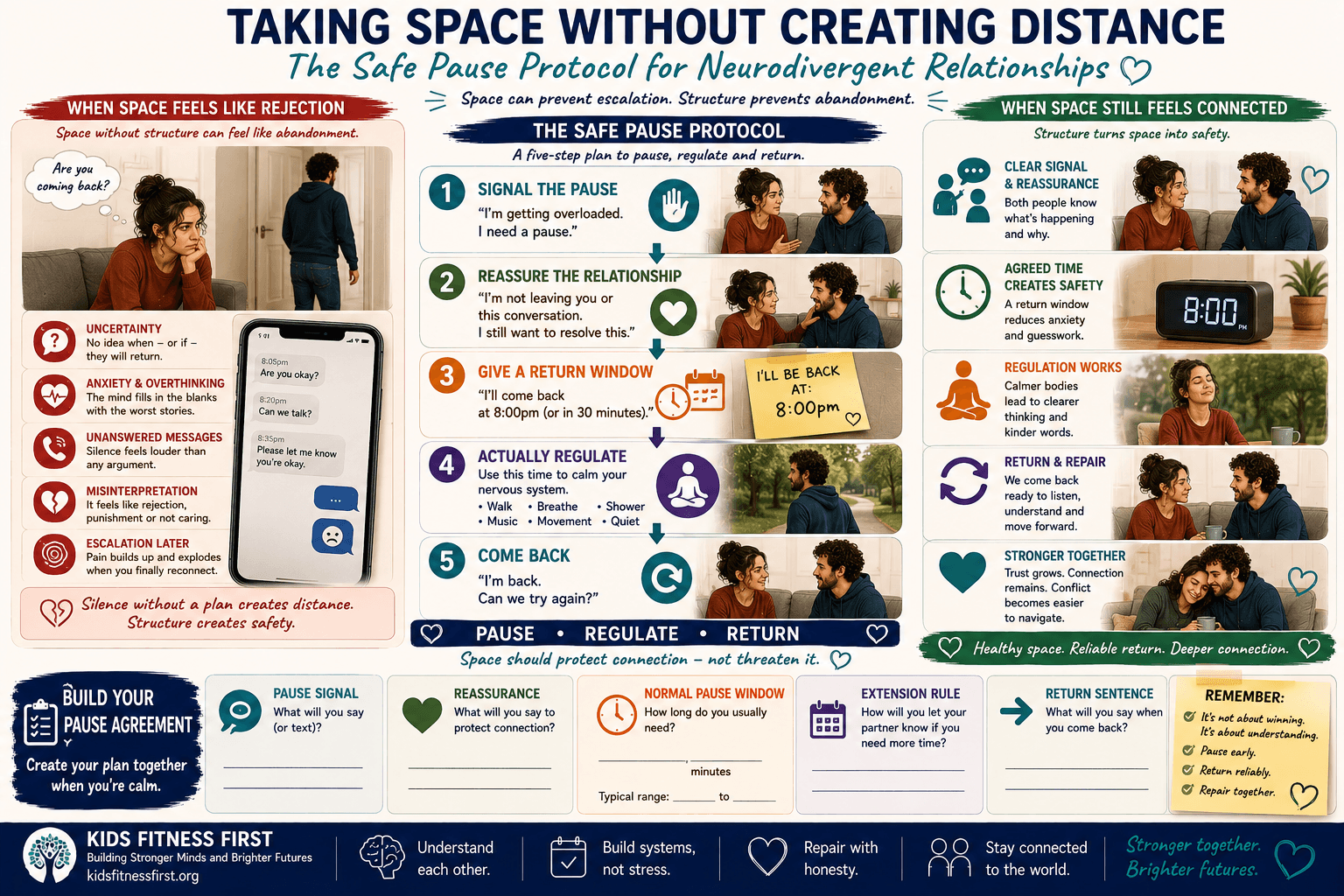
Taking space in neurodivergent relationships can be one of the healthiest things a couple learns to do.
However, it can also become one of the most misunderstood.
Imagine an argument.
One partner becomes overwhelmed.
Their heart is racing.
Likewise, their thoughts are becoming less organised.
They know that if they continue talking, they may become defensive, say something hurtful or shut down completely.
Therefore, they leave the room.
From their perspective, they are preventing the argument from becoming worse.
However, their partner experiences something completely different.
They may think:
“You walked away from me.”
“You don’t care.”
“You always disappear when things become difficult.”
“I have no idea whether you’re coming back.”
Now both people are trying to protect themselves.
Yet the protection strategies collide.
One nervous system needs distance.
Meanwhile, the other nervous system needs reassurance and connection.
Therefore, the problem is not necessarily that one person needs space.
The problem may be that nobody has agreed what taking space is supposed to look like.
That is where the Safe Pause Protocol begins.
This article is specifically about pausing an overloaded conversation without turning the pause into abandonment or avoidance. For broader processing and communication differences, see neurodivergent relationship communication. If harm has already occurred, continue to the relationship repair guide.
Why Staying in the Conversation Is Not Always Healthier
Relationship advice often encourages couples to remain present during difficult conversations.
In principle, that makes sense.
However, there is a point at which staying physically present no longer means staying emotionally available.
For example, once somebody becomes highly overloaded, they may:
- stop processing language accurately;
- become increasingly defensive;
- repeat the same point;
- lose access to useful emotional language;
- misread tone;
- become physically agitated;
- or completely shut down.
Therefore, continuing the conversation may not produce more communication.
Instead, it may simply produce more damage.
At that point, a pause can become responsible.
The key difference is this:
A healthy pause protects the conversation.
An unhealthy disappearance avoids the conversation.
Those are not the same thing.
Why Leaving Can Feel So Threatening to the Other Partner
The person who remains behind does not experience the pause from inside the overloaded nervous system.
Instead, they experience what they can see.
The door closes.
The conversation stops.
Perhaps no return time is given.
Consequently, uncertainty begins.
They may ask:
Is the argument over?
Are they still angry?
Will they return tonight?
Are they punishing me?
Should I follow them?
Should I leave them alone?
Therefore, the space that helps one nervous system regulate may simultaneously activate the other person’s fear, anger or rejection sensitivity.
That is why simply saying:
“I need space.”
may not be enough.
The relationship may also need to know:
What does space mean?
Space Is Different From Silent Treatment
This distinction is essential.
A pause says:
“I need to regulate so I can return more effectively.”
Silent treatment says:
“I am withdrawing communication in a way that leaves you uncertain, punished or controlled.”
Externally, both can involve silence.
However, intention, structure and return are different.
A healthy pause includes:
- communication;
- reassurance;
- a rough timescale;
- genuine regulation;
- and return.
By contrast, punitive withdrawal often includes:
- ambiguity;
- refusal to communicate;
- indefinite disappearance;
- emotional punishment;
- or forcing the other person to chase.
Therefore, couples should not simply ask:
“Did someone leave?”
Instead, ask:
“What structure surrounded the leaving?”
That tells you much more.
The Safe Pause Protocol
The Safe Pause Protocol has five parts:
- Signal the Pause
- Reassure the Relationship
- Give a Return Window
- Actually Regulate
- Come Back
The purpose is simple.
The person who needs space receives space.
Meanwhile, the other partner receives enough certainty to avoid being left emotionally suspended.
Step 1: Signal the Pause
First, say clearly that you need to stop.
For example:
“I’m getting overloaded. I need to pause this.”
Or:
“I’m not processing this well anymore. I need twenty minutes.”
Likewise:
“I want to continue, but not while I’m this activated.”
This language matters.
Instead of simply leaving, you explain what is happening.
Therefore, your partner does not have to interpret the movement alone.
Avoid Blaming Language During the Exit
Compare:
“I need a break because you’re impossible to talk to.”
with:
“I need a break because I’m becoming too overloaded to talk well.”
The first sentence escalates.
The second takes ownership of current capacity.
Therefore, during the exit, describe your nervous system, not your partner’s character.
You can discuss the actual disagreement later.
First, get out of escalation safely.
Step 2: Reassure the Relationship
This is the part many pauses miss.
The person leaving knows why they are leaving.
However, their partner may not.
Therefore, add reassurance.
For example:
“I’m not leaving the conversation.”
“I’m not leaving you.”
“I still want to resolve this.”
“Nothing is being decided right now.”
These sentences may feel unnecessary to the person who needs space.
However, to the other partner, they can completely change the meaning of the pause.
Instead of:
abandonment
the pause becomes:
regulation with return.
Reassurance Does Not Mean Agreeing
You do not have to say:
“You’re right.”
Likewise, you do not need to apologise for something you do not yet understand.
The reassurance is about the relationship, not the argument.
For example:
“I still disagree with you. However, I want to come back and discuss this properly.”
That is enough.
It says:
Conflict exists, but connection still exists too.
Step 3: Give a Return Window
Indefinite silence creates anxiety.
Therefore, give a rough return point.
For example:
“I need thirty minutes. I’ll come back at eight.”
Or:
“I can’t finish this tonight. Can we continue tomorrow at ten?”
Likewise:
“I need an hour. If I still can’t talk after that, I will come back and tell you.”
The return time does not need to be perfect.
However, it should create enough certainty that the other partner knows what happens next.
That changes waiting into structure.
Keep the Return Window Realistic
Do not promise:
“I’ll be back in ten minutes.”
if experience shows that you usually need an hour.
Otherwise, the failed return creates another injury.
Therefore, choose a window you can realistically meet.
If you recover earlier, excellent.
However, if you need longer, communicate again.
For example:
“I’m still too activated. I need another thirty minutes, but I am still coming back.”
That maintains trust.
Step 4: Actually Regulate
A pause only works if the pause changes something.
Therefore, do not spend thirty minutes continuing the argument in your own head.
Likewise, avoid sending angry messages from another room.
Instead, regulate.
What helps will vary.
For example:
- walk;
- shower;
- sit somewhere quiet;
- breathe slowly;
- listen to familiar music;
- move physically;
- drink water;
- use sensory regulation;
- write down thoughts;
- or simply stop speaking for a while.
The goal is not:
“Prove that I was right.”
Instead, ask:
“Can I return with more capacity than I had when I left?”
That is the purpose of the pause.
Do Not Rehearse the Prosecution
There is a common trap.
You leave to calm down.
However, instead of regulating, you mentally build a stronger case.
You remember:
- last month’s argument;
- something said three years ago;
- every example supporting your position;
- and the perfect sentence that will finally prove your partner wrong.
Consequently, you return physically calmer but emotionally more armed.
That is not regulation.
Instead, try asking:
“What is the one issue we actually need to resolve?”
Compression matters here too.
Step 5: Come Back
This is the most important step.
Without return, the pause becomes avoidance.
Therefore, come back when you said you would, or communicate if you need to extend the pause.
Then begin simply.
For example:
“I’m back. I can talk now.”
Or:
“I’m calmer. Can we try again?”
Perhaps you realise you need to repair something first.
Then say:
“Before we continue, I want to acknowledge that I spoke sharply before I left.”
The return does not need to be dramatic.
However, it does need to happen.
Over time, repeated return teaches the relationship:
Space does not mean disappearance.
That can be deeply reassuring.
The Safe Pause Protocol at a Glance
| Step | What to Say or Do | Why It Matters |
|---|---|---|
| 1. Signal | “I’m overloaded. I need a pause.” | Removes ambiguity |
| 2. Reassure | “I’m not leaving this conversation.” | Protects connection |
| 3. Time-Box | “I’ll come back at eight.” | Reduces uncertainty |
| 4. Regulate | Walk, quiet, movement, sensory reset | Makes the pause useful |
| 5. Return | “I’m back. Let’s continue.” | Prevents pause becoming avoidance |
The structure is intentionally simple.
During conflict, complicated systems are harder to remember.
Therefore, five clear steps are enough.
The Partner Who Stays Also Has Work to Do
A safe pause is a two-person agreement.
Therefore, the partner who remains behind also has responsibilities.
If someone has clearly said:
“I need thirty minutes, and I will come back at eight,”
following them around the house may make regulation impossible.
Likewise, sending ten messages during the pause may continue the argument rather than pause it.
Therefore, if safety is not at issue, respect the agreed space.
That may feel difficult.
However, the return window is specifically designed to make that waiting more tolerable.
Do Not Chase Unless the Agreement Is Broken
If your partner leaves without explanation or fails to return repeatedly, that is a different problem.
However, when a clear agreement exists, try to let the pause work.
For example:
“They said thirty minutes. I can wait thirty minutes.”
Use your own regulation during that time.
Perhaps:
- walk;
- breathe;
- write down the one point you want to discuss;
- or simply do something else briefly.
The pause is not only for one nervous system.
Both people can regulate.
ADHD and the Safe Pause
For some people with ADHD, emotional activation may rise quickly.
Therefore, an early pause may be far more effective than trying to keep talking until full dysregulation occurs.
Likewise, once the emotional surge decreases, perspective may return relatively quickly.
However, another ADHD difficulty may appear:
remembering to return.
Therefore, use an alarm.
That small external support matters.
If you say:
“I’ll come back at eight,”
set a phone alarm for 7:55.
The system supports the relationship.
Autism and the Safe Pause
For some autistic people, shutdown or overload may make spoken communication temporarily very difficult.
Therefore, the pause signal might sometimes be written.
For example, a pre-agreed text:
“OVERLOADED. I need 45 minutes. I will come back at 8:30.”
That can still meet the protocol.
Likewise, some autistic adults may need longer recovery after intense sensory or emotional overload.
Therefore, return windows should reflect the actual person rather than an arbitrary relationship rule.
The goal is predictability and return.
Not speed.
Dyslexia and the Safe Pause
Dyslexia may not directly create the need for emotional space.
However, communication involving complex written information, forms, finances or detail-heavy arguments may increase cognitive load.
Therefore, the conflict itself may become harder when too much information is being processed simultaneously.
A pause may help.
Likewise, after returning, the couple may choose a different communication channel.
For example:
“Let’s talk through the important points rather than sending long messages.”
Again, support should match the real barrier.
When One Person Wants Space and the Other Wants Immediate Repair
This is a common collision.
One partner feels:
“I cannot talk right now.”
Meanwhile, the other feels:
“I cannot relax until we have solved this.”
Both are real needs.
However, neither can fully determine the timing alone.
Therefore, the Safe Pause Protocol creates a compromise:
No forced immediate conversation.
No indefinite uncertainty either.
The person needing space gets a pause.
Meanwhile, the person needing connection gets a clear return.
That is adult negotiation between two nervous systems.
Why “We Must Finish Before Bed” Can Backfire
Some couples follow the rule:
Never go to bed angry.
The intention is good.
However, the rule can become harmful if both people are exhausted.
Perhaps it is midnight.
One partner is no longer processing clearly.
The other is desperate for resolution.
Therefore, the conversation continues for another two hours.
Eventually, both say things they regret.
A better rule may be:
“Do not go to bed without a plan.”
For example:
“We haven’t solved this. However, we are okay enough to stop. We will continue tomorrow at ten.”
That preserves connection without demanding impossible processing.
Pausing Is Not Avoidance When Return Is Reliable
The clearest test is pattern.
Does the person return?
Do they engage?
Does the issue eventually get discussed?
If yes, the pause is probably functioning as regulation.
However, if space repeatedly becomes:
- hours of unexplained silence;
- leaving overnight;
- refusing ever to revisit issues;
- disappearing whenever accountability appears;
- or forcing the other partner to abandon concerns,
then the pattern is no longer simply nervous-system regulation.
Something else needs addressing.
Therefore, judge the pause by the full cycle, not just the leaving.
Reflection: What Happens When One of You Needs Space?
Think about your last three difficult conversations.
Then answer separately.
Who Usually Needs the Pause?
Is it always the same person?
If so, do not immediately judge that.
Instead, ask:
What happens inside that person’s nervous system before they leave?
Perhaps:
- racing heart;
- inability to process;
- shame;
- anger;
- sensory overload;
- speech loss;
- or feeling trapped.
Write the early signs.
The earlier those signs are recognised, the earlier a useful pause can happen.
What Does the Other Partner Think the Pause Means?
Complete:
“When you walk away, the story I immediately tell myself is…”
Perhaps:
“You don’t care.”
“You’re punishing me.”
“You are leaving me.”
“You will never come back to this.”
Then ask:
“What reassurance would make the pause feel safer?”
That answer belongs in Step 2.
Does the Person Who Leaves Give a Return Time?
If not, how does the other person know when to stop waiting?
Perhaps they do not.
Therefore, complete:
“A realistic pause for me is usually around…”
Ten minutes?
Thirty?
An hour?
Overnight for very large issues?
Create a range.
What Do You Actually Do During the Pause?
Be honest.
Do you:
- calm down;
- walk;
- breathe;
- think;
- sleep;
- or regulate?
Or do you:
- rehearse arguments;
- text friends about how wrong your partner is;
- write increasingly angry messages;
- or continue mentally escalating?
Complete:
“The thing that actually helps me return calmer is…”
Use that deliberately.
Do You Reliably Return?
This is the central question.
If you say:
“I’ll come back,”
do you?
If not, why?
Perhaps:
- you forget;
- still feel ashamed;
- hope the issue disappears;
- or fear restarting the argument.
Then ask:
“What system would make return more reliable?”
For example:
alarm.
calendar reminder.
written agreement.
specific time.
What Happens When the Pause Ends?
Does one person restart with:
“Anyway, as I was saying…”
and immediately continue at full intensity?
If so, perhaps the return needs a softer opening.
For example:
“Are you ready to continue?”
Then:
“Can we keep this to one issue?”
Compression can make the second attempt much more successful.
Reflection Takeaway
Complete:
“Space feels safe in our relationship when…”
Perhaps:
- the reason is explained;
- reassurance is given;
- there is a return time;
- both people respect the pause;
- and the conversation actually resumes.
That sentence becomes your definition of a healthy pause.
Try This: Build Your Safe Pause Agreement
Do this when you are calm.
Not during an argument.
Write five lines together.
OUR PAUSE SIGNAL
For example:
“I’m overloaded. I need a pause.”
OUR REASSURANCE
For example:
“I’m not leaving you or the conversation.”
OUR NORMAL PAUSE WINDOW
For example:
20–45 minutes.
OUR EXTENSION RULE
For example:
“If I need longer, I will tell you before the original time ends.”
OUR RETURN SENTENCE
For example:
“I’m back. Are you ready to continue?”
Put the agreement somewhere both people can find it.
Perhaps in a shared note.
The goal is not to make arguments robotic.
Instead, it is to remove uncertainty from one of the most emotionally charged moments in conflict.
Create a Pause Card
If spoken language disappears under overload, create a short card or phone note.
For example:
I AM OVERLOADED.
I NEED: 30 minutes.
I AM NOT: ending the relationship or refusing the conversation.
I WILL RETURN AT: 8:00pm.
This can be especially useful when verbal processing becomes difficult.
Again, structure protects both people.
Practise Before You Need It
The first time you use the Safe Pause Protocol should ideally not be during the worst argument of your relationship.
Instead, practise during a lower-level disagreement.
For example:
“I’m getting frustrated. I’m going to take ten minutes and come back.”
Then actually return.
Each successful cycle creates evidence.
Eventually, both nervous systems learn:
Pause → regulate → return.
Not:
Pause → disappear → panic.
That learning can change conflict dramatically.
What If the Other Person Refuses the Pause?
Suppose you say:
“I need twenty minutes.”
However, your partner says:
“No. We are finishing this now.”
That usually does not help.
A person cannot be forced into useful regulation.
Therefore, the couple needs to discuss the pause agreement outside conflict.
Likewise, if one person’s pauses are repeatedly used to avoid all accountability, the other person’s frustration also needs to be recognised.
The framework only works when both people keep their side of the agreement.
One respects the space.
The other respects the return.
Do Not Turn the Pause Into Power
There is another risk.
The person who needs space may begin controlling every difficult conversation by leaving.
For example:
A concern is raised.
They say:
“I’m overloaded.”
Then the conversation disappears indefinitely.
Again.
And again.
That is not the purpose.
Therefore, the pause does not cancel the issue.
It postpones the issue until better capacity exists.
The concern remains legitimate.
That protects the partner who raised it.
A Pause Can Protect Children Too
In families, taking space may prevent children witnessing increasingly dysregulated adult conflict.
For example, one parent may say:
“We’re both getting upset. We’re going to pause this conversation and finish it later.”
That can model something useful.
Children learn:
- conflict happens;
- adults can regulate;
- people do not need to keep shouting;
- and difficult conversations can be returned to.
Therefore, a well-used pause can become part of the family repair model introduced earlier in Book Five.
When the Pause Needs Professional Support
Sometimes conflict includes:
- threats;
- intimidation;
- physical aggression;
- coercive control;
- fear;
- or repeated prolonged withdrawal used as punishment.
In those situations, a simple communication protocol may not be sufficient or appropriate.
Likewise, if one or both partners regularly become so overwhelmed that conversations cannot safely continue, professional support may help identify deeper regulation or relationship needs.
The Safe Pause Protocol is a relationship skill.
It is not a substitute for safety planning or appropriate professional care.
The Best Pause Is Often Earlier Than You Think
Couples frequently wait until somebody is already at 95% overload.
At that point, regulation becomes much harder.
Therefore, learn the earlier signs.
Perhaps:
- speech becomes faster;
- tone changes;
- one person repeats themselves;
- shoulders tighten;
- eye contact becomes difficult;
- thinking becomes rigid;
- or shame begins rising.
At 60%, you may still be able to say:
“I need ten minutes.”
At 95%, you may only be able to leave.
Therefore, early recognition creates more choice.
That is why individual self-awareness from the Relationship Blueprint matters here.
Returning Well Matters More Than Leaving Perfectly
Sometimes the pause exit will not be elegant.
Perhaps you say:
“I can’t do this right now.”
and leave more abruptly than you wanted.
That does not mean the protocol has failed.
You can still return and repair.
For example:
“I left too abruptly. I was overloaded, but I should have told you when I was coming back. I’m sorry.”
Then continue.
Long-term relationships do not require perfect regulation.
Instead, they require enough repair and learning that mistakes become information.
Conclusion: Space Should Protect Connection, Not Threaten It
Taking space in neurodivergent relationships can be healthy.
Sometimes it is essential.
However, space works best when it has structure.
Therefore:
First, signal the pause.
Next, reassure the relationship.
Then, give a realistic return window.
Afterwards, use the time to genuinely regulate.
Finally, come back.
That last step changes everything.
Because the goal is not:
“I need to escape you.”
Instead, it is:
“I need enough space to become capable of meeting you properly again.”
For one nervous system, love may sometimes look like staying close.
For another, love may sometimes look like stepping away before saying something damaging.
A strong relationship needs room for both.
Therefore, the question is not whether couples should ever take space.
The better question is:
“Can we build a kind of space that still feels connected?”
When the answer becomes yes, conflict changes.
One person no longer has to choose between overwhelm and disappearance.
Meanwhile, the other no longer has to choose between chasing and abandonment.
There is another option:
Pause. Regulate. Return.
That is space without distance.
SUGGESTED INTERNAL LINKS
Article 3: The Parent Trap in Neurodivergent Relationships: How Couples Become Manager and Managed
Article 7: When Both Partners Are Overloaded: A Low-Capacity Plan for Neurodivergent Relationships
DISCLAIMER
This article is provided for general educational and informational purposes only. It is not medical, psychological, diagnostic, relationship or couples-therapy advice.
Neurodivergent people vary significantly in how much processing or regulation time they need during conflict. Therefore, there is no universal correct duration for a relationship pause.
A structured pause should not be used to avoid accountability, indefinitely refuse communication, punish another person or exert control through silence.
Likewise, where conflict involves threats, abuse, intimidation, coercive control, physical aggression or safety concerns, a general communication framework may not be appropriate and qualified support may be necessary.