
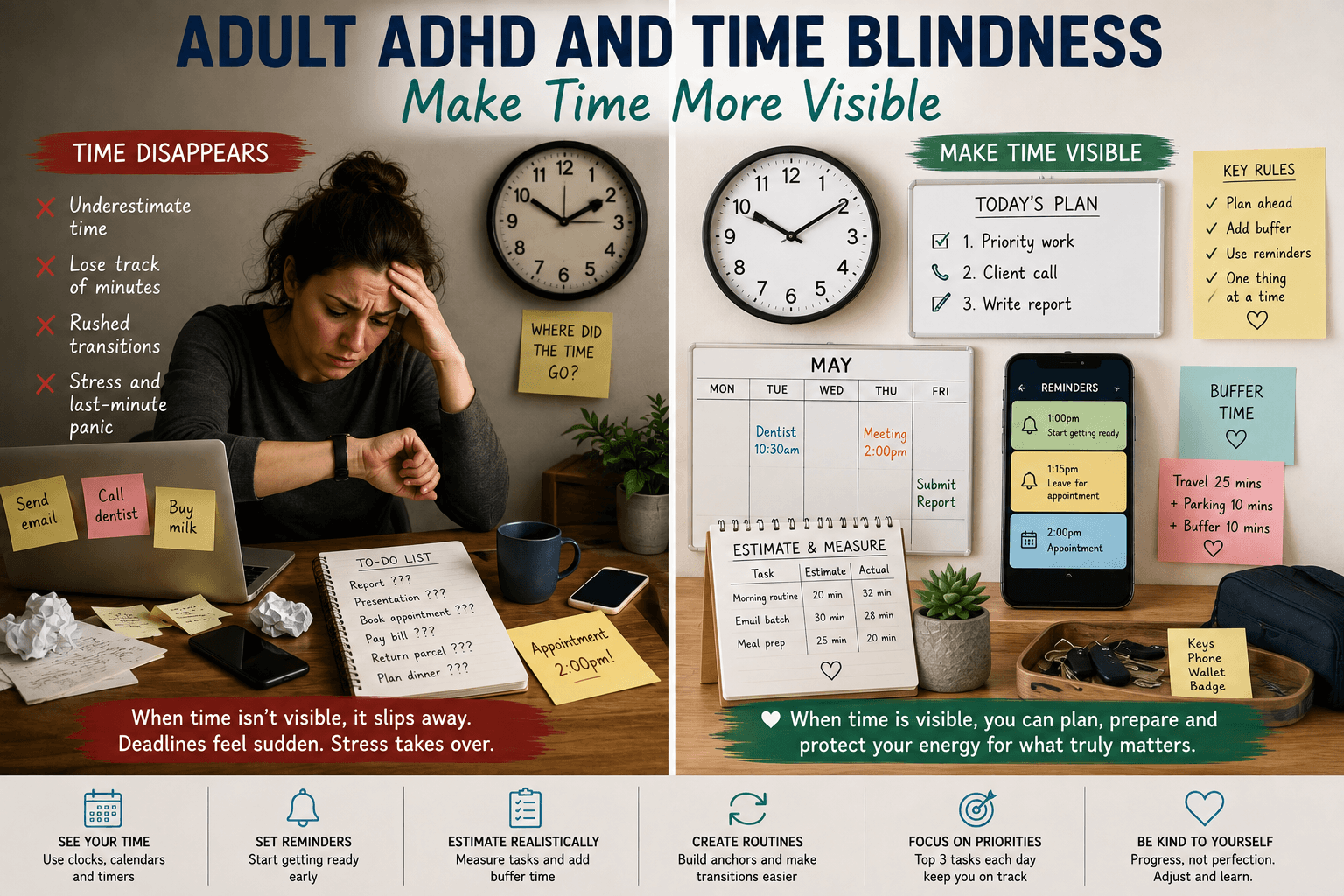
Adult ADHD and Time Blindness: How to Make Time More Visible
Adult ADHD and time blindness can make an ordinary day feel strangely unpredictable.
You sit down to check something quickly.
It should take five minutes.
However, when you look at the clock again, forty minutes have passed.
On another day, you have an appointment at 2:00 pm.
At 12:30, it feels as though you have plenty of time.
Therefore, you start another task.
Suddenly, it is 1:35.
Now you need to find your keys, gather your things and travel.
The relaxed afternoon becomes a rush.
At other times, the opposite happens.
You have an appointment later in the day, and it seems to occupy the entire morning because you are worried about missing it.
These experiences can be frustrating.
However, repeatedly telling yourself to “manage time better” may not solve the underlying problem.
Instead, it can be useful to make time more visible, more concrete and easier to respond to.
What Do People Mean by Time Blindness?
“Time blindness” is a commonly used term for difficulties noticing, estimating or responding to the passage of time.
It is not a formal diagnosis in itself.
However, difficulties with time management, planning and organisation are often discussed in relation to ADHD and executive functioning.
For example, you may:
- underestimate how long something will take;
- become absorbed in an activity and lose track of time;
- struggle to judge when to begin getting ready;
- leave tasks until urgency makes them feel immediate;
- find distant deadlines difficult to act on;
- feel that there is either “now” or “not now.”
As a result, the problem is not necessarily that you do not care about being on time.
The difficulty may be translating an invisible concept — time — into something you can act upon.
Why Adult ADHD and Time Blindness Can Affect Daily Life
Time influences almost everything.
Work.
Appointments.
Travel.
Cooking.
Exercise.
Household tasks.
Sleep.
Social plans.
Therefore, difficulties judging time can create problems across several areas at once.
For example, if you underestimate a morning routine by twenty minutes, you may leave home late.
Consequently, the journey becomes stressful.
You then arrive flustered.
Meanwhile, the stress may affect the next part of your day.
One inaccurate estimate can create a chain of consequences.
That is why adult ADHD and time blindness can be more significant than simply “running a little late.”
Time Is Invisible
A chair is visible.
A pile of paperwork is visible.
A dirty plate is visible.
Time is different.
You cannot physically see thirty minutes.
Therefore, if internal awareness of passing time is unreliable, external signals become useful.
A clock can show time.
A timer can show time passing.
A calendar can show where an event sits in the day.
An alarm can signal that a transition needs to begin.
In other words, you can make an invisible resource more visible.
Start by Measuring Real Time
People often plan using imagined time rather than measured time.
For example:
“A shower takes ten minutes.”
Perhaps it does.
However, showering may not be the whole task.
You also need to:
find clothes;
get undressed;
shower;
dry yourself;
get dressed;
prepare your hair;
collect what you need.
Suddenly, the ten-minute task may actually require thirty minutes.
Therefore, start measuring real activities occasionally.
Time them without judgement.
The results may surprise you.
Estimate First, Measure Second
Try a simple experiment.
Before starting a routine task, write down your estimate.
For example:
“I think this will take 20 minutes.”
Then time it.
Perhaps it takes 32 minutes.
Do this several times.
Over time, you begin building a more accurate personal database.
The aim is not to become obsessed with every minute.
Instead, you are learning the difference between how long a task feels and how long it actually takes.
Add the Hidden Time
Many plans fail because they include only the main activity.
Suppose you have a meeting at 10:00.
The meeting lasts one hour.
You may think:
10:00–11:00 = meeting.
However, the real commitment may include:
9:45 → stop current work.
9:50 → prepare notes.
10:00 → meeting.
11:00 → write actions.
11:10 → reset and return to work.
Now the one-hour meeting occupies closer to ninety minutes.
Therefore, when planning, include the transition time around the activity.
Adult ADHD and Time Blindness When Leaving Home
Leaving home is rarely one action.
It may involve:
finishing what you are doing;
going to the bathroom;
finding shoes;
collecting your bag;
checking the door;
finding keys;
walking to the car;
travelling.
Therefore, an appointment at 2:00 does not mean you need to think about it at 2:00.
You may need to begin the transition much earlier.
This is where countdown reminders can help.
Use a Leaving-Time Alarm
Instead of setting only an appointment reminder, create an alarm for the action you actually need to take.
For example:
Appointment: 2:00 pm
Travel: 25 minutes
Parking/walking: 10 minutes
Buffer: 10 minutes
Your alarm might therefore say:
1:15 PM — LEAVE FOR APPOINTMENT
This is more useful than:
2:00 PM — APPOINTMENT
because the second reminder arrives when you are already supposed to be there.
Add a Preparation Alarm
Sometimes even the leaving alarm is not enough.
At 1:15, you may still be deeply involved in something.
Therefore, add an earlier signal.
For example:
1:00 PM — STOP AND GET READY
1:15 PM — LEAVE
Now the first alarm creates the transition.
The second confirms the departure.
As a result, you are not relying on suddenly remembering the appointment at exactly the right moment.
Give Alarms Clear Instructions
An alarm labelled simply:
1:00
does not tell you much.
Why did you set it?
Instead, label alarms with the action.
For example:
START GETTING READY
LEAVE NOW
STOP WORK
BEGIN BEDTIME ROUTINE
JOIN MEETING IN 10 MINUTES
Consequently, the alarm does not merely tell you the time.
It tells you what the time means.
Use Visual Timers
A traditional clock tells you what time it is.
A visual timer can help show how much time remains.
For example, if you have thirty minutes to work, a countdown timer makes the remaining time visible.
Therefore, instead of repeatedly wondering:
“How long have I got?”
you can check the timer.
This can be useful for:
- focused work;
- getting ready;
- household tasks;
- breaks;
- admin;
- exercise;
- transitions.
Do Not Turn Timers Into Pressure
Timers should support you, not create constant stress.
If every activity is timed, the day may begin to feel like a race.
Therefore, use timers selectively.
They are most useful when:
you regularly lose track of time;
a task has a clear endpoint;
you need to leave at a specific time;
you want to prevent a short activity becoming much longer.
The goal is awareness, not perfection.
Use Clocks Where Time Disappears
Think about where you most often lose track of time.
Perhaps it is:
the bathroom;
the kitchen;
your home office;
the bedroom;
the garden;
a workshop.
If so, consider putting an easy-to-see clock there.
It sounds almost too simple.
However, if time is not visible, checking it requires an intentional action.
A visible clock provides information without requiring you to remember to look for it.
Adult ADHD and Time Blindness at Work
Work can make time particularly difficult because attention is constantly changing.
You may begin a task at 9:00.
Then an email arrives.
A colleague calls.
Meanwhile, another task becomes urgent.
Suddenly, it is lunchtime.
Therefore, create several anchor points during the working day.
For example:
9:00 — choose priority
11:00 — time check
1:00 — lunch
3:00 — review priorities
5:00 — shutdown routine
These anchors divide a long day into more visible sections.
Use Time Checks Instead of Constant Clock Watching
You do not need to watch the clock every five minutes.
Instead, create deliberate check-in points.
For example:
At 11:00, ask:
What have I completed?
What time is it?
What needs to happen before lunch?
At 3:00, ask:
What still matters today?
What can wait?
Do I have any appointments or deadlines approaching?
As a result, you periodically reconnect with the day without constantly interrupting yourself.
Break Long Deadlines Into Nearer Deadlines
A deadline three months away may feel abstract.
Therefore, break it into smaller dates.
Suppose a report is due on 30 September.
Instead of one deadline, create:
5 September — outline
12 September — research complete
19 September — first draft
25 September — edit
28 September — final check
30 September — submit
Now the project contains several visible points.
Consequently, the work becomes connected to the present rather than existing only in the distant future.
Put Preparation Into the Calendar
Calendars often contain events but not preparation.
For example:
Thursday 2:00 — presentation
Yet the presentation requires three hours of preparation.
If those hours are not scheduled, they may remain invisible.
Therefore, put preparation time into the calendar too.
For example:
Tuesday 10:00–11:30 — prepare presentation
Wednesday 3:00–4:30 — finish slides
Now the calendar shows the real workload.
Stop Treating Empty Space as Unlimited Time
A calendar may show a free afternoon.
That does not necessarily mean you have four completely usable hours.
You may need lunch.
You may receive calls.
You may need a break.
Tasks require transitions.
Therefore, avoid filling every empty space.
A realistic schedule includes breathing room.
Build Buffers Into the Day
A buffer is extra time deliberately left around an activity.
For example:
You think the journey takes 25 minutes.
Allow 35.
You think the task takes 45 minutes.
Allow an hour.
The extra time absorbs small delays.
As a result, one unexpected problem does not automatically make everything else late.
Use a Personal Buffer Rule
You may find it useful to create a simple rule.
For example:
Travel → add 15 minutes.
Appointments → arrive 10 minutes early.
Important work → add 25% to my first estimate.
The exact numbers depend on your life.
However, having a default buffer removes the need to calculate from scratch each time.
Adult ADHD and Time Blindness During Hyperfocus
Sometimes concentration becomes so strong that the outside world seems to disappear.
You begin an interesting activity.
Then hours pass.
Meanwhile, meals, messages or other commitments may be forgotten.
Strong focus can be useful.
However, it can also make transitions difficult when another responsibility is waiting.
Therefore, if you know you are entering an activity where time tends to disappear, set an external signal beforehand.
For example:
3:30 — CHECK TIME
4:00 — STOP AND PREPARE TO LEAVE
This protects the next commitment without requiring you to continuously monitor the clock.
Use More Than One Cue for Important Events
If something genuinely matters, one reminder may not be enough.
For example:
Day before: appointment tomorrow.
One hour before: prepare.
Thirty minutes before: leave.
This may seem excessive to someone who naturally tracks time well.
However, the purpose is not to impress anyone with your memory.
The purpose is to arrive where you need to be.
Use the amount of support that works.
Make “Later” More Specific
One of the most dangerous words in planning is:
Later.
“I’ll do it later.”
But when is later?
This afternoon?
Tonight?
Tomorrow?
Next week?
Instead, turn “later” into something visible.
For example:
Today at 4:00.
After lunch.
Saturday morning.
Before I leave work.
A specific point gives the task somewhere to live.
Replace “Soon” With a Real Time
The same applies to:
Soon.
“I’ll reply soon.”
“I’ll pay it soon.”
“I’ll book it soon.”
However, “soon” has no boundary.
Therefore, where something matters, give it one.
For example:
Reply before 3:00.
Pay bill Friday morning.
Book appointment during lunch.
Now the intention is easier to act upon.
Adult ADHD and Time Blindness Around Household Tasks
Household jobs can expand unexpectedly.
You think:
“I’ll quickly tidy the kitchen.”
Then you notice a cupboard.
Then paperwork.
Then something needs taking upstairs.
Suddenly, an hour has passed.
Therefore, define the task before beginning.
For example:
“For the next 15 minutes, I am clearing the kitchen surfaces only.”
Set a timer.
When it ends, decide whether to continue.
In this way, the task gains a visible boundary.
Use Short Time Containers
A time container gives an activity a defined period.
For example:
10 minutes — paperwork
20 minutes — cleaning
30 minutes — email
45 minutes — focused work
This can make large tasks easier to approach.
Instead of asking:
“Can I finish all of this?”
you ask:
“Can I work on this for twenty minutes?”
That is often a simpler decision.
Be Careful With “Just One More Thing”
You are about to leave.
Then you think:
“I’ll just send one email.”
Or:
“I’ll quickly put this away.”
Five minutes becomes fifteen.
Now you are late.
Therefore, once the leaving transition has started, consider using a rule:
No new tasks.
Write the new task down.
Then leave.
This protects the commitment you already made.
Create a Closing Window Before Leaving
If you need to leave at 3:00, consider stopping new work at 2:40.
Use those twenty minutes to:
save your work;
write the next action;
use the bathroom;
collect your things;
check the route;
leave.
As a result, departure becomes a process rather than a sudden event.
Use Routines as Time Anchors
Regular routines can give the day structure.
For example:
Breakfast → check calendar.
Lunch → review afternoon.
Dinner → prepare tomorrow.
Bedtime routine → check morning commitments.
These anchors connect time to activities that already happen.
Therefore, you do not need to rely entirely on the clock.
The routine itself becomes a cue.
Adult ADHD and Time Blindness Around Bedtime
Bedtime can be another place where time disappears.
You intend to go to bed at 11:00.
At 10:30, you begin watching something.
Suddenly, it is midnight.
Therefore, bedtime may need a start alarm, not simply a target bedtime.
For example:
10:00 — begin winding down
10:30 — prepare for bed
11:00 — lights out target
The earlier cue creates space for the transition.
Make Tomorrow Visible Tonight
Before finishing the day, check tomorrow.
What time is the first appointment?
When do you need to leave?
What needs to go with you?
What is the first important task?
Then, prepare what you can.
This connects external memory with time management.
As a result, tomorrow’s schedule is less likely to arrive as a surprise.
Link Time With External Memory
The previous article explored adult ADHD and external memory.
These ideas work well together.
A calendar remembers the appointment.
An alarm remembers when preparation should begin.
A checklist remembers what you need.
A transition zone remembers where your keys and bag belong.
Therefore, you do not need one perfect internal sense of time.
Several external systems can work together.
Link Time With Decision Fatigue
The previous article also explored adult ADHD and decision fatigue.
Time systems can reduce decisions too.
If your calendar already tells you when admin happens, you do not need to repeatedly decide when to do it.
If the leaving alarm tells you when to go, you do not need to keep asking:
“Should I leave yet?”
If tomorrow’s first task is already scheduled, the morning contains one less decision.
Consequently, making time visible can also reduce mental effort.
Do Not Punish Yourself for an Inaccurate Estimate
You thought the task would take thirty minutes.
It took an hour.
That information is useful.
Therefore, record it mentally or practically.
Next time, allow more.
The goal is not:
“I should have been faster.”
A more useful response is:
“Now I know this usually takes around an hour.”
Better information creates better planning.
Learn Your Personal Time Patterns
Perhaps you consistently underestimate travel.
Maybe getting ready takes longer than expected.
Perhaps emails expand endlessly.
Alternatively, you may allow too much time for certain tasks because you are worried about being late.
Notice the pattern.
Then, adjust the system around your real behaviour.
Your schedule should reflect the time your life actually takes.
Adult ADHD and Time Blindness on Low-Energy Days
Time management can become harder when energy is low.
You may move more slowly.
Transitions may take longer.
Simple tasks may require additional pauses.
Therefore, your normal schedule may not fit every day.
On lower-energy days, increase buffers where possible.
Reduce unnecessary commitments.
Choose fewer priorities.
Use stronger reminders.
Most importantly, plan according to the capacity you actually have rather than the capacity you wish you had.
A Simple Time-Visibility System
You do not need dozens of apps.
A basic system might contain:
Calendar
For appointments and scheduled work.
Visible Clock
For awareness of the current time.
Countdown Timer
For activities where time tends to disappear.
Preparation Alarm
For starting a transition.
Leaving Alarm
For the actual departure.
Buffer
For unexpected delays.
Together, these tools make time easier to see and respond to.
Try the 15-Minute Reality Check
Choose one task you regularly underestimate.
Before starting, write:
Estimated time: ____
Then measure it.
Afterwards, write:
Actual time: ____
Repeat this on several occasions.
Eventually, you may discover a pattern.
Perhaps your “ten-minute” morning routine consistently takes twenty-five minutes.
That information can immediately improve future planning.
Start With One Time Problem
Do not attempt to control every minute of the day.
Choose one repeated problem.
Perhaps you are regularly late leaving home.
Maybe you lose time online.
You might underestimate household jobs.
Then create one support.
For example:
Late leaving → preparation alarm.
Online time disappearing → visual timer.
Household task expanding → 20-minute time container.
Use it for a week.
Afterwards, notice whether the problem becomes easier.
Then decide whether another area needs support.
Reflection Questions
- Which activities make you lose track of time most easily?
- Which tasks usually take longer than you expect?
- Do you know how long your morning routine actually takes?
- Are your appointment reminders early enough to be useful?
- Would a preparation alarm help before leaving?
- Where would a visible clock be useful?
- Which long deadline could be divided into smaller dates?
- How much buffer do you normally allow for travel?
- Which task could benefit from a countdown timer?
- What is one way you could make time more visible today?
Conclusion
Adult ADHD and time blindness can make planning difficult when time feels abstract, inconsistent or easy to lose track of.
However, the answer does not need to be watching the clock constantly.
Instead, make time easier to see.
Measure how long common tasks actually take.
Add hidden preparation and transition time.
Use visible clocks and countdown timers.
Create preparation alarms as well as leaving alarms.
In addition, build buffers around important commitments and break distant deadlines into nearer steps.
Most importantly, stop treating inaccurate estimates as personal failures.
They are information.
Therefore, when something repeatedly takes longer than expected, ask:
“How can I make the real amount of time more visible next time?”
Over time, adult ADHD and time blindness may become easier to manage when your environment, calendar, alarms and routines help carry some of the responsibility for tracking time.
SUGGESTED INTERNAL LINKS
- Adult ADHD and Decision Fatigue: How to Make Everyday Choices Easier
- Adult ADHD and External Memory: How to Stop Holding Everything in Your Head