
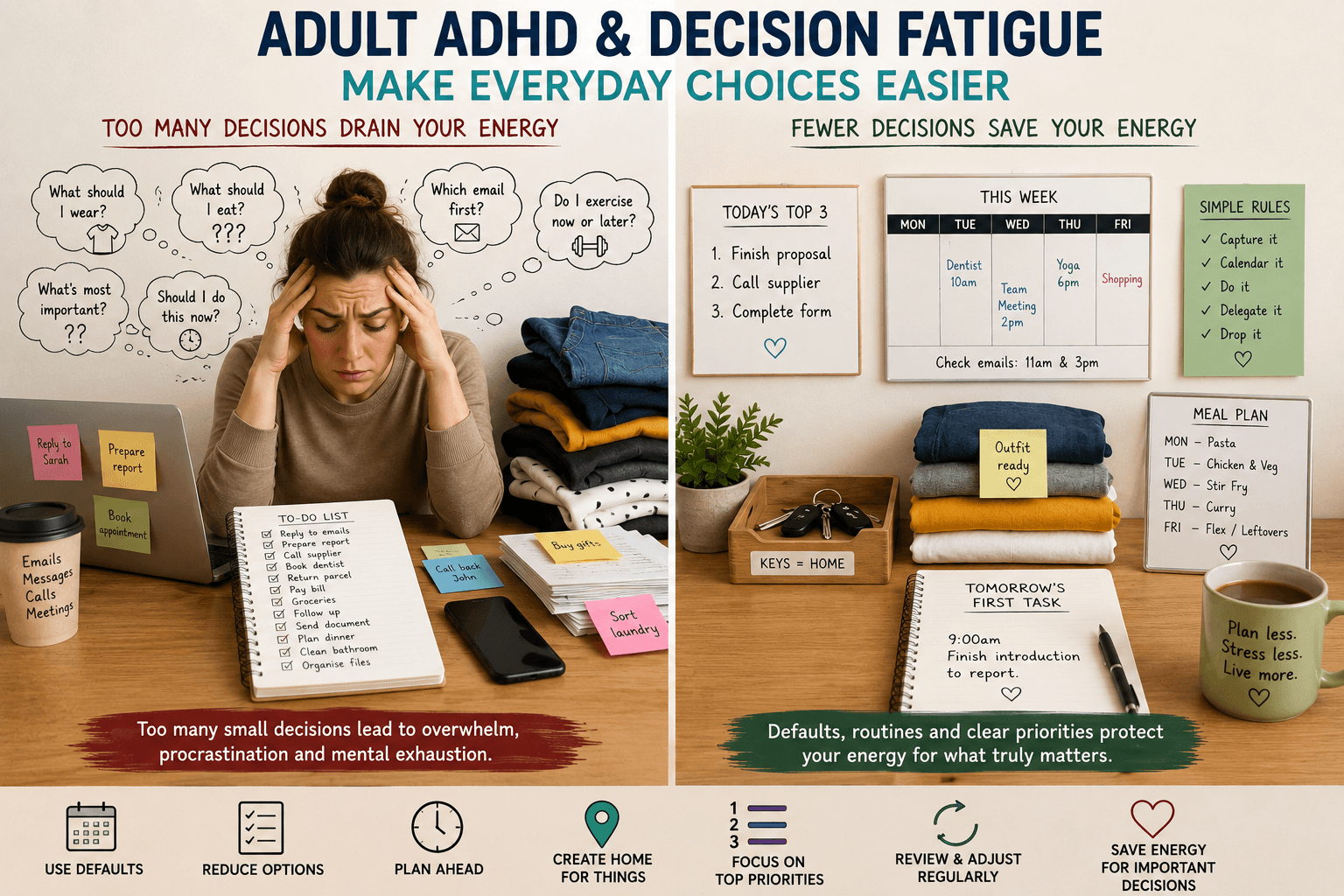
Adult ADHD and Decision Fatigue: How to Make Everyday Choices Easier
Adult ADHD and decision fatigue can make an ordinary day feel surprisingly demanding.
What should I wear?
What should I eat?
Which email should I answer first?
Should I do this now or later?
Which task matters most?
Where should I start?
None of these decisions seems particularly difficult on its own. However, they can quickly add up.
By lunchtime, you may already have made dozens of small choices.
Meanwhile, larger decisions are still waiting.
Eventually, you reach an important task and suddenly feel unable to decide what to do.
You may procrastinate.
You might repeatedly change your mind.
Alternatively, you may avoid the decision completely.
At that point, it is easy to think:
“Why can’t I just make a decision?”
However, the problem may not be the individual choice.
Instead, you may already have spent a large amount of mental energy making decisions throughout the day.
That is where reducing unnecessary choices can help. This page is deliberately practical: it focuses on defaults, preparation and simple systems that reduce the number of recurring choices you need to make. For the broader explanation of symptoms, causes and warning signs, start with ADHD Decision Fatigue: Signs, Causes and Mental Overload.
What Is Decision Fatigue?
Decision fatigue is a useful way of describing how repeated choices can become mentally tiring.
Imagine beginning the day with a full battery.
Every decision uses a small amount of attention.
Some decisions use very little.
Others require much more thought.
However, when decisions continue throughout the day, the mental effort can accumulate.
As a result, later choices may feel more difficult than earlier ones.
You may become slower.
You might become more impulsive.
Alternatively, you may postpone the decision altogether.
Therefore, the aim is not to remove every choice from life.
It is to reduce the decisions that do not deserve so much of your attention.
Why Adult ADHD and Decision Fatigue Can Feel Overwhelming
Everyday life contains countless choices.
For example:
What should I do first?
Which task is most urgent?
Should I answer that message now?
Where did I put the information?
Do I need to remember this?
What should I cook?
When should I leave?
In addition, distractions can interrupt the decision-making process.
You begin deciding one thing.
Then a notification appears.
Meanwhile, another task comes to mind.
When you return to the original decision, you may need to start thinking about it again.
Therefore, adult ADHD and decision fatigue can sometimes involve not only making many decisions, but repeatedly reopening decisions that were never fully completed.
Not Every Decision Deserves Equal Attention
Some decisions genuinely matter.
For example:
A major financial decision.
A career change.
A health decision.
An important family matter.
A significant purchase.
These deserve careful thought.
However, many everyday decisions do not require the same level of attention.
Which mug should you use?
When should you check email?
Where should your keys go?
What should you eat for breakfast?
Therefore, one useful strategy is to reduce the mental effort spent on low-value decisions.
Save your attention for choices where it genuinely matters.
Create Defaults
A default is a decision you make once and then reuse.
For example:
You may have a standard breakfast on weekdays.
You might check email at set times.
Perhaps your keys always go in the same place.
Maybe Monday evening is your regular household admin time.
As a result, you do not need to make the same decision repeatedly.
The default has already made part of the choice for you.
Defaults Do Not Need to Be Permanent
A default is not a rule you can never change.
It simply provides a starting point.
For example:
Default: I exercise after breakfast.
If Tuesday becomes unusually busy, you can exercise later.
Default: I do household admin on Saturday morning.
If Saturday is unavailable, you can move it.
The advantage is that you do not need to decide from scratch every day.
Instead, you follow the default unless there is a reason to change it.
Reduce Morning Decisions
Mornings can contain many choices before the day has properly started.
What should I wear?
What should I eat?
What do I need to take?
What should I do first?
Therefore, preparing some of these decisions in advance can reduce morning friction.
For example:
Choose clothes the night before.
Prepare your bag.
Decide tomorrow’s first task.
Put keys in their usual place.
Check the calendar before bed.
As a result, the morning begins with fewer open questions.
Use a Small Menu of Choices
Too many options can make simple decisions harder.
Suppose you ask:
“What should I eat tonight?”
The answer could be almost anything.
Instead, create a small menu.
For example:
Monday → pasta.
Tuesday → chicken.
Wednesday → something quick.
Thursday → curry.
Friday → flexible choice.
You do not have to follow the plan perfectly.
However, it gives you somewhere to begin.
The same idea can work with clothes, exercise, household jobs and even work tasks.
Adult ADHD and Decision Fatigue at Work
Work can generate continuous decisions.
Which email first?
Which project first?
Should I answer this message now?
Should I interrupt the current task?
What is most urgent?
Meanwhile, colleagues may introduce additional priorities.
As a result, the day can become a stream of small decisions rather than sustained work.
One solution is to decide some things before the working day becomes busy.
For example:
Choose your first priority before opening email.
Set specific periods for routine messages.
Create a simple rule for urgent work.
Keep today’s priorities visible.
Consequently, fewer decisions need to be made in the middle of interruptions.
Decide Tomorrow’s First Task Today
This is one of the simplest strategies in this article.
Before finishing work, ask:
“What is the first useful thing I should do tomorrow?”
Then write it down.
For example:
Tomorrow, 9:00 — finish introduction to report.
Now tomorrow morning begins with direction.
You do not need to open the computer and ask:
What should I do?
Where should I start?
What is most important?
Instead, the decision has already been made.
Use a Top Three
A long task list can create too many competing choices.
Twenty items may all appear important.
Therefore, choose a smaller daily priority list.
For example:
Today’s Top Three
- Finish proposal.
- Call supplier.
- Complete form.
Other tasks can still exist.
However, these three provide direction.
When you finish one, you already know what deserves attention next.
Use Rules for Repeated Decisions
Simple personal rules can remove repeated choices.
For example:
If it is an appointment, it goes straight into the calendar.
If something needs to leave the house tomorrow, it goes beside the door.
If a task takes less than two minutes and I have time, I complete it.
If I cannot deal with an email now, I add the action to my task list.
These rules create predictable responses.
Therefore, you spend less time deciding what to do with the same types of situations.
Give Important Objects Permanent Homes
Some decisions should disappear almost completely.
Where should I put my keys?
Where should this paperwork go?
Where do chargers belong?
Where should I leave my bag?
If the answer changes every day, each object creates another small decision.
Instead, give frequently used items permanent homes.
Keys → hook.
Wallet → tray.
Important paperwork → admin zone.
Chargers → charging area.
Bag → transition zone.
As a result, putting something away becomes less of a decision.
Adult ADHD and Decision Fatigue Around Food
Food can create a surprising number of daily decisions.
Breakfast.
Lunch.
Dinner.
Shopping.
Snacks.
Ingredients.
Cooking.
Therefore, creating several default meals can reduce mental effort.
You might have:
Three easy breakfasts.
Three quick lunches.
Five reliable evening meals.
A standard shopping list.
In addition, keeping a few simple backup meals available can help on low-energy days.
The goal is not to remove variety.
Instead, it is to make food decisions easier when you do not want to think about them.
Simplify Clothing Decisions
Clothing can create similar friction.
What matches?
What is clean?
What is suitable?
What will the weather be like?
Therefore, simplify where useful.
For example:
Prepare clothes the night before.
Keep work outfits together.
Create several combinations you already know work.
Check tomorrow’s weather before choosing.
As a result, one morning decision becomes easier.
Use Checklists Instead of Re-Deciding
Repeated routines should not require repeated planning.
If you travel regularly, create a travel checklist.
If you leave for work every morning, create a leaving-home checklist.
If you complete the same work process regularly, create a work checklist.
Therefore, instead of asking:
“What do I need?”
you ask:
“Have I completed the list?”
That is a much smaller decision.
Reduce Digital Choices
Phones and computers contain almost unlimited choices.
Which app?
Which message?
Which article?
Which video?
Which notification?
Consequently, a short phone check can turn into dozens of tiny decisions.
One way to reduce this is to create clearer digital boundaries.
For example:
Turn off unnecessary notifications.
Keep distracting apps away from the first screen.
Close unused browser tabs.
Check messages at planned times.
In addition, remove apps you rarely use.
Fewer visible options can mean fewer invitations to switch attention.
Do Not Make Important Decisions When You Are Exhausted
Some decisions can wait.
If you are mentally drained at the end of a difficult day, it may not be the best time to make a major choice.
Therefore, when possible, pause.
Write down the decision.
Gather the necessary information.
Then return to it during a stronger period.
This connects directly with adult ADHD and energy management, discussed earlier in this series.
Important decisions deserve enough attention.
Use High-Energy Periods for High-Value Decisions
Perhaps you think most clearly in the morning.
If so, protect some of that period for important thinking.
Conversely, if your concentration improves later in the day, use that window where possible.
The key is to notice your own pattern.
Then, match difficult decisions with periods when your attention is more available.
Separate Decisions From Actions
Sometimes a task feels difficult because it contains several hidden decisions.
For example:
“Sort holiday.”
That may actually mean:
Choose dates.
Choose destination.
Set budget.
Compare flights.
Choose hotel.
Book.
That is not one task.
It is several decisions and actions.
Therefore, break it down.
For example:
First: choose possible dates.
Next: set maximum budget.
Then: shortlist three destinations.
Afterwards: compare travel options.
Suddenly, the first step becomes much clearer.
Limit Research Before Making a Choice
Research can feel productive.
However, unlimited research can create more choices rather than fewer.
Imagine comparing twenty products.
Each has different features.
Then you read fifty reviews.
Now the decision is harder than when you started.
Instead, set a limit.
For example:
Compare three options.
Read five reliable reviews.
Set three essential criteria.
Then decide.
This creates an endpoint.
Use Three Criteria
When a choice feels complicated, identify the three things that matter most.
For example, when choosing a laptop:
- Budget.
- Battery life.
- Screen size.
Now compare options against those priorities.
Otherwise, you may become distracted by dozens of features that do not actually matter to you.
This approach can make complex choices more manageable.
Adult ADHD and Decision Fatigue When Shopping
Shopping creates an enormous number of choices.
Brands.
Sizes.
Prices.
Features.
Reviews.
Offers.
Delivery options.
Therefore, decide your criteria before shopping.
For example:
Budget: £100 maximum.
Colour: black.
Must arrive this week.
Now hundreds of possibilities become a smaller group.
As a result, the shopping process becomes more focused.
Stop Reopening Decisions Without New Information
You make a choice.
Then you reconsider it.
Then you check again.
Later, you reconsider it again.
However, if no new information has appeared, repeatedly reopening the decision may simply consume more energy.
Therefore, after making a reasonable choice, ask:
“Has anything genuinely changed?”
If the answer is no, consider leaving the decision closed.
Not every choice needs repeated review.
Good Enough Can Be Useful
Some decisions need the best possible answer.
Many do not.
Sometimes good enough is genuinely enough.
For example:
Choosing a notebook.
Buying basic household supplies.
Selecting tonight’s meal.
Picking a simple storage basket.
Spending thirty minutes finding the perfect version may not improve the outcome meaningfully.
Therefore, reserve perfection for decisions where it genuinely matters.
Create a “Good Enough” Rule
You might use a rule such as:
If two options both meet my main requirements, choose the simpler or cheaper one.
This creates an endpoint.
Otherwise, you may continue comparing options long after the practical decision has already been solved.
Adult ADHD and Decision Fatigue at Home
Homes contain endless small choices.
What needs cleaning?
What needs buying?
What should we eat?
What should be done first?
Who needs to go where?
Therefore, routines can remove some of these repeated decisions.
For example:
Shopping on the same day.
Admin at the same time each week.
Regular meal options.
Fixed places for important objects.
A visible family calendar.
As a result, household life becomes slightly more predictable.
Predictability can reduce unnecessary decision-making.
Share Decisions Where Appropriate
You do not necessarily need to make every household decision yourself.
If several people share the home, consider sharing responsibility.
For example:
One person manages the shopping list.
Another handles a particular household task.
Family appointments go onto a shared calendar.
Consequently, one person does not need to carry every decision mentally.
Use Your Environment to Make the Decision Obvious
Good environments can remove choices.
If your walking shoes are beside the door, going for a walk becomes easier.
If the paperwork tray is beside the desk, you know where the form belongs.
If tomorrow’s clothes are ready, the morning decision has already been made.
Therefore, your environment can act as part of your decision-making system.
This connects directly with the earlier article on adult ADHD and home zones.
External Memory Reduces Decision Fatigue
The previous article explored adult ADHD and external memory.
The two ideas work well together.
If you write down what needs doing, you do not need to repeatedly ask:
“What am I forgetting?”
If the calendar holds your appointments, you do not need to keep deciding when they happen.
If today’s top three tasks are visible, choosing what to do next becomes easier.
Therefore, external memory does more than support remembering.
It can also reduce repeated decision-making.
Create a Decision-Free Start to the Day
Imagine beginning the day with:
Clothes already chosen.
Breakfast already decided.
Bag already packed.
Keys in their usual place.
First work task already written down.
You still have choices to make.
However, you have removed several low-value decisions before the day has properly begun.
As a result, more attention remains available for what matters later.
Adult ADHD and Decision Fatigue on Low-Energy Days
Decision-making can feel especially difficult when energy is low.
On those days, defaults become more valuable.
You do not need to create a new meal plan.
Use the backup meal.
You do not need to design the perfect workout.
Take the usual short walk.
You do not need to decide between ten tasks.
Choose from today’s top three.
Therefore, good defaults create a simpler path when thinking capacity is reduced.
Build a Low-Energy Decision Plan
Consider deciding in advance what happens on difficult days.
For example:
Food: simple backup meal.
Exercise: ten-minute walk.
Work: complete one priority.
Household: essential tasks only.
Admin: postpone unless urgent.
This means the low-energy day does not require another complicated decision about how to handle low energy.
The plan already exists.
Stop Asking Yourself the Same Question
Repeated questions are a useful clue.
If you regularly ask:
What should I eat?
Where are my keys?
When should I exercise?
What should I do first?
When should I check email?
you may have found an opportunity for a default.
Therefore, notice the questions that keep returning.
Then ask:
“Can I answer this once instead of every day?”
That is the heart of reducing decision fatigue.
Adult ADHD and Decision Fatigue After a Late Diagnosis
After a late ADHD diagnosis, you may look back and recognise how much energy went into everyday decisions.
Perhaps you created routines without knowing why they helped.
Maybe unstructured days always felt harder.
You might have performed well when expectations were clear but struggled when everything was open-ended.
Understanding adult ADHD and decision fatigue can provide another way to interpret those experiences.
Rather than expecting yourself to make unlimited decisions effortlessly, you can design parts of life so that fewer decisions are necessary.
A Simple Decision-Reduction System
You do not need to restructure your whole life.
Start with five areas.
1. Morning
Choose clothes and prepare important items the night before.
2. Work
Decide tomorrow’s first task today.
3. Food
Create several reliable default meals.
4. Home
Give important objects permanent locations.
5. Tasks
Choose a daily top three.
Together, these changes remove several repeated decisions.
Once they become familiar, you can decide whether another area would benefit from the same approach.
Start With One Repeated Decision
Do not attempt to remove every decision.
Instead, choose one that repeatedly wastes time or energy.
Perhaps:
What to eat for lunch.
Where to put your keys.
Which task to start first.
When to exercise.
Then create one default.
Use it for a week.
Afterwards, ask:
Did this make life easier?
If yes, keep it.
Then choose another repeated decision.
Small changes can gradually reduce a surprising amount of mental friction.
Reflection Questions
- Which decisions do you make repeatedly every day?
- Which choices feel hardest when you are tired?
- What could become a useful default?
- Could you choose tomorrow’s first task today?
- Which objects need permanent homes?
- Could a small menu simplify meals?
- Are too many options making any current decision harder?
- Which decision could be replaced with a checklist?
- What important choices deserve your strongest energy?
- What is one decision you could remove from tomorrow?
Conclusion
Adult ADHD and decision fatigue can make ordinary choices consume more attention than expected.
However, you do not need to eliminate decision-making.
Instead, reduce the decisions that do not deserve so much mental energy.
Create defaults.
Use checklists.
Prepare tomorrow’s first task today.
Give important objects permanent homes.
Limit unnecessary options.
In addition, use your strongest energy for decisions that genuinely matter.
Most importantly, notice the questions you repeatedly ask yourself.
If the same question appears every day, perhaps it does not need a new answer every day.
Therefore, instead of asking:
“How can I become better at making endless decisions?”
try asking:
“Which decisions could I stop needing to make?”
Over time, adult ADHD and decision fatigue can become easier to manage when everyday life contains clearer defaults, fewer unnecessary choices and more attention available for the decisions that truly matter.
SUGGESTED INTERNAL LINKS
- Adult ADHD and Motivation: How to Get Started When You Know What You Need to Do
- Adult ADHD and Overthinking: How to Quiet the Mental Noise
DISCLAIMER
This article is provided for general educational and informational purposes only. It does not provide medical, psychological, diagnostic or therapeutic advice. Therefore, it should not be used as a substitute for individual guidance from an appropriately qualified healthcare professional.
Difficulty making decisions can have many causes, and ADHD experiences vary considerably between individuals. If decision-making difficulties are significantly affecting your wellbeing or daily life, or if you have concerns about ADHD, mental health, medication, diagnosis or treatment, please speak with an appropriately qualified healthcare professional.