
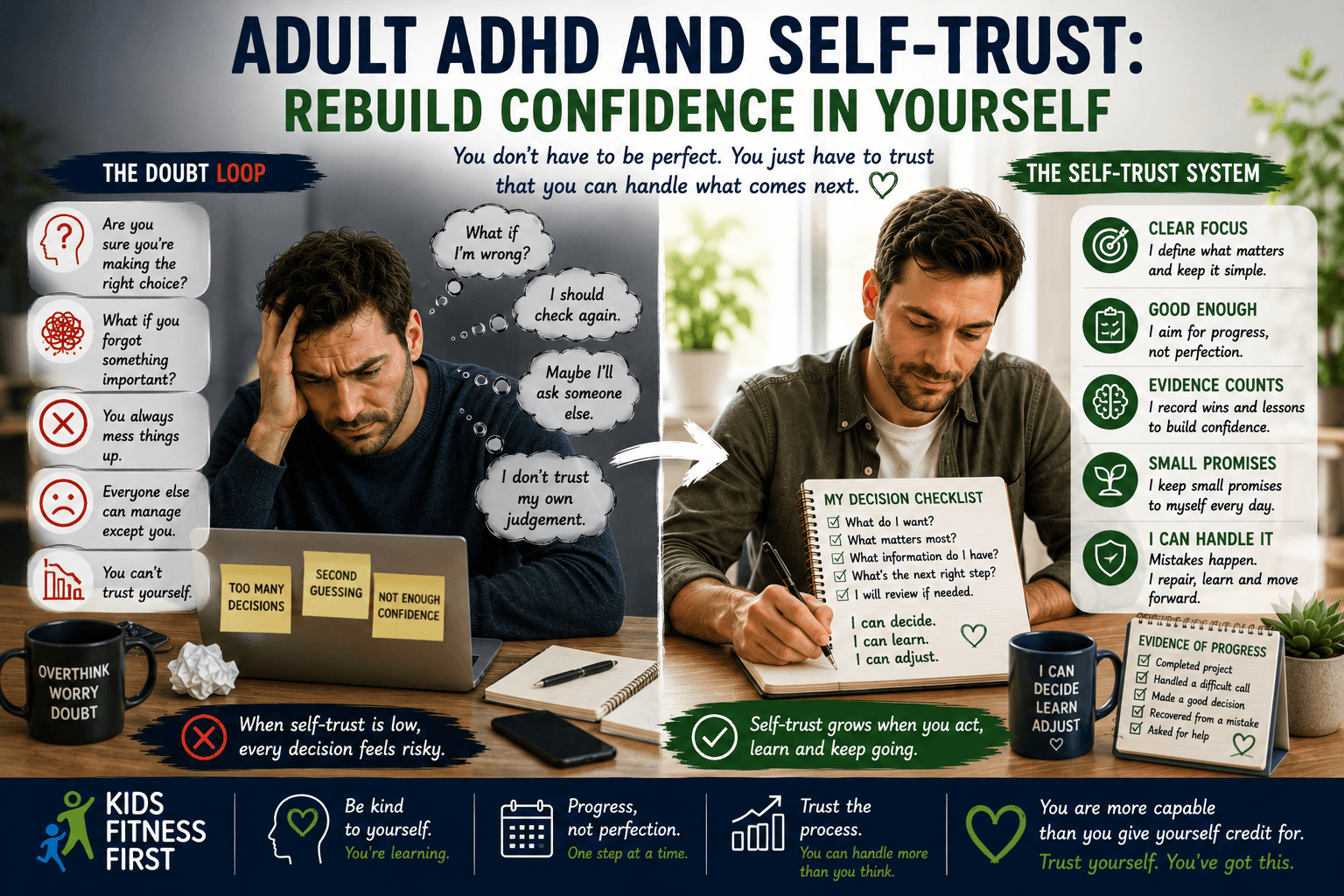
Adult ADHD and Self-Trust: How to Rebuild Confidence in Yourself
Adult ADHD and self-trust can become closely connected over time.
Perhaps you make a decision.
Then you question it.
You check again.
You ask somebody else what they think.
However, even after receiving reassurance, the uncertainty remains.
You may wonder:
“Have I forgotten something?”
“What if I have made the wrong choice?”
“Should I ask somebody else?”
“Can I really trust myself with this?”
At first, this may look like ordinary caution.
However, if you have spent years being criticised for forgetting, changing direction, running late or struggling with organisation, self-doubt can gradually become a habit.
As a result, you may stop trusting your own judgement even in situations where you are perfectly capable of deciding.
Therefore, rebuilding self-trust is not about becoming certain all the time.
Instead, it is about learning that you can make reasonable decisions, handle mistakes and adjust when new information appears.
What Does Self-Trust Mean?
Self-trust does not mean believing that you will never make a mistake.
Nobody can promise that.
Instead, self-trust means believing that you can:
make a reasonable choice;
notice when something is not working;
ask for help when necessary;
repair mistakes;
learn from experience;
change direction when the evidence changes.
Therefore, confidence does not have to come from always being right.
It can come from knowing that you can respond when things do not go perfectly.
That distinction is important.
Why Adult ADHD and Self-Trust Can Become Difficult
Repeated difficulties can slowly change how you see yourself.
Perhaps you forget appointments.
Maybe you lose things.
You may start projects enthusiastically and later struggle to finish them.
Meanwhile, other people may comment:
“Are you sure?”
“Have you checked?”
“You always forget.”
“Maybe let someone else handle it.”
Over time, those messages can become internal.
Consequently, even when nobody is questioning you, you may begin questioning yourself.
That is one reason adult ADHD and self-trust may require deliberate rebuilding.
Self-Trust Is Built Through Evidence
You do not need to convince yourself with empty positive statements.
Instead, collect evidence.
For example:
You remembered the appointment because you used a reminder.
You completed the application because you broke it into stages.
You handled a difficult conversation calmly.
You finished the report.
You made a decision and it worked.
As a result, confidence begins to rest on real experiences rather than wishful thinking.
Keep a Self-Trust Record
Create a simple note called:
Things I Handled Well
Add examples such as:
- made an important call;
- kept an appointment;
- completed a difficult task;
- solved a problem;
- recovered after a mistake;
- made a good decision;
- asked for help at the right time.
This does not need to become a daily project.
However, recording evidence can help counter the tendency to remember failures more strongly than successes.
Adult ADHD and Self-Trust: Start With Small Decisions
If decision-making has become difficult, do not begin by trying to feel completely confident about major choices.
Start smaller.
For example:
What should I work on first?
Which appointment time suits me?
What should I eat?
Which task can wait?
Make the decision.
Then let it stand.
As a result, you begin practising the experience of choosing without endlessly reopening the question.
Use a Decision Deadline
Some decisions benefit from a time limit.
For example:
“I will choose by 4 pm.”
Until then, gather the information you genuinely need.
Afterwards, decide.
Therefore, the decision has an endpoint.
Otherwise, research and second-guessing can continue indefinitely.
Know What Information Is Enough
You do not need every possible piece of information before making most everyday decisions.
For example, choosing between two suitable products may not require reading fifty reviews.
Instead, decide what matters most.
Perhaps:
price;
quality;
delivery time.
Once the options meet those criteria, choose.
As a result, confidence becomes linked to a clear process rather than a feeling of absolute certainty.
Adult ADHD and Self-Trust After a Mistake
Mistakes can damage self-trust if you interpret them too broadly.
You forget a deadline.
Then the thought becomes:
“This proves I cannot manage anything.”
However, one mistake does not automatically invalidate every decision you make.
Therefore, ask:
“What exactly failed?”
Perhaps the reminder was too late.
Maybe the task was not in the calendar.
Perhaps the workload was unrealistic.
As a result, the problem becomes something you can improve rather than evidence that you should never trust yourself.
Repair Builds Confidence
Self-trust grows not only from success but also from repair.
For example:
You send the wrong document.
You notice.
You correct it.
You apologise if necessary.
Then you create a check for next time.
That sequence matters.
Therefore, the lesson becomes:
“I made a mistake and handled it.”
That can build more durable confidence than pretending mistakes never happen.
Keep Small Promises to Yourself
Self-trust can weaken when you repeatedly make unrealistic promises.
For example:
“Tomorrow I will reorganise my entire life.”
Then tomorrow arrives, and it does not happen.
Instead, make smaller promises.
For example:
“After breakfast, I will check my calendar.”
Or:
“I will work on the form for ten minutes.”
Then do it.
As a result, your own commitments start becoming more believable.
Make Promises Smaller, Not Louder
When a plan fails, the instinct may be to make a bigger promise.
“This time I am definitely going to do everything.”
However, greater intensity does not necessarily create better follow-through.
Instead, reduce the promise until it becomes realistic.
For example:
Not:
“I will exercise every day.”
But:
“I will walk for ten minutes three times this week.”
Success creates useful evidence.
Adult ADHD and Self-Trust at Work
Work can test self-confidence.
You may receive feedback.
You may need to make decisions under pressure.
Perhaps you worry about missing something.
Therefore, use systems to support your judgement.
For example:
write important decisions down;
use checklists for repeated processes;
confirm complex instructions;
review important work before submission.
These supports do not mean you cannot trust yourself.
Instead, they are part of how you create reliable performance.
Confidence and Systems Can Work Together
There is a misconception that confident people should not need reminders, lists or checks.
That is not true.
Professionals use systems constantly.
Pilots use checklists.
Doctors use protocols.
Businesses use processes.
Therefore, using external support does not weaken self-trust.
In fact, reliable systems can strengthen it.
Ask for Clarification Without Giving Away Your Confidence
There is a difference between clarification and dependency.
For example:
“Can you confirm which deadline takes priority?”
is a practical question.
However:
“I don’t know what to do. Can you make every decision for me?”
moves responsibility elsewhere.
Therefore, ask for information when needed while still keeping ownership of your decision.
Adult ADHD and Self-Trust in Relationships
Self-doubt can also appear in relationships.
You may question:
Did I misunderstand?
Was I too much?
Should I have said something differently?
However, continuously doubting your own perceptions can be exhausting.
Therefore, use a balanced approach.
Ask:
What happened?
What did I feel?
What evidence do I have?
Is clarification needed?
As a result, you neither assume you are always right nor automatically assume you are wrong.
Trust Your Feelings Without Treating Them as Proof
Feelings provide information.
For example:
“I felt uncomfortable during that conversation.”
That matters.
However:
“I felt uncomfortable, therefore the other person definitely intended to hurt me.”
goes further than the evidence.
Therefore, trust yourself enough to notice the feeling while still checking the facts.
That is balanced self-trust.
Adult ADHD and Self-Trust After Criticism
Criticism can make you doubt yourself immediately.
Someone disagrees.
Suddenly, your original view feels worthless.
However, disagreement does not automatically mean you were wrong.
Therefore, ask:
What part of the criticism is useful?
What evidence supports my original view?
Has any new information appeared?
Then, adjust if necessary.
You do not need to abandon your judgement simply because another person has a different opinion.
Feedback Is Information, Not Ownership
Other people can provide information.
However, they do not automatically own every decision about your life.
Therefore, listen carefully.
Take useful information.
Then decide what applies.
This is especially important when advice conflicts.
One person says one thing.
Another says the opposite.
Eventually, you still need a process for deciding what fits your situation.
Use a Trusted Decision Process
A simple decision process can make choices easier.
Step 1
Define the decision.
Step 2
Identify the three things that matter most.
Step 3
Gather enough information.
Step 4
Choose.
Step 5
Set a review point only if needed.
As a result, you can trust the process even when you cannot predict the outcome perfectly.
Do Not Judge Decisions Only by Outcomes
Sometimes you make a good decision and still get a poor outcome.
You choose carefully, but circumstances change.
That does not necessarily mean the original decision was bad.
Likewise, a careless decision may occasionally work out well.
Therefore, judge the quality of a decision by the information available at the time.
Ask:
“Was this reasonable based on what I knew?”
That is a fairer measure.
Adult ADHD and Self-Trust With Uncertainty
Some decisions cannot be made with complete certainty.
Career changes.
Relationships.
Big purchases.
New projects.
Therefore, waiting until all uncertainty disappears may mean never deciding.
Instead, ask:
“Do I have enough information to make a reasonable next move?”
Sometimes you do not need the final answer.
You need the next step.
Use Reversible Decisions
Some choices can be tested.
For example:
Try the routine for two weeks.
Use the new system for one month.
Attend one session.
Start with a small purchase.
As a result, the decision becomes an experiment rather than an irreversible commitment.
This can make self-trust easier to practise.
Adult ADHD and Self-Trust on Low-Energy Days
Self-doubt can increase when you are tired.
You may question decisions you felt comfortable with earlier.
Therefore, be careful about reopening major choices during low-energy periods.
If nothing important has changed, consider waiting until you are rested.
As a result, temporary exhaustion does not automatically rewrite yesterday’s reasonable decision.
Energy Management Supports Self-Trust
Article 7 explored adult ADHD and energy management.
The connection is important.
If you make demanding decisions when exhausted, the process may feel harder.
Therefore, where possible, make important decisions during stronger periods.
Conversely, use low-energy periods for simpler tasks.
This creates better conditions for judgement.
External Memory Supports Self-Trust
Article 8 explored adult ADHD and external memory.
External systems can reduce the fear of forgetting.
For example:
calendar;
reminders;
checklists;
written next actions.
As a result, you do not need to rely on memory alone.
That can make it easier to trust yourself because your systems support your intentions.
Decision Fatigue Can Undermine Self-Trust
Article 9 explored adult ADHD and decision fatigue.
After many choices, you may begin doubting even simple decisions.
Therefore, reduce low-value choices with defaults.
For example:
default breakfast;
regular admin day;
fixed location for keys.
As a result, your decision-making energy is preserved for situations that genuinely matter.
Time Blindness Can Damage Confidence
Article 10 explored adult ADHD and time blindness.
If you repeatedly underestimate time, you may begin thinking:
“I cannot trust my planning.”
However, the solution is not to give up on planning.
Instead, use measured time, visible clocks and buffers.
As a result, your estimates become more reliable.
Procrastination Can Affect Self-Trust
Article 11 explored adult ADHD and procrastination.
You may repeatedly promise:
“I will do it later.”
Then later arrives and the task remains undone.
Consequently, your own promises start feeling unreliable.
Therefore, make the promise smaller.
For example:
“At 2 pm, I will open the document and work for five minutes.”
Then follow through.
Overwhelm Can Make You Doubt Everything
Article 12 explored adult ADHD and overwhelm.
When too many demands compete, decision-making becomes harder.
Then you may assume:
“I am bad at decisions.”
However, the problem may be the load.
Therefore, reduce the visible list.
Choose fewer priorities.
Then, decide again.
The answer may become much clearer.
Prioritisation Builds Trust in Your Choices
Article 13 explored adult ADHD and prioritisation.
When you choose one main priority and follow it, you create evidence that your decisions can guide action.
Therefore, do not constantly change direction unless something significant changes.
Give your chosen priority enough time to work.
Routine Can Build Reliability
Article 14 explored adult ADHD and routine.
A flexible routine creates repeated evidence.
You check your calendar.
You prepare tomorrow.
You complete your shutdown routine.
Over time, those repeated actions create a stronger feeling of reliability.
Self-trust grows through repetition.
Follow-Through Builds Confidence
Article 15 explored adult ADHD and follow-through.
Every closed loop is evidence.
Finished report.
Submitted form.
Completed household task.
Therefore, notice completion.
Do not dismiss it simply because you immediately move to the next job.
Your brain needs evidence of success too.
Emotional Regulation Protects Decisions
Article 16 explored adult ADHD and emotional regulation.
Strong emotions can make decisions feel urgent.
Therefore, pause during emotional peaks.
Return when possible.
As a result, your choices are less likely to be driven entirely by a temporary state.
Rejection Sensitivity Can Undermine Self-Trust
Article 17 explored adult ADHD and rejection sensitivity.
When another person disagrees with you, you may immediately assume your view is wrong.
Therefore, separate:
their opinion;
the facts;
your own judgement.
Then decide whether anything genuinely needs changing.
Self-Criticism Can Erode Self-Trust
Article 18 explored adult ADHD and self-criticism.
A harsh inner voice repeatedly tells you that your mistakes prove you cannot be trusted.
However, fair self-talk creates a different message:
“I made a mistake. I can repair it and learn.”
That message supports self-trust because it leaves room for growth.
Adult ADHD and Self-Trust: Stop Reopening Closed Decisions
A common pattern is making a decision and then repeatedly checking it.
You choose.
Then reconsider.
Then search again.
Then ask another person.
However, unless new information has appeared, repeated review may simply increase uncertainty.
Therefore, ask:
“Has anything meaningful changed?”
If not, consider leaving the decision closed.
Create a Review Rule
For larger decisions, set a planned review point.
For example:
“I will use this system for one month, then review it.”
Now you do not need to judge the decision every day.
As a result, the choice gets enough time to produce useful evidence.
Build Confidence Through Repetition
Self-trust rarely arrives in one dramatic moment.
Instead, it grows through repeated experiences.
You make a decision.
You act.
You observe the result.
You adjust if needed.
Then you do it again.
Over time, your brain receives a different message:
“I can work things out.”
Keep a “Decisions That Worked” List
Record decisions that turned out reasonably well.
For example:
Started using reminders.
Changed morning routine.
Asked for clarification.
Said no to an unnecessary commitment.
Moved an important task earlier.
As a result, you build evidence that your judgement is not defined only by mistakes.
Adult ADHD and Self-Trust After a Late Diagnosis
After a late ADHD diagnosis, self-trust may need particular attention.
Perhaps you spent years believing that your difficulties meant you were careless, unreliable or incapable.
Maybe you learned to rely heavily on other people’s judgement.
Understanding adult ADHD and self-trust can provide a different framework.
The goal is not to pretend every instinct is correct.
Instead, it is to combine self-awareness with practical systems, evidence and fair judgement.
You can trust yourself and still use support.
Those ideas are not opposites.
Rewrite the Meaning of Support
Using reminders does not mean:
“I cannot trust myself.”
It can mean:
“I know what helps me succeed.”
Using a checklist does not mean:
“I am incapable.”
It can mean:
“I am designing reliability into the task.”
Asking for clarification does not mean:
“I do not know anything.”
It can mean:
“I want accurate information before deciding.”
That is self-trust in practice.
Build a Personal Self-Trust Toolkit
Your toolkit might include:
Evidence Record
Keep examples of things you handled well.
Decision Process
Use consistent criteria before choosing.
Small Promises
Make commitments you can realistically keep.
Review Points
Stop repeatedly reopening decisions.
Repair Process
Know how to respond when mistakes happen.
External Systems
Use reminders and checklists where they help.
Reversible Experiments
Test uncertain choices on a smaller scale.
Fair Self-Talk
Judge events specifically rather than attacking your identity.
Use the tools that fit the situation.
A Simple Self-Trust Routine
When adult ADHD and self-trust feel difficult, try this:
First: Define the decision or problem clearly.
Next: Identify what information genuinely matters.
Then: choose a reasonable action.
After that: write down the decision if helpful.
Next: avoid reopening it unless new information appears.
Finally: review what happened and record what you learned.
This turns self-trust into a process rather than a feeling you have to wait for.
Start With One Promise
Choose one small promise to yourself.
For example:
“Tonight, I will put my keys in the tray.”
Do it.
Tomorrow, repeat it.
Then, choose another small commitment.
Over time, repeated follow-through creates evidence.
That evidence can gradually rebuild confidence in your own reliability.
Reflection Questions
- In which situations do you doubt yourself most?
- Do you frequently reopen decisions after making them?
- What evidence shows that you have made good decisions before?
- Which small promises could you realistically keep this week?
- Do you treat mistakes as proof that you cannot trust yourself?
- Which systems make you more reliable?
- Could one current decision be tested rather than made permanently?
- Which outside opinions influence you too strongly?
- What decision have you already made that does not need more review?
- What one action could strengthen your self-trust today?
Conclusion
Adult ADHD and self-trust can become difficult after years of mistakes, criticism, second-guessing or feeling misunderstood.
However, confidence does not require certainty.
Instead, build evidence.
Make smaller decisions.
Keep realistic promises.
Use systems that support you.
In addition, learn to repair mistakes rather than treating them as proof that you are incapable.
Most importantly, stop measuring self-trust by whether you are always right.
A stronger measure is:
Can I make a reasonable decision, learn from what happens and adjust when necessary?
Therefore, instead of asking:
“Can I trust myself never to get this wrong?”
try asking:
“Can I trust myself to handle what happens next?”
Over time, adult ADHD and self-trust may grow when your decisions become more deliberate, your systems become more reliable and your successes are allowed to count.
SUGGESTED INTERNAL LINKS
- Adult ADHD and Self-Criticism: How to Build a Kinder Inner Voice
- Adult ADHD and Follow-Through: How to Finish What You Start
DISCLAIMER
This article is provided for general educational and informational purposes only. It does not provide medical, psychological, diagnostic or therapeutic advice and should not be used as a substitute for individual guidance from an appropriately qualified healthcare professional.
Low self-confidence, persistent self-doubt and decision-making difficulties can have many causes, and ADHD experiences vary considerably between individuals. Therefore, if these difficulties are severe, persistent or significantly affecting your wellbeing or daily life, or if you have concerns about ADHD, mental health, diagnosis, medication or treatment, please speak with an appropriately qualified healthcare professional.