
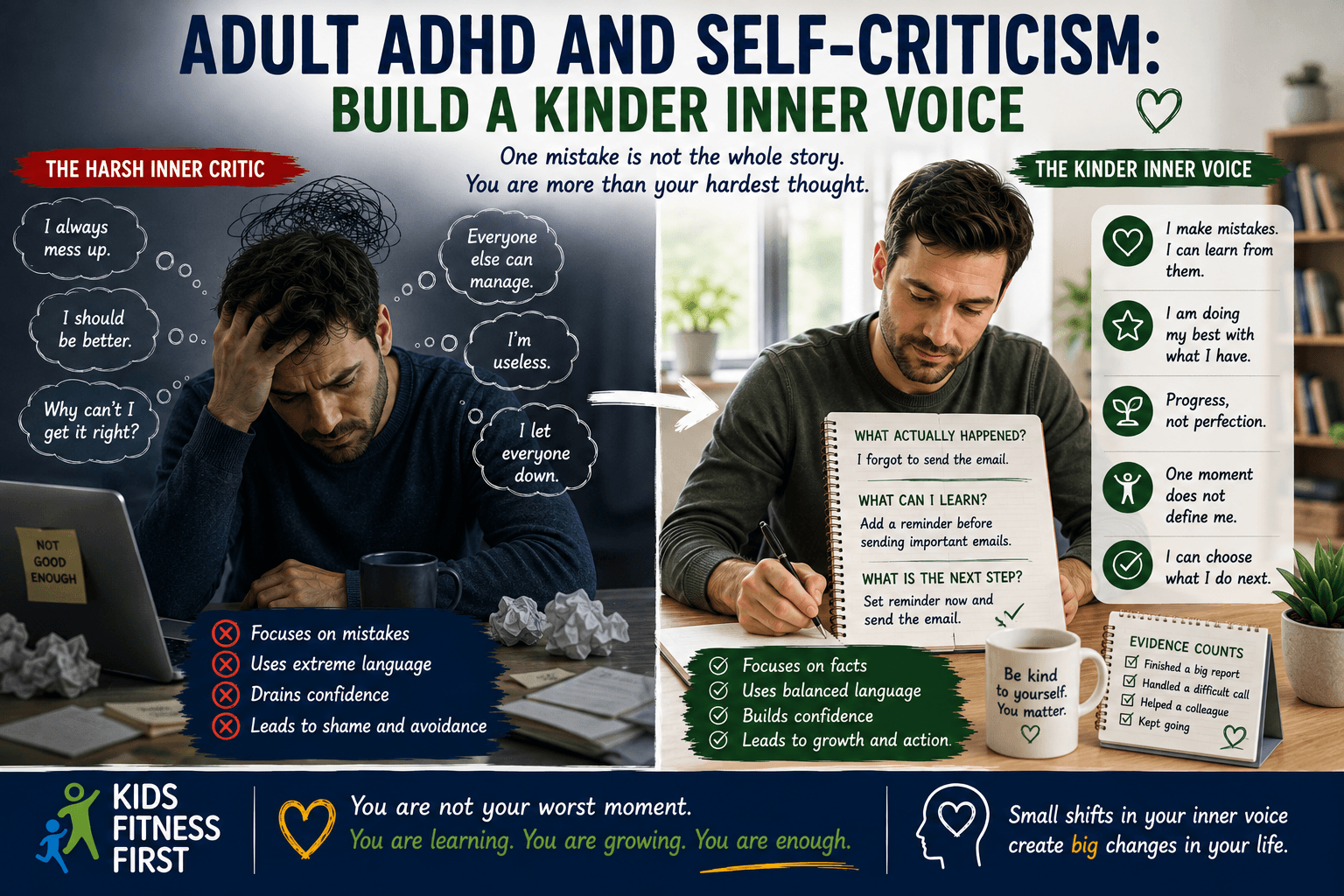
Adult ADHD and Self-Criticism: How to Build a Kinder Inner Voice
Adult ADHD and self-criticism can become closely connected over time.
You forget something.
You miss a deadline.
You lose your keys.
You start a task late.
You become distracted.
At first, these may seem like ordinary mistakes.
However, the internal response can quickly become much harsher than the situation itself.
You may think:
“Why do I always do this?”
“I should be better than this.”
“Everyone else manages.”
“I am useless.”
Meanwhile, one mistake becomes evidence for a much bigger conclusion.
Instead of:
“I forgot the appointment.”
the thought becomes:
“I cannot be trusted with anything.”
That difference matters.
Therefore, one useful goal is not to pretend mistakes do not matter.
Instead, it is to respond to them in a way that helps you learn, repair and move forward without attacking your whole identity.
Why Adult ADHD and Self-Criticism Can Build Over Time
Self-criticism often develops gradually.
Perhaps you were frequently told:
“Pay attention.”
“Try harder.”
“Stop being lazy.”
“Why are you always late?”
“Why can’t you just remember?”
Over time, repeated comments like these can become part of your internal voice.
Even when nobody else is criticising you, you may begin doing it yourself.
As a result, every mistake can feel like confirmation of an old belief.
That is one reason adult ADHD and self-criticism may become particularly difficult after years of misunderstanding your own patterns.
A Mistake Is Not an Identity
This is one of the most important distinctions in this article.
A mistake describes an event.
An identity statement describes you as a whole person.
For example:
Event: I forgot to send the email.
Identity statement: I am hopeless.
These are not the same.
Therefore, when you notice a harsh thought, ask:
“Am I describing what happened, or am I judging who I am?”
That question can change the direction of the whole response.
Adult ADHD and Self-Criticism: Use Specific Language
Specific language is usually more useful than global language.
Compare:
“I always mess everything up.”
with:
“I forgot to attach the document.”
The second statement is uncomfortable, but it is also workable.
You can solve it.
For example:
Send the correct attachment.
Apologise if necessary.
Create a reminder for next time.
As a result, the focus moves from shame to action.
Watch for Words Like “Always” and “Never”
Harsh self-talk often uses extreme language.
“I always get this wrong.”
“I never finish anything.”
“Nothing I do works.”
However, these statements are rarely completely accurate.
Therefore, challenge the language.
Ask:
“Is this really always true?”
Perhaps you have completed many things.
Maybe the problem happens often, but not every time.
As a result, the thought becomes more balanced.
Replace “Always” With “Sometimes”
For example:
Instead of:
“I always forget things.”
try:
“I sometimes forget things when I am overloaded.”
Instead of:
“I never finish anything.”
try:
“I struggle to finish some tasks when the end is unclear.”
The second version still acknowledges the difficulty.
However, it does not turn the difficulty into your entire identity.
Notice the Tone of Your Inner Voice
Imagine saying your internal thoughts out loud to another person.
Would you say:
“You’re pathetic.”
“You never do anything right.”
“Everyone else can manage except you.”
Probably not.
Therefore, ask:
“Why am I speaking to myself in a way I would never speak to someone else?”
That does not mean becoming overly positive.
Instead, it means aiming for fair language.
Fair Is Better Than Fake Positive
A kinder inner voice does not need to say:
“Everything is wonderful.”
That may feel false.
Instead, aim for balance.
For example:
“I made a mistake, and I can repair it.”
“This task is difficult for me, but I can break it down.”
“I am frustrated, but this does not define me.”
“I can learn from this without attacking myself.”
These statements are realistic.
Therefore, they are often easier to believe.
Adult ADHD and Self-Criticism After Procrastination
Procrastination can trigger a strong internal backlash.
You delay something.
Then the deadline gets close.
Finally, you complete it under pressure.
Afterwards, instead of recognising that the task is done, the inner voice says:
“You should have done this days ago.”
That may be true.
However, repeating it after the task is finished does not improve the past.
Therefore, ask a more useful question:
“What would make starting earlier easier next time?”
That creates learning instead of punishment.
Turn Shame Into Information
Shame says:
“There is something wrong with me.”
Information says:
“Something in this system is not working.”
For example:
You keep missing appointments.
Instead of:
“I am irresponsible.”
ask:
“Is my reminder system strong enough?”
You regularly lose keys.
Instead of:
“I am hopeless.”
ask:
“Do my keys have one permanent place?”
Therefore, problems become design questions.
That is much more useful.
Adult ADHD and Self-Criticism at Work
Work can create many opportunities for self-judgement.
You miss a detail.
Someone corrects you.
A task takes longer than expected.
However, professional growth often requires mistakes, feedback and adjustment.
Therefore, separate:
“This piece of work needs improvement.”
from:
“I am bad at my job.”
The first statement can lead to action.
The second can damage confidence without helping performance.
Use Feedback as Data
Suppose your manager says:
“This report needs clearer evidence.”
Self-criticism may say:
“They think I am incompetent.”
A more useful response is:
“The report needs clearer evidence.”
Then ask:
What evidence is missing?
What can I add?
When can I revise it?
As a result, feedback becomes data rather than a verdict.
Adult ADHD and Self-Criticism in Relationships
Relationships can also trigger self-blame.
A conversation goes badly.
Someone is disappointed.
You forget something important.
Immediately, the thought may become:
“I ruin everything.”
However, relationships are rarely defined by one moment.
Therefore, describe the event more precisely.
For example:
“I forgot something that mattered to them, and I need to repair it.”
That leaves room for responsibility.
Importantly, it also leaves room for repair.
Responsibility Without Self-Attack
Being kinder to yourself does not mean avoiding responsibility.
You can say:
“I handled that badly.”
and still avoid:
“I am a terrible person.”
Those are different statements.
Therefore, accountability and self-respect can exist together.
In fact, balanced self-talk may make repair easier because shame is less likely to cause avoidance.
Apologise Specifically
If you need to apologise, make it clear and specific.
For example:
“I am sorry I forgot the appointment. I understand that caused inconvenience. I have added a reminder system so I am less likely to repeat it.”
This is stronger than:
“I’m sorry, I’m awful, I ruin everything.”
The first version takes responsibility.
The second turns the focus onto your shame.
Adult ADHD and Self-Criticism After a Bad Day
Some days simply go badly.
You are late.
You forget something.
The house is messy.
Work is unfinished.
At that point, the inner voice may conclude:
“Today was a disaster.”
However, even a difficult day usually contains more than one story.
Perhaps you attended an important meeting.
Maybe you solved one problem.
You might have supported someone.
Therefore, before labelling the whole day, ask:
“What actually happened?”
Be specific.
Use a Balanced Day Review
At the end of a difficult day, write three things:
What Was Hard
What genuinely went wrong?
What I Handled
What did I still manage?
What I Will Change
What one adjustment would help tomorrow?
As a result, the day becomes information rather than a verdict on your character.
Stop Comparing Your Behind-the-Scenes With Someone Else’s Outside
Comparison can intensify self-criticism.
You see someone who appears organised.
They seem calm.
They are on time.
Their home looks perfect.
However, you are seeing only part of their life.
You may not see the support they have, the systems they use or the problems they manage privately.
Therefore, comparisons are often incomplete.
Instead, compare your current system with your previous one.
Ask:
“Am I learning what works better for me?”
Progress Is Often Uneven
Improvement rarely moves in a straight line.
You may have three good weeks.
Then one difficult week.
That does not erase the progress.
Therefore, avoid interpreting setbacks as proof that nothing works.
Instead, ask:
“What changed?”
Sleep?
Stress?
Workload?
Routine?
Environment?
As a result, setbacks become something you can investigate.
Adult ADHD and Self-Criticism on Low-Energy Days
Low-energy days can make self-criticism louder.
A task that is usually manageable may feel difficult.
You may move more slowly.
Then, the inner voice says:
“You are being lazy.”
However, capacity changes.
Therefore, adjust the expectation.
Use a minimum version.
Choose fewer priorities.
Build in recovery.
As a result, the day can still be useful without demanding your maximum performance.
Energy Management Can Reduce Self-Criticism
Article 7 explored adult ADHD and energy management.
The connection is important.
If you expect high-energy performance during a low-energy period, you may repeatedly disappoint yourself.
Therefore, match tasks to capacity where possible.
For example:
High energy → difficult writing.
Low energy → routine admin.
As a result, your expectations become more realistic.
Decision Fatigue Can Fuel Harsh Self-Talk
Article 9 explored adult ADHD and decision fatigue.
When mentally exhausted, choices become harder.
Then a small decision may take too long.
Afterwards, self-criticism says:
“Why can’t I make a simple decision?”
Therefore, reduce repeated choices.
Use defaults.
Create routines.
As a result, fewer situations become opportunities for unnecessary self-judgement.
Procrastination Can Trigger Self-Criticism
Article 11 explored adult ADHD and procrastination.
The cycle can look like this:
Delay.
Stress.
Rush.
Complete.
Criticise yourself.
Then avoid the next task because the whole experience felt unpleasant.
Therefore, breaking the self-criticism cycle can also make future task initiation easier.
Instead of punishment, use review.
Ask what made starting difficult.
Then adjust the system.
Overwhelm Can Make Everything Feel Personal
Article 12 explored adult ADHD and overwhelm.
When you are overloaded, even a small mistake can feel like proof that you are failing everywhere.
Therefore, reduce the load before judging yourself.
Brain dump.
Choose one priority.
Pause new input.
Then, review the problem more fairly.
The interpretation may change when the system is calmer.
Prioritisation Can Protect Confidence
Article 13 explored adult ADHD and prioritisation.
If you try to complete fifteen priorities in one day, you are likely to end the day feeling behind.
However, the problem may be the plan rather than your ability.
Therefore, choose fewer priorities.
As a result, success becomes more realistic and visible.
Routine Can Reduce Repeated Self-Blame
Article 14 explored adult ADHD and routine.
Routines reduce the number of things that depend on memory and motivation.
For example:
Keys go in one place.
Calendar checked after breakfast.
Tomorrow prepared before bed.
As a result, fewer avoidable problems occur.
That can reduce the amount of material available for self-criticism.
Follow-Through Can Build Evidence of Competence
Article 15 explored adult ADHD and follow-through.
When you complete tasks and close loops, record it.
Do not immediately move on without noticing.
For example:
Application submitted.
Report finished.
Appointment booked.
Room reset.
These are pieces of evidence.
Therefore, let completed work count.
Emotional Regulation Supports a Kinder Inner Voice
Article 16 explored adult ADHD and emotional regulation.
Strong emotion can make self-talk more extreme.
You feel embarrassed.
Then the thought becomes:
“I am a complete failure.”
Therefore, pause before believing every thought that appears during an emotional peak.
Name the feeling.
Let the intensity reduce.
Then, review the situation.
Rejection Sensitivity Can Intensify Self-Criticism
Article 17 explored adult ADHD and rejection sensitivity.
If criticism feels intense, you may immediately turn it inward.
Someone gives feedback.
You think:
“They do not respect me.”
Then:
“Maybe I am not good enough.”
Therefore, separate facts from assumptions.
One person’s response is not a complete measure of your worth.
Adult ADHD and Self-Criticism: Keep an Evidence File
Harsh self-talk often remembers failures more easily than successes.
Therefore, create a record.
This could include:
positive feedback;
completed projects;
problems solved;
things you handled well;
kind messages;
milestones;
difficult situations you recovered from.
As a result, when the inner voice says:
“You never get anything right.”
you have evidence that the statement is false.
Create a “What Went Right” Note
At the end of the week, write three things that went well.
They do not need to be dramatic.
For example:
I made the difficult phone call.
I finished one task I had avoided.
I recovered after a stressful morning.
Over time, this creates a more balanced record of your life.
Do Not Dismiss Small Wins
Self-criticism often moves the goalposts.
You complete something.
Then immediately think:
“That was easy. It does not count.”
However, progress does count.
Therefore, allow small wins to remain wins.
If something was difficult for you and you did it, that is useful evidence.
Adult ADHD and Self-Criticism With Perfectionism
Perfectionism can hide inside self-criticism.
You think:
“If I cannot do this perfectly, I should not do it.”
Or:
“If I make one mistake, the whole thing is ruined.”
However, many tasks require competence, not perfection.
Therefore, define the standard.
For example:
Clear.
Accurate.
Complete.
Submitted.
That may be enough.
Use the Good-Enough Question
Ask:
“What would good enough look like here?”
For example:
A good-enough email is clear and polite.
A good-enough report is accurate and complete.
A good-enough workout is ten useful minutes on a difficult day.
As a result, the standard becomes realistic.
Adult ADHD and Self-Criticism After a Late Diagnosis
After a late ADHD diagnosis, the inner voice may begin to make more sense.
Perhaps you spent years believing you were lazy, careless or inconsistent.
Maybe you judged yourself for difficulties you did not fully understand.
Understanding adult ADHD and self-criticism can offer another way to review that history.
However, the goal is not to excuse every mistake.
Instead, it is to replace inaccurate character judgements with useful understanding.
You can take responsibility and still treat yourself fairly.
Rewrite Old Labels
Perhaps you have carried labels such as:
lazy;
disorganised;
unreliable;
too much;
too sensitive.
Ask whether those labels describe the whole truth.
For example:
“Lazy” may sometimes mean struggling to start a task.
“Disorganised” may mean needing stronger external systems.
“Too sensitive” may mean emotions arrive strongly.
That does not erase the difficulty.
However, it creates a more accurate description.
Build a Personal Self-Talk Toolkit
Your toolkit might include:
Event vs Identity
Describe what happened, not who you are.
Specific Language
Replace global statements with precise ones.
Balanced Reframe
Use fair rather than fake-positive language.
Evidence File
Keep proof of progress and competence.
Good-Enough Standard
Reduce perfectionistic pressure.
Repair Question
Ask what can be fixed now.
Learning Question
Ask what would help next time.
Minimum Version
Adjust expectations on low-energy days.
Use the tools that match the moment.
A Simple Self-Criticism Reset
When adult ADHD and self-criticism become intense, try this:
First: Notice the harsh thought.
Next: Write down what actually happened.
Then: Remove words such as “always,” “never” and “everything.”
After that: Describe the problem specifically.
Next: Ask what can be repaired or learned.
Finally: choose one balanced sentence.
For example:
“I forgot something important. I am frustrated, but I can repair it and strengthen my reminder system.”
That is realistic.
Start With One Repeated Thought
Think about one sentence you often say to yourself.
Perhaps:
“I am useless.”
Now rewrite it.
Ask:
What usually triggers this thought?
What is actually happening?
A more accurate version might be:
“I become disorganised when too many tasks are competing for attention.”
That gives you something you can work with.
Reflection Questions
- What do you usually say to yourself after a mistake?
- Do you use words such as “always” or “never”?
- Are you describing an event or judging your identity?
- Would you speak to another person in the same way?
- What would a fairer version of the thought sound like?
- Which past labels still influence how you see yourself?
- What recent success have you dismissed too quickly?
- Where could you use a good-enough standard?
- What evidence shows that one mistake does not define you?
- What one sentence would you like your inner voice to use more often?
Conclusion
Adult ADHD and self-criticism can turn ordinary mistakes into much larger judgements about your worth, ability or character.
However, harshness is not the same as accountability.
You can recognise a mistake without attacking yourself.
Instead, describe what happened specifically.
Remove extreme language.
Look for the real problem.
Ask what can be repaired.
In addition, keep evidence of progress, completed work and situations you have handled well.
Most importantly, aim for a fair inner voice rather than a perfect one.
Therefore, instead of asking:
“What is wrong with me?”
try asking:
“What happened, what do I need, and what would help me handle this better next time?”
Over time, adult ADHD and self-criticism may become easier to manage when mistakes become information, progress is allowed to count and your inner voice becomes more accurate, balanced and constructive.
SUGGESTED INTERNAL LINKS
- Adult ADHD and Rejection Sensitivity: How to Respond Without Spiralling
- Adult ADHD and Emotional Regulation: How to Stay Steady When Emotions Run High
DISCLAIMER
This article is provided for general educational and informational purposes only. It does not provide medical, psychological, diagnostic or therapeutic advice and should not be used as a substitute for individual guidance from an appropriately qualified healthcare professional.
Harsh self-criticism, low confidence and negative self-talk can have many causes, and ADHD experiences vary considerably between individuals. Therefore, if negative thoughts are persistent, severe or significantly affecting your wellbeing or daily life, or if you have concerns about ADHD, mental health, diagnosis, medication or treatment, please speak with an appropriately qualified healthcare professional.