
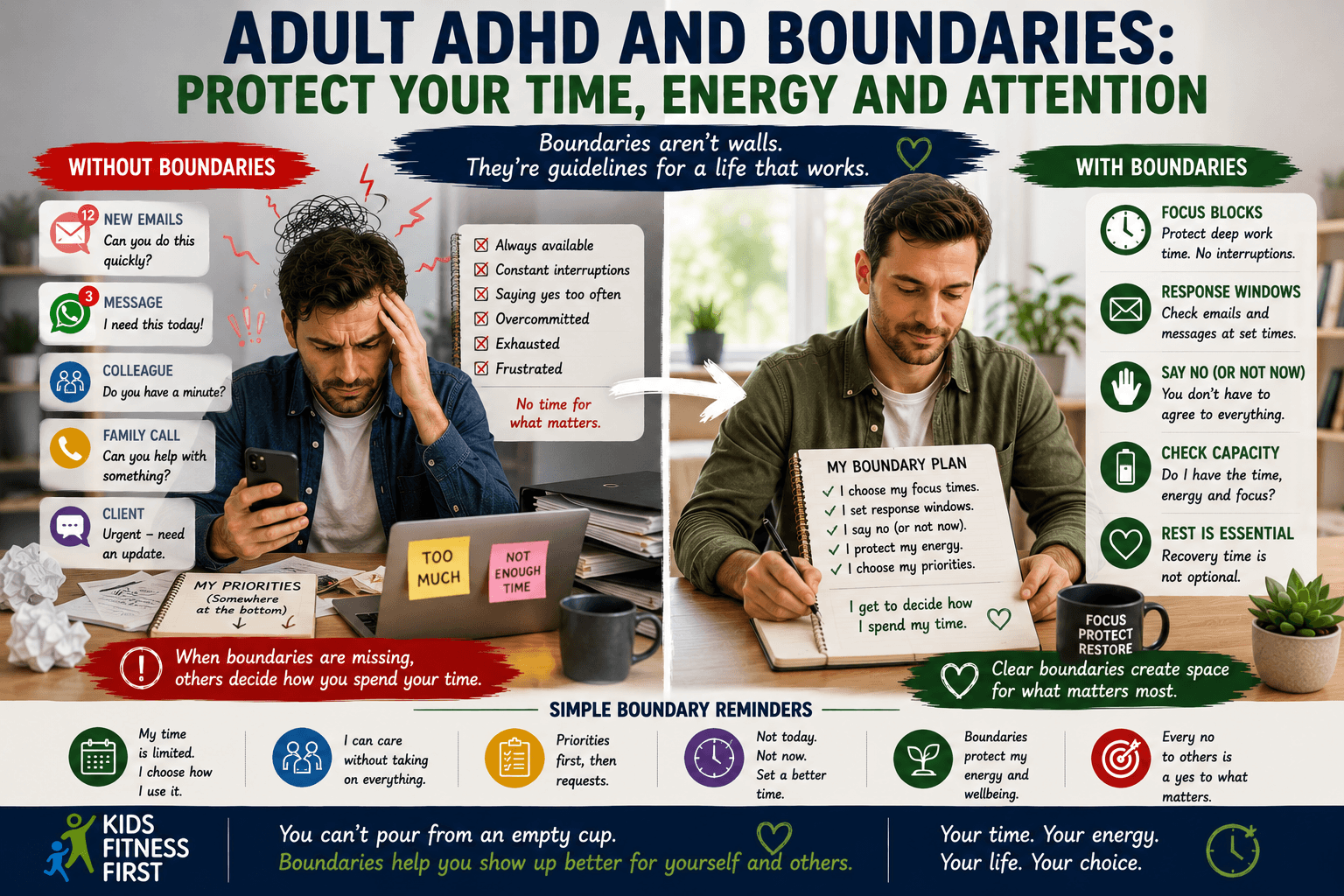
Adult ADHD and Boundaries: How to Protect Your Time, Energy and Attention
Adult ADHD and boundaries can become difficult when your attention is already being pulled in several directions.
A message arrives.
Someone asks for help.
A colleague needs something quickly.
A family member wants an answer.
Meanwhile, your own task remains unfinished.
At first, each request may seem small. However, when several demands arrive together, your time and attention can disappear surprisingly quickly.
You may say:
“Yes, no problem.”
Then another request arrives.
You agree again.
Eventually, your own priorities are pushed to the end of the day.
By evening, you may feel tired, frustrated or behind.
At that point, it is easy to think:
“Why did I agree to all of this?”
However, boundaries are not about becoming unhelpful or difficult.
Instead, boundaries help define what you can reasonably give while still protecting your own responsibilities, attention and wellbeing.
Therefore, building clearer limits can make everyday life easier to manage.
What Are Boundaries?
A boundary is simply a limit.
It can define:
when you are available;
what you are willing to do;
how much time you can give;
what behaviour you accept;
when you need space;
what belongs to you and what belongs to someone else.
For example, a boundary might be:
“I cannot take another task today, but I can look at it tomorrow.”
Or:
“I do not answer work messages after 7 pm.”
Or:
“I need ten minutes before continuing this conversation.”
Importantly, a boundary is not necessarily a rejection of another person.
Instead, it is information about what is realistic.
Why Adult ADHD and Boundaries Can Become Difficult
Boundaries can be difficult for many reasons.
Perhaps you do not want to disappoint people.
Maybe you worry that saying no will create conflict.
You may also forget how much you have already committed to.
Meanwhile, a new request appears easy when considered by itself.
For example:
“Can you just do this quickly?”
You may think:
“Yes, that will only take ten minutes.”
However, the task may interrupt what you are already doing, require extra decisions and make it harder to return to the original task.
As a result, the real cost may be much greater than ten minutes.
That is one reason adult ADHD and boundaries can become closely connected with task switching, overwhelm and energy management.
Boundaries Protect Attention
Attention is limited.
Every interruption has a cost.
You stop the current task.
You switch context.
You respond.
Then you try to remember where you were.
Therefore, protecting attention can be just as important as protecting time.
For example:
Close email during focused work.
Put your phone on silent.
Tell colleagues when you will be available.
Ask family members not to interrupt during a specific work period unless something is urgent.
As a result, the task in front of you has a better chance of being completed.
Adult ADHD and Boundaries: Start With Availability
Many boundary problems begin with constant availability.
Messages arrive at all times.
Phone calls interrupt work.
People expect quick replies.
However, being reachable does not mean you must always respond immediately.
Therefore, create clearer availability windows.
For example:
9:00–11:00 → focused work
11:00 → messages and email
Afternoon → calls
This does not need to be rigid.
Instead, it gives other people and your own brain a clearer pattern.
Use Response Windows
A response window is a planned period for communication.
For example:
Check email at 10:30, 1:00 and 4:00.
Check personal messages at lunch and after work.
As a result, communication still happens.
However, it no longer interrupts every hour of the day.
This can be particularly useful when you are trying to complete work that requires concentration.
Saying No Is a Practical Skill
Many people think of “no” as rude.
It does not need to be.
A clear, respectful no can protect both people from unrealistic expectations.
For example:
“I cannot do that today.”
“I do not have capacity for another project this week.”
“I can help for 20 minutes, but I cannot take responsibility for the whole task.”
These responses are not aggressive.
They simply define the limit.
Use “Not Now” When No Feels Too Final
Sometimes the answer is not permanently no.
It is simply not now.
For example:
“I cannot look at this today, but I can review it tomorrow afternoon.”
Or:
“I cannot speak right now, but I can call you after 5 pm.”
Therefore, boundaries do not always close the door.
Sometimes they simply move the request to a better time.
Adult ADHD and Boundaries at Work
Work can be particularly challenging because requests often come from several directions.
A manager asks for something.
A colleague needs help.
An email looks urgent.
A client calls.
Meanwhile, you already have your own priorities.
Therefore, work boundaries often begin with clarification.
For example:
“I currently have A and B due today. Which should take priority if this new task is urgent?”
This makes the workload visible.
As a result, you are not silently absorbing every new demand.
Do Not Automatically Accept Every New Task
A new task should not automatically become your top priority.
Instead, ask:
What is the deadline?
What happens if it waits?
Who owns the decision?
What does it replace?
Therefore, when someone adds a new task, consider asking:
“What should I move to make room for this?”
That question can be extremely useful.
It turns an invisible workload problem into a visible priority decision.
Use Written Confirmation
If priorities change frequently, written confirmation can protect clarity.
For example:
“Just to confirm, I will pause Project A and complete Project B first.”
Now everyone understands the decision.
As a result, you are less likely to carry conflicting expectations mentally.
Adult ADHD and Boundaries Around Meetings
Meetings can take more energy than their calendar slot suggests.
A one-hour meeting may also require preparation, recovery and follow-up.
Therefore, avoid filling every gap around meetings where possible.
For example:
Leave fifteen minutes before a difficult meeting to prepare.
Leave ten minutes afterwards to write actions.
As a result, the meeting does not spill unpredictably into the rest of the day.
Protect Your Focus Blocks
A focus block is time reserved for important work.
For example:
10:00–11:30 → report
During that time:
phone on silent;
email closed;
messages paused;
unrelated tasks captured for later.
Therefore, your focus block becomes a boundary around attention.
This is particularly useful for work that requires concentration.
Adult ADHD and Boundaries at Home
Home boundaries can be less visible than work boundaries.
Family members may assume you are available because you are physically present.
For example:
You are trying to complete paperwork.
Someone asks a question.
Then another.
Eventually, the task disappears.
Therefore, create simple signals.
For example:
“I need 30 minutes to finish this. After that, I am available.”
Or:
“If the door is closed, please only interrupt for something important.”
Clear communication is usually better than expecting other people to guess.
Create Shared Expectations
Boundaries work better when people understand them.
For example:
“From 6:30 to 7:00, I am finishing work. After that, I am available.”
“Sunday morning is when I deal with household admin.”
“Please put non-urgent requests on the family list rather than interrupting immediately.”
As a result, the household develops clearer patterns.
Adult ADHD and Boundaries With Technology
Technology can make boundaries disappear.
Work follows you home.
Messages arrive in bed.
Notifications appear during meals.
Therefore, digital boundaries can be especially valuable.
For example:
Turn off non-essential notifications.
Keep work apps off the home screen.
Use Do Not Disturb during focused work.
Avoid checking work email immediately after waking where possible.
As a result, the phone becomes less able to decide what deserves your attention.
Create a Phone Boundary
A simple phone boundary might be:
No phone during first 20 minutes of the morning.
Or:
Phone stays away during dinner.
Or:
No work email after 7 pm.
You do not need all of these.
Instead, choose the boundary that solves your biggest problem.
Boundaries Can Reduce Decision Fatigue
Article 9 explored adult ADHD and decision fatigue.
Boundaries reduce repeated decisions.
For example:
If you never take work calls after 7 pm, you do not need to decide every evening whether to answer.
If you check email at set times, you do not need to decide every five minutes whether to check.
Therefore, boundaries create pre-made decisions.
That protects mental energy.
Boundaries Can Reduce Overwhelm
Article 12 explored adult ADHD and overwhelm.
Overwhelm grows when too many demands remain active.
Therefore, boundaries help reduce incoming load.
You can say:
Not today.
Not now.
Not my responsibility.
Not during focused work.
As a result, fewer tasks enter your active mental space.
Prioritisation Supports Boundaries
Article 13 explored adult ADHD and prioritisation.
It is easier to protect time when you know what matters most.
If today’s main priority is clear, you can evaluate new requests against it.
Ask:
“Does this deserve to replace the current priority?”
If not, move it later.
Therefore, prioritisation gives boundaries a reason.
Routine Makes Boundaries Easier
Article 14 explored adult ADHD and routine.
A repeated routine can strengthen boundaries.
For example:
Morning → focused work.
Lunch → messages.
End of work → shutdown.
Evening → personal time.
As a result, boundaries become part of the day rather than something you need to invent each time.
Follow-Through Needs Boundaries
Article 15 explored adult ADHD and follow-through.
Finishing becomes difficult when new tasks constantly interrupt existing work.
Therefore, protect completion time.
For example:
3:30–4:00 → close open tasks only.
No new projects.
No unnecessary calls.
As a result, more tasks actually reach completion.
Emotional Regulation Supports Boundaries
Article 16 explored adult ADHD and emotional regulation.
Sometimes boundaries are hardest when emotions are high.
You may agree to something because you feel guilty.
Or you may react too strongly and create conflict.
Therefore, pause before answering difficult requests.
Try:
“Let me check what I have on and come back to you.”
This creates time to decide rather than responding emotionally.
Rejection Sensitivity Can Make Boundaries Hard
Article 17 explored adult ADHD and rejection sensitivity.
You may worry:
“If I say no, they will be angry.”
“They will think I am selfish.”
“They will stop asking me.”
However, healthy relationships can usually tolerate reasonable limits.
Therefore, one person’s disappointment does not automatically mean your boundary was wrong.
Self-Criticism Can Weaken Boundaries
Article 18 explored adult ADHD and self-criticism.
After saying no, the inner voice may say:
“You should have helped.”
“You are being difficult.”
However, guilt is not always evidence that you made the wrong decision.
Therefore, ask:
“Was the boundary reasonable?”
If yes, allow the discomfort to pass without automatically reversing the decision.
Self-Trust Strengthens Boundaries
Article 19 explored adult ADHD and self-trust.
Boundaries become easier when you trust your own judgement.
For example:
You know you are already overloaded.
Someone asks for more.
Self-trust allows you to say:
“I do not have capacity for that.”
without needing five other people to approve the decision.
Adult ADHD and Boundaries Around Helping Others
Helping other people can be positive.
However, support becomes unsustainable when you repeatedly give more than you can afford.
Therefore, consider the difference between:
helping;
rescuing;
taking over.
For example:
Helping might mean explaining how to complete a form.
Taking over may mean completing the whole form while your own work waits.
Therefore, ask:
“What level of help can I reasonably give?”
Use Limited Offers
Instead of:
“I will sort everything for you.”
try:
“I can help you for twenty minutes.”
Or:
“I can review the first page.”
Or:
“I can show you how I would start.”
As a result, you can still support someone without automatically absorbing the whole responsibility.
Know What Is Yours
A useful boundary question is:
“Is this actually my responsibility?”
Sometimes you may feel responsible for:
another person’s mood;
another person’s deadline;
another person’s lack of planning;
another person’s disappointment.
However, not everything belongs to you.
Therefore, distinguish between:
What I can influence.
What I am responsible for.
What belongs to someone else.
Adult ADHD and Boundaries With Last-Minute Requests
Last-minute requests can feel automatically urgent.
Someone says:
“I need this today.”
However, their urgency may come from their own planning.
Therefore, ask:
“Is this genuinely urgent for me too?”
Sometimes the answer will be yes.
Sometimes it will be no.
As a result, you avoid allowing every external deadline to automatically become your emergency.
Use the Capacity Question
Before agreeing to something, ask:
“Do I actually have capacity?”
Not:
Do I technically have an empty hour?
But:
Do I have the time, energy and attention?
That distinction matters.
Therefore, capacity includes more than available minutes.
Boundaries Around Social Commitments
Social commitments also use energy.
You may agree to everything because you do not want to disappoint people.
However, too many commitments can leave little recovery time.
Therefore, before saying yes, ask:
“How will I feel before and after this?”
If the week is already demanding, one more commitment may cost more than expected.
Give Yourself Time Before Saying Yes
You do not have to answer immediately.
Try:
“Let me check my diary.”
Or:
“I will come back to you later today.”
This is a useful boundary.
As a result, you can review your actual commitments before adding another one.
Adult ADHD and Boundaries on Low-Energy Days
Low-energy days may require stronger boundaries.
For example:
Fewer calls.
Fewer social commitments.
More recovery.
Simpler priorities.
Therefore, a boundary that is reasonable on a high-energy day may need to change when capacity is lower.
This is flexibility, not failure.
Use a Minimum Availability Day
On difficult days, define what you can realistically offer.
For example:
Important work only.
Essential calls only.
No optional meetings.
Simple evening.
As a result, your remaining energy is protected for what genuinely matters.
Adult ADHD and Boundaries With Rest
Rest needs boundaries too.
If every free moment becomes:
email;
chores;
messages;
catch-up work;
then rest disappears.
Therefore, protect some time where productivity is not the goal.
For example:
After 8 pm → no admin.
Sunday afternoon → no work.
Lunch → no email.
As a result, recovery becomes part of the system rather than something that happens only when everything else is finished.
Rest Does Not Need to Be Earned by Finishing Everything
There will always be another task.
Another message.
Another job.
Therefore, waiting until everything is complete before resting may mean never resting.
A useful boundary might be:
“At 6 pm, work stops even if some tasks remain.”
Then unfinished work moves to tomorrow.
This creates an actual endpoint.
Adult ADHD and Boundaries After a Late Diagnosis
After a late ADHD diagnosis, you may recognise why boundaries were difficult in the past.
Perhaps you overcommitted because you wanted to prove you were capable.
Maybe you said yes because you feared disappointing people.
You may also have underestimated how much interruptions and social demands cost you.
Understanding adult ADHD and boundaries can provide another way to review these patterns.
The goal is not to withdraw from people.
Instead, it is to create enough limits that your relationships, work and responsibilities become more sustainable.
Boundaries Are Information
A boundary does not need a long explanation.
For example:
“I cannot do that today.”
That is information.
You do not necessarily need to justify every detail.
However, if context is useful, keep it simple.
For example:
“I already have two deadlines today, so I cannot take another task until tomorrow.”
Clear.
Polite.
Specific.
Avoid Over-Explaining
When uncomfortable saying no, you may explain too much.
Then the explanation creates openings for negotiation.
For example:
“I can’t because I have this and this and maybe later unless…”
Instead, keep the message clear.
“I cannot do that today, but I can look at it Thursday.”
As a result, the boundary is easier to understand.
Use Calm, Repeated Language
Sometimes someone will push against a boundary.
You do not necessarily need a new argument.
Repeat the limit.
For example:
“I understand it is important. I still cannot complete it today.”
This keeps the conversation calm.
Therefore, consistency is often more effective than increasingly detailed explanations.
Build a Personal Boundary Toolkit
Your toolkit might include:
Response Windows
Choose when you check communication.
Focus Blocks
Protect important work from interruptions.
Not-Now Response
Move requests to a better time.
Capacity Question
Check time, energy and attention before agreeing.
Limited Offer
Help without taking over.
Priority Clarification
Ask what new work should replace.
Digital Boundary
Control when technology can interrupt you.
Rest Boundary
Protect recovery time.
Use the tools that solve your actual problems.
A Simple Boundary Routine
When adult ADHD and boundaries become difficult, try this:
First: Pause before answering a new request.
Next: Check your current commitments.
Then: ask whether you genuinely have capacity.
After that: decide yes, no or not now.
Next: communicate the answer clearly.
Finally: avoid reopening the decision simply because you feel uncomfortable.
This turns boundaries into a process rather than a confrontation.
Start With One Boundary
Do not change everything at once.
Choose one repeated problem.
Perhaps:
work messages after hours;
constant email checking;
people interrupting focused work;
saying yes too quickly;
too many social commitments.
Then create one simple boundary.
For example:
“I will not check work email after 7 pm.”
Use it for a week.
Afterwards, notice whether your energy, focus or stress changes.
Then decide whether another boundary would help.
Reflection Questions
- Where do other people’s requests most often interrupt your priorities?
- Do you say yes before checking your capacity?
- Which part of the day needs better protection?
- Could response windows reduce interruptions?
- Which work requests should trigger a priority clarification?
- Where could you use a “not now” response?
- Are you taking responsibility for things that belong to someone else?
- Which digital boundary would reduce stress?
- Is rest protected anywhere in your week?
- What one reasonable boundary could you start using today?
Conclusion
Adult ADHD and boundaries can become difficult when other people’s requests, interruptions and expectations constantly compete for your time, energy and attention.
However, boundaries do not mean becoming unavailable or uncaring.
Instead, they create clearer limits around what you can reasonably give.
Protect focused work.
Use response windows.
Check your capacity before agreeing.
Ask what new work should replace.
In addition, use “not now” when something can wait and protect recovery time before your energy is completely depleted.
Most importantly, remember that discomfort does not automatically mean a boundary is wrong.
Therefore, instead of asking:
“How can I keep everyone happy?”
try asking:
“What can I realistically give without abandoning my own priorities?”
Over time, adult ADHD and boundaries may become easier when your time has clearer limits, your attention is better protected and your commitments reflect your real capacity.
SUGGESTED INTERNAL LINKS
- Adult ADHD and Self-Trust: How to Rebuild Confidence in Yourself
- Adult ADHD and Routine: How to Build Structure Without Feeling Trapped
DISCLAIMER
This article is provided for general educational and informational purposes only. It does not provide medical, psychological, diagnostic, legal or therapeutic advice and should not be used as a substitute for individual guidance from an appropriately qualified professional.
Difficulties with boundaries, overcommitment, stress and interpersonal relationships can have many causes, and ADHD experiences vary considerably between individuals. Therefore, if these issues are persistent, severe or significantly affecting your wellbeing, relationships or daily life, please speak with an appropriately qualified professional.