
Focus Keyphrase:
Adult ADHD and Work Exhaustion: Is Your Job Taking More Energy Than It Should?
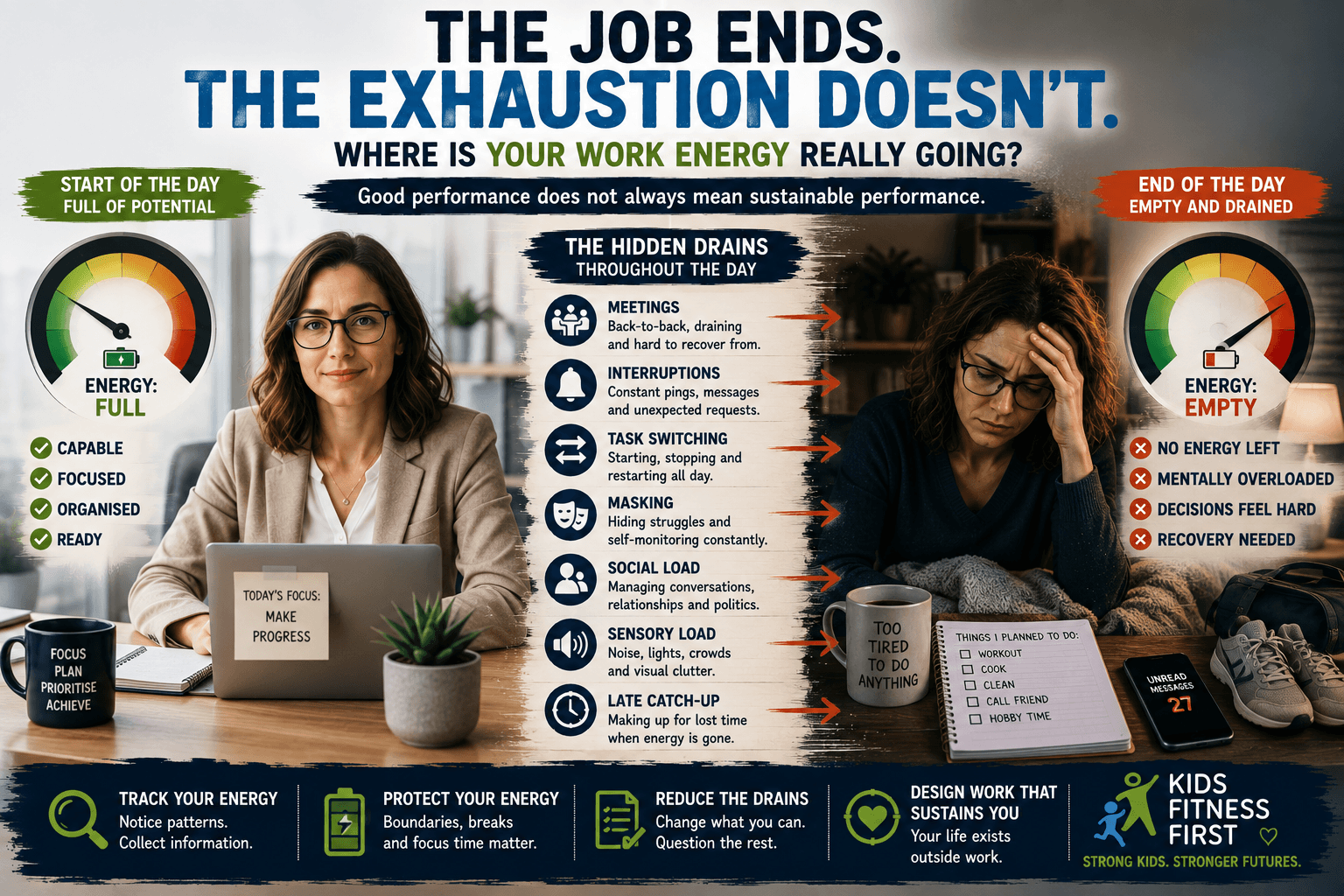
Adult ADHD and work exhaustion can be difficult to recognise because exhaustion does not always look like failure.
You may still be getting the work done.
You may still attend meetings.
You may still reply to messages.
Perhaps nobody around you has any idea that anything is wrong.
However, once the working day ends, the picture may change completely.
You get home and have very little left.
Perhaps you sit down and cannot start anything else.
Maybe you avoid conversation because even simple interaction feels like too much.
Likewise, cooking, exercising, answering personal messages or doing basic household jobs may feel disproportionately difficult.
Meanwhile, the next working day arrives before you feel fully recovered.
This cycle can continue for months or even years.
Therefore, the important question is not only:
“Can I do this job?”
Instead, ask:
“What is this job costing me to keep doing it?”
That distinction is central to Work That Fits — Book Four of The X Variable Series. This article focuses on the ongoing energy cost of staying functional at work. If that strain has developed into sustained overload or reduced capacity, see ADHD and career burnout; for rebuilding without returning to the same pattern, see ADHD and burnout recovery.
Work Exhaustion Is Not the Same as Being Busy
Everyone gets tired after demanding work.
A difficult week can leave anybody needing rest.
However, ongoing work exhaustion is different.
It may look like:
needing most evenings to recover;
spending weekends trying to restore energy;
avoiding social plans because work has taken everything;
feeling physically present at home but mentally unavailable;
starting Monday without feeling properly recovered from the previous week.
Therefore, the issue is not whether work sometimes tires you.
The more useful question is:
“Is the level of exhaustion proportionate to the work I am doing?”
Adult ADHD and Work Exhaustion Can Hide Behind Competence
One reason this pattern is easy to miss is that professional performance may still look strong.
Perhaps you meet targets.
Likewise, you may receive positive feedback.
You might even be promoted.
However, none of those things tell us how much internal effort was required.
For example, two employees may produce the same standard of work.
The first finishes comfortably during normal hours.
The second reaches the same result through constant self-monitoring, repeated checking, late-evening catch-up and deadline pressure.
The output looks similar.
However, the energy cost is completely different.
The Masking Tax Can Become an Exhaustion Tax
Article 4 explored adult ADHD and workplace masking.
That hidden effort can become one of the biggest contributors to work exhaustion.
Perhaps you spend the day:
trying not to interrupt;
forcing yourself to sit still;
pretending verbal instructions were clear;
rechecking work repeatedly;
monitoring how you sound in meetings;
hiding sensory discomfort;
catching up after constant distraction.
Each action may appear small.
However, taken together, they can create a significant Masking Tax.
Over time, that Masking Tax can become an exhaustion tax paid after work.
Adult ADHD and Work Exhaustion: Look at the Whole Day
When evaluating whether a job is sustainable, do not look only at your contracted hours.
Instead, include:
the preparation before work;
the mental effort during work;
the catch-up afterwards;
the recovery time;
the emotional residue.
For example, a job may officially last eight hours.
However, if you also spend an hour preparing mentally, another hour catching up and the whole evening recovering, its practical cost is much larger.
Therefore, the real working day may extend far beyond the hours written in the contract.
The After-Work Collapse
One of the clearest signs of work exhaustion is the after-work collapse.
You finish the day.
Then something seems to switch off.
Perhaps you intended to go for a walk.
Instead, you lie down.
Maybe you planned to cook.
Instead, you choose the easiest available food.
Likewise, you may cancel plans because conversation or travel feels impossible.
This does not automatically mean the job is wrong.
However, repeated collapse is useful information.
Adult ADHD and Work Exhaustion: What Does Collapse Look Like for You?
Collapse does not always look dramatic.
Sometimes it looks like:
scrolling for two hours without really enjoying it;
sitting in the car after work because you cannot transition;
staring at the television while feeling completely blank;
avoiding messages;
putting off basic tasks;
eating whatever requires the least effort.
Therefore, do not only look for obvious burnout.
Instead, notice what happens when the working day ends.
Weekend Recovery Can Hide a Deeper Problem
Perhaps you get through the week.
Then Saturday arrives.
You sleep longer.
You cancel plans.
You do almost nothing.
By Sunday afternoon, you begin to feel more like yourself.
Then Sunday evening arrives and Monday is already approaching.
As a result, the weekend becomes less about living and more about repairing the damage created by the week.
That pattern matters.
A job that requires two days of recovery after five days of work may be costing more than it appears.
Work Can Be Sustainable on Paper but Unsustainable in Life
Imagine that the salary is good.
The role is secure.
The employer is respected.
The work is interesting.
On paper, everything looks strong.
However, if the job leaves you with almost no capacity for:
relationships;
exercise;
sleep;
hobbies;
household responsibilities;
parenting;
friendships,
then the role may still be unsustainable.
Therefore, career fit should be judged within the context of your whole life.
Adult ADHD and Work Exhaustion: Identify the Main Drain
Not all exhaustion comes from the same source.
The useful question is:
“What part of the job costs me the most energy?”
Perhaps it is:
constant interruption;
social interaction;
open-plan noise;
unclear priorities;
repetitive administration;
frequent task switching;
long meetings;
commuting;
emotional conflict;
late working.
Therefore, do not simply conclude:
“Work exhausts me.”
Instead, identify the specific drain.
Use an Energy Map
A simple energy map can help.
Write down the main parts of a normal working day.
Then mark each one:
Gives Energy
Neutral
Drains Energy
For example:
| Work Activity | Energy Effect |
|---|---|
| Complex problem-solving | Gives energy |
| Team meeting | Drains energy |
| Admin catch-up | Drains energy |
| Independent planning | Neutral |
| Client crisis | Gives energy initially, drains later |
As a result, you begin to see where the real cost is coming from.
Adult ADHD and Work Exhaustion: Not All Productive Work Feels the Same
Two tasks can both be useful.
However, they may affect you differently.
For example:
One hour solving a difficult problem may leave you energised.
One hour processing repetitive forms may leave you depleted.
Therefore, the goal is not simply to ask:
“Am I productive?”
Instead, ask:
“Which types of productivity are sustainable for me?”
That question is much more useful for long-term career design.
High-Stimulation Work Can Feel Good Until It Does Not
Some work environments are fast, urgent and intense.
You may feel excellent in them at first.
There is novelty.
Clear priority.
Immediate feedback.
Constant movement.
However, chronic intensity can become exhausting.
Therefore, do not confuse:
“I perform well under pressure”
with:
“I should live under constant pressure.”
Those are different statements.
Adult ADHD and Work Exhaustion: Urgency Can Borrow Energy
Urgency can temporarily create focus.
A deadline appears.
Suddenly, you can work intensely.
You complete the task.
However, the energy may be borrowed from later.
Afterwards, you crash.
Therefore, if your whole working system depends on urgency, the pattern may look productive in short bursts while being extremely expensive over time.
Repetitive Work Can Drain Differently
At the opposite end, some work is not stressful because it is urgent.
Instead, it is draining because it is repetitive.
Perhaps you need enormous effort to begin.
You become distracted.
Then you judge yourself for taking too long.
Consequently, a simple task may consume far more energy than its difficulty suggests.
Again, the important question is not whether you can force yourself through it.
It is whether that level of effort is sustainable.
Work Exhaustion Can Come From Constant Switching
Task switching is another hidden drain.
You begin a report.
Then a message arrives.
You answer it.
Afterwards, somebody asks a question.
Then you return to the report and cannot remember where you were.
This pattern repeats all day.
As a result, you may spend more energy restarting attention than actually using it.
Therefore, reducing interruptions may sometimes help more than improving motivation.
Adult ADHD and Work Exhaustion: Meetings Have a Hidden Cost
A one-hour meeting does not always cost one hour.
It may also require:
preparation;
social monitoring;
note-taking;
decision-making;
recovery;
follow-up tasks.
Therefore, if your calendar is full of meetings, the real cost may be much larger than the visible hours.
This is especially important if the meetings repeatedly break up periods of deeper work.
Social Load Can Be a Major Drain
Some roles involve constant interaction.
Calls.
Meetings.
Clients.
Team discussions.
Informal conversation.
For some people, this is energising.
For others, it is expensive.
Therefore, do not assume that a socially demanding role is sustainable simply because you are good at it.
Ability and energy cost are separate questions.
Adult ADHD and Work Exhaustion: Sensory Load Matters
Noise, lighting and visual movement can also contribute to fatigue.
For example:
phones ringing;
people talking nearby;
bright lighting;
constant movement;
multiple screens;
background music.
None of these may seem serious individually.
However, eight hours of sensory input can add up.
Therefore, if you feel noticeably better working in a quiet environment, record that as career information.
Unclear Work Is Expensive Work
Ambiguity can also be exhausting.
You receive instructions such as:
“Just take a look at this.”
What does that mean?
Review it?
Rewrite it?
Fix it?
Send recommendations?
When expectations are unclear, you may spend significant energy trying to guess what success looks like.
Therefore, clear instructions can reduce more than confusion.
They can reduce energy waste.
Adult ADHD and Work Exhaustion: Micromanagement Can Multiply Effort
Micromanagement can create another layer of work.
You perform the task.
Then you explain the task.
Then you update somebody.
Then they check it.
Then you adapt it to their preferred method.
As a result, the work becomes much more expensive than necessary.
If autonomy repeatedly reduces your exhaustion, that pattern deserves attention.
Commuting Is Part of the Energy Calculation
Career discussions sometimes treat commuting as separate from work.
However, your body does not necessarily make that distinction.
A long commute may include:
traffic;
crowded transport;
noise;
uncertainty;
time pressure.
Therefore, if you arrive already depleted, the workday has effectively started before you reach the workplace.
Likewise, the return journey may delay recovery.
Adult ADHD and Work Exhaustion: Track Recovery, Not Just Performance
Performance tells you whether the work was completed.
Recovery tells you what it cost.
Therefore, for one week, record:
End of Workday
How much energy remains?
Two Hours Later
Have you recovered?
Bedtime
Do you feel more settled?
Saturday Morning
Are you still recovering?
This creates a much more realistic picture of sustainability.
Use a Simple 1–10 Energy Scale
You do not need complicated tracking.
At the end of each workday, rate your energy:
10 = energised
5 = tired but functional
1 = completely depleted
Then write the biggest drain.
For example:
Tuesday — 3/10 — four meetings and constant interruptions.
After one or two weeks, patterns may become obvious.
Adult ADHD and Work Exhaustion: What Happens on Good Days?
Do not study only bad days.
Look at days when work felt easier.
What was different?
Perhaps:
fewer meetings;
more autonomy;
one clear priority;
quiet environment;
later start;
working from home;
more meaningful work.
Therefore, good days can reveal conditions worth increasing.
The 10% Better Question
Do not immediately ask:
“How do I completely redesign my job?”
Instead, ask:
“What would make this workday 10% less exhausting?”
Perhaps:
one meeting removed;
written priorities;
thirty minutes of uninterrupted work;
a proper lunch break;
less notification noise;
one remote day;
clearer task boundaries.
Small changes can provide useful evidence.
Adult ADHD and Work Exhaustion: Reduce Avoidable Recovery Debt
Think of exhaustion as creating recovery debt.
If Monday creates more fatigue than Monday evening can repair, some of that debt moves into Tuesday.
Then Tuesday adds more.
By Friday, you are deeply depleted.
Therefore, one useful goal is reducing the amount of recovery debt created each day.
You may not eliminate tiredness.
However, you may reduce accumulation.
Protect the End of the Workday
The final part of the day can make a difference.
If you stop suddenly with ten unfinished tasks mentally open, they may follow you home.
Therefore, create a short shutdown routine.
For example:
write unfinished tasks down;
identify tomorrow’s first priority;
close unnecessary tabs;
finish one small open loop;
leave at the agreed time where possible.
As a result, the working day has a clearer ending.
Adult ADHD and Work Exhaustion: Avoid Late-Night Compensation
A common pattern is losing focus during the day and then working at night to catch up.
This can feel necessary.
However, repeated late-night compensation can damage recovery and sleep.
Then the next day begins with less energy.
Consequently, the cycle reinforces itself.
Therefore, if late catch-up is frequent, investigate what is happening earlier in the day rather than treating the evening as the permanent solution.
Boundaries Protect Energy
Book Three explored adult ADHD and boundaries.
Those boundaries remain important in working life.
For example:
do not automatically accept every extra task;
ask what new priority should replace;
protect lunch;
define communication windows;
stop work at a reasonable point where circumstances allow.
Boundaries do not eliminate workload.
However, they can stop workload expanding without limit.
Adult ADHD and Work Exhaustion: Ask What Belongs to You
Sometimes exhaustion comes partly from responsibilities you have quietly absorbed.
Perhaps you are:
fixing everyone else’s mistakes;
managing team emotions;
covering repeated staffing gaps;
answering messages outside work;
doing tasks that belong elsewhere.
Therefore, ask:
“Is this actually part of my role?”
If not, the problem may involve boundaries rather than personal capacity.
When Rest Stops Working
Rest should restore you at least to some degree.
However, if weekends, holidays or sleep no longer seem to help much, the level of exhaustion may require greater attention.
This article cannot determine whether somebody is experiencing burnout or another health issue.
Therefore, persistent, severe or worsening exhaustion deserves appropriate professional assessment.
Do not assume every form of fatigue is caused by ADHD or work.
Adult ADHD and Work Exhaustion Is Not Always ADHD
This distinction is essential.
Exhaustion can have many causes.
For example:
long hours;
poor sleep;
stress;
physical illness;
mental health difficulties;
care responsibilities;
medication effects;
financial pressure;
poor workplace culture.
Therefore, do not automatically label all work exhaustion as ADHD-related.
Instead, use the ADHD lens as one part of a wider review.
The Wrong Job or the Wrong Environment?
Later articles in Book Four will examine this distinction more closely.
Perhaps the actual work is wrong for you.
Alternatively, you may enjoy the work but struggle with the environment.
For example:
good job + constant interruption = exhaustion.
good job + poor manager = exhaustion.
good job + excessive meetings = exhaustion.
Therefore, do not assume exhaustion always means changing career completely.
Sometimes the right intervention is more specific.
Adult ADHD and Work Exhaustion: The Energy-Cost Audit
Choose a normal working week.
Then rate these areas:
Focus Demand
How hard is it to maintain concentration?
Social Demand
How much interaction is required?
Sensory Demand
How noisy, bright or busy is the environment?
Switching Demand
How frequently must you change tasks?
Masking Demand
How much self-monitoring is required?
Recovery Demand
How much time do you need afterwards?
Rate each:
Low / Medium / High
Then ask:
Which two areas are costing me the most?
Start there.
Your 7-Day Work Exhaustion Audit
For the next seven working days, record four things:
1. Energy Before Work
Rate 1–10.
2. Energy After Work
Rate 1–10.
3. Biggest Drain
Name one thing.
4. Recovery Time
How long before you felt reasonably functional again?
At the end of the week, look for patterns.
You are not trying to prove anything.
Instead, you are collecting data.
The Green, Amber and Red Workday
Another useful tool is to classify working days.
GREEN
You are tired but still have some life left after work.
AMBER
You function at work but need substantial recovery afterwards.
RED
Work regularly leaves you unable to function properly outside it.
One red day occasionally may happen.
However, if most days are amber or red, the current pattern deserves closer attention.
Reflection Questions
- How much energy do you usually have left when work ends?
- What happens during your first two hours after work?
- Are weekends mainly used for recovery?
- Which part of the working day drains you most?
- Do meetings cost more energy than their duration suggests?
- Does constant task switching affect you?
- Are you working late to compensate for daytime distraction?
- Which good working days felt noticeably easier, and why?
- What could make your current job 10% less exhausting?
- Are you good at your job but paying too much energy to remain good at it?
Conclusion: Do Not Measure Work Only by Whether You Survive It
Adult ADHD and work exhaustion can remain hidden for a long time when professional performance still looks good.
You may meet the deadline.
You may get the promotion.
Perhaps everybody thinks you are coping.
However, if work repeatedly consumes your evenings, weekends and recovery capacity, the cost matters.
Therefore, career sustainability should not be judged only by:
“Can I do the work?”
Instead, ask:
“Can I do this work and still have enough of myself left for the rest of my life?”
That question may reveal a very different answer.
The solution is not automatically resignation.
It may involve:
reducing masking;
protecting focus;
changing the environment;
clarifying priorities;
setting boundaries;
reducing unnecessary meetings;
working differently.
Most importantly, start by identifying where the energy is actually going.
Because exhaustion is not only a feeling.
It is information.
And once you can see the pattern clearly, you can begin deciding what needs to change.
SUGGESTED INTERNAL LINKS
- Adult ADHD and Career History: Why Your Working Life May Look More Chaotic Than It Really Is
- Adult ADHD and Workplace Masking: The Hidden Energy Cost of Looking Fine at Work
DISCLAIMER
This article is provided for general educational and informational purposes only. It does not provide medical, psychological, diagnostic, employment or legal advice and should not be used as a substitute for individual guidance from an appropriately qualified professional.
Persistent fatigue and exhaustion can have many causes, including health conditions, sleep difficulties, medication, mental health factors, stress and workplace conditions. Therefore, ongoing or severe exhaustion should not automatically be attributed to ADHD or neurodivergence.
If exhaustion is persistent, worsening or significantly affecting your health, emotional wellbeing or daily functioning, please seek appropriate professional advice.