Adult ADHD and Workplace Masking: The Hidden Energy Cost of Looking Fine at Work
Adult ADHD and workplace masking can create a confusing situation.
From the outside, you may appear completely fine.
You arrive at work.
You attend meetings.
You answer emails.
You meet deadlines.
Perhaps colleagues even describe you as organised, confident or highly capable.
However, they may not see what happens underneath.
You may spend enormous amounts of energy remembering what other people seem to remember automatically.
Likewise, you may carefully monitor how much you speak, how you sit, when you interrupt and whether your attention appears to be drifting.
Perhaps you work late to compensate for a day filled with interruptions.
Meanwhile, you may hide how overwhelmed you actually feel.
Then you get home.
And collapse.
This hidden difference between appearing fine and the amount of effort required to appear fine is central to the idea of workplace masking explored in Work That Fits — Book Four of The X Variable Series.
Importantly, masking can help somebody function within a workplace. However, it can also carry a cost. If hiding difficulties is consuming substantial energy, two separate questions may follow: whether to disclose information at work, and whether a specific workplace accommodation could reduce an unnecessary barrier. Neither decision requires treating masking, disclosure and accommodations as the same issue.
What Is Workplace Masking?
Workplace masking can involve changing, suppressing or carefully managing aspects of yourself so that you appear to fit expected professional behaviour.
For example, you may hide:
difficulty concentrating;
forgetfulness;
restlessness;
sensory discomfort;
confusion about unclear instructions;
the effort required to remain organised;
the need for movement;
the amount of preparation required before meetings.
Likewise, you may deliberately imitate behaviours that appear more acceptable.
Perhaps you force yourself to sit still.
Maybe you rehearse what you are going to say.
You might carefully monitor eye contact or facial expressions.
Therefore, masking is not simply about pretending.
Instead, it can involve continuous self-monitoring.
Adult ADHD and Workplace Masking Can Be Difficult to See
One reason masking can remain hidden is that it may produce the appearance of competence.
Imagine two employees.
Both submit the same report on Friday.
The first completes it comfortably during normal working hours.
The second struggles to begin, becomes repeatedly distracted, works late several evenings and finally finishes it through intense deadline pressure.
The final result may look identical.
However, the cost of producing that result was completely different.
Therefore, performance alone does not always reveal whether a working arrangement is sustainable.
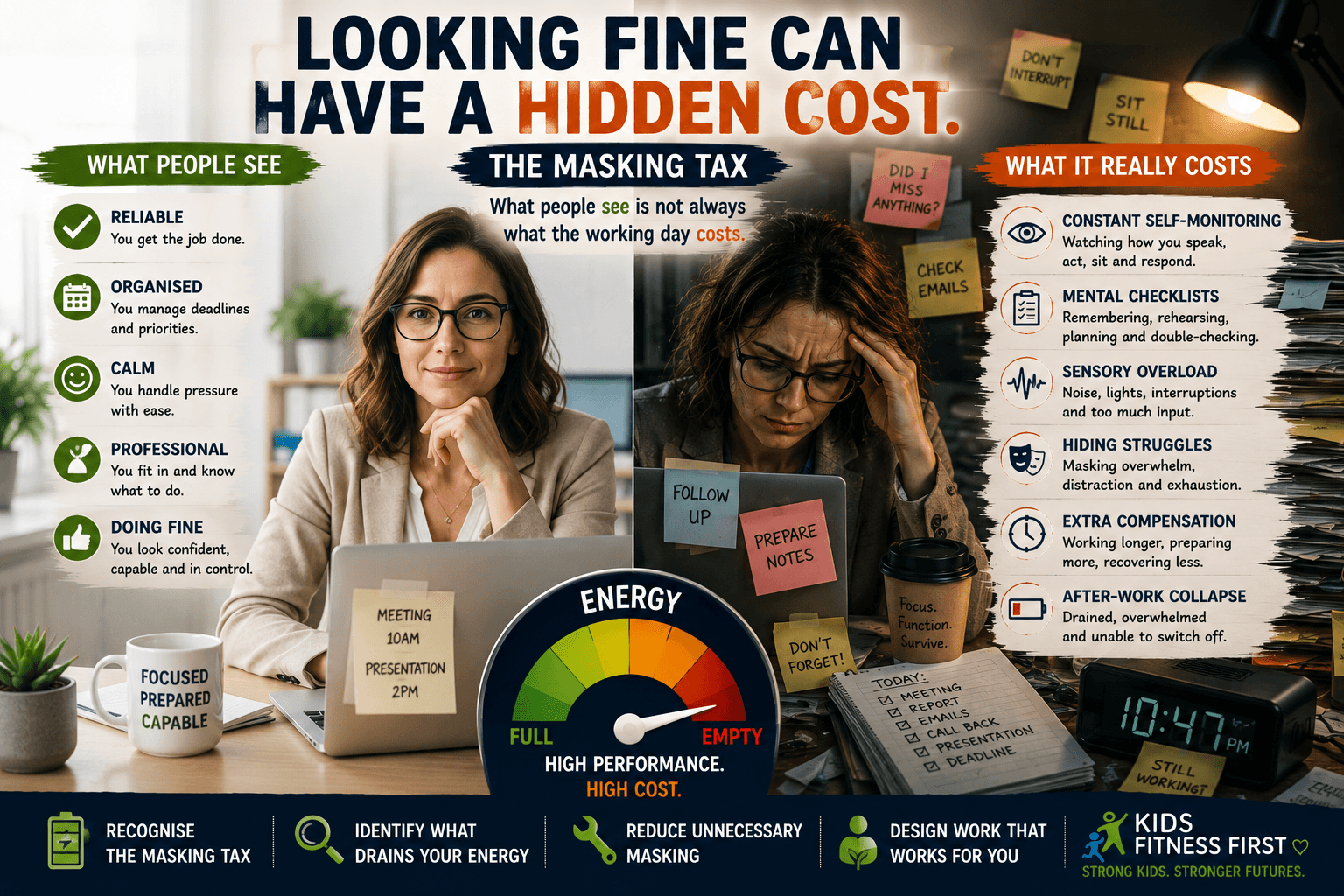
The Masking Tax
Book Four introduces the idea of the Masking Tax.
The Masking Tax is the hidden cost of continually managing how you appear while simultaneously trying to perform the actual job.
In practical terms, you are doing two jobs.
First, you are completing the work.
At the same time, you are monitoring yourself while completing it.
That second layer may include questions such as:
Am I talking too much?
Did I interrupt?
Do I look distracted?
Did I forget something?
Should I pretend I understood that instruction?
Am I being too enthusiastic?
Am I moving too much?
Consequently, a considerable amount of mental energy can be spent on appearing appropriately professional rather than on the work itself.
Adult ADHD and Workplace Masking: Cognitive Masking
One part of the Masking Tax can be cognitive.
This involves compensating for difficulties that other people may never see.
For example, you may:
write everything down because you are frightened of forgetting;
set several alarms for one meeting;
re-read emails repeatedly before sending them;
prepare excessively for conversations;
work longer hours to compensate for distraction;
create complicated reminder systems.
These strategies are not automatically negative.
In fact, some may be extremely useful.
However, the important question is:
“How much effort is required simply to maintain the appearance that everything is effortless?”
If that effort becomes excessive, the system may need attention.
Social Masking at Work
Another part of masking can be social.
Workplaces contain unwritten rules.
When should you speak?
How much enthusiasm is appropriate?
How long should you make eye contact?
When is a meeting actually finished?
How much personal information should you share?
For some people, these expectations are relatively automatic.
However, others may consciously analyse them.
As a result, a normal meeting can contain two simultaneous tasks.
Task One
Understand and contribute to the meeting.
Task Two
Continuously monitor your own behaviour.
Consequently, meetings may be far more tiring than their duration suggests.
Adult ADHD and Workplace Masking: Emotional Masking
Work also requires emotional regulation.
Perhaps you feel frustrated when priorities suddenly change.
Maybe criticism affects you strongly.
Alternatively, an interruption may completely derail the concentration you spent an hour building.
However, the professional expectation may be:
stay calm;
smile;
adapt;
continue.
Therefore, you suppress the visible reaction.
Sometimes that is an appropriate professional skill.
Everyone regulates emotion to some extent at work.
However, if substantial emotional suppression happens throughout the day, the accumulated effort may become significant.
Identity Masking
Masking can go deeper than behaviour.
Over time, you may begin constructing a workplace version of yourself.
Perhaps this version is:
less enthusiastic;
less direct;
more restrained;
more conventional;
more socially polished;
less visibly uncertain.
At first, this may simply feel professional.
However, if the gap between the workplace version of you and the rest of you becomes too large, work can begin to feel like continuous performance.
Therefore, ask:
“Am I adapting professionally, or am I spending the entire day pretending to be somebody else?”
The distinction matters.
Everyone Masks Sometimes
It is important not to pathologise ordinary professional behaviour.
Most people behave differently at work than they do at home.
You may speak differently to a customer than to a close friend.
Likewise, you may control frustration during a meeting even though you would express it more openly elsewhere.
That is normal.
Therefore, the issue is not whether you ever modify your behaviour.
Instead, the more useful questions are:
How much masking am I doing?
How much energy does it consume?
What happens afterwards?
Adult ADHD and Workplace Masking: The After-Work Collapse
One of the clearest signs that work may be costing more than it appears is what happens afterwards.
Perhaps you function reasonably well throughout the day.
Then you get home and cannot do anything.
You may:
lie on the sofa;
avoid conversation;
scroll for hours;
eat whatever requires the least effort;
cancel plans;
struggle to make simple decisions.
Meanwhile, colleagues may have no idea.
They saw the competent version of you.
Your family or personal life receives the exhausted version.
Therefore, evaluating work only by what happens between nine and five can miss an important part of the picture.
The Weekend Recovery Cycle
The same pattern can appear across the week.
Monday to Friday, you function.
However, by Saturday, you are depleted.
Perhaps you sleep for much longer.
You avoid social plans.
Household tasks accumulate.
Then Sunday becomes partly about recovering and partly about preparing mentally for Monday.
Consequently, employment may be consuming not only working hours but also much of the recovery time surrounding them.
That does not automatically mean the job is wrong.
However, it is information worth noticing.
Adult ADHD and Workplace Masking: When Success Hides the Problem
High performance can make masking particularly difficult to recognise.
Imagine that you:
meet targets;
receive promotions;
earn well;
manage responsibility;
receive positive feedback.
Everyone assumes the arrangement is working.
Perhaps you assume the same.
However, externally visible success does not reveal the internal cost.
Therefore, ask two separate questions:
Am I performing well?
and:
Is the way I am achieving that performance sustainable?
You need both answers.
Competence and Sustainability Are Different
This distinction appeared in Article 3 when we explored invisible work.
You can be very good at something that costs you too much.
Likewise, you can perform extremely well inside an environment that requires constant compensation.
Therefore, competence does not automatically prove fit.
A sustainable career needs more than the ability to survive the role.
It also needs a reasonable relationship between:
effort;
energy;
recovery;
reward;
life outside work.
Why Masking Can Become Automatic
If you have masked for years, you may no longer notice yourself doing it.
Perhaps you learned early that certain behaviours received negative reactions.
You may have heard:
“Stop interrupting.”
“Pay attention.”
“Sit still.”
“You’re too much.”
“Why can’t you just be organised?”
Over time, you may have learned to monitor those behaviours automatically.
Therefore, workplace masking may not feel like a conscious decision.
Instead, it can feel like:
“This is simply how I have to behave at work.”
Adult ADHD and Workplace Masking After a Late Diagnosis
A late ADHD diagnosis can sometimes change how somebody understands years of working life.
Perhaps you previously thought:
“Everyone must be this exhausted.”
Then you discover that some colleagues do not spend Sunday mentally rehearsing Monday.
Maybe they do not need three reminder systems for every meeting.
Perhaps they do not spend an hour recovering after a routine conversation.
However, diagnosis should not become an explanation for every workplace difficulty.
Instead, it can provide another lens for examining why certain environments or expectations may have required unusually high effort.
Masking Can Sometimes Be Useful
Masking should not automatically be described as entirely harmful.
In some situations, adjusting behaviour can be practical.
For example, you may choose to:
prepare carefully for an important presentation;
reduce interruptions during a meeting;
use a more formal communication style with a client;
manage an emotional response until you have time to process it privately.
Those choices may support professional goals.
Therefore, the aim is not necessarily:
“Stop masking completely.”
Instead, a more realistic goal may be:
“Reduce unnecessary masking and understand the cost of the masking I choose to keep.”
Adult ADHD and Workplace Masking: Necessary or Habitual?
A useful question is:
“What would actually happen if I stopped doing this?”
For example:
Do you really need to hide every movement?
Do you genuinely need to pretend that you understood unclear instructions?
Must every email be reread six times?
Would asking for written instructions actually create a problem?
Could you take notes openly rather than pretending you will remember?
Sometimes the answer will be:
“Yes, this workplace genuinely expects it.”
However, at other times, you may discover:
“I have been doing this because I assumed I had to.”
That distinction can be powerful.
Asking Clarifying Questions Is Not Failure
Suppose your manager gives you a complicated verbal instruction.
You nod.
Then you leave the room unsure what they actually want.
Perhaps you are worried that asking for clarification will make you look incompetent.
However, pretending to understand may create more problems later.
Instead, you could ask:
“Could you confirm the three priorities you want me to focus on?”
Or:
“Would you mind sending those points in writing so I can make sure I action them correctly?”
This is not necessarily a weakness.
Instead, it may be an effective working strategy.
External Systems Can Reduce Masking Pressure
Book Three of The X Variable Series explored external memory, visible time, routines and environmental design.
Those ideas also matter at work.
For example, using:
calendars;
task lists;
written agendas;
timers;
checklists;
meeting notes;
project-management systems
can reduce the need to hold everything internally.
As a result, less energy may be spent pretending that memory and organisation happen automatically.
The system does part of the work.
Adult ADHD and Workplace Masking: The Environment Matters
Some workplaces require more masking than others.
Imagine two environments.
Workplace A
Frequent interruptions.
Open-plan office.
Unclear expectations.
Constant meetings.
Heavy social pressure.
Manager monitors every detail.
Workplace B
Clear priorities.
Some control over working methods.
Quiet space available.
Written follow-up after important meetings.
Performance judged mainly on outcomes.
The same person may function very differently in those two workplaces.
Therefore, if masking feels overwhelming, do not assume the only solution is changing yourself.
The environment may also need examination.
The Masking Tax Is Not Only About ADHD
Although this series is ADHD-led, masking can also be relevant to other neurodivergent adults.
For example, an autistic employee may spend substantial energy navigating social expectations, sensory environments or communication conventions.
Likewise, a dyslexic employee may develop extensive strategies to hide difficulty with particular forms of written work while their stronger verbal, strategic or systems abilities remain less visible.
Therefore, the exact form of masking differs between individuals.
The important principle is to identify the gap between:
what other people see
and
what it costs you to produce what they see.
Adult ADHD and Workplace Masking: Calculate Your Masking Tax
You do not need an exact numerical score.
Instead, create a simple audit.
Choose a typical working day.
Then list the moments when you deliberately manage or hide something.
For example:
| Situation | What I Mask | Energy Cost |
|---|---|---|
| Team meeting | Restlessness and urge to interrupt | Medium |
| Verbal instructions | Difficulty retaining details | High |
| Open-plan office | Distraction and sensory load | High |
| Client call | Emotional reaction | Medium |
| End-of-day admin | Difficulty initiating repetitive work | High |
Then ask:
Which of these costs could be reduced?
That is where the exercise becomes useful.
Separate the Job From the Mask
Suppose you genuinely love the central work.
Perhaps you are a designer who loves designing.
However, most of your exhaustion comes from:
office interruptions;
daily meetings;
unnecessary social events;
constant switching;
unclear communication.
That distinction matters.
You may not need a completely different career.
Instead, you may need different working conditions.
This is why Book Four separates job fit from environment fit.
Adult ADHD and Workplace Masking: Look at Recovery Time
Another useful measure is recovery.
After an ordinary workday, how long does it take before you feel like yourself again?
Ten minutes?
An hour?
The entire evening?
The whole weekend?
There is no universal correct answer.
However, recovery time provides information about the cost of your current working pattern.
Therefore, track it for one week.
You may notice patterns that are difficult to see day by day.
What Happens to the Rest of Your Life?
Work should not be assessed entirely in isolation.
Suppose you perform brilliantly professionally.
However, because of the effort required, you have little capacity left for:
relationships;
parenting;
exercise;
cooking;
friendships;
interests;
rest.
That does not automatically mean you should leave the job.
Nevertheless, the wider cost deserves to be included in the calculation.
A career exists inside a life.
It is not the whole life.
Reduce One Piece of Unnecessary Masking
Do not attempt to transform your entire working life tomorrow.
Instead, identify one low-risk change.
For example:
ask for clarification rather than pretending to understand;
take notes openly;
use a visible checklist;
move during a telephone call if appropriate;
block a short period for uninterrupted work;
turn off unnecessary notifications;
request an agenda before an important meeting.
Then observe what happens.
If the change helps and causes no meaningful problem, keep it.
This is experimentation rather than revolution.
Adult ADHD and Workplace Masking: Do Not Overshare Automatically
Recognising masking does not mean you must immediately disclose ADHD or other personal information to colleagues or employers.
Disclosure is a separate decision.
Later in Book Four, we will examine workplace disclosure and accommodations in more detail.
For now, remember:
You can sometimes improve working conditions by describing what helps you perform without explaining every private reason behind it.
For example:
“I work best when priorities are confirmed in writing.”
That is a functional request.
It focuses on performance.
Functional Language Can Be Powerful
Instead of:
“I am terrible at remembering verbal instructions.”
try:
“I produce more accurate work when key actions are written down.”
Instead of:
“I can’t concentrate in here.”
you might say:
“I am more productive on detailed work when I have a quieter block without interruptions.”
The difference is not about hiding.
Instead, it is about describing the working condition and the outcome clearly.
The Goal Is Not to Become Completely Unfiltered
Professional environments still require judgement.
You cannot necessarily say everything you think.
Likewise, everybody must sometimes adapt to other people.
Therefore, reducing masking does not mean abandoning professional behaviour.
Instead, it means questioning the unnecessary layers of performance that consume energy without improving the work.
Ask:
“Is this helping me work effectively, or am I doing it mainly to appear acceptable?”
Adult ADHD and Workplace Masking: Build a Lower-Tax Workday
A lower-Masking-Tax workday might include:
clear priorities;
written instructions;
fewer unnecessary interruptions;
appropriate movement;
planned focus periods;
less unnecessary social performance;
realistic breaks;
external task systems;
a defined end to the workday.
You may not control every factor.
However, even small changes can reveal which conditions make the greatest difference.
Your 7-Day Masking Audit
For the next seven working days, ask yourself three questions at the end of each day:
1. What did I hide or heavily manage today?
Be specific.
2. What cost the most energy?
Look beyond the actual workload.
3. What could make tomorrow 10% easier?
Choose something small.
For example:
write the task down;
ask for clearer priorities;
move one meeting;
protect thirty minutes of focus;
take a proper break.
At the end of the week, look for repetition.
The repeated costs deserve the most attention.
The Masking Tax Traffic-Light System
You can also classify behaviours into three groups.
GREEN — Helpful and Low Cost
These strategies support performance without draining you excessively.
Keep them.
AMBER — Useful but Expensive
These strategies help, but they consume substantial energy.
Investigate alternatives.
RED — High Cost With Little Benefit
These behaviours drain you while adding little real value.
Question whether they are necessary.
This makes masking more practical to analyse.
You are not asking whether all masking is good or bad.
Instead, you are asking whether each behaviour earns its energy cost.
Reflection Questions
- What do colleagues see when they look at you at work?
- What effort do they not see?
- Which behaviours do you consciously monitor?
- Which workplace situations require the most masking?
- How much recovery do you need after an ordinary workday?
- Does work regularly consume your evenings or weekends through recovery?
- Which masking strategies genuinely help you perform?
- Which ones are mainly habits developed through fear of judgement?
- Could your environment be changed to reduce some of the Masking Tax?
- What is one low-risk piece of unnecessary masking you could experiment with reducing?
Conclusion: Looking Fine Is Not the Same as Being Fine
Adult ADHD and workplace masking can make a working life appear much easier from the outside than it feels from the inside.
You may be successful.
You may be reliable.
Perhaps you are highly valued.
However, none of those things automatically tells us what that performance costs.
Therefore, the important question is not simply:
“Can I do this job?”
Instead, ask:
“What does doing this job require from me, and is that cost sustainable?”
Some masking may be useful.
Some may be necessary.
However, some may simply be old habits built around trying not to look different.
By identifying the Masking Tax, you can begin separating those categories.
Then you can ask:
What should I keep?
What could the environment carry instead?
What could I stop hiding?
What could I ask to be clearer?
What could I make easier?
You do not need to remove every mask.
Instead, the goal is to stop paying unnecessary energy for work that could be designed differently.
Because a career that fits should not only look successful from the outside.
It should leave enough of you available for the life that exists when the working day ends.
SUGGESTED INTERNAL LINKS
- Adult ADHD and Career History: Why Your Working Life May Look More Chaotic Than It Really Is
- Adult ADHD and Your CV: Why Your Resume May Be Telling the Wrong Story
DISCLAIMER
This article is provided for general educational and informational purposes only. It does not provide medical, psychological, diagnostic, employment or legal advice and should not be used as a substitute for individual guidance from an appropriately qualified professional.
ADHD, autism, dyslexia and other neurodivergent experiences vary considerably between individuals. Not everyone masks, and masking can take different forms in different people and environments.
If work-related exhaustion, distress or difficulties are significantly affecting your health, emotional wellbeing or everyday functioning, consider seeking appropriate professional support. Likewise, workplace disclosure, disability rights and accommodations can depend on individual circumstances and applicable employment law.