Adult ADHD and Cognitive Strengths: Discover Your Unique Work Signature
Adult ADHD and cognitive strengths can be difficult to recognise when most of your attention has been directed towards what goes wrong.
Perhaps you have spent years thinking about what you forget.
Likewise, you may have focused on what you delay, what you find difficult or what seems to take you longer than other people.
However, that is only one side of the picture.
There is another question worth asking:
“When do I work exceptionally well?”
Perhaps you notice patterns that other people miss.
Alternatively, you may explain complicated ideas in a way that suddenly makes sense.
Likewise, you may become deeply absorbed when a problem genuinely interests you.
Therefore, understanding your strengths is not about pretending difficulties do not exist.
Instead, it is about building a more complete picture of how you think and work.
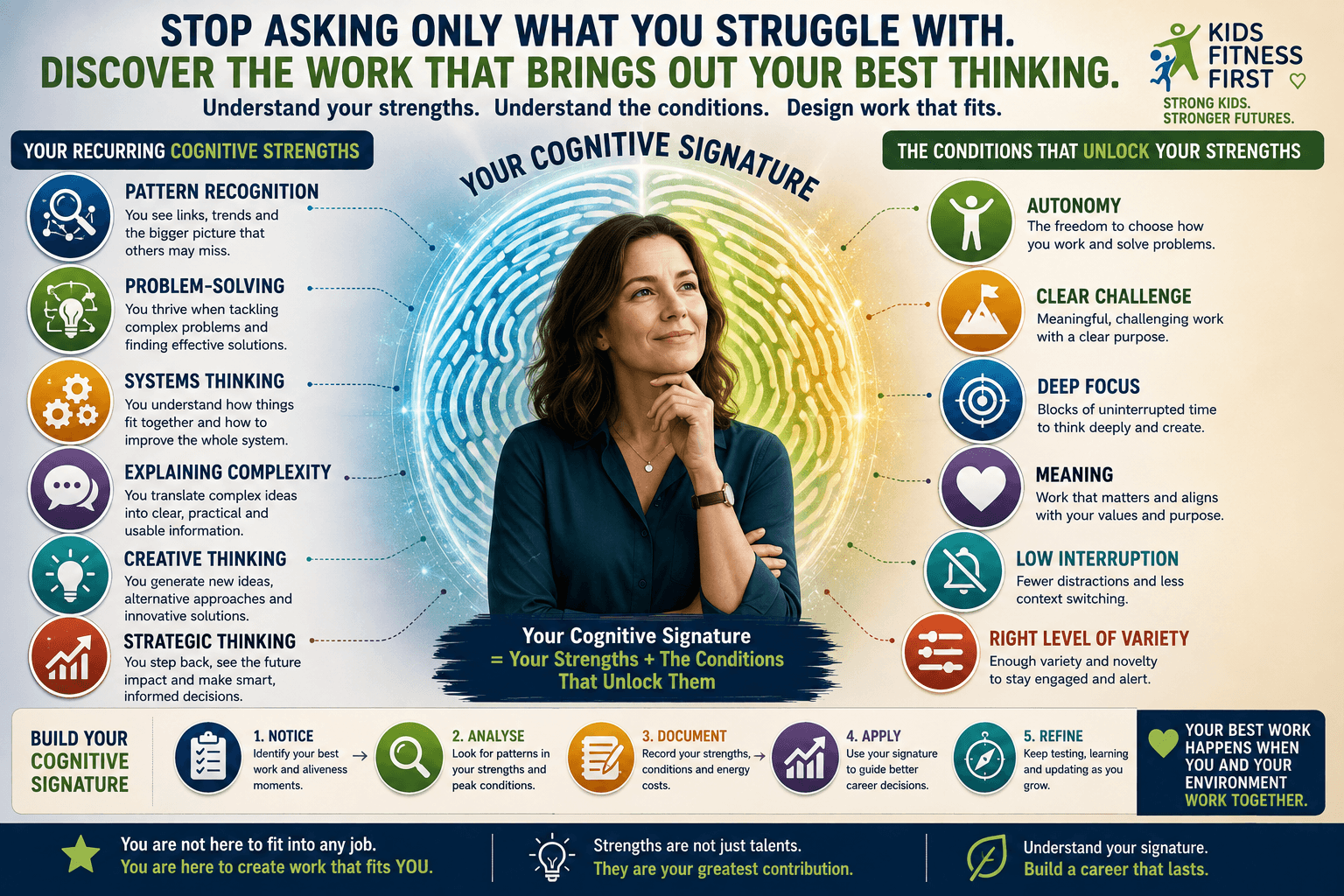
That fuller picture begins with what Work That Fits calls your Cognitive Signature.
What Is a Cognitive Signature?
A Cognitive Signature is the recurring combination of abilities, conditions and working styles that tend to bring out your strongest performance.
It is not a personality label.
Likewise, it is not a diagnosis.
Nor does it mean every adult with ADHD shares the same strengths.
Instead, it is a practical description of:
what kinds of work engage you;
what thinking you do particularly well;
which conditions help that thinking appear;
what repeatedly disrupts it.
Therefore, your Cognitive Signature is personal.
Moreover, it should be built from evidence across your working life rather than from assumptions or stereotypes.
Adult ADHD and Cognitive Strengths: Stop Starting With Weaknesses
Many people begin career planning by asking:
“What am I bad at?”
That information can be useful.
However, it should not be the whole starting point.
For example, you may successfully avoid a role containing heavy administration.
Yet, if the replacement role gives you no meaningful challenge, it may still be a poor fit.
Therefore, career design needs two questions.
First:
“What repeatedly drains me?”
Then:
“What consistently brings out my best thinking?”
Together, those questions provide much better information.
Look at Your Best Work, Not Your Best Job Title
Your strongest work may not have happened inside your most senior or prestigious role.
For example, your best thinking may have appeared during a difficult project.
Alternatively, it may have happened during a side project, a customer problem or a period of independent analysis.
Therefore, do not search only for impressive titles.
Instead, search for moments of genuine performance.
Ask:
“When did I feel sharp, useful and fully engaged?”
Those moments can reveal more than the job title itself.
Adult ADHD and Cognitive Strengths: Pattern Recognition
One recurring strength for some adults may be pattern recognition.
For example, this can involve:
seeing links between apparently separate information;
spotting inconsistencies;
recognising trends;
noticing what does not fit;
identifying the real issue beneath a surface problem.
Several customer complaints may appear unrelated.
However, you may notice that they all point towards one broken process.
Likewise, several project delays may look separate.
Yet, you may see that they all begin at the same stage.
Therefore, if people repeatedly rely on you to see the bigger picture, record it.
Do not automatically dismiss the ability simply because it feels natural.
Problem-Solving Can Be a Core Strength
Some people become noticeably more engaged when something needs solving.
A problem appears.
First, you investigate.
Then, you connect the available information.
Afterwards, you test possible solutions.
Eventually, you find a workable answer.
Meanwhile, routine maintenance may feel considerably harder.
This does not mean you should deliberately build a working life around constant emergencies.
However, it may mean that challenge, novelty and clear problems unlock some of your strongest thinking.
Therefore, ask:
“What kinds of problems do I repeatedly solve well?”
Adult ADHD and Cognitive Strengths: Explaining Complexity
Another recurring strength may involve translation.
Perhaps you can take something technical, complicated or confusing and make it easier to understand.
For example, you might be particularly good at:
turning jargon into plain English;
explaining a process;
helping a client understand several options;
making an abstract idea practical.
Therefore, if people repeatedly tell you:
“You explain that really well,”
do not dismiss the feedback.
Instead, ask what is happening underneath that ability.
It may combine:
understanding;
synthesis;
perspective;
communication;
judgement.
As a result, what appears to be “just explaining” may represent a valuable professional strength.
Systems Thinking
Some people naturally think in systems.
Instead of seeing one isolated task, they immediately notice what comes before it.
Likewise, they notice what depends on it, where the bottleneck sits and what will happen next.
As a result, they may be particularly effective at:
process improvement;
operations;
strategy;
project design;
workflow development.
Therefore, if this pattern appears repeatedly, include it in your Cognitive Signature.
Adult ADHD and Cognitive Strengths: Creative Thinking
Creative thinking does not only mean artistic work.
Instead, creativity can appear in highly practical settings.
For example, it may involve:
finding an alternative approach;
seeing several possible solutions;
combining ideas from different areas;
questioning an inefficient convention.
Therefore, if people repeatedly say:
“I would never have thought of that,”
treat that as evidence.
Likewise, if you frequently find a different route when the obvious one fails, record the pattern.
Creativity can be valuable in business, operations, education, technology and many other fields.
Strategic Thinking
Strategic thinking often involves stepping above the immediate task.
Instead of asking only:
“What do we do next?”
you may naturally ask:
“Where is this going?”
Or:
“What problem are we actually trying to solve?”
As a result, you may spot consequences or opportunities that are not immediately obvious.
That kind of thinking can be valuable in leadership, consulting, analysis and business development.
However, it may remain underused in roles dominated by repetitive execution.
Therefore, if strategic thinking appears among your best moments, include it.
Adult ADHD and Cognitive Strengths: Verbal Improvisation
Some people think particularly well while speaking.
For example, they may perform strongly during:
presentations;
negotiation;
teaching;
sales;
live problem-solving;
interviews.
Meanwhile, putting the same idea into writing may take considerably longer.
Therefore, notice the format in which your thinking becomes easiest to access.
The strength may not only be what you know.
Instead, it may also involve how you best retrieve and communicate what you know.
Deep Focus Can Be Conditional
ADHD is often discussed in terms of difficulty focusing.
However, many adults describe periods of intense concentration when the task is especially engaging.
The important point is not to romanticise this.
Instead, ask what conditions appear around your best periods of focus.
For example:
interest;
challenge;
clear outcome;
meaning;
low interruption;
autonomy.
Therefore, focus may be highly dependent on context.
That context belongs inside your Cognitive Signature.
Adult ADHD and Cognitive Strengths: Aliveness Moments
Earlier articles introduced the idea of aliveness moments.
These are periods when you felt genuinely engaged rather than simply coping.
Return to those moments now.
First, ask:
What were you doing?
Then ask:
Who were you working with?
Likewise:
Was the task difficult?
Was it urgent?
Did you have autonomy?
Were you creating or improving something?
As a result, aliveness moments can reveal both the strength itself and the conditions that helped it appear.
Your Strength Is Not the Same as Your Job
Suppose your job title was:
Marketing Manager.
Your actual strength may have been:
seeing patterns in audience behaviour.
Likewise, a teacher’s real strength may have been:
explaining difficult ideas clearly.
Similarly, a project manager’s strongest contribution may have been:
identifying risks before they became problems.
Therefore, separate the role from the cognitive contribution underneath it.
Once you do that, transferable strengths become much easier to see.
Adult ADHD and Cognitive Strengths: Look Across Industries
A strength becomes particularly interesting when it appears across several unrelated industries.
For example:
Retail → solved difficult customer problems.
Operations → diagnosed workflow problems.
Consulting → identified client problems.
Education → helped learners understand difficult concepts.
The industries changed.
However, the underlying ability remained similar.
Therefore, the strength may be more central to your professional identity than the sectors themselves.
Recurring Strengths Are Better Evidence Than One Good Day
One strong performance is useful.
However, repetition provides much stronger evidence.
Ask:
What do different people repeatedly rely on me for?
Likewise:
What feedback keeps appearing?
Which tasks bring out similar strengths across several roles?
Therefore, look for patterns rather than isolated compliments.
Your Cognitive Signature should be built from repeated evidence.
Adult ADHD and Cognitive Strengths: What Feels Easy to You?
One of the hardest strengths to recognise is often the ability that feels obvious.
You may think:
“Anyone could do that.”
However, if other people repeatedly struggle with something you find intuitive, pay attention.
For example:
seeing structure inside chaos;
finding missing information;
connecting ideas quickly;
recognising what does not fit;
generating alternatives.
Therefore, ease can sometimes hide value.
Instead of dismissing the ability, investigate it.
Strengths Can Also Carry Costs
A strength is not always free.
Perhaps you are excellent during a crisis.
However, constant crisis may exhaust you.
Likewise, you may be highly persuasive during meetings.
Yet, heavy social interaction may leave you depleted afterwards.
Therefore, every suspected strength should be assessed alongside its energy cost.
Ask two questions:
“Am I good at this?”
and:
“Can I do enough of this sustainably?”
Both answers matter.
Adult ADHD and Cognitive Strengths: High Value, High Cost
You may identify a capability that organisations value greatly but that you cannot sustain continuously.
For example:
difficult negotiation;
conflict resolution;
urgent troubleshooting.
That does not mean you should abandon the strength.
Instead, you may want a role where the capability is used selectively.
Therefore, career design should consider frequency as well as ability.
A high-value strength does not need to occupy every hour of your working week.
Build Your Cognitive Signature Evidence Bank
Create a document with five columns:
| Situation | What I Did Well | Strength | Conditions | Energy Cost |
|---|---|---|---|---|
| Project crisis | Found bottleneck quickly | Pattern recognition | Urgent, clear goal | Medium |
| Client presentation | Explained technical issue clearly | Translation | Live interaction | Low |
| Process redesign | Created simpler workflow | Systems thinking | Autonomy, quiet | Low |
First, record the situation.
Then, describe what you actually did well.
Afterwards, name the underlying strength.
Finally, record the conditions and energy cost.
As a result, vague beliefs about strengths become evidence.
Moreover, you begin seeing the environment in which each ability performs best.
Adult ADHD and Cognitive Strengths: Identify Peak Conditions
A strength does not operate in isolation.
Perhaps your best thinking appears when:
you work independently;
the task is challenging;
the outcome is clear;
interruptions are limited;
you have enough autonomy.
Therefore, identify both:
the strength
and
the conditions that unlock it.
That combination is much more useful than a generic skills list.
Your Peak Conditions May Matter as Much as the Role
Imagine you are excellent at analysis.
However, your analytical ability appears strongest when you have two uninterrupted hours.
Now imagine a workplace that gives you only fragmented twenty-minute periods.
As a result, your strongest ability may appear weaker than it really is.
Therefore, poor conditions can hide genuine ability.
This connects directly to Article 7 on the wrong work environment.
Adult ADHD and Cognitive Strengths: Notice Collapse Conditions Too
Now identify what reduces access to your strengths.
For example:
constant interruption;
unclear priorities;
heavy social load;
repetitive administration;
lack of sleep;
micromanagement.
These are your collapse conditions.
Therefore, your Cognitive Signature should include both sides:
what activates strong performance;
and
what reliably disrupts it.
A useful career profile needs both pieces.
Strength Is About Contribution, Not Superiority
The purpose of this framework is not to claim that ADHD makes somebody better than other people.
It does not.
Likewise, not every adult with ADHD will identify the same strengths.
Instead, the framework asks a practical question:
“What contribution do I repeatedly make well?”
Therefore, the approach remains strengths-based without turning ADHD into a stereotype.
Adult ADHD and Cognitive Strengths: Build a Strength Statement
Once patterns begin appearing, create a simple statement.
For example:
“I am strongest when I can analyse complex information, identify the underlying problem and explain the solution clearly.”
Alternatively:
“I do my best work when I have autonomy, a clear challenge and enough uninterrupted time to build or improve a system.”
This is not a slogan.
Instead, it is a working hypothesis.
Therefore, test it against real career evidence.
Test the Statement Against Your Career History
Return to Article 1.
Then look at several past roles.
Ask:
Does this statement explain my strongest moments?
Likewise:
Does it explain why some jobs felt much better than others?
If yes, the statement may be useful.
However, if it only explains one isolated experience, keep refining it.
Therefore, the goal is consistency rather than creating a description that merely sounds impressive.
Adult ADHD and Cognitive Strengths: Use Your CV Differently
Article 2 explored your CV.
Once your strengths become clearer, your CV can highlight evidence of them.
For example, rather than writing only:
“Managed project activity.”
you might accurately describe:
“Identified recurring project bottlenecks and redesigned the workflow to improve delivery.”
The wording must remain truthful.
However, the contribution becomes much clearer.
As a result, employers can see not only what you were responsible for but also how you added value.
Use Strengths During Career Decisions
Article 9 explored career decisions.
Now add another question:
“Which option gives me the greatest opportunity to use my strongest recurring abilities?”
A job may offer a higher salary.
Likewise, it may provide a better title or a prestigious employer.
However, if it barely uses your strengths, it may still be a poor fit.
Therefore, add cognitive-strength fit to your decision criteria.
Adult ADHD and Cognitive Strengths: Avoid the Strength Trap
There is one important warning.
Once you identify a strength, you may be tempted to build your entire identity around it.
However, that can become restrictive.
You may have several strengths.
Likewise, they may evolve over time.
Therefore, treat the Cognitive Signature as a living document.
Update it as new evidence appears.
Strengths Can Develop
Something that once felt difficult may become a strength through experience.
Likewise, a capability you used heavily during one stage of your career may become less central later.
Therefore, your Cognitive Signature is not fixed forever.
Instead, it is a practical snapshot of your current recurring patterns.
Adult ADHD and Cognitive Strengths: The Strengths Triangle
Use three questions for every suspected strength.
1. Am I Good at It?
Look for evidence.
2. Does It Give or Drain Energy?
This helps measure sustainability.
3. Do Other People Value It?
This helps reveal career usefulness.
Therefore, a strong career strength often sits where all three overlap.
You perform well.
The capability has value.
And importantly, the energy cost is reasonable enough to sustain.
Your 7-Day Cognitive Strength Audit
For seven working days, record:
1. Best Moment of the Day
When did you work particularly well?
2. What Were You Doing?
Be specific.
3. Which Strength Was Present?
For example:
analysis;
problem-solving;
communication;
pattern recognition;
creativity.
4. What Conditions Helped?
Quiet?
Urgency?
Autonomy?
Meaning?
5. Energy Afterwards
Higher / Same / Lower.
At the end of each day, record the answers briefly.
Then, at the end of the week, look for repetition.
As a result, you may begin seeing patterns that ordinary performance reviews never revealed.
The Green, Amber and Red Strength Test
GREEN — Strong and Sustainable
You perform well.
Likewise, the work is valued.
Most importantly, the energy cost is reasonable.
Therefore, this may be a good capability to use regularly.
AMBER — Strong but Expensive
You perform well.
However, the energy cost is high.
Therefore, use the strength selectively or change the conditions around it.
RED — Weak, Inconsistent or Too Expensive
The capability may be inconsistent.
Alternatively, the energy cost may be too high to use regularly.
Therefore, do not build your career around it simply because somebody once praised you for it.
Create Your First Cognitive Signature
Use this template:
I AM STRONGEST WHEN I…
I NATURALLY NOTICE…
PEOPLE OFTEN RELY ON ME FOR…
I DO MY BEST THINKING WHEN…
MY PERFORMANCE DROPS WHEN…
I WANT MORE WORK THAT INVOLVES…
I WANT LESS WORK THAT INVOLVES…
First, complete the answers quickly.
Then, leave the document for a few days.
Afterwards, return to it and compare it against your work history.
Finally, refine it as more evidence appears.
Your First Strengths Map
Once you have completed the template, create three lists.
MORE
Work you want more of.
For example:
problem-solving;
analysis;
creative thinking;
strategy.
LESS
Work you want less of.
For example:
constant interruption;
repetitive administration;
heavy social load.
CONDITIONS
The conditions that help.
For example:
autonomy;
quiet;
clear goals;
meaningful challenge.
Together, these three lists form a practical first version of your Cognitive Signature.
Adult ADHD and Cognitive Strengths: Apply It to a Future Job
Suppose you are considering a new role.
Do not only ask:
What is the salary?
What is the title?
Where is it located?
Instead, compare the role with your Cognitive Signature.
Ask:
Will I use my strongest abilities?
Will I have the conditions that help them appear?
How much of the role involves my collapse conditions?
Therefore, your Cognitive Signature becomes a practical decision tool rather than an abstract self-description.
Do Not Expect a Perfect Match
No job will perfectly match every strength and preference.
There will still be routine work.
Likewise, there will still be difficult days.
However, the goal is not perfection.
Instead, the goal is improving the overall ratio.
You want more work that uses your strongest contribution and less work that continually undermines it.
Therefore, think in terms of better fit rather than perfect fit.
Adult ADHD and Cognitive Strengths: Build Evidence Before Making Big Changes
Recognising one strength does not mean you need to immediately change career.
Instead, gather evidence.
Try a project.
Take on a different responsibility.
Ask to contribute in an area that uses the strength.
Then, observe what happens.
Do you perform well?
Do other people value the contribution?
Does the work feel sustainable?
As a result, career decisions become grounded in experience rather than theory.
Reflection Questions
- What work have you repeatedly done particularly well?
- What do colleagues naturally come to you for?
- Which strengths appear across several different jobs?
- What tasks make you feel most mentally alive?
- What kinds of problems do you solve well?
- Do you think best verbally, visually, analytically or practically?
- Which strengths feel almost too easy to count?
- What conditions consistently help your best thinking appear?
- Which conditions make access to those strengths harder?
- Which future roles would give you more opportunity to use your strongest recurring abilities?
SUGGESTED INTERNAL LINKS
- Adult ADHD and Career Decisions: How to Tell Whether to Stay, Change Roles or Change Employers
- Adult ADHD and Career Burnout: Could the Problem Be Your Current Life Stage?
DISCLAIMER
This article is provided for general educational and informational purposes only. It does not provide medical, psychological, diagnostic, employment, recruitment or career advice.
ADHD and neurodivergent experiences vary considerably between individuals. The strengths discussed here should not be assumed to apply to every person with ADHD, autism, dyslexia or another neurodivergent profile.
Likewise, identifying a personal strength does not guarantee success in a particular occupation. Career suitability also depends on experience, qualifications, environment, opportunity, interests, health, financial circumstances and many other factors.
Where significant career or health decisions are involved, consider obtaining appropriate professional advice.