Adult ADHD and Peak Performance: Discover the Conditions That Bring Out Your Best Work
Adult ADHD and peak performance can be misunderstood when success is measured only by consistency.
Perhaps you have experienced days when your thinking felt unusually clear.
You solved difficult problems quickly.
Likewise, you may have produced several hours of excellent work without constantly forcing yourself to concentrate.
Then, on another day, even relatively simple tasks felt difficult.
However, the difference may not simply be motivation.
Instead, something about the conditions may have changed.
Perhaps the first task was interesting.
Maybe the objective was clear.
Likewise, you may have had uninterrupted time, enough autonomy or a meaningful deadline.
Therefore, rather than asking only:
“Why can’t I perform like that all the time?”
ask:
“What was present when I performed at my best?”
That question moves the focus away from self-criticism and towards evidence.
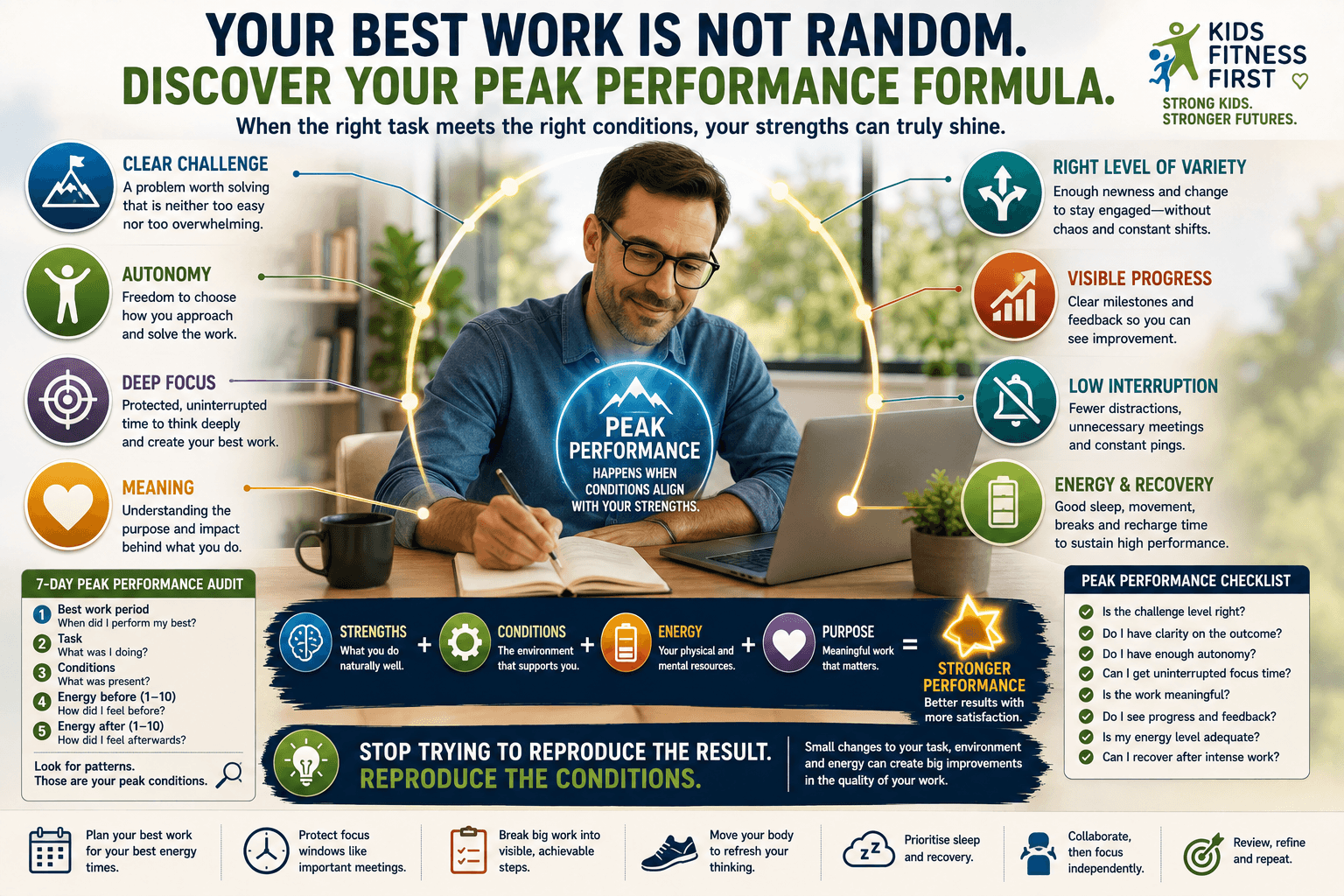
As a result, you can begin identifying your personal Peak Performance Formula.
Peak Performance Is Not Maximum Effort
Peak performance does not mean working at maximum intensity every day.
In fact, trying to operate permanently at maximum intensity is unlikely to be sustainable.
Instead, peak performance means understanding the conditions in which your abilities are most accessible.
For example, you may think particularly well when:
the problem is challenging;
the objective is clear;
you have enough autonomy;
interruptions are limited;
the work feels meaningful.
Therefore, the goal is not to force yourself into a permanent high-performance state.
Instead, the goal is to recognise the circumstances that repeatedly help good work happen.
Adult ADHD and Peak Performance: Your Best Days Contain Evidence
Think about three of your best working days.
They do not need to have been perfect.
Instead, choose days when you felt:
engaged;
capable;
useful;
mentally alert;
satisfied with what you produced.
Then ask:
What were you working on?
Who were you working with?
How much control did you have?
Was the work difficult?
Were you interrupted?
Did you understand the purpose?
Therefore, do not simply remember that the day went well.
Break the day apart.
The individual ingredients may reveal a repeatable pattern.
Start With the Task
First, examine the work itself.
Perhaps your strongest performance appears when the task involves:
solving a problem;
creating something;
analysing information;
explaining complexity;
improving a system;
responding to a clear challenge.
By contrast, performance may drop during repetitive or poorly defined work.
Therefore, ask:
“What was I actually doing when I was at my best?”
Be specific.
For example, “working on a project” is too broad.
Instead:
“I was analysing why the project kept falling behind and redesigning the process.”
That description reveals much more.
Adult ADHD and Peak Performance: Challenge Matters
Some people perform better when a task contains enough challenge to be engaging.
If the work is too easy, attention may drift.
However, if the challenge becomes overwhelming, performance can also fall.
Therefore, the useful zone may sit somewhere between boredom and overload.
Imagine a simple scale:
Too Easy → Engaging Challenge → Too Difficult
Your goal is not maximum difficulty.
Instead, your goal is finding the level of challenge that keeps you mentally involved without making the task unmanageable.
The Goldilocks Zone of Work
Think of challenge as having three zones.
TOO LITTLE CHALLENGE
The work feels repetitive.
Consequently, attention becomes difficult to sustain.
USEFUL CHALLENGE
The task requires thinking.
However, it still feels achievable.
As a result, engagement may increase.
TOO MUCH CHALLENGE
The task feels chaotic or impossible.
Therefore, stress may begin replacing productive engagement.
This middle area can be thought of as your Goldilocks Zone.
Not too little.
Not too much.
Instead, enough challenge to activate your abilities.
Adult ADHD and Peak Performance: Clear Outcomes Can Change Everything
A difficult task can sometimes feel easier than a simple but vague one.
Why?
Because clarity matters.
For example:
“Improve the report.”
may be difficult to start.
However:
“Reduce the report to five pages and make the recommendations clear for Monday’s meeting.”
provides a much clearer target.
Therefore, ask:
“Do I perform better when I know exactly what finished looks like?”
If the answer is yes, clear outcomes belong inside your Peak Performance Formula.
Autonomy Can Be an Important Ingredient
Some people work better when they understand the objective but have flexibility over how to reach it.
For example:
“Here is the problem. Find the best solution.”
may produce stronger performance than:
“Follow these twelve steps exactly.”
That does not mean structure is always bad.
However, excessive control can sometimes reduce engagement.
Therefore, ask:
“How much freedom did I have during my strongest work?”
If autonomy repeatedly appears, record it.
Adult ADHD and Peak Performance: Structure and Autonomy Can Coexist
Autonomy does not necessarily mean having no structure.
In fact, some people perform best with both.
For example:
Clear destination + freedom over the route.
You know:
what must be delivered;
when it is required;
what quality is expected.
However, you still have flexibility over how you organise the work.
Therefore, do not treat structure and autonomy as opposites.
Your best formula may require both.
Interruption Has a Performance Cost
Imagine you finally become deeply engaged in a complex task.
Then an email appears.
Next, somebody asks a question.
Afterwards, your phone rings.
Eventually, you return to the original task.
However, your thinking may no longer be where it was.
Therefore, interruption does not only consume the minute required to answer the message.
It may also create a restart cost.
As a result, frequent interruption can make strong performance harder to access.
Adult ADHD and Peak Performance: Protect Focus Windows
If uninterrupted time consistently improves your work, consider protecting focus windows where realistically possible.
For example:
30 minutes;
60 minutes;
90 minutes;
two hours.
During that period, reduce avoidable interruption.
Then observe what happens.
Do you produce more?
Does the work feel easier?
Is the quality better?
Therefore, treat focused time as an experiment rather than assuming longer hours automatically produce better results.
Time of Day Matters
Not everyone performs equally well throughout the day.
Perhaps your clearest thinking appears early in the morning.
Alternatively, you may become much more mentally effective later in the day.
Therefore, observe rather than assume.
For one week, record your concentration at different times.
For example:
Morning
6/10
Midday
8/10
Afternoon
5/10
Evening
7/10
As a result, you may discover a useful energy pattern.
Adult ADHD and Peak Performance: Match Work to Energy
Once you identify stronger and weaker periods, consider matching tasks to them where possible.
For example:
Higher-Energy Period
analysis;
writing;
strategy;
problem-solving.
Lower-Energy Period
routine email;
administration;
simple updates;
filing.
Therefore, instead of expecting identical performance throughout the day, use your strongest periods more deliberately.
This is not always possible.
However, even small adjustments can be useful.
Meaning Can Increase Engagement
A task can become easier to engage with when you understand why it matters.
For example, entering information into a spreadsheet may feel meaningless.
However, if you understand that the information will directly influence an important decision, the task may feel different.
Therefore, ask:
“Do I perform better when I can see the purpose?”
If yes, meaning belongs inside your performance conditions.
Adult ADHD and Peak Performance: Urgency Can Help — But Be Careful
Some people notice that deadlines increase focus.
Suddenly, the task becomes clear.
Other distractions disappear.
As a result, performance rises.
However, there is an important danger.
If you repeatedly depend on last-minute urgency to activate performance, you may create unnecessary stress.
Therefore, the goal is not:
“Create more emergencies.”
Instead, ask:
“What does urgency provide that ordinary work does not?”
Perhaps it provides:
a clear deadline;
one obvious priority;
immediate consequences;
reduced choice.
If so, those ingredients may be recreated without waiting for a crisis.
Create Artificial Clarity, Not Artificial Panic
Suppose you work well under deadlines.
Rather than leaving everything until the last moment, create an earlier checkpoint.
For example:
Final deadline: Friday
Personal completion target: Wednesday
Then create a clear Wednesday deliverable.
As a result, you may gain some of the structure of urgency without the full stress of a last-minute crisis.
Therefore, reproduce the useful ingredient rather than the damaging part.
Adult ADHD and Peak Performance: Novelty Can Increase Interest
New problems can be stimulating.
Likewise, unfamiliar projects may create curiosity.
However, novelty eventually fades.
Therefore, a role based entirely on newness may still become difficult once the work becomes familiar.
Instead, ask whether your ideal work contains renewable variety.
For example:
different clients;
different problems;
changing projects;
new challenges within a stable profession.
That may provide variety without requiring constant career change.
Variety Is Not the Same as Chaos
A varied job can contain:
different tasks;
new challenges;
several projects.
However, chaos contains:
unclear priorities;
constant interruption;
unpredictable demands;
no stable system.
Therefore, do not confuse the two.
You may need variety.
Yet, you may still perform best inside a clear structure.
Adult ADHD and Peak Performance: Feedback Speed Matters
Some work provides feedback quickly.
You solve a problem and immediately see whether the solution worked.
Other work may take months before results become visible.
Therefore, ask whether faster feedback helps maintain your engagement.
For example:
sales;
technical troubleshooting;
teaching;
project milestones;
creative production.
If visible progress repeatedly improves performance, include it in your formula.
Progress Creates Momentum
Large projects can feel abstract.
Therefore, break them into visible stages.
For example:
Research → Outline → Draft → Review → Complete.
Then mark each stage as finished.
As a result, progress becomes easier to see.
Moreover, visible progress can create a sense of momentum.
Adult ADHD and Peak Performance: Social Conditions Matter
Your strongest performance may also depend on who is around you.
Perhaps you work best independently.
Alternatively, you may think better when ideas can be discussed with somebody else.
Likewise, you may enjoy collaboration but need private time afterwards to complete the work.
Therefore, ask:
“What social environment existed during my strongest work?”
The answer may reveal an important condition.
Collaboration Versus Constant Availability
Working with people can be valuable.
However, collaboration does not require permanent accessibility.
For example, you may perform well with:
a 30-minute planning meeting;
followed by;
two hours of independent work.
Therefore, the ideal structure may alternate between collaboration and concentration.
Adult ADHD and Peak Performance: Environment Matters Too
Physical surroundings can affect performance.
For example:
noise;
lighting;
temperature;
movement;
visual distraction;
workspace layout.
Therefore, notice whether your best work repeatedly happens in particular environments.
Perhaps you think better:
at home;
in a private office;
in a quiet library;
with headphones;
while standing;
after walking.
Again, the goal is not to create universal rules.
Instead, it is to identify your personal pattern.
Movement May Be Part of Your Working Pattern
Some people think better after movement.
For example, a short walk may help them organise an idea.
Likewise, standing during a phone call may feel easier than sitting still.
Therefore, if movement repeatedly supports your thinking, record it.
Your Peak Performance Formula can include physical conditions as well as cognitive ones.
Adult ADHD and Peak Performance: Sleep and Recovery Matter
You cannot understand performance without considering recovery.
A perfect task in a perfect environment may still feel difficult after several nights of poor sleep.
Likewise, prolonged stress can reduce access to abilities that normally feel easy.
Therefore, do not interpret every low-performance day as evidence of poor career fit.
Sometimes capacity is the missing variable.
This connects directly to Article 8 on career burnout.
High Performance Has a Recovery Cost
Suppose you complete four hours of extremely demanding analytical work.
The output may be excellent.
However, you may be mentally exhausted afterwards.
Therefore, ask not only:
“Can I perform at this level?”
Also ask:
“How often can I perform at this level sustainably?”
That distinction matters.
Peak performance should not require permanent depletion.
Adult ADHD and Peak Performance: The Performance Equation
A useful way to think about your strongest work is:
STRENGTHS + CONDITIONS + ENERGY + PURPOSE = STRONGER PERFORMANCE
Your strengths matter.
However, strengths alone are not enough.
The conditions need to support them.
Likewise, you need enough available energy.
Finally, the task needs enough relevance or purpose to engage you.
Therefore, when performance drops, investigate all four parts rather than automatically blaming yourself.
Connect This to Your Cognitive Signature
Article 10 introduced your Cognitive Signature.
For example, perhaps your recurring strength is:
problem-solving.
Now Article 11 adds another layer.
You may discover that problem-solving works best when you have:
a clear challenge;
autonomy;
90 minutes without interruption;
visible progress;
enough energy.
Therefore:
Cognitive Signature = What you do well
while:
Peak Performance Formula = The conditions that help you do it well
Together, they provide a much richer picture of career fit.
Adult ADHD and Peak Performance: Build Your Formula
Complete the following statements.
I PERFORM BEST WHEN THE TASK IS…
THE IDEAL LEVEL OF CHALLENGE IS…
I NEED THIS MUCH AUTONOMY…
MY BEST FOCUS PERIOD IS…
MY STRONGEST TIME OF DAY IS…
I WORK BEST AROUND PEOPLE WHEN…
THE ENVIRONMENT SHOULD INCLUDE…
THE ENVIRONMENT SHOULD REDUCE…
I NEED TO UNDERSTAND…
AFTER INTENSE WORK I NEED…
Once completed, you have the first version of your Peak Performance Formula.
Your 7-Day Peak Performance Audit
For seven working days, record five things.
1. Best Work Period
When did you perform particularly well?
2. Task
What were you doing?
3. Conditions
Quiet?
Challenge?
Autonomy?
Urgency?
Meaning?
Collaboration?
4. Energy Before
Rate 1–10.
5. Energy Afterwards
Rate 1–10.
At the end of the week, compare your strongest periods.
Then ask:
“What keeps appearing?”
Those repeated conditions are more useful than assumptions.
Adult ADHD and Peak Performance: The Peak Performance Score
For each important task, score the following from 1–5.
| Factor | Score |
|---|---|
| Interest | /5 |
| Challenge | /5 |
| Clarity | /5 |
| Autonomy | /5 |
| Focus opportunity | /5 |
| Meaning | /5 |
| Energy available | /5 |
Then compare high-performance tasks with low-performance tasks.
As a result, you may begin seeing why certain work consistently feels easier.
The Green, Amber and Red Performance Test
GREEN — Peak Conditions
The work is engaging.
The challenge is appropriate.
The objective is clear.
Likewise, you have enough focus and energy.
Therefore, strong performance becomes easier to access.
AMBER — Partial Fit
Some conditions work.
However, one or two important ingredients are missing.
Therefore, adjust the task or environment where possible.
RED — Collapse Conditions
The work is unclear, highly fragmented, excessively draining or consistently mismatched with your strengths.
Therefore, pushing harder may not be the best first solution.
Instead, identify what is structurally wrong.
Do Not Turn Peak Performance Into Another Standard
Once you identify your best conditions, there is a temptation to think:
“Now I should perform brilliantly every day.”
However, that defeats the purpose.
Human performance naturally varies.
People become tired.
Life changes.
Unexpected problems happen.
Therefore, your Peak Performance Formula is not another standard to judge yourself against.
Instead, it is a tool for designing work more intelligently.
Adult ADHD and Peak Performance: Aim for More Good Hours, Not Perfect Days
Perhaps you cannot redesign your entire job.
However, you may be able to improve two hours.
For example:
protect 9:00–11:00 for demanding work.
Then move routine communication later.
As a result, only part of the working day changes.
Yet that small change may significantly improve output.
Therefore, do not underestimate the value of creating more good hours.
Use Peak Conditions When Evaluating Jobs
When considering a future role, ask:
Will I have uninterrupted time?
How much autonomy will I have?
How clear are priorities?
How much variety exists?
What level of social interaction is expected?
How quickly will I see progress?
Therefore, career decisions can become more precise.
Instead of asking only:
“Do I like this job?”
you can ask:
“Does this job contain enough of the conditions that help me work well?”
Adult ADHD and Peak Performance: Ask Better Interview Questions
Job interviews are not only opportunities for employers to assess you.
They are also opportunities for you to understand the working environment.
Therefore, consider questions such as:
“How are priorities normally communicated?”
“How much uninterrupted working time does this role typically have?”
“How much autonomy does the person have over how work is completed?”
“How frequently do priorities change?”
“What does a normal working day look like?”
The answers may reveal more about fit than the job title itself.
Small Changes Can Produce Large Differences
Perhaps you cannot change:
your employer;
your profession;
your working hours.
However, you may still be able to change:
when you do demanding tasks;
how notifications are managed;
where you work;
how projects are broken down;
when meetings occur.
Therefore, begin with controllable variables.
As a result, you can test whether conditions genuinely influence performance before making larger career decisions.
Reflection Questions
- When have you produced some of your best work?
- What type of task were you doing?
- How much challenge was present?
- Did you have a clear outcome?
- How much autonomy did you have?
- How frequently were you interrupted?
- What time of day were you working?
- Did the work feel meaningful?
- Were you working independently or collaboratively?
- What was your energy level beforehand?
- How did you feel afterwards?
- Which conditions appear repeatedly across your best working moments?
Conclusion: Stop Trying to Reproduce the Result — Reproduce the Conditions
Adult ADHD and peak performance is not about finding a trick that allows you to work at maximum intensity every day.
Instead, it is about understanding patterns.
Perhaps your best work appears when the challenge is clear.
Likewise, you may need autonomy, quiet, visible progress and meaningful purpose.
Alternatively, collaboration may unlock your thinking before independent focus completes the work.
Therefore, your strongest performance may not be random.
It may be conditional.
Once you understand those conditions, you can begin designing around them.
First, identify your strengths.
Then identify the circumstances in which those strengths appear.
Afterwards, examine the energy cost.
Finally, look for ways to reproduce the useful conditions more often.
Most importantly, do not ask:
“Why can’t I be at my best all the time?”
Instead, ask:
“What helps me access my best work more consistently?”
That is a more useful question.
Because the goal is not permanent peak performance.
The goal is a working life where good performance does not have to happen by accident.
SUGGESTED INTERNAL LINKS
- Adult ADHD and Cognitive Strengths: Discover Your Unique Work Signature
- Adult ADHD and Career Decisions: How to Tell Whether to Stay, Change Roles or Change Employers
DISCLAIMER
This article is provided for general educational and informational purposes only. It does not provide medical, psychological, diagnostic, occupational-health, employment or career advice.
ADHD experiences vary considerably between individuals. Therefore, the working patterns and possible strengths discussed in this article should not be assumed to apply to every adult with ADHD or another neurodivergent profile.
Likewise, concentration, energy and work performance can be affected by many factors, including sleep, physical health, mental health, medication, stress and personal circumstances.
Therefore, persistent or significant changes in concentration, energy, mood or daily functioning should not automatically be attributed to ADHD or working conditions. Where appropriate, seek qualified professional advice.