Adult ADHD and Workplace Struggles: Identify the Conditions That Make Your Brain Shut Down
Adult ADHD and workplace struggles can sometimes feel inconsistent.
One day, you work extremely well.
However, the next day, the same type of work may feel almost impossible.
You may wonder:
“What happened?”
Perhaps your ability did not disappear.
Instead, the conditions around you may have changed.
For example, you may have slept badly.
Likewise, you may have had several meetings, constant interruptions or unclear priorities.
Perhaps you were already carrying a heavy mental load before the working day even began.
Therefore, instead of asking only:
“Why am I struggling?”
ask:
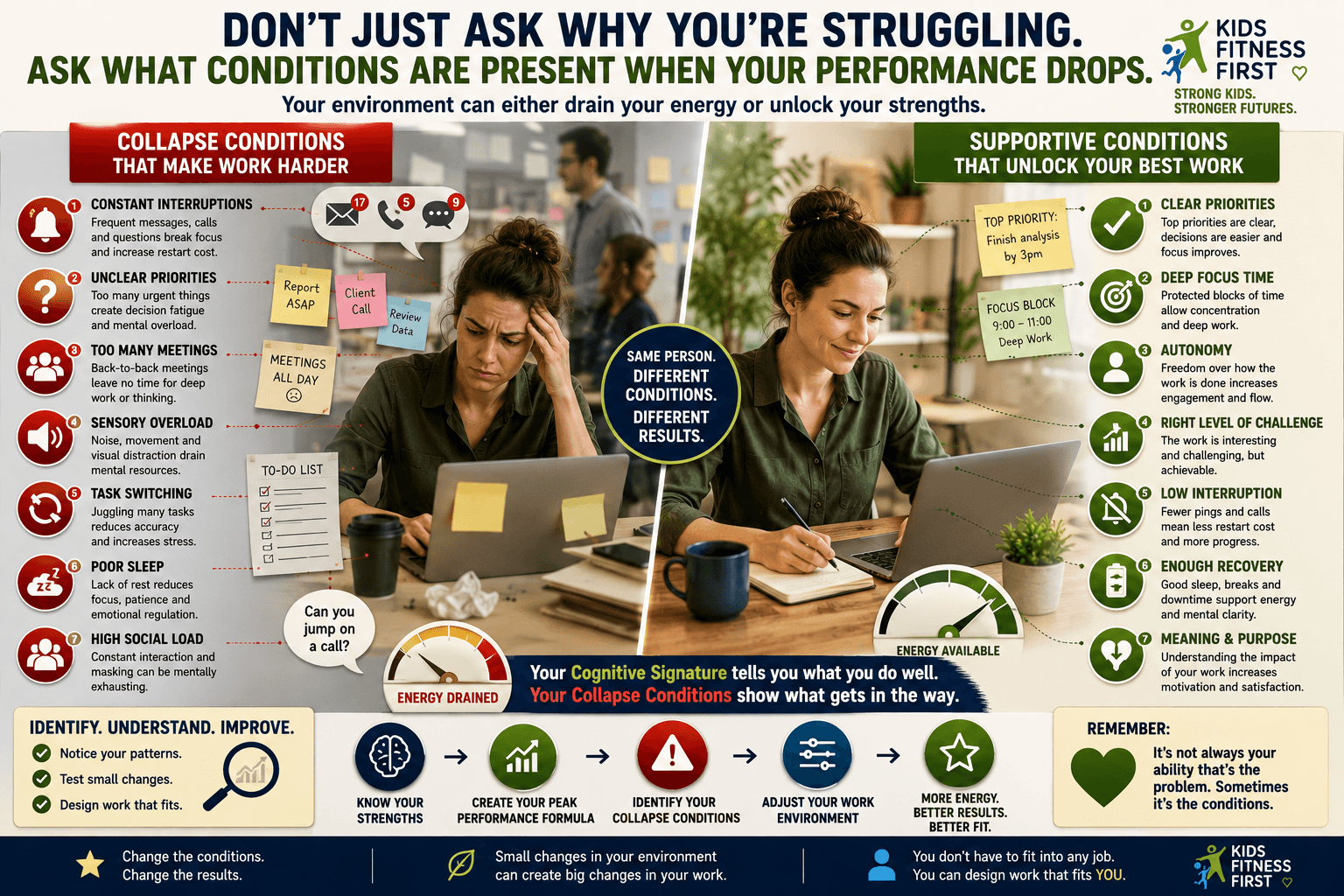
“What conditions are present when my performance drops?”
That question is central to Work That Fits.
Article 10 introduced your Cognitive Signature.
Article 11 explored your Peak Performance Formula.
Now Article 12 looks at the other side of the picture:
your collapse conditions.
This article focuses on identifying recurring barriers. For the broader environmental picture, see Adult ADHD and Work Environment; once a barrier is clear, our workplace accommodations guide looks at practical adjustments that may help.
What Are Collapse Conditions?
Collapse conditions are the recurring circumstances that make it much harder for you to access your normal strengths.
They do not necessarily cause total collapse.
Instead, they may produce:
slower thinking;
avoidance;
irritability;
difficulty starting;
poor concentration;
more mistakes;
exhaustion;
loss of confidence.
Therefore, a collapse condition is not simply something you dislike.
It is a condition that repeatedly changes how well you can function.
Adult ADHD and Workplace Struggles: Why Conditions Matter
Imagine that one of your strengths is problem-solving.
On Monday, you receive one clear problem.
You have ninety uninterrupted minutes.
As a result, you work brilliantly.
However, on Tuesday, you receive the same kind of problem while:
three people interrupt you;
your phone keeps ringing;
you have another meeting in twenty minutes;
your manager changes the priority twice.
Suddenly, the same skill becomes harder to access.
Therefore, the problem may not be your capability.
Instead, the environment may be blocking access to that capability.
Ability Is Not Always Available on Demand
People often assume that if you can do something once, you should be able to do it equally well at any time.
However, performance is more conditional than that.
For example, your ability to concentrate may change according to:
sleep;
noise;
stress;
task clarity;
time pressure;
social load;
energy;
interruptions.
Therefore, your working ability should not be judged without considering context.
Adult ADHD and Workplace Struggles: Constant Interruptions
One of the most common collapse conditions is repeated interruption.
You begin a task.
Then a message arrives.
Afterwards, a colleague asks a question.
Next, a meeting reminder appears.
Eventually, you return to the task.
However, you may no longer remember exactly where your thinking was going.
As a result, much of your energy is spent restarting.
Therefore, interruption can create much more difficulty than its visible duration suggests.
The Restart Cost
A five-minute interruption may not cost only five minutes.
Instead, it may also require another ten or fifteen minutes to rebuild concentration.
Therefore, several small interruptions can fragment an entire morning.
For example:
9:00 — begin report.
9:12 — message.
9:20 — return.
9:35 — colleague question.
9:45 — return.
10:00 — meeting.
By lunchtime, you may feel as though you have worked constantly.
However, the original report has barely moved.
That is restart cost.
Adult ADHD and Workplace Struggles: Unclear Priorities
Another collapse condition can be unclear prioritisation.
Suppose you are given five important tasks.
Then your manager says:
“Just get through as much as you can.”
That sounds flexible.
However, it may create hidden decision load.
Which task comes first?
What is genuinely urgent?
What will create a problem if it is late?
Therefore, unclear priorities can turn ordinary work into a continuous decision-making exercise.
A clearer instruction may reduce the mental load considerably.
Too Many Priorities Can Mean No Priority
When everything is urgent, nothing is clear.
For example:
Task A is important.
Task B is urgent.
Task C came from senior management.
Task D has a customer waiting.
Task E is already overdue.
As a result, your attention may repeatedly switch between them.
Therefore, one useful question is:
“What is the single most important thing right now?”
If nobody can answer that, the system may be creating unnecessary difficulty.
Adult ADHD and Workplace Struggles: Excessive Task Switching
Variety can be useful.
However, constant switching can be exhausting.
For example:
email;
spreadsheet;
customer call;
meeting;
report;
message;
presentation;
back to email.
Each switch requires your brain to leave one context and enter another.
Consequently, a day can feel busy without allowing enough depth for meaningful progress.
Therefore, notice whether your performance drops when the working day becomes highly fragmented.
Variety and Fragmentation Are Not the Same
A varied job may contain several interesting tasks.
However, those tasks can still be organised into sensible blocks.
Fragmentation is different.
Instead, it involves being pulled repeatedly between competing demands.
Therefore, you may enjoy variety while still struggling with constant context switching.
That distinction matters.
Adult ADHD and Workplace Struggles: Open-Plan Noise
For some people, background noise is manageable.
However, for others, conversation and movement continually attract attention.
You may hear:
a colleague laughing;
a phone ringing;
a printer starting;
somebody discussing lunch;
a meeting happening nearby.
None of those sounds may be important.
However, your attention still has to decide whether they matter.
Therefore, sensory filtering itself can become work.
Sensory Load Can Accumulate Quietly
Sensory overload does not always look dramatic.
Instead, it may appear gradually.
For example:
you become more irritable;
small sounds become harder to tolerate;
concentration becomes more fragile;
you start making mistakes;
you desperately want to leave.
Therefore, if your working ability consistently drops after several hours in a busy environment, sensory load may be part of the pattern.
Adult ADHD and Workplace Struggles: Too Many Meetings
Meetings can be useful.
However, excessive meetings can become a collapse condition.
For example, three one-hour meetings do not only consume three hours.
They may also break up the spaces between them.
As a result, your day becomes:
meeting;
small gap;
meeting;
small gap;
meeting.
Therefore, you may never reach a long enough period of uninterrupted concentration.
Meetings Can Have Hidden Costs
A meeting may require:
preparation;
social attention;
note-taking;
decision-making;
follow-up;
recovery.
Therefore, its real energy cost may be much larger than the calendar shows.
Likewise, if meetings occur throughout the day, they may repeatedly interrupt deeper work.
As a result, meeting density can become a major factor in workplace struggles.
Adult ADHD and Workplace Struggles: Social Load
Some jobs involve almost continuous interaction.
Customers.
Colleagues.
Managers.
Video calls.
Team chats.
For some people, this is energising.
However, for others, continuous social contact requires significant effort.
Therefore, do not assess social work only by whether you are good at it.
Also ask:
“What does it cost me?”
High Social Skill Does Not Mean Low Social Cost
You may be excellent with people.
For example, you may present confidently, manage difficult conversations and build strong relationships.
However, those abilities may still require substantial energy.
Therefore, a highly social role can be a poor fit even when your performance looks strong.
This is another example of the difference between competence and sustainability.
Adult ADHD and Workplace Struggles: Micromanagement
Micromanagement can create a specific kind of cognitive pressure.
You may know what needs doing.
However, somebody repeatedly checks:
Have you started?
Where are you up to?
Why did you do it that way?
Can you send an update?
Consequently, part of your attention moves away from the task and towards monitoring how you are being monitored.
Therefore, excessive oversight can increase both interruption and masking.
Autonomy Can Reduce Friction
Some people perform better when the outcome is clear but the method is flexible.
For example:
“Please complete this by Thursday afternoon.”
may create less pressure than:
“Do Step 1 at 9:00, Step 2 at 10:00 and send me an update after every stage.”
Therefore, if performance improves with appropriate autonomy, that condition belongs in your work profile.
Adult ADHD and Workplace Struggles: Vague Instructions
Vague instructions can create another hidden burden.
For example:
“Can you tidy this up?”
What does that mean?
Shorten it?
Correct errors?
Change the structure?
Rewrite it completely?
Therefore, the task becomes two tasks:
- work out what is wanted;
- complete the work.
As a result, uncertainty consumes energy before the actual work even begins.
Clear Outcomes Can Reduce Shutdown
Compare:
“Look at the presentation.”
with:
“Check the presentation for spelling errors and reduce it to ten slides by 3 pm.”
The second instruction is much clearer.
Therefore, if vague tasks consistently make starting difficult, ask for:
a clear outcome;
a deadline;
a priority;
specific criteria.
Clarity can reduce unnecessary cognitive load.
Adult ADHD and Workplace Struggles: Too Much Repetitive Work
Repetition can also become a collapse condition.
For example:
data entry;
routine processing;
repeated checks;
standard follow-up.
Some routine work is unavoidable.
However, if most of your role consists of low-stimulation repetition, engagement may become increasingly difficult.
Therefore, notice whether concentration improves dramatically when the work becomes more challenging or meaningful.
If it does, low stimulation may be an important part of the pattern.
Repetition Is Different From Predictability
Predictability can be useful.
You may appreciate knowing what happens next.
However, predictability does not require doing the same low-stimulation task all day.
Therefore, you can benefit from structure while still needing variety.
The goal is not chaos.
Instead, it may be stable structure with changing problems inside it.
Adult ADHD and Workplace Struggles: Lack of Meaning
Some tasks become much harder when their purpose is unclear.
For example, you may be asked to complete a report every Friday.
However, nobody seems to read it.
As a result, motivation can decline.
Therefore, ask:
“Who uses this work, and what decision does it support?”
Understanding the purpose may increase engagement.
However, if the task genuinely creates little value, frustration may also be reasonable.
Adult ADHD and Workplace Struggles: Poor Sleep
Not all collapse conditions exist inside the workplace.
Poor sleep can dramatically reduce access to focus, patience and emotional regulation.
Therefore, if work becomes noticeably harder after several bad nights, include sleep inside the analysis.
Likewise, if your job repeatedly forces late-night catch-up, then work and sleep may be reinforcing each other negatively.
Recovery Debt
Imagine that Monday takes more energy than Monday night restores.
Therefore, you begin Tuesday already depleted.
Tuesday creates more debt.
Likewise, Wednesday adds more.
By Friday, a relatively ordinary task may feel impossible.
Therefore, collapse may reflect accumulated recovery debt rather than the task alone.
Adult ADHD and Workplace Struggles: Emotional Pressure
Emotional conditions matter too.
For example:
conflict;
criticism;
uncertainty;
fear of mistakes;
job insecurity.
These conditions can consume attention even while you are trying to complete unrelated work.
As a result, less cognitive capacity remains available for the task itself.
Therefore, emotional safety belongs inside your workplace profile.
Fear Can Change Performance
Imagine that every small mistake receives an aggressive response.
Over time, you may begin checking everything repeatedly.
You hesitate.
Then you avoid decisions.
Consequently, performance may become slower even though your underlying ability has not changed.
Therefore, management style and psychological safety can directly affect working performance.
Adult ADHD and Workplace Struggles: Masking Pressure
Article 4 explored workplace masking.
Masking can become a collapse condition when too much energy is used to appear unaffected.
For example, you may hide:
restlessness;
confusion;
sensory discomfort;
the need for notes;
difficulty with interruptions.
As a result, some energy is spent doing the work while another part is spent hiding how difficult the conditions feel.
Therefore, heavy masking can make an otherwise manageable day much more expensive.
Notice the Combination Effect
Collapse conditions rarely appear one at a time.
Perhaps noise alone is manageable.
Likewise, meetings alone may be manageable.
However:
poor sleep + noise + three meetings + unclear priorities
may push you beyond your workable limit.
Therefore, look at combinations rather than searching for one single trigger.
Adult ADHD and Workplace Struggles: The Threshold Effect
Imagine your capacity as a container.
Every demand adds something:
noise;
interruptions;
meetings;
poor sleep;
social pressure.
Initially, you cope.
However, once the total demand crosses a certain threshold, performance drops sharply.
Therefore, the final interruption may appear to cause the problem.
In reality, it may simply be the last demand added to an already full system.
Do Not Judge the Final Straw Alone
Perhaps you become extremely frustrated because somebody asks:
“Can you quickly look at this?”
The request itself seems small.
However, it may arrive after:
four hours of interruption;
a difficult meeting;
no lunch;
poor sleep.
Therefore, the intensity of your reaction may make more sense when viewed in context.
That does not excuse inappropriate behaviour.
Instead, it provides information about overload.
Adult ADHD and Workplace Struggles: Build Your Collapse-Condition List
Create three categories.
LOW IMPACT
Conditions you can usually manage.
For example:
occasional background noise;
one unexpected call.
MEDIUM IMPACT
Conditions that increase difficulty.
For example:
several meetings;
moderate task switching.
HIGH IMPACT
Conditions that consistently cause performance to drop.
For example:
constant interruption;
unclear priorities;
heavy social load combined with poor sleep.
Therefore, the goal is not eliminating every irritation.
Instead, identify the conditions with the greatest effect.
Create a Collapse Conditions Evidence Bank
Use a simple table:
| Situation | Condition | What Happened | Energy Cost |
|---|---|---|---|
| Report deadline | Constant interruptions | Lost track repeatedly | High |
| Team day | 5 meetings | Little deep work completed | High |
| Quiet home day | Clear priorities | Strong output | Low |
| Client event | Heavy social load | Needed long recovery | High |
As a result, vague feelings become visible patterns.
Adult ADHD and Workplace Struggles: Find Your Top Three
You do not need a list of twenty problems.
Instead, identify the three conditions that consistently have the greatest impact.
For example:
- constant interruption;
- unclear priorities;
- meeting-heavy days.
Then focus improvement efforts there.
Therefore, workplace redesign becomes more targeted and less overwhelming.
The 10% Improvement Question
Ask:
“Which change would make this working day 10% easier?”
Perhaps:
one hour without interruption;
written priorities;
two fewer meetings;
a quieter workspace;
clearer instructions.
You may not be able to remove the whole problem.
However, even a partial improvement can provide valuable evidence.
Adult ADHD and Workplace Struggles: Test Before You Conclude
Suppose you believe:
“I cannot do this kind of work.”
Before accepting that conclusion, change one major condition if possible.
For example, complete the same type of task in a quiet environment.
Then compare.
If performance improves substantially, the task may not have been the primary issue.
Therefore, experiments can prevent inaccurate conclusions about ability.
Separate Collapse Conditions From Personal Failure
A difficult environment can create thoughts such as:
“I am useless.”
However, a more accurate statement might be:
“I struggle to perform detailed work while being interrupted every ten minutes.”
Those are very different conclusions.
Therefore, describe conditions precisely.
Precision makes problems easier to solve.
Adult ADHD and Workplace Struggles: Your 7-Day Collapse Audit
For seven working days, record:
1. Lowest Performance Period
When did work feel hardest?
2. What Were You Doing?
Name the task.
3. What Conditions Were Present?
For example:
interruptions;
noise;
unclear priorities;
meetings;
poor sleep;
social load.
4. Energy Before
Rate 1–10.
5. Energy Afterwards
Rate 1–10.
6. What Might Have Helped?
Name one realistic change.
At the end of the week, look for repetition.
Adult ADHD and Workplace Struggles: The Green, Amber and Red Condition Test
GREEN — Supportive Condition
The environment helps you function.
For example:
clear priorities;
enough focus time;
reasonable autonomy.
Therefore, protect these conditions where possible.
AMBER — Manageable but Costly
You can perform.
However, the condition increases effort or recovery needs.
Therefore, monitor and adjust it.
RED — Collapse Condition
The condition consistently reduces performance, increases masking or creates heavy exhaustion.
Therefore, this area deserves serious attention.
Your Collapse Condition Profile
Complete these statements:
MY PERFORMANCE DROPS WHEN…
I BECOME MOST DISTRACTED WHEN…
MY ENERGY FALLS FASTEST WHEN…
I STRUGGLE TO START WHEN…
I NEED THE MOST RECOVERY AFTER…
MY TOP THREE COLLAPSE CONDITIONS ARE…
ONE CHANGE THAT WOULD HELP IS…
This profile can sit beside your Cognitive Signature and Peak Performance Formula.
The Full Picture So Far
By Article 12, you now have three important pieces.
Cognitive Signature
What you do well.
Peak Performance Formula
The conditions that help you do it well.
Collapse Condition Profile
The conditions that make your performance harder to access.
Together, these form a much stronger picture of career fit.
Therefore, future decisions can move beyond job titles and salary alone.
Adult ADHD and Workplace Struggles: Use the Profile in Job Searches
When evaluating a future role, ask:
How often will I be interrupted?
How many meetings are typical?
How are priorities communicated?
How noisy is the environment?
How much autonomy is available?
What level of social interaction is expected?
Therefore, you can look for conditions before accepting the job rather than discovering them afterwards.
Use It in Interviews
You can also ask practical interview questions.
For example:
“How are priorities normally set in this team?”
“How meeting-heavy is a typical week?”
“How much uninterrupted time does this role normally have?”
“How much autonomy is there over how work is organised?”
Therefore, interviews become a two-way assessment of fit.
Adult ADHD and Workplace Struggles: Use Functional Language at Work
If you want to improve conditions, you do not always need to begin with a personal diagnosis.
For example:
Instead of:
“I cannot cope with interruptions.”
you might say:
“I produce more accurate work when I have an uninterrupted block for detailed tasks.”
Likewise:
“I work best when the top priorities are clear at the start of the day.”
This focuses on performance and practical conditions.
Do Not Try to Remove Every Difficulty
No workplace will eliminate all frustration.
There will still be:
meetings;
interruptions;
boring tasks;
busy periods.
Therefore, the goal is not a perfectly controlled environment.
Instead, it is reducing the conditions that repeatedly produce the largest performance cost.
That is a more realistic target.
Adult ADHD and Workplace Struggles: The Goal Is Better Fit, Not Zero Stress
Some challenge can be useful.
Likewise, occasional pressure may be manageable.
Therefore, the question is not:
“Can I eliminate every source of discomfort?”
Instead, ask:
“Can I create a working pattern where the difficult conditions do not dominate?”
That is a better measure of sustainability.
Reflection Questions
- When does your performance drop most sharply?
- Which types of interruptions affect you most?
- Does noise change how easily you concentrate?
- How much task switching occurs during an ordinary day?
- Do unclear priorities make starting harder?
- How meeting-heavy is your week?
- What is the energy cost of social interaction?
- How does poor sleep change your work?
- Which combinations of conditions create overload fastest?
- What are your three most important collapse conditions?
- Which one could realistically be reduced first?
- What condition do you need to protect because it consistently helps?
Conclusion: Identify the Conditions Before You Judge Yourself
Adult ADHD and workplace struggles can become much easier to understand when you stop treating every difficult day as evidence about your ability.
Sometimes the task is genuinely difficult.
However, sometimes the task is happening inside difficult conditions.
You may be dealing with:
constant interruptions;
unclear priorities;
sensory load;
heavy social demands;
micromanagement;
poor sleep;
too many meetings.
Therefore, rather than asking only:
“Why am I failing today?”
ask:
“What conditions are present today that make good performance harder to access?”
First, identify your strengths.
Then identify your peak-performance conditions.
Afterwards, identify your collapse conditions.
As a result, you begin building a much more accurate picture of the work that fits you.
Most importantly, remember:
A strength can still disappear from view when the environment makes it difficult to access.
Therefore, before deciding that you have lost your ability, examine the conditions.
Because sometimes the problem is not that your brain stopped working.
It is that the working conditions stopped helping it work well.
SUGGESTED INTERNAL LINKS
- Adult ADHD and Peak Performance: Discover the Conditions That Bring Out Your Best Work
- Adult ADHD and Peak Performance: Discover the Conditions That Bring Out Your Best Work
DISCLAIMER
This article is provided for general educational and informational purposes only. It does not provide medical, psychological, diagnostic, occupational-health, employment or legal advice.
ADHD and neurodivergent experiences vary considerably between individuals. Therefore, the workplace conditions discussed in this article should not be assumed to affect every person in the same way.
Likewise, changes in concentration, energy, mood or work performance can have many causes, including sleep difficulties, physical health, mental health, medication, stress and personal circumstances.
Therefore, persistent or significant difficulties should not automatically be attributed to ADHD or workplace conditions. Where appropriate, seek qualified professional advice.