When One Partner Changes Faster: The Growth Gap in Neurodivergent Relationships
A neurodivergent relationship growth gap can appear at a surprising moment.
Perhaps the relationship has finally begun improving.
One partner has started reading about ADHD.
They recognise their shame cycle.
Likewise, they have stopped apologising automatically and started asking more clearly for what they need.
Perhaps they have begun using calendars, reminders or written plans.
They now recognise overload earlier.
Therefore, they leave a noisy event before reaching breaking point.
They may also begin saying:
“I need ten minutes before we continue this conversation.”
Or:
“I can take responsibility for that, but I need it in the shared calendar.”
From the outside, this looks like progress.
And it is.
However, something unexpected can happen.
Their partner may not immediately experience the change as positive.
Instead, they may think:
“You never used to need this.”
“Why are there suddenly so many rules?”
“You seem more difficult since learning all this.”
Or even:
“Everything is about ADHD now.”
At the same time, the neurodivergent partner may think:
“I’m finally learning to understand myself. Why aren’t you pleased?”
Both people can feel confused.
Therefore, Article 19 explores a difficult but common relationship problem:
What happens when one person begins changing faster than the relationship around them?
Growth Can Disrupt a Relationship Before It Improves It
We usually describe personal growth as automatically positive.
For example:
- better boundaries;
- clearer communication;
- improved self-understanding;
- stronger accountability;
- more self-respect;
- and better nervous-system regulation.
Naturally, these can strengthen relationships.
However, personal change also alters established patterns.
Therefore, even healthy growth can initially create instability.
Imagine that one partner has always said yes to social events.
Now they begin saying:
“I can do one event this weekend, but not two.”
That is healthier self-advocacy.
However, perhaps the other partner has spent fifteen years relying on them to attend everything.
Consequently, the change creates practical and emotional consequences.
Likewise, perhaps one person previously took over every household task when their ADHD partner struggled.
Now the ADHD partner says:
“I want responsibility for this myself. Please stop reminding me and let the system remind me.”
Again, that may be healthy.
However, the other partner may feel anxious.
They may think:
“I’ve heard promises before. What if everything falls apart?”
Therefore, growth often changes more than the individual.
It changes the relationship system.
The Old Relationship Had an Architecture
Every long-term relationship develops roles.
Perhaps one person became:
the organised one.
Meanwhile, the other became:
the spontaneous one.
One became:
the emotional one.
The other became:
the calm one.
Perhaps one partner became the manager.
Meanwhile, the other became the person being managed.
These roles may not have been ideal.
Nevertheless, they became familiar.
Therefore, when one person changes, the old architecture begins moving.
The organised partner may no longer want to organise everything.
The apologetic partner may stop automatically saying sorry.
Likewise, the partner who previously tolerated overload may begin leaving earlier.
Consequently, the relationship experiences uncertainty.
This does not mean the change is wrong.
Instead, it means the relationship needs to update around it.
The Growth Gap
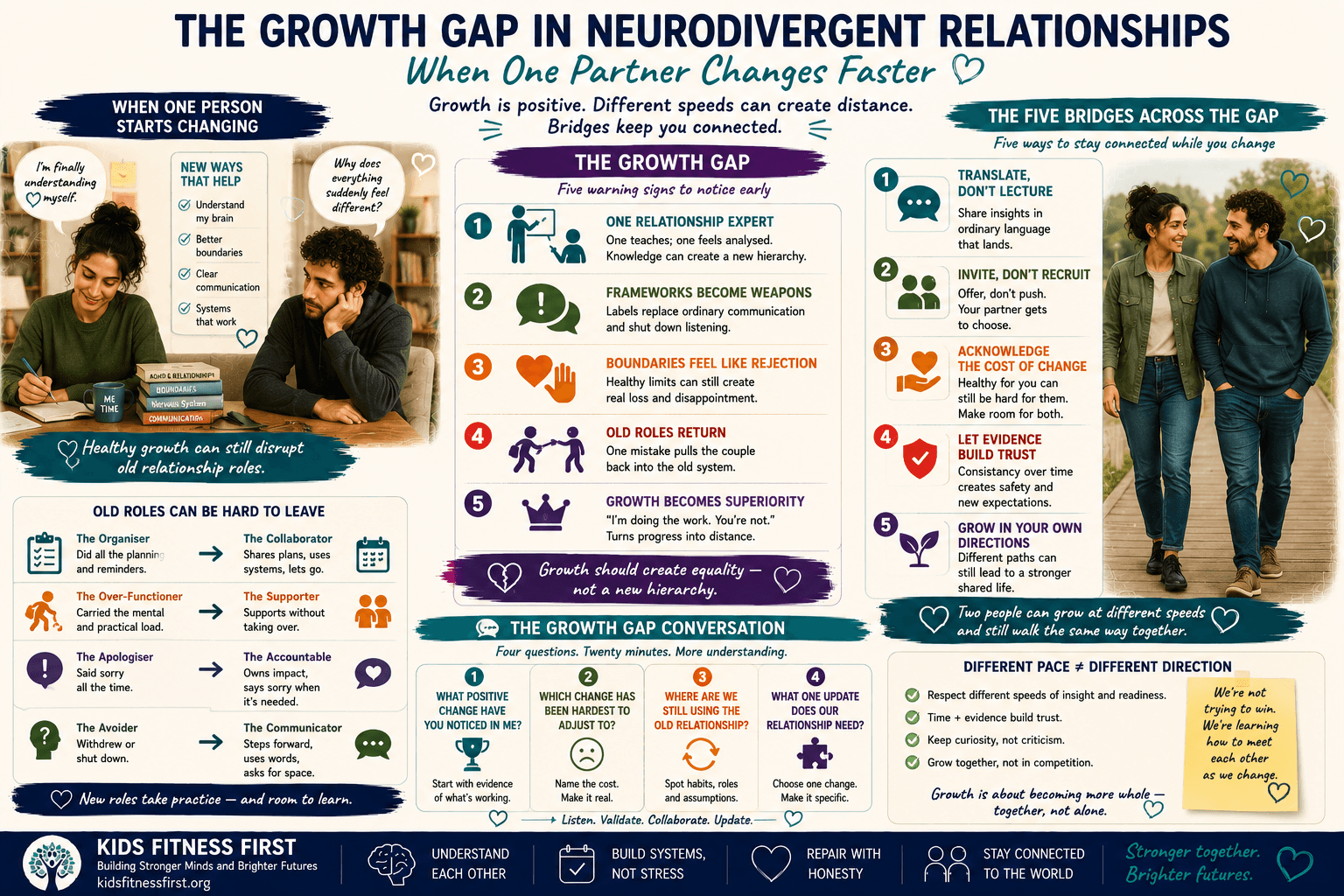
The Growth Gap appears when one partner changes their understanding, behaviour or boundaries significantly faster than the other partner adapts.
It may include differences in:
- self-awareness;
- knowledge about neurodivergence;
- willingness to use relationship frameworks;
- emotional language;
- boundary-setting;
- accountability;
- practical systems;
- or readiness to change old roles.
At first, one person may feel excited.
They finally have language.
They finally understand themselves.
However, their partner may feel left behind.
Therefore, the person who is growing may experience:
“Why won’t you come with me?”
Meanwhile, the other may experience:
“Why is everything suddenly changing?”
Neither experience should automatically be dismissed.
Five Signs a Growth Gap May Be Appearing
The Growth Gap often becomes visible through five patterns:
- One Person Becomes the Relationship Expert
- New Language Starts Feeling Like a Weapon
- Boundaries Are Experienced as Rejection
- Old Roles Fight to Re-Establish Themselves
- Progress Turns Into Superiority and Defensiveness
Recognising these signs early can prevent growth from becoming another source of conflict.
Sign 1: One Person Becomes the Relationship Expert
One partner reads the books.
They listen to podcasts.
Likewise, they learn terms such as:
- executive dysfunction;
- sensory overload;
- emotional dysregulation;
- masking;
- repair;
- invisible labour;
- Parent Trap;
- and nervous-system regulation.
Eventually, they understand the frameworks very well.
However, the relationship may quietly develop a new hierarchy.
Now one person is:
the informed one.
Meanwhile, the other becomes:
the person who needs educating.
This can create resentment.
For example:
“That’s just your shame cycle.”
“You’re doing the Parent Trap again.”
“You’re dysregulated.”
Perhaps the labels are technically accurate.
However, being analysed during conflict rarely feels like being understood.
Therefore, useful language can become harmful when it is used at somebody rather than with them.
Knowledge Should Increase Curiosity, Not Certainty
The more you learn about neurodivergence, the easier it can become to believe you know exactly what is happening.
However, frameworks are not mind-reading tools.
Therefore, instead of:
“You’re shutting down because you’re ashamed.”
try:
“You’ve gone quiet. Is shame part of what is happening, or do you need space?”
Likewise, instead of:
“That’s your ADHD talking.”
try:
“Is working memory making this difficult, or is something else going on?”
The second approach leaves room for the actual person.
Consequently, knowledge becomes a bridge rather than a verdict.
Sign 2: New Language Starts Feeling Like a Weapon
Relationship terminology can be useful.
However, once introduced, it can also become ammunition.
For example:
“You’re deflecting.”
“You’re over-functioning.”
“That’s invisible labour.”
“You’re crossing my boundary.”
“You’re dysregulated.”
Sometimes these descriptions may be correct.
Nevertheless, during a heated argument, they may sound like clinical accusations.
Consequently, the receiving partner may stop listening to the underlying concern.
Instead, they defend themselves against the label.
Therefore, a good rule is:
Use frameworks to understand patterns after the heat has reduced, not to win arguments while the heat is rising.
Translate Frameworks Back Into Ordinary Language
Instead of:
“You’re activating the Parent Trap.”
try:
“I’m starting to feel like I’m managing this for both of us again.”
Instead of:
“You’re deflecting.”
try:
“I don’t think my original concern has been answered yet.”
Likewise, instead of:
“That’s emotional dysregulation.”
try:
“This feels too intense for us to solve well right now.”
Ordinary language often lands better.
Therefore, learn the framework internally.
Then speak human externally.
Sign 3: Boundaries Are Experienced as Rejection
One of the biggest sources of Growth Gap tension is new boundaries.
Perhaps one person finally learns to say:
“I need to leave by nine.”
“I cannot discuss this when I’m exhausted.”
“I need one weekend day without social commitments.”
“I will not keep doing all the household administration.”
These boundaries may represent healthy self-advocacy.
However, the other partner may experience them as withdrawal.
They may think:
“You used to do this.”
Or:
“Why am I suddenly asking too much?”
The truth may be:
The old behaviour was never sustainable.
Perhaps it was maintained through masking, guilt, fear or over-functioning.
Therefore, when healthier limits appear, the relationship may initially feel like it is losing something.
In reality, it may be discovering the true cost that had previously been hidden.
A Boundary Can Create Real Loss
This is important.
Just because a boundary is healthy does not mean the other person’s disappointment is invalid.
Suppose one partner says:
“I cannot attend every large family event anymore.”
That may be necessary.
However, the other partner may genuinely grieve having their partner beside them at those events.
Both truths can coexist.
Therefore:
“I need this boundary.”
and:
“I understand this boundary costs you something.”
can both be true.
Mature growth makes room for both.
Boundaries Need Negotiation Around the Edges
For example:
Need: fewer large social events.
Possible negotiation:
- attend the most important ones;
- attend for a shorter period;
- travel separately so one partner can leave earlier;
- the other partner attends some events alone;
- or replace some large gatherings with smaller family contact.
The boundary remains.
However, the relationship still collaborates around it.
Therefore, healthy boundaries should create clarity, not unilateral disappearance.
Sign 4: Old Roles Fight to Re-Establish Themselves
Relationship roles are persistent.
Perhaps the neurodivergent partner has begun managing their own appointments.
However, their partner still says:
“Don’t forget your appointment tomorrow.”
Why?
Because years of experience taught them that reminders were necessary.
Likewise, perhaps the more organised partner has begun stepping back.
However, after one mistake, they immediately take everything over again.
The old system says:
“See? This is why we need to do things the old way.”
Consequently, one failure can erase months of experimentation.
That is how roles harden again.
Expect Some Mess During Role Change
If one adult is reclaiming responsibility, there may be mistakes.
Not dangerous ones.
Not catastrophic ones.
However, small recoverable mistakes may occur.
For example:
- an appointment needs rearranging;
- a shopping item is forgotten;
- a non-critical deadline is missed.
The managing partner may find this extremely uncomfortable.
However, adult responsibility requires room to learn.
Therefore, ask:
“Is this mistake safe enough for the new system to learn from?”
If yes, redesign.
Do not immediately return to supervision.
Otherwise, the relationship may never escape the old role structure.
Sign 5: Progress Turns Into Superiority and Defensiveness
Growth can produce pride.
That is understandable.
Perhaps one person has worked hard.
They have changed patterns that felt impossible for years.
However, progress can become relationally dangerous if it turns into:
“I’m doing the work. You’re not.”
The other partner may then respond defensively:
“Everything is always my fault now.”
Consequently, both stop growing.
One becomes superior.
The other becomes resistant.
Therefore, the goal is not:
“Who is more evolved?”
Instead:
“Is the relationship becoming more workable for both people?”
That is the only useful measure.
Never Use Therapy-Speak as a Status Symbol
Knowing more psychological vocabulary does not automatically mean behaving more relationally.
In fact, a person can know every framework and still:
- avoid accountability;
- dismiss their partner;
- become controlling;
- or use sophisticated language to prove themselves right.
Therefore, ask:
“Is my knowledge making me kinder, clearer and more responsible?”
If not, the knowledge is not yet becoming wisdom.
The Five Bridges Across the Growth Gap
The Growth Gap does not need to become permanent.
Five practices can help:
- Translate, Don’t Lecture
- Invite, Don’t Recruit
- Acknowledge the Cost of Change
- Let Evidence Build Trust
- Keep Both People Growing in Their Own Direction
Bridge 1: Translate, Don’t Lecture
If you discover something useful, resist delivering a forty-minute explanation unless your partner wants one.
Instead, translate the insight into one practical sentence.
For example:
Rather than:
“I read that ADHD working-memory impairments mean prospective memory is affected…”
say:
“If an arrangement matters, I need us to put it into the calendar immediately.”
The second sentence gives your partner something actionable.
Likewise:
Instead of explaining sensory-processing theory for twenty minutes, say:
“Large restaurants drain me quickly. Could we choose somewhere quieter?”
Knowledge should make communication simpler.
Not heavier.
Bridge 2: Invite, Don’t Recruit
You may become enthusiastic about what you are learning.
Naturally, you want your partner to understand it too.
However, constant recommendations can feel like pressure.
For example:
“You need to read this.”
“Listen to this podcast.”
“You should do this exercise.”
“Why haven’t you watched that video?”
Eventually, the partner may resist the subject itself.
Therefore, offer rather than recruit.
Try:
“I found something that helped me understand what happens during our arguments. Would you like the short version?”
Now they can say yes or no.
Autonomy matters on both sides.
Bridge 3: Acknowledge the Cost of Change
Perhaps your new boundary improves your nervous-system health.
However, it may increase your partner’s responsibilities in another area.
Perhaps moving out of the Parent Trap means the managing partner must tolerate more uncertainty.
Likewise, a new communication system may initially feel less spontaneous.
Therefore, say:
“I know this change affects you too.”
That sentence can be powerful.
Growth becomes easier to support when the other person’s adaptation is recognised.
Bridge 4: Let Evidence Build Trust
If your partner has experienced years of broken promises, they may not immediately trust your new system.
That is understandable.
Therefore, do not demand instant belief.
Instead, produce evidence.
For example:
You say:
“I will take responsibility for the appointments.”
Then do it.
Again.
And again.
Likewise:
“If I take space during conflict, I will return within thirty minutes.”
Then return.
Over time, behaviour updates the relationship’s expectations.
Therefore, allow trust to grow at the speed of evidence.
Bridge 5: Keep Both People Growing in Their Own Direction
Growth does not require both partners to study the same material.
Perhaps one person needs to work on:
- shame;
- executive systems;
- or self-advocacy.
Meanwhile, the other may need to work on:
- over-functioning;
- resentment;
- boundaries;
- or rebuilding their individual social life.
These are different directions.
However, both may strengthen the same relationship.
Therefore, do not measure growth by sameness.
Measure it by whether each person is becoming more capable of participating as a whole adult.
The Growth Gap at a Glance
| Growth Gap Problem | What Often Happens | Better Direction |
|---|---|---|
| One relationship expert | One teaches, one is taught | Stay curious; ask before interpreting |
| Frameworks become weapons | Labels replace communication | Translate into ordinary language |
| Boundaries feel like rejection | Healthier limits create loss | Recognise cost and negotiate around edges |
| Old roles return | One mistake restores the old system | Allow safe learning and redesign |
| Growth becomes superiority | “I’m doing the work; you’re not” | Focus on relationship function, not status |
What If Your Partner Does Not Want to Change?
This is one of the hardest questions.
Perhaps you genuinely change.
You take responsibility.
You communicate more clearly.
Likewise, you improve systems and stop repeating old behaviours.
However, your partner refuses every attempt to change the relationship.
What then?
First, distinguish between:
different pace
and
complete refusal.
Someone may need more time.
Likewise, they may dislike your terminology while still participating practically.
That is different from refusing accountability, communication or reasonable negotiation altogether.
Therefore, ask:
“Are they resisting my method — or resisting all change?”
Those are not the same.
Respect Different Paces, But Notice Permanent Stagnation
Relationships do not require both people to develop at identical speed.
However, a partnership becomes difficult when only one person is willing to adapt indefinitely.
Therefore, over time, ask:
- Can both people acknowledge problems?
- Can both participate in practical changes?
- Can both repair?
- Can both make room for each other’s needs?
- Can both reconsider old roles?
If the answer remains consistently no, the Growth Gap may represent something deeper than different learning speeds.
At that point, outside support may be useful.
Reflection: How Has Growth Changed Your Relationship?
Do this separately.
Then compare answers.
What Have You Changed in the Last Year?
List three things.
Perhaps:
- you apologise less;
- use better reminders;
- recognise overload;
- leave social events earlier;
- set boundaries;
- repair more cleanly;
- or ask directly for support.
Then ask:
“Which change am I proudest of?”
Recognition matters.
Which Change Has Cost Your Partner Something?
This does not mean the change was wrong.
Instead, look honestly at the adjustment required from them.
Perhaps your new social boundary means they attend more events alone.
Likewise, your refusal to accept constant reminders means they must tolerate uncertainty.
Complete:
“A healthy change I made that may still have been difficult for my partner is…”
Then ask them whether your understanding is accurate.
Where Are You Still Using Old Roles?
Perhaps you still assume:
“You’re the organised one.”
Or:
“You’re the sensitive one.”
Likewise:
“You always handle money.”
“You don’t do paperwork.”
Ask:
“Is this role still true, or have we simply stopped checking?”
Are You Using Any Framework Against Each Other?
Be honest.
Have phrases such as:
- shame cycle;
- Parent Trap;
- overload;
- invisible labour;
- boundary;
- deflection;
- or neurodivergence
become accusations during arguments?
If yes, complete:
“The ordinary-language version of what I’m actually trying to say is…”
For example:
Instead of:
“You’re deflecting.”
write:
“I still need you to answer the concern I raised.”
That is usually more useful.
Do You Feel Left Behind by Your Partner’s Growth?
This question matters for the partner who may have adapted more slowly.
Perhaps you feel:
- criticised;
- analysed;
- overwhelmed by terminology;
- worried that the relationship is changing;
- or afraid you no longer know the rules.
Complete:
“The change that has been hardest for me to understand is…”
Then:
“What I need in order to adapt is…”
Perhaps:
time.
less jargon.
clear examples.
reassurance.
evidence.
a chance to negotiate.
These needs deserve language too.
Are You Becoming More Equal or Simply Reversing the Hierarchy?
This is an important question.
Perhaps the previously managed partner has become very knowledgeable.
Now they correct the former manager constantly.
The hierarchy has changed direction.
However, equality has not arrived.
Therefore, ask:
“Are we moving towards adult-and-adult, or have we simply changed who gets to be the expert?”
That distinction matters.
Reflection Takeaway
Complete:
“Growth should help us become more equal, more accurate and more connected. Therefore, the next change I want to make is…”
Keep it specific.
For example:
“I will stop using framework labels during arguments.”
Or:
“I will explain my boundary without expecting immediate agreement.”
Or:
“I will give the new system three months of evidence before deciding it has failed.”
One change is enough.
Try This: The Growth Gap Conversation
Set aside twenty minutes.
Use four questions only.
Question 1: What Change Have You Noticed in Me?
Each person asks:
“What is one positive change you’ve noticed in me?”
Listen.
Do not minimise it.
Do not reply:
“Yes, but…”
Simply say:
“Thank you.”
This begins the conversation with evidence that growth is already happening.
Question 2: Which Change Has Been Hardest to Adjust To?
Each person answers.
For example:
“Your new social boundaries have been hard for me.”
Or:
“It’s difficult when you stop me reminding you because I still worry the task won’t happen.”
Do not immediately defend.
Instead, say:
“I can understand why that adjustment is difficult.”
Recognition does not cancel the change.
Question 3: Where Are We Still Using the Old Relationship?
Ask:
“What role or habit are we still repeating even though one or both of us have changed?”
Perhaps:
- reminders;
- apologising;
- over-explaining;
- assuming silence means anger;
- social compromises;
- or one person carrying all planning.
Choose one.
Question 4: What One Update Does the Relationship Need?
For example:
“We need to update our social rule.”
“We need clearer ownership of appointments.”
“We need to stop using labels in conflict.”
“We need to review how I take space and return.”
Write the answer down.
Then stop.
Do not redesign the entire relationship.
The goal is one update.
The Person Who Changes First Cannot Change the Relationship Alone
This is both obvious and easy to forget.
One person can:
- improve communication;
- take responsibility;
- create systems;
- set healthier boundaries;
- and change their own responses.
However, they cannot single-handedly create mutuality.
Therefore, personal growth matters enormously.
Nevertheless, relationship growth eventually requires two participants.
That does not mean both must be equally enthusiastic.
However, both must be capable of some form of collaboration.
Otherwise, one person eventually becomes exhausted from trying to redesign a two-person system alone.
Do Not Delay Your Own Growth to Keep the Relationship Comfortable
There is another side.
Some people recognise the Growth Gap and become frightened.
Therefore, they stop changing.
They think:
“If I set this boundary, my partner will be upset.”
Or:
“If I stop apologising, they’ll think I’m selfish.”
Consequently, they return to old patterns simply to preserve familiarity.
However, a relationship that only works when one person remains unhealthy is not genuinely stable.
Therefore, the aim is not to stop growth.
Instead, bring the relationship into the change as thoughtfully as possible.
Growth with communication is usually easier than growth delivered as a sudden new set of unexplained rules.
When Diagnosis Accelerates the Growth Gap
A late ADHD, autism or dyslexia diagnosis can accelerate change dramatically.
Suddenly, one person has a new explanation for decades of experience.
They may read everything.
They rethink childhood.
Likewise, they reconsider work, parenting, relationships and identity.
Meanwhile, their partner may still be adjusting to the original diagnosis.
Therefore, the diagnosed person may feel:
“Everything finally makes sense.”
while their partner feels:
“Everything suddenly seems different.”
Both experiences are understandable.
Therefore, diagnosis should ideally become a shared learning process without requiring both people to process it at identical speed.
Leave Room for Grief Around Change
Sometimes growth means accepting that an old version of the relationship is ending.
Perhaps the partner who always attended every social event will no longer do so.
Maybe the person who handled all administration is stepping back.
Likewise, spontaneous conversations may become more scheduled because scheduled communication works better.
There may be genuine grief in those changes.
Therefore, do not force every loss into a positive narrative.
You can say:
“This new arrangement is healthier, and I still miss part of the old one.”
Both can be true.
That honesty often makes adaptation easier.
Evidence Matters More Than Promises
This principle runs throughout Book Five.
Perhaps you say:
“I’m different now.”
Your partner may not immediately believe you.
That can hurt.
However, perhaps they have heard similar promises before.
Therefore, rather than arguing for recognition, allow changed behaviour to accumulate.
If you now return after conflict, keep returning.
If you now own a responsibility, keep owning it.
Likewise, if your boundary has changed, communicate it consistently rather than unpredictably.
Eventually, evidence creates a new story.
That is how relationship architecture updates.
Conclusion: Grow Without Leaving Each Other Behind
A neurodivergent relationship growth gap can appear precisely because something positive is happening.
One person begins to understand themselves.
They change.
They advocate.
They repair.
They stop carrying shame.
Perhaps they build better systems.
However, the relationship may still be organised around the person they used to be.
Therefore, tension appears.
The answer is not to stop growing.
Likewise, the answer is not to drag your partner through your growth at your pace.
Instead:
Translate rather than lecture.
Invite rather than recruit.
Recognise the cost of change.
Let evidence build trust.
Allow both people to grow in different directions.
Most importantly, remember:
Growth is not proven by how much language you know.
It is proven partly by what your growth does to the way you treat the person beside you.
Are you more curious?
More accountable?
More respectful?
More capable of saying what you need without attacking?
More able to see your partner as another whole adult rather than a problem to solve?
If so, the relationship is not being left behind.
It is learning how to grow around the people both of you are becoming.
And that may be one of the most important forms of long-term love:
not demanding that your partner remain who they were when you first understood them.
Instead, continuing to meet them again as they change.
SUGGESTED INTERNAL LINKS
Article 5: Rebuilding Connection After Survival Mode: How Neurodivergent Couples Find Their Way Back
Article 8: Communication in Neurodivergent Relationships: 4 Principles That Make Conversations Land
DISCLAIMER
This article is provided for general educational and informational purposes only. It is not medical, psychological, diagnostic, relationship or couples-therapy advice.
Neurodivergent people and relationships vary considerably. Therefore, partners should not assume that a disagreement about change necessarily reflects resistance, pathology or lack of care.
Likewise, psychological or neurodivergence-related terminology should not be used to diagnose, control or dismiss another person during conflict.
Where one or both partners experience persistent serious conflict, coercion, intimidation, emotional abuse or difficulty adapting safely to major relationship changes, appropriately qualified professional support may be necessary.