
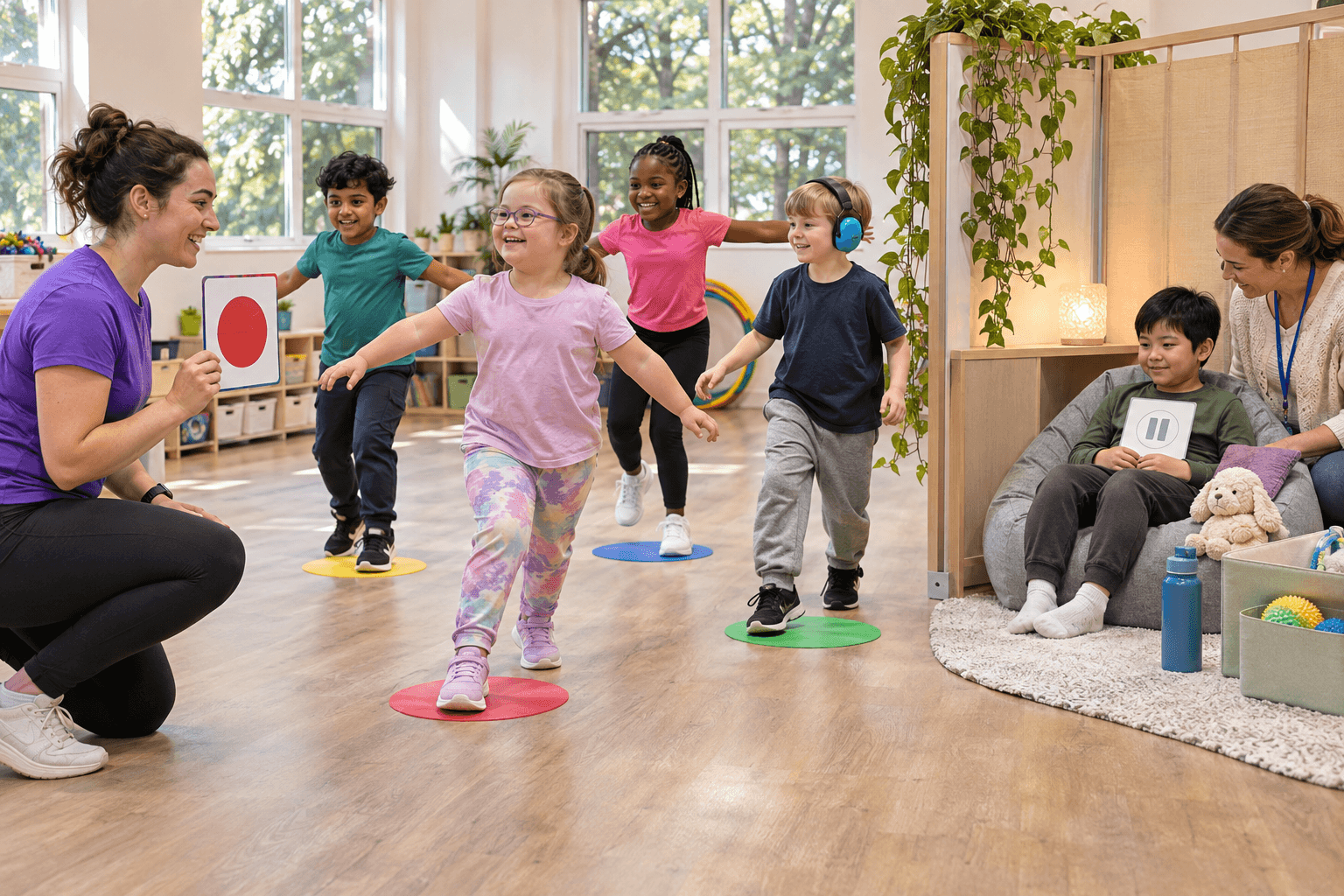
Group games can be exciting, but noise, movement, changing rules and busy spaces can sometimes feel overwhelming. A child who enjoys an activity one moment may need a quieter space the next. Having a simple pause-and-return plan allows children to take a break without feeling they have failed or missed their chance to participate.
The aim is to make breaks a normal part of group play. Children should know they can pause, observe or rejoin when comfortable, without having to explain themselves in front of others. This approach can support children with different sensory, communication and movement needs.
Why a pause-and-return plan matters
Every child experiences sensory information differently. Some enjoy lively music and fast movement, while others find unexpected sounds, bright lights or crowded spaces uncomfortable.
A child may need a break because they feel tired, distracted, anxious or overwhelmed. Taking time away from an activity does not necessarily mean they dislike it.
The National Autistic Society’s guidance on sensory processing explains why understanding individual sensory experiences and providing quieter spaces can be helpful.
A predictable approach makes it easier for children to recognise their needs and participate in ways that suit them.
Create a simple four-step pause-and-return plan
1. Agree on a pause signal
Before beginning a game, show children how they can request a break.
They might say “pause”, raise a hand, point to a picture card or use an agreed gesture. Children who communicate without speech should have an equally accessible option.
Explain that nobody needs to give a reason for taking a break.
Allow children to practise the signal while everyone is calm, so they understand how it works before they need it.
2. Provide a comfortable break space
Choose a quieter area away from the busiest part of the activity.
This might be a chair beside the room, a comfortable mat or a separate supervised space. Make sure the area is accessible, with sufficient room for mobility equipment.
Offer simple choices such as sitting quietly, watching the game or using a familiar sensory item.
Avoid introducing unfamiliar equipment or expecting every child to find the same things calming.
A break should never be treated as punishment or isolation. Maintain appropriate supervision and follow the child’s established support arrangements.
3. Keep the activity predictable
A child taking a break should not feel that the whole game has changed while they were away.
Explain what will happen next using short instructions, gestures or pictures. Where possible, keep the rules consistent and avoid unexpected loud signals.
For example, an adult might quietly explain:
“The group is still playing the colour game. You can watch, help choose a colour or join the next round.”
There is no need to repeatedly ask whether the child is ready to return. Give them time and space.
4. Offer a gentle way back
Returning to an activity should be a choice, not a requirement.
A child might prefer to watch one round, hold a marker, choose the next instruction or participate alongside a trusted partner before joining the full group.
Others may decide not to return during that session. That is acceptable.
Avoid drawing attention to the child’s return with applause, questions or public praise unless you know they welcome that attention.
The important outcome is that children feel included and retain control over how they participate.
Five ways to make group games easier to rejoin
Small adjustments can make a difference without changing the purpose of the activity.
- Use familiar rules. Keep instructions simple and demonstrate movements before starting.
- Offer different participation roles. Children can move, point, observe, choose colours or guide a partner.
- Avoid elimination games. Nobody should lose their opportunity to participate because they need a break.
- Provide visual reminders. Pictures or simple cards can help children understand what happens next.
- Keep transitions gentle. Give advance notice when activities are changing and allow enough time to respond.
These adjustments can be particularly helpful during movement games involving music, changing positions or group instructions.
For related ideas, explore our sensory-friendly physical activities for autistic children and inclusive seated movement games.
A practical example: The colour movement game
Imagine a group playing a simple game where each colour represents a movement.
- Red means opening and closing hands.
- Blue means gently moving shoulders.
- Yellow means reaching comfortably to one side.
A child begins to find the group noise uncomfortable and shows their agreed pause card.
The adult acknowledges the signal calmly and allows the child to move to the supervised quiet area.
The game continues without comment.
A few minutes later, the child watches the other players. An adult offers the option of choosing the next colour, joining the movement or continuing to watch.
The child chooses yellow and participates through a small hand movement.
There is no race to return, no expectation to complete every action and no need to explain the break.
Help children understand that breaks are normal
Introduce the pause-and-return system to the whole group rather than presenting it as a special rule for one child.
Explain that everyone sometimes needs time to rest, think or feel comfortable.
Adults can model this by offering short pauses between activities and reminding children that watching can also be a valid way to participate.
UK NHS-linked Healthier Together sensory-processing guidance also highlights the value of predictable routines, clear communication, quieter spaces and appropriate movement breaks.
Different children will need different approaches. Ask children and their families or support teams what works best, particularly where individual care or support plans are already in place.
Notice comfort and participation, not speed
After a session, consider whether children understood their choices, had access to a suitable break space and felt comfortable returning or remaining observers.
A successful session does not require every child to participate continuously.
Some children may stay involved for the entire game. Others may take several breaks or prefer to observe. What matters is creating an environment where each child is respected and can take part safely.
Takeaway: A pause-and-return plan helps make sensory-friendly group games more predictable, flexible and inclusive. When children know they can step away and return without pressure, group activities can become more comfortable and welcoming for everyone.