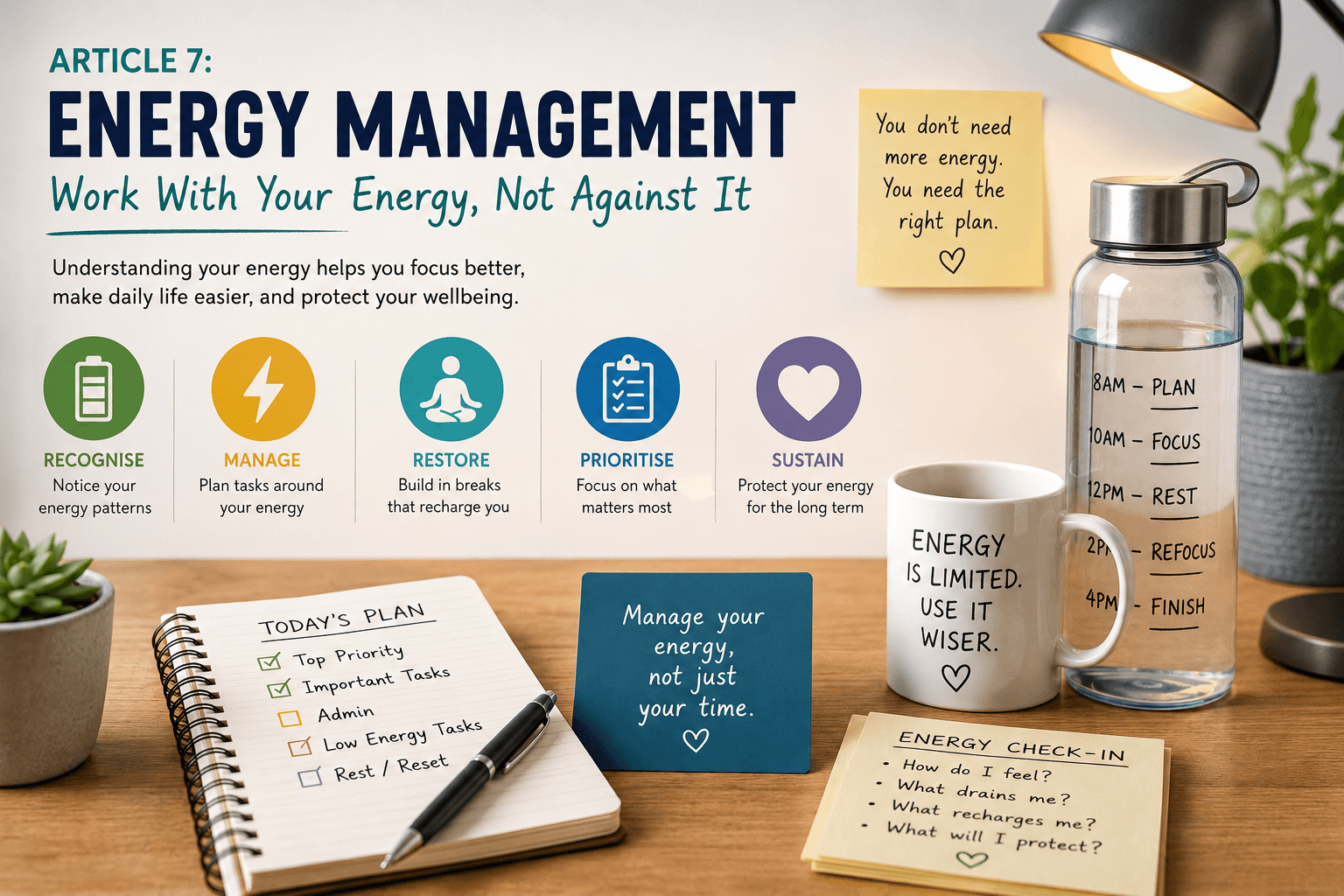
Adult ADHD and Energy Management: How to Work With Your Natural Rhythm
Adult ADHD and energy management can have a major effect on how manageable a day feels.
You may have enough time to complete a task.
However, that does not always mean you have enough mental energy to do it well.
Perhaps you sit down to deal with something important at 4 pm.
The time is available.
The task is clear.
Yet your concentration has disappeared.
You read the same sentence several times.
You check your phone.
You get up for a drink.
Eventually, something that might have taken twenty minutes earlier in the day takes an hour.
Then frustration appears.
“Why can’t I just get this done?”
However, perhaps the problem is not the amount of time available.
Perhaps the problem is the amount of usable energy available at that particular moment.
That distinction matters.
Time management asks:
“When can I fit this in?”
Energy management asks:
“When am I most able to do this well?”
Both questions are useful.
However, for many adults, the second one is often overlooked.
Why Adult ADHD and Energy Management Matter
Not every hour of the day feels the same.
Some periods may bring stronger concentration.
At other times, your mind may feel slower or more easily distracted.
Energy can also change depending on:
- sleep;
- stress;
- food;
- physical activity;
- workload;
- interruptions;
- social demands;
- the type of task;
- how interesting something feels.
Therefore, expecting the same level of performance throughout the entire day may be unrealistic.
Instead, begin noticing your natural rhythm.
When do you usually think most clearly?
When does starting feel easier?
When do you become restless?
When does concentration drop?
These patterns can provide useful information.
Time and Energy Are Not the Same Thing
Imagine your calendar shows two free hours.
On paper, that looks like useful working time.
However, perhaps those two hours come after:
Three meetings.
Several difficult conversations.
A busy morning.
A long journey.
Your calendar is empty.
Your mental energy may not be.
This is why traditional planning can sometimes fail.
It measures available time but ignores available capacity.
Therefore, adult ADHD and energy management should consider both.
A demanding task needs more than an empty space in the diary.
It also needs enough attention and mental energy to complete it.
Start by Tracking Your Energy
Before changing your schedule, observe it.
For several days, notice your energy at different times.
You do not need a complicated system.
Simply rate your energy:
High
Medium
Low
For example:
8:00 am — Medium
10:00 am — High
1:00 pm — Medium
3:30 pm — Low
7:00 pm — Medium
Do this for a few ordinary days.
Then look for patterns.
Perhaps your strongest period appears between 9 am and 11 am.
Maybe evenings are better.
Alternatively, your energy may change significantly from day to day.
The aim is not to force a pattern.
It is to discover whether one already exists.
Identify Your High-Energy Tasks
Not every task requires the same amount of energy.
Some activities need concentration, decision-making and creativity.
Others are simpler.
High-energy tasks might include:
- writing;
- planning;
- problem-solving;
- difficult conversations;
- important financial decisions;
- complex paperwork;
- learning something new;
- creative work.
These tasks deserve your stronger periods where possible.
Therefore, instead of filling your best hours with routine emails, consider protecting them for work that genuinely needs your attention.
Identify Your Low-Energy Tasks
Other tasks require less concentration.
For example:
- filing;
- simple email replies;
- organising documents;
- straightforward household jobs;
- basic shopping;
- routine admin;
- preparing materials;
- updating lists.
These tasks still matter.
However, they may fit better into lower-energy periods.
As a result, you are not demanding peak concentration for work that does not need it.
Match the Task to the Energy
This is one of the simplest changes you can make.
Rather than asking:
“What time should I do this?”
try:
“What level of energy does this task need?”
Then match the two where possible.
For example:
High Energy
Write proposal.
Solve problem.
Prepare presentation.
Make important decision.
Medium Energy
Meetings.
Routine emails.
Planning.
Household admin.
Low Energy
Filing.
Simple tidying.
Preparing tomorrow’s materials.
Checking straightforward information.
This does not need to become rigid.
Instead, it gives you another way to organise the day.
Protect Your Best Hours
Once you identify your stronger periods, be careful what you put inside them.
It is easy to spend your best energy on:
Email.
Social media.
Minor admin.
Unnecessary meetings.
Small errands.
By the time the important task appears, your strongest period has gone.
Therefore, consider protecting part of your high-energy window.
For example:
9:00–10:30 → priority work
Emails wait until afterwards.
This does not mean ignoring other responsibilities.
Instead, you are deliberately using your strongest attention for the work that benefits most from it.
Adult ADHD and Energy Management at Work
Workplaces often organise people around clock time.
Meetings happen at fixed hours.
Emails arrive continuously.
Deadlines do not always respect natural energy.
Therefore, you may not have complete control.
However, small adjustments can still help.
For instance:
Schedule difficult work before routine admin where possible.
Batch meetings rather than spreading them throughout the day.
Keep one period free from notifications.
Prepare the next day’s priority before leaving.
Use lower-energy periods for simpler tasks.
Even partial control can make a difference.
Meetings Can Cost More Energy Than Their Length Suggests
A one-hour meeting does not always cost only one hour.
You may need time beforehand to prepare.
During the meeting, you concentrate, respond and process information.
Afterwards, your brain may need time to reset.
Therefore, three meetings spread across a day can consume much more energy than their calendar blocks suggest.
This is especially important when planning demanding work around meetings.
If possible, avoid placing your most difficult task immediately after several intense conversations.
Instead, allow some recovery space.
Social Energy Counts Too
Energy is not only physical.
Social interaction also uses mental resources.
For some people, meetings, telephone calls or busy environments can be energising.
For others, they can be draining.
Therefore, notice your own pattern.
Perhaps you enjoy social interaction but need quiet afterwards.
Maybe working alone for too long reduces your energy.
There is no correct answer.
The goal is simply to recognise the cost and benefit of different activities.
Once you understand the pattern, you can plan more realistically.
Decision-Making Uses Energy
Every decision uses some mental capacity.
What should I do first?
Should I answer this now?
What should I eat?
Which option is best?
Where should I put this?
Many small decisions can quietly drain energy.
Therefore, simplify repeated choices.
For example:
Choose tomorrow’s clothes tonight.
Keep several regular meal options.
Use one main calendar.
Decide tomorrow’s first task before finishing today.
Create fixed homes for important items.
These changes reduce the number of decisions competing for your attention.
Protect Energy by Reducing Daily Friction
This connects directly with the previous articles in this series.
If you spend ten minutes searching for keys, that uses energy.
If the desk must be cleared before work starts, that uses energy.
If you constantly switch tasks, that uses energy.
If every object has an unclear home, that uses energy.
Therefore, energy management is not only about rest.
It is also about removing unnecessary drains.
A smoother environment can preserve energy for things that genuinely matter.
Notice Your Energy Leaks
An energy leak is something that repeatedly uses more energy than it should.
For example:
Constant notifications.
Repeated arguments.
Searching for things.
Unclear priorities.
Too many commitments.
Unfinished tasks.
Clutter.
Long meetings.
Trying to remember everything.
Individually, each leak may seem manageable.
Together, however, they can leave very little energy for meaningful work.
Therefore, ask:
“What drains me repeatedly without giving much back?”
That question can reveal useful changes.
Use a Daily Energy Budget
Imagine your available energy as a budget.
You would not spend all your money before lunch and then expect the rest of the day to cost nothing.
Yet people often do exactly that with energy.
A morning may contain:
Exercise.
Household jobs.
A difficult meeting.
Several calls.
Email.
Then an important project is scheduled for the afternoon.
By then, the budget may already be low.
Therefore, think ahead.
If one part of the day will be demanding, reduce unnecessary demands elsewhere.
This creates balance.
Do Not Spend High Energy on Low-Value Tasks
This can happen easily.
You wake feeling clear and focused.
Then you spend an hour:
Checking messages.
Reading news.
Browsing social media.
Answering minor emails.
By the time you begin the important work, the strongest energy has already been spent.
Therefore, ask:
“What deserves my best attention today?”
Start there where practical.
You can deal with the smaller tasks later.
Create a Minimum Version for Low-Energy Days
Not every day will follow the plan.
Some mornings begin badly.
Perhaps you sleep poorly.
Maybe stress is high.
You may simply feel flat.
Therefore, important routines need smaller versions.
For example:
Normal exercise: 30 minutes.
Low-energy version: 10-minute walk.
Normal planning: review the whole week.
Low-energy version: check tomorrow.
Normal work target: complete full section.
Low-energy version: write the opening paragraph.
The smaller version keeps direction without demanding energy you do not currently have.
Low Energy Does Not Mean No Progress
This is important.
Many people use an all-or-nothing standard.
If they cannot complete the full task, they do nothing.
However, a smaller action still moves things forward.
Ten minutes of paperwork is better than waiting three weeks for the perfect afternoon.
One paragraph is still progress.
Preparing materials today may make tomorrow easier.
Therefore, adjust the amount of work rather than abandoning the direction entirely.
Build Recovery Into the Day
Energy is not only spent.
It can also be restored.
However, recovery does not always mean sleeping or taking a long break.
Short recovery periods may include:
- walking outside;
- drinking water;
- stretching;
- sitting quietly;
- listening to music;
- moving away from a screen;
- eating;
- changing environment;
- taking several minutes without new information.
What helps will vary.
Therefore, notice which activities actually leave you feeling better afterwards.
Not Every Break Restores Energy
This is worth considering.
You may take a “break” by opening social media.
Twenty minutes later, your mind contains even more information.
Messages.
News.
Videos.
Opinions.
Your body stopped working.
Your attention did not.
Therefore, ask:
“Does this activity actually help me recover?”
Sometimes scrolling may be enjoyable.
However, it may not provide the type of recovery you need.
Experiment with quieter breaks and notice the difference.
Use Micro-Breaks Before You Are Exhausted
Waiting until you are completely drained makes recovery harder.
Instead, use short pauses earlier.
For example:
After 45 minutes of focused work, stand up.
After a meeting, walk for two minutes.
Before switching to a difficult task, make a drink and reset.
These breaks can be very short.
The aim is not to interrupt productivity constantly.
Instead, prevent attention from becoming completely depleted.
Protect Your Energy From Constant Availability
Modern technology makes it easy to remain available all day.
Email.
Messages.
Calls.
Notifications.
Group chats.
Every interruption asks for attention.
Therefore, protecting energy may sometimes mean becoming temporarily unavailable.
For example:
Silence notifications for thirty minutes.
Close email during focused work.
Put the phone away.
Tell colleagues when you will reply.
This creates periods where your attention belongs to the task in front of you.
Adult ADHD and Energy Management at Home
Home life contains many invisible demands.
Cleaning.
Cooking.
Shopping.
Children.
Paperwork.
Repairs.
Appointments.
Messages.
Therefore, household energy can disappear quickly.
One useful strategy is to avoid stacking several demanding jobs together.
For example, if you have a difficult workday, perhaps that evening is not the ideal time for major household admin.
Move it where possible.
Likewise, simple preparation on a higher-energy day can reduce pressure later.
Use Preparation to Save Future Energy
Preparation is one of the most effective ways to move energy from one part of the day to another.
For example:
Prepare clothes tonight.
Tomorrow morning requires less thought.
Cook extra food today.
Tomorrow’s dinner becomes easier.
Write tomorrow’s priority before finishing work.
Tomorrow starts more clearly.
Charge devices now.
Future-you does not need to search for a cable.
Small acts of preparation preserve later energy.
Notice What Gives You Energy
Energy management should not focus only on what drains you.
Some activities can increase energy.
Perhaps:
Exercise helps.
Music helps.
Being outdoors helps.
Talking to certain people helps.
Solving interesting problems helps.
Creative work helps.
Quiet helps.
Therefore, identify your positive sources too.
Ask:
“What activities usually leave me feeling better than before?”
Then make room for some of them.
Interest Can Change Energy
You may notice a strange pattern.
A boring task feels exhausting after ten minutes.
Yet an interesting activity can hold your attention for hours.
Therefore, energy is not always purely physical.
Interest matters.
One way to use this is to pair low-interest tasks with something more engaging.
For example:
Listen to music while tidying.
Work beside someone else.
Use a timer as a challenge.
Change location.
Add a visible progress tracker.
The task remains the same.
However, the experience becomes less draining.
Do Not Confuse Adrenaline With Sustainable Energy
Urgency can create a powerful burst of energy.
A deadline approaches.
Suddenly, concentration appears.
You work quickly.
The task gets done.
This can feel effective.
However, repeatedly relying on last-minute pressure may also create stress and exhaustion.
Therefore, distinguish between:
Emergency energy
and
Sustainable energy
Emergency energy may help occasionally.
It should not become the main system.
A more sustainable approach uses clearer deadlines, smaller steps and earlier starts where possible.
Create a High-Energy List and a Low-Energy List
This is a practical system you can use immediately.
Keep two lists.
When Energy Is High
- important writing;
- complex decisions;
- planning;
- creative work;
- difficult conversations;
- problem-solving.
When Energy Is Low
- filing;
- basic admin;
- organising documents;
- preparing materials;
- simple household tasks;
- routine replies.
Now, when your energy changes, you do not need to invent a plan.
Choose from the appropriate list.
This reduces both decision-making and frustration.
Stop Fighting the Wrong Hour
Sometimes you repeatedly schedule a difficult task at a time when you rarely perform well.
Perhaps you plan important work late in the evening.
Every day, you postpone it.
Eventually, you conclude:
“I have no discipline.”
However, perhaps the hour is simply wrong.
Therefore, experiment.
Move the task earlier.
Or later.
Try a different environment.
Notice whether starting becomes easier.
A small scheduling change can sometimes achieve more than additional pressure.
Your Natural Rhythm May Not Match Someone Else’s
Productivity advice often assumes one ideal schedule.
Wake early.
Exercise.
Start deep work immediately.
However, people differ.
Some think clearly first thing.
Others need time before concentration builds.
Some perform strongly in the evening.
Therefore, use advice as a starting point, not a rule.
Your most useful schedule is the one that matches your actual energy as closely as your responsibilities allow.
Adult ADHD and Energy Management During Busy Weeks
Busy periods need different expectations.
If the week contains travel, deadlines, family responsibilities or several meetings, your normal capacity may be reduced.
Therefore, adjust early.
Reduce optional commitments.
Use simpler meals.
Lower non-essential targets.
Move routine admin.
Protect recovery time.
This is not giving up.
It is adapting the plan to reality.
Plan Recovery After Demanding Events
Some activities have an energy cost that continues afterwards.
A long meeting.
A difficult appointment.
Travel.
A social event.
A presentation.
Therefore, do not always schedule another demanding activity immediately afterwards.
When possible, leave some space.
Even fifteen minutes may help.
A realistic schedule includes the recovery cost, not just the event itself.
Use Energy to Choose Your Next Task
Sometimes you have several important tasks and cannot decide where to begin.
Energy can help.
Ask:
“Which of these fits the energy I have right now?”
If concentration is strong, do the demanding one.
If energy is low, complete something simpler that still moves the day forward.
This is more useful than either forcing an unsuitable task or doing nothing.
Avoid Filling Every Good Day
A high-energy day can create its own trap.
You feel excellent.
Therefore, you add more.
And more.
And more.
By evening, you are exhausted.
Then the next day becomes much harder.
Therefore, even good days need limits.
Use the energy.
However, do not automatically spend all of it.
Leaving something in reserve may support tomorrow.
Rest Is Part of the System
Rest is often treated as the reward for finishing everything.
The problem is that everything is rarely finished.
There is always another email.
Another job.
Another piece of admin.
Therefore, if rest happens only after all tasks disappear, it may never arrive.
Instead, treat recovery as part of the system.
You do not charge your phone only after every possible app has been used.
Likewise, your own energy needs regular renewal.
Adult ADHD and Energy Management After a Late Diagnosis
After a late ADHD diagnosis, you may look back and realise that many struggles were not simply about time.
Perhaps you repeatedly tried to complete difficult work at the wrong time of day.
Maybe you used your strongest attention on small tasks.
You might have ignored recovery because you believed rest had to be earned.
Understanding adult ADHD and energy management can create a different approach.
Instead of forcing every hour to produce the same result, you begin working with the energy that is actually available.
That can make planning more realistic.
Start With One Week of Observation
Do not redesign your schedule immediately.
For the next week, observe.
Notice:
When concentration feels strongest.
When attention drops.
Which tasks drain you.
Which activities restore you.
When interruptions have the biggest effect.
At the end of the week, choose one change.
Perhaps you move an important task earlier.
Maybe you protect one high-energy hour.
You could add a short recovery period after meetings.
Try it.
Then observe again.
Energy management develops through experimentation.
Reflection Questions
- What time of day do you usually think most clearly?
- When does your energy normally drop?
- Which tasks use the most mental energy?
- Which low-energy tasks could you save for later in the day?
- What activities restore your energy?
- Which repeated interruption drains you most?
- Are you using your best hours on low-value tasks?
- What could you prepare today to save energy tomorrow?
- What would your minimum productive day look like?
- Which one change could better match your schedule to your natural rhythm?
Conclusion
Adult ADHD and energy management can change the way you think about productivity.
Time matters.
However, time alone does not determine what you can realistically do.
A free hour with no mental energy is not the same as a free hour when you feel clear and focused.
Therefore, start noticing your natural rhythm.
Protect your stronger periods for demanding work.
Save simpler jobs for lower-energy times.
Reduce repeated friction.
Build recovery into the day.
Prepare in advance.
Most importantly, create smaller versions of important routines for difficult days.
You do not need to perform at the same level every hour.
Nor do you need to force your energy to match somebody else’s schedule.
Instead, ask:
“What is the best use of the energy I actually have right now?”
That question can lead to a more realistic, sustainable and supportive way of organising daily life.
Suggested Internal Links
- Adult ADHD and Home Zones: How to Design Spaces That Support Your Brain
- Adult ADHD and Task Switching: How to Make Transitions Easier
Disclaimer
This article is provided for general educational and informational purposes only. It does not provide medical, psychological, diagnostic or therapeutic advice. Therefore, it should not be used as a substitute for individual guidance from an appropriately qualified healthcare professional.
Energy levels can be affected by many factors, including sleep, stress, physical health, medication and mental health. ADHD experiences also vary considerably between individuals. If you have concerns about persistent fatigue, ADHD, medication, diagnosis, treatment or your general health, please speak with an appropriately qualified healthcare professional.