
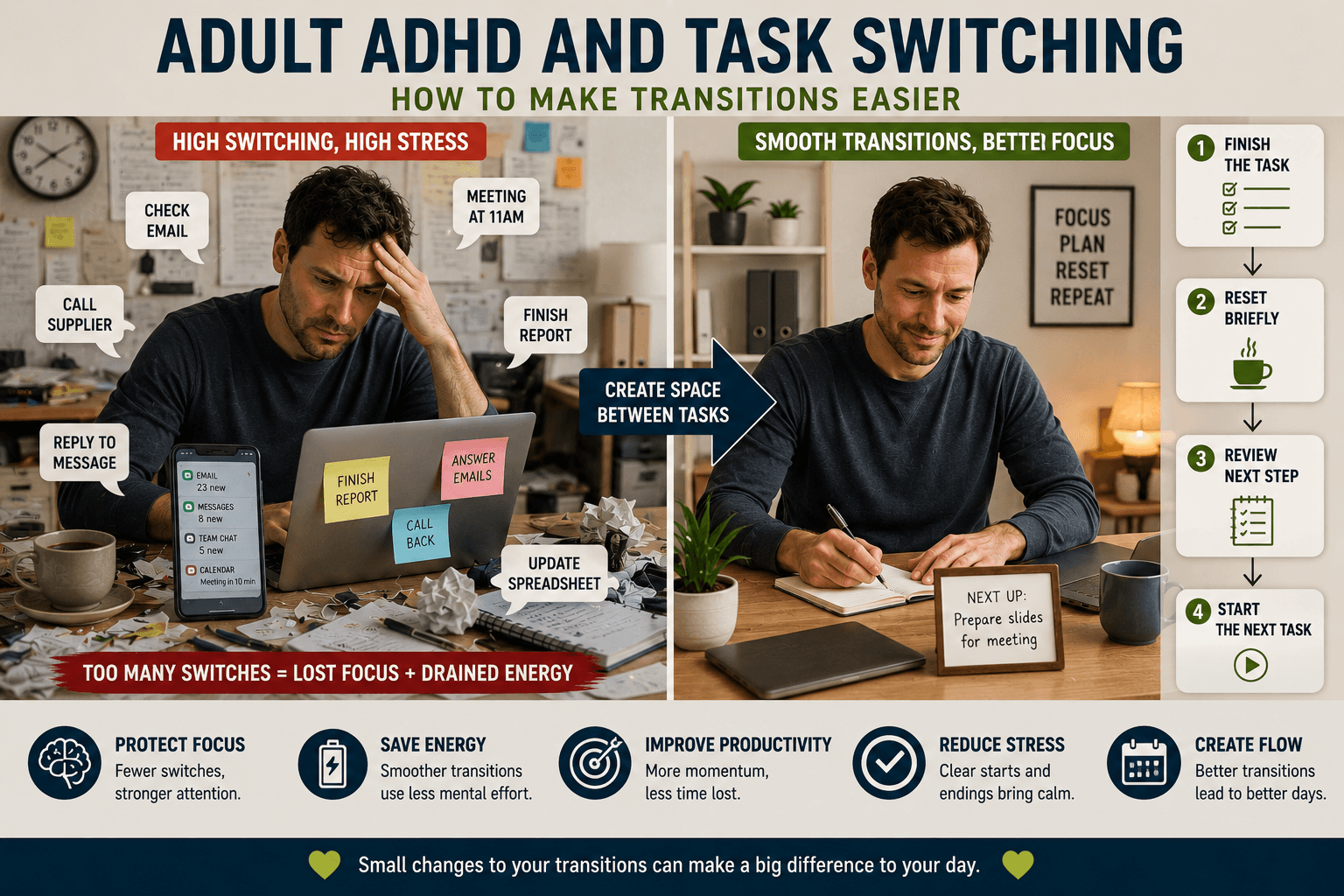
Adult ADHD and Task Switching: How to Make Transitions Easier
Adult ADHD and task switching can make an ordinary day feel much more tiring than expected.
You finish one task.
Then you know you need to start another.
However, the next step does not happen immediately.
You check your phone.
You make a drink.
You answer a message.
You look for something.
Ten minutes later, the original transition has disappeared.
This can be frustrating because the difficulty is not always the task itself.
Sometimes the hard part is moving from one thing to the next.
That gap between activities can create a surprising amount of friction.
Therefore, improving transitions can make a day feel calmer, clearer and easier to manage.
What Is Task Switching?
Task switching means moving attention from one activity to another.
For example:
Stopping one piece of work and starting another.
Moving from a meeting to focused work.
Finishing lunch and returning to a task.
Leaving home.
Coming back home.
Moving from work time to rest time.
These moments may appear small.
However, each transition asks the brain to stop one mental state and enter another.
That can take effort.
As a result, adult ADHD and task switching may become especially noticeable during busy days with many interruptions.
Why Transitions Can Feel Hard
Imagine reading something important.
You are focused.
Then someone asks you a question.
You answer.
Afterwards, returning to the original task feels harder than expected.
The difficulty may come from several things.
You need to remember where you were.
You need to rebuild concentration.
You may have lost the original thought.
Meanwhile, the interruption may have introduced another idea.
Therefore, even a brief switch can create more work than it appears to.
This is why a day full of interruptions may feel exhausting even when no single task was particularly demanding.
Task Switching Can Break Momentum
Momentum matters.
Once you are fully engaged in something, continuing can become easier.
However, every switch interrupts that momentum.
For example, suppose you are writing.
You stop to answer one email.
That email requires checking a file.
The file reminds you of another task.
Suddenly, the writing session has disappeared.
Therefore, protecting momentum can be useful.
The aim is not to avoid all task switching.
That would be unrealistic.
Instead, reduce unnecessary switches where possible.
Notice Where Your Day Breaks Apart
Before trying to improve transitions, notice where they go wrong.
Ask:
When do I lose momentum?
Which transition takes much longer than it should?
Where do I regularly get distracted?
Which part of the day becomes messy after one interruption?
Perhaps the problem appears:
After meetings.
After lunch.
When arriving home.
When starting work.
When moving between computer tasks.
When getting ready for bed.
Once the pattern becomes clear, you can design a better handover.
Use a Clear End Point
One reason task switching becomes difficult is that one activity does not clearly end.
You stop halfway.
Then you move to something else.
Later, you cannot remember where to restart.
Therefore, create a simple closing step.
For example:
Before leaving a document, write:
“Next: finish paragraph on page 4.”
Before ending work, write tomorrow’s first task.
Before stopping a household job, note what remains.
This creates a bridge back.
As a result, restarting becomes easier.
Adult ADHD and Task Switching at Work
Work often creates many rapid transitions.
Email.
Meetings.
Calls.
Messages.
Reports.
Questions from colleagues.
Each one pulls attention in a different direction.
Therefore, a working day can become fragmented.
One practical solution is to group similar tasks.
For example:
Answer several emails together.
Make calls in one block.
Handle simple admin at the same time.
Keep deeper work in a separate period.
This reduces the number of switches.
Fewer switches can mean less lost momentum.
Batch Similar Tasks
Task batching is simple.
Instead of doing one email, then one call, then one document, group similar activities.
For example:
Email block: 20 minutes.
Calls: two or three together.
Admin: one short block.
Focused work: protected separately.
The task list does not change.
However, the number of transitions does.
That can make the day feel smoother.
Build a Transition Ritual
A small repeated action can signal that one mode is ending and another is beginning.
For example:
Finish work → close laptop, stand up, make a drink.
Start work → clear desk, open one document, set timer.
Come home → put keys away, change clothes, sit down for five minutes.
Prepare for bed → charge phone, dim lights, check tomorrow.
The ritual does not need to be complicated.
In fact, simpler is better.
Over time, the repeated sequence can make transitions feel more automatic.
Use a One-Minute Reset
Sometimes you do not need a full routine.
You simply need a pause.
Try a one-minute reset between tasks.
Stand up.
Breathe.
Close the previous tabs.
Put away one item.
Look at the next task.
Then begin.
This creates a clear mental break.
Without a pause, one activity can bleed into the next.
With one, the next task may feel easier to enter.
Keep the Next Task Visible
If you finish one task and then need to decide what comes next, the transition becomes harder.
Therefore, decide before the transition happens.
For example:
Before finishing lunch, know what you will do afterwards.
Before ending work today, choose tomorrow’s first task.
Before completing one project, identify the next step.
This reduces decision-making at the exact moment your attention is already moving.
Avoid Opening Too Many Loops
An open loop is something unfinished that remains mentally active.
One unfinished email.
One half-completed form.
One browser tab waiting.
One message you intend to answer.
Several open loops can make task switching harder because every transition creates another unfinished item.
Therefore, close simple loops when practical.
If something takes two minutes, complete it.
If it takes longer, schedule it.
The goal is not to finish everything immediately.
Instead, give each unfinished task a clear place.
Use a Parking List
New thoughts often appear during another task.
You remember:
Call dentist.
Buy milk.
Check insurance.
Reply to someone.
If you follow every thought immediately, task switching becomes constant.
Therefore, keep a small parking list.
Write the thought down.
Then return to the current task.
Later, review the list.
This allows the idea to remain safe without requiring an immediate switch.
Protect Focus From Notifications
Notifications create forced transitions.
You may be concentrating well.
Then a message appears.
Even if you do not answer, part of your attention has already moved.
Therefore, consider reducing unnecessary alerts.
Use silent mode.
Turn off non-essential notifications.
Check messages at specific times.
Close email during focused work.
This does not eliminate communication.
Instead, it gives you more control over when transitions happen.
Adult ADHD and Task Switching After Meetings
Meetings can create a particular transition problem.
You leave the meeting with new information, questions and tasks.
Then you are expected to immediately begin something else.
However, the mind may still be processing what just happened.
Therefore, build a short buffer after important meetings.
Even five minutes can help.
Write down actions.
Close the notes.
Take a short walk.
Then begin the next task.
This prevents the meeting from leaking into the rest of the day.
Give Yourself a Re-entry Note
Interruptions are unavoidable.
Therefore, create a re-entry note before you step away.
For example:
“When I return, check figures in section 3.”
Or:
“Next action: call supplier.”
This can take ten seconds.
However, it may save several minutes of trying to remember what you were doing.
It also reduces the mental effort of restarting.
Do Not Switch Just Because Something Feels Difficult
Sometimes a task becomes uncomfortable.
At that moment, another task suddenly looks attractive.
You think:
I should check email.
Maybe I should tidy first.
I’ll make a coffee.
This can look like task switching.
However, it may actually be avoidance.
Therefore, when the urge to switch appears, ask:
“Is the next task genuinely more important, or am I trying to escape this one?”
That question can help protect momentum.
Use Timers to Create Boundaries
A timer can help define when one task ends.
For example:
Work on report for 25 minutes.
Then take five minutes to reset.
Afterwards, move to the next task.
This gives the transition a clear boundary.
The timer does not need to control the whole day.
Instead, use it when the lack of an endpoint makes switching difficult.
Keep Transitions Simple at Home
Home life contains constant task switching.
Cooking.
Laundry.
Messages.
Children.
Cleaning.
Work.
Errands.
Therefore, try to reduce unnecessary overlap.
For example:
Finish preparing food before starting paperwork.
Put laundry into one stage before moving to another task.
Create one place for household admin.
Avoid trying to complete five small jobs at once.
Parallel activity can feel efficient.
However, it often creates more unfinished loops.
Adult ADHD and Task Switching When Working From Home
Working from home can blur transitions.
One minute you are working.
The next, you notice dishes.
Then the washing.
Then a delivery arrives.
As a result, the whole day becomes a series of small switches.
Therefore, create visible boundaries.
Work in one area where possible.
Keep household jobs outside the work block.
Use a clear start and finish routine.
When work ends, close the laptop and leave the work area.
These small cues can help separate roles.
Create a Start-Up Routine
Starting work is also a transition.
Therefore, reduce the number of steps required.
A simple start-up routine might be:
Put phone away.
Open calendar.
Check main priority.
Open the correct document.
Begin.
Nothing more.
A short routine creates direction without becoming another task.
Create a Shutdown Routine
Likewise, ending work should have a clear finish.
For example:
Save current work.
Write the next action.
Check tomorrow’s calendar.
Close unnecessary tabs.
Clear one small surface.
Then stop.
This makes the transition from work to personal time clearer.
Moreover, it gives tomorrow a better starting point.
Use Movement Between Mental Modes
Physical movement can help mark a transition.
Walk to another room.
Step outside for two minutes.
Stretch.
Get water.
Move from desk to sofa.
The movement does not need to be exercise.
Instead, it tells the body:
That task has ended. Something else is beginning.
This can be especially useful after focused work or difficult conversations.
Avoid Filling Every Transition With Your Phone
A common habit is reaching for the phone whenever one task ends.
You finish work.
Phone.
Meeting ends.
Phone.
You wait for the kettle.
Phone.
These short checks may feel harmless.
However, they introduce another mental environment into every transition.
Therefore, experiment with leaving some transitions empty.
Finish one task.
Pause.
Then move directly to the next.
This can make the day feel less fragmented.
Make Transitions Predictable
Predictability reduces decision friction.
For example:
After breakfast → begin work.
After lunch → short walk.
After work → five-minute reset.
After dinner → household admin.
Before bed → prepare tomorrow.
The structure does not need to be rigid.
However, repeated patterns give the brain fewer decisions to make.
As a result, adult ADHD and task switching may become easier to manage.
Use the Environment to Signal the Switch
Your surroundings can help.
Different spaces can represent different activities.
Desk → focused work.
Sofa → rest.
Kitchen table → admin.
Front door area → leaving home.
Even if you have limited space, small changes can create cues.
For example, clear the laptop away when work ends.
Put a notebook on the table when admin begins.
Change lighting.
Use headphones only during work.
The signal helps your brain recognise the new mode.
Transition Friction on Low-Energy Days
Task switching often becomes harder when energy is low.
On a good day, you may easily move between activities.
However, when tired, every switch feels larger.
Therefore, simplify transitions on difficult days.
Reduce the number of tasks.
Batch similar activities.
Use clearer cues.
Give yourself more time between demanding tasks.
Most importantly, do not expect the same pace every day.
A slower transition is still a transition.
Stop Measuring Yourself by Speed
You may notice that other people appear to move quickly between tasks.
They finish one thing and immediately begin the next.
However, speed is not the only measure of effectiveness.
A short pause can improve focus.
A written restart note can reduce mistakes.
A deliberate transition can protect energy.
Therefore, do not judge yourself because you need more separation between activities.
Use the transition that helps you function best.
Adult ADHD and Task Switching After a Late Diagnosis
After a late ADHD diagnosis, you may look back and realise that many difficult days were not caused by one large problem.
Instead, the day may have contained dozens of small transitions.
Each one required you to stop, reset and begin again.
Understanding adult ADHD and task switching can change the way you plan.
Rather than forcing yourself to handle endless interruptions, you can begin reducing them.
You can group similar work.
Protect focused periods.
Create buffers.
Use re-entry notes.
Most importantly, you can treat transitions as real parts of the day rather than empty spaces between the “important” tasks.
Start With One Difficult Transition
Do not change your whole schedule.
Choose one transition that regularly causes problems.
Perhaps:
Starting work.
Returning after lunch.
Leaving home.
Finishing meetings.
Ending the working day.
Going to bed.
Then ask:
“What would make this handover clearer?”
Maybe you need a written next step.
Perhaps a timer helps.
A short walk may create the break.
You might need to prepare the next task beforehand.
Try one change.
Then notice whether the transition becomes easier.
Reflection Questions
- Which transition in your day is hardest?
- When do you most often lose momentum?
- Which interruptions are avoidable?
- Could you batch any similar tasks together?
- What would help you restart after an interruption?
- Which transition needs a short buffer?
- Do you automatically reach for your phone between tasks?
- What could become your work start-up routine?
- What could become your work shutdown routine?
- Which transition could you improve today?
Conclusion
Adult ADHD and task switching can make busy days more demanding than they appear.
The difficulty is not always the work itself.
Often, the repeated stopping and restarting uses more energy than expected.
Therefore, protect momentum where possible.
Batch similar tasks.
Reduce unnecessary interruptions.
Use clear ending points.
Write re-entry notes.
Create short buffers.
Most importantly, give transitions a place in your plan.
You do not need to move instantly from one task to another.
Sometimes a short pause, a written next action or a simple routine is exactly what makes the next task possible.
Instead of asking:
“Why am I taking so long to move on?”
try asking:
“What would make this transition easier?”
That question can turn the gaps between tasks from points of frustration into useful parts of your daily structure.
Suggested Internal Links
- Adult ADHD and Daily Friction: How Small Obstacles Drain Your Energy
- Adult ADHD and Visual Clutter: How to Create a Calmer, More Focused Space
Disclaimer
This article is provided for general educational and informational purposes only. It does not provide medical, psychological, diagnostic or therapeutic advice. Therefore, it should not be used as a substitute for individual guidance from an appropriately qualified healthcare professional.
ADHD experiences vary considerably between individuals. If you have concerns about ADHD, mental health, medication, diagnosis or treatment, please speak with an appropriately qualified healthcare professional.