
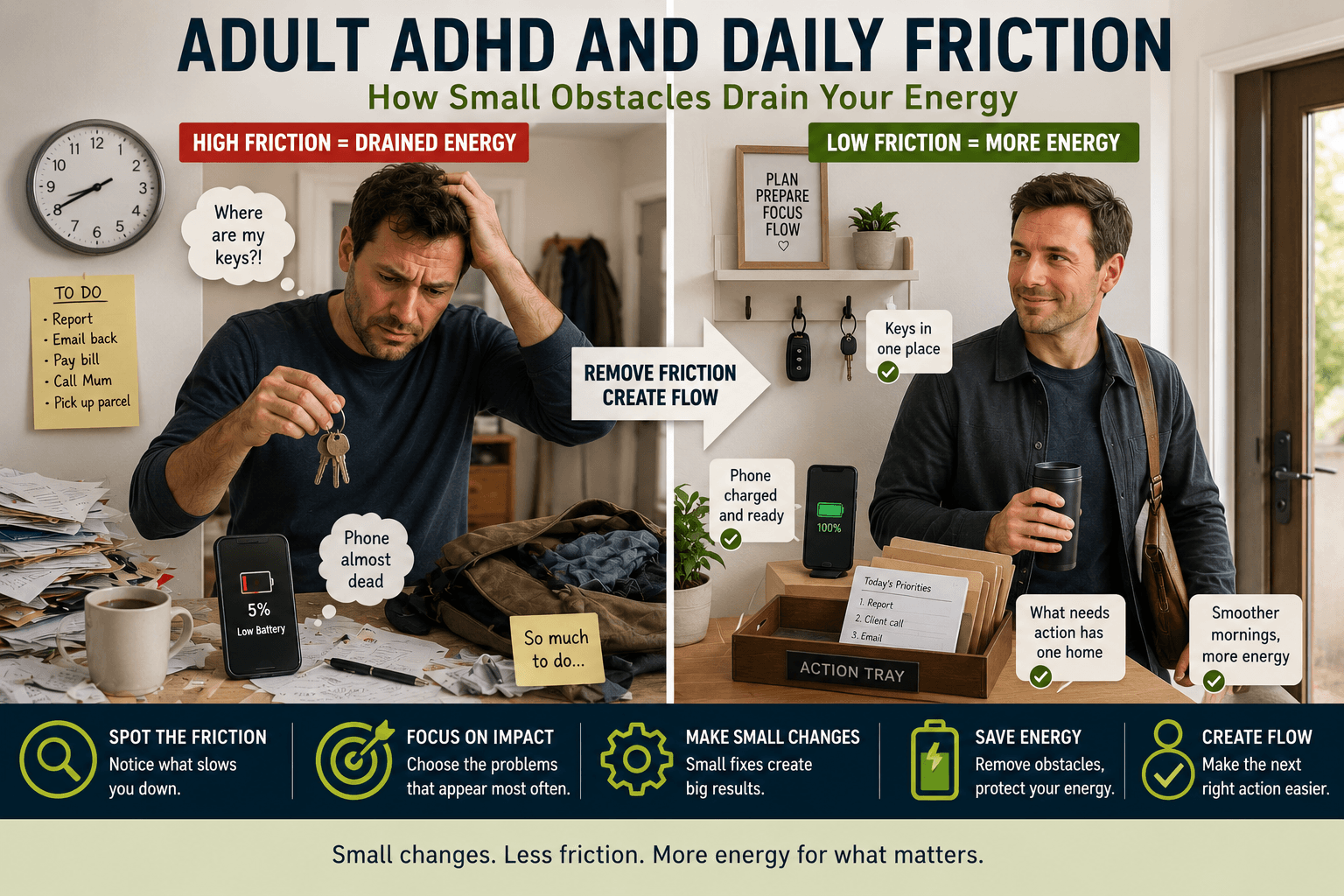
Adult ADHD and Daily Friction: How Small Obstacles Drain Your Energy
Adult ADHD and daily friction can create problems that are easy to underestimate.
Imagine an ordinary morning.
You want to make coffee, but the kettle needs filling.
Your phone is almost out of battery.
The charger is in another room.
Then you realise you cannot find your keys.
While searching, you notice a letter that needs answering.
Next, your attention moves to an unfinished job on the kitchen table.
None of these problems is particularly serious.
However, each one interrupts what you were trying to do.
By the time you leave home, you may already feel irritated, rushed and mentally tired.
Yet nothing dramatic has happened.
That is the power of daily friction.
A small obstacle might cost only a few seconds. Nevertheless, when the same obstacle appears again and again, the cost builds.
Therefore, improving everyday life does not always require a major new routine.
Sometimes it begins with identifying the small things that repeatedly get in your way.
What Is Daily Friction?
Daily friction is any unnecessary obstacle between you and the action you are trying to take.
For example:
You need your keys, but they could be in several places.
You want to exercise, but your trainers are upstairs.
A document needs completing, but you cannot remember where you saved it.
Your laptop is nearly flat, but the charger is in another room.
You want to cook, but the worktop has to be cleared first.
Each obstacle creates an extra step.
Often, the step looks too small to matter.
However, repeated small steps use attention, time and energy.
That is why adult ADHD and daily friction deserve to be considered together.
The issue is not simply inconvenience.
Every extra step creates another opportunity for attention to move somewhere else.
Why Small Obstacles Can Become Big Problems
Suppose you need to send an email.
The task itself may take five minutes.
However, before you can start:
You need to find the information.
Then you search for the correct email address.
A notification appears.
You check it.
Afterwards, you remember something unrelated.
Twenty minutes later, the original email is still unfinished.
The problem was not necessarily the email.
The problem was everything between the intention and the action.
Therefore, when a simple task repeatedly remains unfinished, ask:
“What happens between deciding to do this and actually doing it?”
That space is often where the friction lives.
The Hidden Cost of Adult ADHD and Daily Friction
A single irritating moment is easy to ignore.
However, dozens of small irritations can change the entire feel of a day.
Repeated friction can cost:
- time;
- attention;
- mental energy;
- patience;
- confidence;
- momentum.
For example, searching for your keys for three minutes may not seem important.
Yet if the same thing happens several times a week, you are repeatedly starting the day with stress.
Likewise, an awkward filing system may add only thirty seconds to a task.
But if you avoid using it because it feels difficult, paperwork may begin to build up.
Therefore, the real cost of friction is often larger than the individual moment suggests.
Stop Calling Every Difficulty a Motivation Problem
When something does not get done, motivation often receives the blame.
You may think:
“I just need to make myself do it.”
Sometimes that is true.
However, the task may also contain unnecessary barriers.
Imagine wanting to exercise.
Your equipment is packed away.
Your clothes need finding.
The headphones are not charged.
You have not decided what exercise to do.
Starting now requires several decisions.
Compare that with:
Your clothes are ready.
The trainers are beside the door.
Your headphones are charged.
The activity is already chosen.
The motivation may be exactly the same.
Yet the second version is easier to begin.
Therefore, before questioning your motivation, check the friction.
The Five Common Types of Daily Friction
Daily friction can appear in many forms.
However, five types are especially useful to notice.
1. Search Friction
Search friction happens whenever you spend time looking for something that should be easy to find.
Common examples include:
- keys;
- phone;
- wallet;
- glasses;
- chargers;
- documents;
- passwords;
- work files.
Search friction is extremely common.
Fortunately, it is often relatively easy to reduce.
The basic rule is:
One important item. One obvious home.
For example:
Keys → hook beside the door.
Wallet → bowl in the hallway.
Chargers → charging station.
Current paperwork → action tray.
The aim is not perfect organisation.
Instead, reduce the number of places you need to search.
2. Access Friction
Access friction appears when something you use regularly is harder to reach than it needs to be.
For example:
The mugs you use every morning are on the highest shelf.
Your medication is stored far from where you take it.
Exercise equipment is hidden in a cupboard.
The file you use daily is buried inside several computer folders.
Technically, everything is organised.
Practically, the organisation adds steps.
Therefore, ask:
“Could this live closer to where I actually use it?”
Frequently used items deserve easy access.
3. Decision Friction
Some friction is invisible because nothing is physically missing.
Instead, the obstacle is having to decide.
What should I wear?
What should I eat?
Which task comes first?
When should I exercise?
Where should this paper go?
Each decision is small.
Nevertheless, repeated decisions can make a day feel much heavier.
Therefore, create defaults.
For example:
Choose several regular breakfast options.
Keep commonly worn clothes together.
Decide tomorrow’s first task before finishing work today.
Use one main paperwork tray.
Defaults reduce unnecessary choice.
4. Transition Friction
Transitions occur when you move from one activity to another.
Leaving home.
Starting work.
Finishing a meeting.
Beginning dinner.
Changing from work mode to rest mode.
These moments can be surprisingly difficult.
For instance, you may finish one task and then spend fifteen minutes wondering what comes next.
Therefore, make transitions clearer.
At the end of one task, write the next action down.
Before leaving work, prepare tomorrow’s starting point.
When arriving home, place keys and bags in their usual location.
A clear transition reduces the chance that attention becomes lost between activities.
5. Emotional Friction
Some tasks carry more than practical difficulty.
They may also carry dread.
Opening a certain email.
Calling someone.
Completing overdue paperwork.
Dealing with a bill.
Answering a message you have postponed.
The task itself might take five minutes.
However, the emotional weight can make it feel much larger.
Therefore, emotional friction needs a slightly different approach.
Reduce everything around the task that can be reduced.
Have the phone number ready.
Put the paperwork together.
Write down what you need to say.
Choose a time.
Then make the first action as small as possible.
You may not remove the discomfort.
However, you can prevent unnecessary practical friction from making the emotional friction even heavier.
Why the Same Problems Keep Appearing
One of the most useful things about adult ADHD and daily friction is that the problems are often repetitive.
You may feel as though dozens of different things go wrong.
However, many of those moments can come from only a few causes.
For example:
Missing charger.
Missing keys.
Cluttered worktop.
Unclear task list.
Too many phone notifications.
Those five things may create twenty frustrating moments in one day.
Therefore, you do not necessarily need twenty solutions.
You may only need five.
This is where a simple friction audit can help.
Try a One-Day Friction Audit
Choose an ordinary day.
Not your best day.
Not your worst day.
Just a typical one.
Keep a small notebook or phone note available.
Every time something makes a normal action harder, record it.
For example:
7:20 — could not find keys.
8:05 — phone battery low again.
9:10 — searched for work document.
11:30 — notification interrupted report.
13:00 — no clear space to prepare lunch.
Do not fix anything yet.
Simply notice.
This matters because trying to fix the problem immediately can distract you from seeing the larger pattern.
Therefore:
Capture first. Fix later.
Record the Tiny Irritations Too
This part is important.
You may think:
“That is too small to write down.”
Write it down anyway.
The drawer that sticks.
The charger that is always elsewhere.
The app that takes too many taps to reach.
The shoes that never stay together.
The cupboard that needs reorganising before you can find anything.
Small irritations are exactly what the audit is designed to capture.
Individually, they seem unimportant.
Together, they can explain why everyday life feels harder than expected.
Group Similar Problems Together
At the end of the day, review the list.
Do not treat every entry as a separate problem.
Instead, group similar items.
Perhaps you recorded:
Could not find keys.
Could not find wallet.
Could not find headphones.
These may all belong under:
Important items have no permanent home.
Likewise:
Could not find report.
Could not find invoice.
Could not remember document location.
These may become:
Digital filing is too complicated.
Suddenly, a long list becomes shorter.
That is useful because the day may not contain thirty separate problems.
Perhaps it contains six repeating ones.
Find the High-Return Fixes
After grouping the list, ask:
“Which three problems create the most repeated frustration?”
Start there.
Do not begin with the hardest problem.
Instead, begin with the one that gives the greatest return for the smallest change.
For example:
A second phone charger may remove several daily frustrations.
A hook beside the door may remove repeated searches for keys.
Moving the mugs beside the kettle may improve every morning.
Turning off unnecessary notifications may remove dozens of interruptions.
Small changes can have large effects when they solve a repeated problem.
Fix One Thing at a Time
After completing a friction audit, enthusiasm may arrive.
You suddenly want to fix everything.
New storage.
New routines.
New organisation.
New apps.
However, this can create another problem.
Several half-finished improvements become new sources of friction.
Therefore, choose one fix.
Complete it.
Use it for several days.
Then decide whether it helped.
Afterwards, move to the next one.
Slow improvement is often easier to maintain.
Eliminate Friction Where Possible
Some friction can disappear completely.
For example:
Missing keys → permanent hook.
Forgotten bill → automatic payment where appropriate.
Dead phone → fixed charging station.
Repeatedly forgotten shopping item → shared shopping list.
If a problem can be removed entirely, that is often the best solution.
Why?
Because an eliminated problem no longer requires future motivation or memory.
The environment handles it.
Reduce Friction When You Cannot Remove It
Not everything can disappear.
Perhaps your commute is difficult.
Maybe a weekly meeting is tiring.
Certain paperwork may always be necessary.
Therefore, ask how the friction can be reduced.
For example:
Prepare your bag before the commute.
Keep headphones ready.
Put documents together before the meeting.
Write questions beforehand.
Schedule a short break afterwards.
The difficult activity still exists.
However, fewer unnecessary problems surround it.
Delegate Some Friction
Sometimes the best solution is not doing the task yourself.
That might mean:
Sharing a household responsibility.
Using automatic payments.
Asking someone else to make a booking.
Using delivery for a repetitive purchase.
Getting professional help for complicated administration.
Delegation does not mean you are incapable.
Instead, it can be a sensible way to protect limited energy for things only you can do.
Delete Friction That Does Not Need to Exist
Some tasks continue simply because they have always been there.
An unused subscription.
A newsletter you never read.
An unnecessary recurring commitment.
A complicated system nobody needs.
Therefore, ask:
“Does this actually need to exist?”
Sometimes the best way to manage a task is to remove it.
This can be especially useful digitally.
Unsubscribe.
Delete.
Cancel.
Simplify.
Every removed demand is one less thing competing for attention.
Adult ADHD and Daily Friction in the Morning
Mornings often reveal friction clearly.
You may need to:
Get dressed.
Eat.
Find keys.
Prepare bags.
Check appointments.
Leave on time.
If several small things go wrong, the whole morning can feel stressful.
Therefore, prepare the environment the night before.
For example:
Lay out clothes.
Put keys in their normal place.
Prepare the bag.
Charge devices.
Check the calendar.
Decide breakfast.
These tasks may take only a few minutes in the evening.
However, they can remove several morning decisions.
Adult ADHD and Daily Friction at Work
Work can contain its own repeated friction.
Too many notifications.
Unclear priorities.
Constant meetings.
Difficulty finding files.
A cluttered desk.
Repeated interruptions.
Therefore, observe which problems appear most often.
Perhaps your first change is:
Turn off email notifications during focused work.
Or:
Create one folder for the current project.
Maybe:
Write tomorrow’s first task before leaving.
Again, you do not need to redesign your entire working life.
One useful change can remove dozens of repeated interruptions.
Digital Friction Can Be Just as Expensive
Not all friction is physical.
Digital life creates its own barriers.
For example:
Too many browser tabs.
Several calendars.
Passwords you cannot remember.
Unnecessary authentication steps.
Unread email.
Files saved in inconsistent locations.
Apps sending constant notifications.
Therefore, include digital problems in your audit.
Ask:
What do I repeatedly search for?
What repeatedly interrupts me?
Which digital task requires more steps than necessary?
Where possible, simplify.
Watch for Friction Around Transitions
Transitions deserve special attention because they are easy to overlook.
What happens when you:
Wake up?
Leave home?
Start work?
Finish lunch?
Return home?
Finish work?
Prepare for bed?
If one transition repeatedly goes badly, improve that transition rather than trying to redesign the whole day.
For example, if leaving home is stressful, create a door zone.
If starting work is difficult, prepare the first task beforehand.
If evenings disappear into phone scrolling, change where the phone lives after work.
Small transition changes can influence much larger parts of the day.
Use Friction in Your Favour
Friction is not always bad.
You can also use it deliberately.
Make unwanted behaviours slightly harder.
For example:
Keep your phone away from the desk.
Remove social media apps from the first screen.
Log out after use.
Keep snacks you want less often somewhere less visible.
At the same time, remove friction from useful behaviours.
Water on the desk.
Trainers beside the door.
Notebook already open.
Calendar visible.
Now the environment helps guide behaviour.
Adult ADHD and Daily Friction on Low-Energy Days
Low-energy days reveal whether a system is genuinely useful.
On a good day, you may tolerate extra steps.
You can search for things.
You may overcome distractions.
You can remember what comes next.
However, when energy is limited, the same friction feels much larger.
Therefore, reducing repeated obstacles can be especially valuable.
A good system does not need you to perform at your best.
Instead, it removes unnecessary work before you begin.
This is one reason adult ADHD and daily friction can be such a useful area to examine.
Sometimes life does not need more discipline.
It needs fewer obstacles.
Do Not Turn Friction Reduction Into Perfectionism
Once you start noticing friction, you may see it everywhere.
This can become another project.
Every drawer could improve.
Every digital folder could change.
Every routine could become more efficient.
However, the aim is not to optimise every second of life.
Instead, focus on the repeated problems that genuinely affect you.
If something is mildly inconvenient once a month, it may not deserve attention.
If something frustrates you five times a day, it probably does.
Choose according to impact.
Revisit the Audit When Life Changes
Friction changes over time.
A new job can create different problems.
Moving home changes routines.
Children grow.
Technology changes.
Health changes.
Therefore, a friction audit does not need to be a one-time exercise.
Consider repeating it after a significant life change or every few months.
Often, the largest problems disappear first.
Later audits may reveal smaller issues that were previously hidden beneath the bigger ones.
Judge Solutions by Whether They Work
An ADHD-friendly solution does not have to look conventional.
Perhaps the keys live on a brightly coloured hook.
Maybe the paperwork tray sits somewhere visitors can see it.
Your work file may remain directly on the desktop.
Perhaps you need two chargers rather than carrying one around.
That is fine.
The question is not:
“Is this how organised people do it?”
The better question is:
“Does this reduce friction in my actual life?”
If it does, the system is doing its job.
Start With the Most Annoying Repeated Problem
You do not need to wait for a full audit.
Think about yesterday.
What small problem happened repeatedly?
Perhaps you searched for the same object twice.
Maybe your phone interrupted you throughout the morning.
You might have moved paperwork several times because it had no home.
Choose that problem.
Then ask:
Can I eliminate it?
If not:
Can I reduce it?
If not:
Can I delegate or delete it?
Those questions can turn an ordinary frustration into a practical change.
Reflection Questions
- Which small problem irritates you most often?
- What do you regularly spend time searching for?
- Which item needs a permanent home?
- What part of your morning contains the most friction?
- Which repeated decision could become a default?
- Which digital interruption happens most often?
- What could you prepare the night before?
- Which unnecessary task could you remove?
- Which responsibility could be shared or delegated?
- What single friction point could you reduce today?
Conclusion
Adult ADHD and daily friction can make ordinary life use far more energy than expected.
The individual obstacles may look small.
A missing charger.
An unclear task.
An awkward cupboard.
A misplaced key.
A distracting notification.
However, when these things happen repeatedly, they create a constant background cost.
Therefore, do not assume every difficult day requires more motivation or discipline.
Sometimes the better question is:
“What keeps getting in my way?”
Notice the repeated friction.
Record it.
Group the patterns.
Then fix the highest-impact problem first.
Where possible, eliminate the obstacle completely.
Otherwise, reduce it, delegate it or remove the task altogether.
Most importantly, keep the process small.
You do not need to optimise your entire life.
You simply need to stop fighting the same unnecessary obstacles every day.
When adult ADHD and daily friction are approached this way, a few small changes can make the whole day feel lighter.
Suggested Internal Links
- Adult ADHD and Visual Clutter: How to Create a Calmer, More Focused Space
- Adult ADHD and Daily Structure: How to Build a Life That Works With Your Brain
Disclaimer
This article is provided for general educational and informational purposes only. It does not provide medical, psychological, diagnostic or therapeutic advice. Therefore, it should not be used as a substitute for individual guidance from an appropriately qualified healthcare professional.
ADHD experiences vary considerably between individuals. If you have concerns about ADHD, mental health, medication, diagnosis or treatment, please speak with an appropriately qualified healthcare professional.