
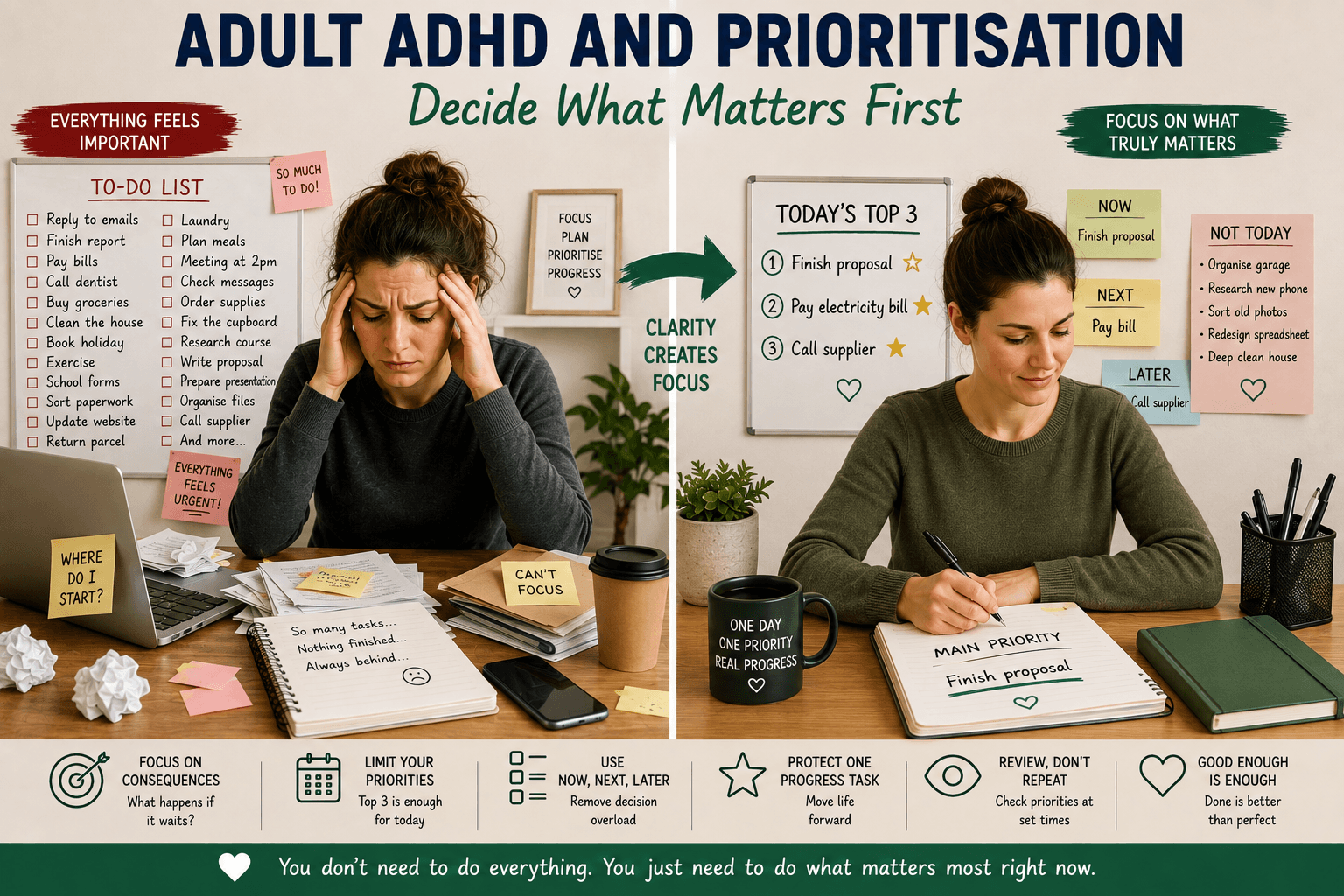
Adult ADHD and Prioritisation: How to Decide What Matters First
Adult ADHD and prioritisation can become difficult when everything appears important at the same time.
You may have:
emails to answer;
appointments to arrange;
paperwork to complete;
work deadlines;
shopping;
household jobs;
messages;
family responsibilities;
unfinished projects.
At first, the list may simply look busy. However, once several demands begin competing for attention, it can become difficult to decide where to start.
One task feels urgent.
Another feels important.
A third is quick.
A fourth has been avoided for several days.
Meanwhile, a notification arrives with something new.
Now the question becomes:
“Which one should I do first?”
That sounds simple.
However, when every option carries some importance, choosing can become mentally expensive.
Therefore, one useful goal is not to become perfect at prioritising everything.
Instead, it is to make the number of active priorities smaller.
Why Adult ADHD and Prioritisation Can Be Difficult
A task list does not automatically tell you what deserves attention first.
It simply tells you what exists.
For example:
Pay bill.
Reply to email.
Finish presentation.
Buy food.
Call dentist.
Complete form.
All six tasks may matter.
However, they do not necessarily matter equally today.
Some have deadlines.
Others can wait.
Some have consequences if delayed.
Others simply feel urgent because they are visible.
Therefore, adult ADHD and prioritisation can become easier when you separate:
what exists;
what matters;
what matters now.
Those are three different questions.
Urgent and Important Are Not the Same
A task can feel urgent without being especially important.
For example, an email marked “urgent” may demand attention.
However, your report due today may have a much larger consequence if ignored.
Likewise, a phone notification creates immediacy.
That does not automatically make it the most valuable use of your time.
Therefore, ask two questions:
Is this genuinely urgent?
Is this genuinely important?
A task may be:
urgent and important;
important but not urgent;
urgent but low importance;
neither urgent nor important.
That distinction can reduce confusion.
Use a Simple Priority Filter
When your list feels crowded, try this:
1. What has a real deadline?
Identify tasks with an actual date or time attached.
2. What has a consequence?
Ask what happens if the task waits.
3. What moves something important forward?
Some tasks may not be urgent, but they support a larger goal.
4. What can wait?
Not everything needs action today.
This simple filter prevents every item from being treated as equal.
Adult ADHD and Prioritisation: Start With Consequences
When several tasks compete, ask:
“Which one creates the biggest problem if I do nothing?”
For example:
Late payment fee.
Missed appointment.
Unsubmitted work.
Someone waiting for essential information.
Those consequences help clarify priority.
However, avoid turning every small inconvenience into a crisis.
The aim is to identify meaningful consequences, not increase anxiety.
Use a Daily Top Three
A very long list can create constant decision-making.
Therefore, choose a smaller daily view.
For example:
Today’s Top Three
- Finish proposal.
- Pay electricity bill.
- Call supplier.
Everything else remains on the master list.
However, only these three compete for immediate attention.
As a result, the day becomes easier to read.
You do not need to repeatedly ask which of twenty tasks matters most.
One Main Priority Can Be Enough
Some days need even more simplicity.
Choose one main priority.
Then ask:
“What is the one thing that would make today feel meaningfully productive?”
Perhaps it is:
Submit application.
Finish draft.
Attend appointment.
Resolve one important admin problem.
Then, allow everything else to become secondary.
This does not mean other tasks are unimportant.
Instead, it gives the day a centre.
Do the Main Priority Before Easy Distractions Where Possible
Small tasks often feel attractive.
Reply to one email.
Check messages.
Order something online.
Move paperwork.
However, completing many easy tasks can create the feeling of productivity without moving the most important work forward.
Therefore, where practical, begin with the meaningful priority before allowing the smaller tasks to fill the day.
This is especially useful during your stronger energy period.
Use Your Best Energy on Your Best Priority
Earlier in this series, we discussed adult ADHD and energy management.
The two ideas connect directly.
If your strongest focus usually appears in the morning, try not to spend that entire period on low-value admin.
Instead, protect at least part of it for the task that benefits most from clear thinking.
Later, when energy falls, routine jobs may fit more comfortably.
As a result, prioritisation includes not only what you do, but also when you do it.
Separate Priority From Ease
A task can be easy without being important.
Likewise, an important task may be difficult.
Therefore, avoid automatically choosing the easiest item first.
Ask:
“Am I choosing this because it matters, or because it feels easier?”
There is nothing wrong with completing a quick task.
However, if easy work repeatedly replaces important work, priorities may need to become more visible.
Use a Quick-Win Carefully
Sometimes one small task can create useful momentum.
For example:
Send one document.
Pay one bill.
Make one short call.
That can reduce mental load.
However, use quick wins strategically.
Complete one or two.
Then return to the main priority.
Otherwise, the entire day can disappear into minor tasks.
Adult ADHD and Prioritisation at Work
Workplaces often contain competing demands from several people.
Your manager has one priority.
A colleague has another.
Your inbox suggests something else.
A meeting creates new actions.
Therefore, work priorities sometimes need clarification.
Where appropriate, ask:
“Which of these needs to come first?”
This is particularly useful when two people have given conflicting deadlines.
Clarification can prevent you from carrying responsibility for a decision that belongs elsewhere.
Ask for Priority Clarification
A simple question can reduce a great deal of stress.
For example:
“I currently have A, B and C due. Which should take priority?”
This makes the workload visible.
It also creates shared understanding.
As a result, you can focus on one direction rather than trying to satisfy several competing demands simultaneously.
Group Related Tasks
Prioritisation is not only about choosing individual tasks.
Sometimes grouping related tasks makes the day easier.
For example:
Calls together.
Emails together.
Paperwork together.
Shopping together.
Therefore, after choosing priorities, consider whether similar lower-level tasks can be batched.
This reduces switching and makes the schedule more efficient.
Adult ADHD and Prioritisation at Home
Home life rarely provides a formal priority list.
Everything simply appears.
Laundry.
Cleaning.
Food.
Appointments.
Repairs.
Paperwork.
Therefore, decide what “good enough” looks like today.
For example:
Food sorted.
One load of washing.
Important paperwork completed.
Kitchen usable.
That may be enough.
You do not need to solve every household task on the same day.
Use Zones to Clarify Home Priorities
Earlier, we discussed adult ADHD and home zones.
Zones can also help with prioritisation.
For example:
Admin zone → paperwork that needs action.
Transition zone → things needed tomorrow.
Focus zone → current priority task.
Rest zone → no work.
As a result, the environment helps show what deserves attention in each area.
Distinguish Maintenance From Progress
Some tasks maintain life.
Others move life forward.
Maintenance tasks include:
cleaning;
shopping;
routine email;
basic admin.
Progress tasks might include:
finishing a course;
writing a proposal;
applying for something;
building a project;
learning a skill.
Both matter.
However, if maintenance consumes all available time, longer-term goals may never move forward.
Therefore, try to include at least one progress task where possible.
Protect One Progress Task
A useful rule might be:
One progress task before the day fills with maintenance.
For example:
Write 30 minutes of the report before checking routine admin.
Complete one application section before household tasks.
Work on the important project before browsing messages.
This keeps longer-term priorities visible.
Adult ADHD and Prioritisation When Everything Feels Urgent
When everything feels urgent, use an emergency filter.
Ask:
- Is there a real deadline today?
- Is there a serious consequence if this waits?
- Is someone depending on this now?
- Can this safely move to tomorrow?
If the answer shows that something can wait, move it.
Therefore, urgency becomes something you test rather than simply feel.
Create a “Not Today” List
A “not today” list can be just as useful as a to-do list.
For example:
Not today:
research new phone;
organise old photos;
deep clean garage;
redesign spreadsheet;
browse holiday options.
These tasks may matter eventually.
However, they are not today’s priorities.
Writing them down gives them a safe place without allowing them to compete for today’s attention.
Do Not Let Visibility Decide Priority
The task in front of you often feels more important simply because you can see it.
The email notification.
The pile of paperwork.
The open browser tab.
Meanwhile, something genuinely important may be hidden inside your calendar or task list.
Therefore, priority should come from consequence and value, not simply visibility.
This is another reason a daily top three can help.
External Memory Supports Prioritisation
Article 8 explored adult ADHD and external memory.
External memory makes priorities easier because information is visible.
A calendar shows deadlines.
A task list shows open actions.
A whiteboard shows today’s top three.
Therefore, you do not need to keep asking yourself what you may have forgotten.
The system can hold that information for you.
Decision Fatigue Can Damage Prioritisation
Article 9 explored adult ADHD and decision fatigue.
If you repeatedly choose between twenty tasks, your mental energy can disappear.
Therefore, reduce the number of choices.
Choose priorities once.
Write them down.
Then follow them until something meaningful changes.
Do not continuously reopen the decision simply because another task appears.
Time Blindness Can Distort Priority
Article 10 explored adult ADHD and time blindness.
A task with a distant deadline may feel unimportant until the deadline suddenly becomes close.
Therefore, break longer projects into nearer checkpoints.
For example:
Week 1 → outline.
Week 2 → draft.
Week 3 → review.
Week 4 → submit.
Now each stage receives a visible priority before urgency arrives.
Procrastination Can Change What Feels Important
Article 11 explored adult ADHD and procrastination.
A task you avoid may become increasingly urgent simply because the deadline gets closer.
Therefore, do not wait for urgency to decide priority.
If something is important but difficult to start, break it into a small next action earlier.
This prevents the task from becoming tomorrow’s emergency.
Overwhelm Can Flatten Priorities
Article 12 explored adult ADHD and overwhelm.
When overwhelmed, every task may appear equally important.
Therefore, reduce the visible list.
Brain dump everything.
Then choose:
one main priority;
two supporting tasks;
everything else later.
This restores some hierarchy to the day.
Use “Now, Next, Later”
If a top-three system still feels too broad, try:
Now
The task currently receiving attention.
Next
The task that follows.
Later
Everything else.
This removes almost all immediate choice.
You only need to know:
What am I doing now?
and:
What comes next?
That can be particularly useful during busy periods.
Make “Now” Very Clear
Your Now task should be specific.
Not:
Work on project.
Instead:
Complete section two of project report.
Not:
Sort paperwork.
Instead:
Open and process five letters.
Clear actions reduce the chance of becoming stuck at the starting point.
Avoid Changing Priorities Too Often
Priorities can change.
That is normal.
However, if they change every ten minutes, sustained work becomes difficult.
Therefore, consider changing priority only when:
a genuine emergency appears;
a deadline changes;
new important information arrives;
someone with appropriate responsibility changes the requirement.
A new email does not automatically qualify.
Use Scheduled Priority Reviews
Instead of continuously reconsidering the day, review priorities at set times.
For example:
Morning → choose top three.
After lunch → check progress.
Late afternoon → decide what moves to tomorrow.
As a result, you reduce constant re-planning.
The system gives you permission to focus between reviews.
Adult ADHD and Prioritisation on Low-Energy Days
Low-energy days need fewer priorities.
Perhaps your normal top three becomes:
Essential
One task.
Helpful
One small task.
Optional
Everything else.
Therefore, prioritisation should adapt to your available energy.
A realistic plan is more useful than an ambitious plan that cannot be followed.
Create a Minimum Priority
Ask:
“What is the smallest meaningful thing that genuinely needs to happen today?”
That may be:
Attend appointment.
Send one document.
Pay one bill.
Prepare tomorrow.
On some days, that is sufficient.
Importantly, reduced capacity does not mean the priority system has failed.
It means the system is adapting.
Use Deadlines Carefully
Deadlines can clarify priority.
However, not all deadlines are equally fixed.
Some are external and firm.
Others are personal targets.
Therefore, mark them differently.
For example:
FIXED — submit by Friday
TARGET — draft by Wednesday
This helps distinguish consequences.
Use a Simple Priority Score
If several tasks still seem equal, use three questions.
Score each task from 0 to 2:
Consequence
What happens if it waits?
Deadline
How soon does it need action?
Value
How much does completing it matter?
Add the scores.
The highest score may deserve earlier attention.
This does not need to become a complicated formula.
Instead, it simply forces you to compare tasks using consistent criteria.
Do Not Optimise Every Decision
Prioritisation can itself become another form of procrastination.
You spend twenty minutes deciding the perfect order for five small tasks.
At that point, simply completing one may have been more useful.
Therefore, once the priority is reasonably clear, begin.
A good-enough order is often sufficient.
Finish Before Re-Prioritising Where Practical
If you are halfway through an important task, a new minor task should not automatically replace it.
Instead, capture the new task.
Then finish the current block where practical.
Afterwards, review whether the new item deserves a change in priority.
This protects momentum.
Adult ADHD and Prioritisation After a Late Diagnosis
After a late ADHD diagnosis, you may recognise a long history of difficulties deciding what deserved attention first.
Perhaps you completed easy tasks while important ones remained unfinished.
Maybe urgency repeatedly became the main way priorities were created.
You may also have performed well in structured environments because someone else had already decided what mattered first.
Understanding adult ADHD and prioritisation can provide a different approach.
The goal is not to make perfect decisions.
Instead, it is to create enough structure that fewer decisions need to be made in the middle of a busy day.
Build a Personal Priority Toolkit
Your toolkit might include:
Daily Top Three
Limit immediate competition.
One Main Priority
Give the day a centre.
Now, Next, Later
Reduce choice even further.
Not Today List
Protect attention from non-urgent tasks.
Emergency Filter
Test whether something is truly urgent.
Priority Review
Reassess only at planned times.
Progress Task
Protect something that moves a larger goal forward.
Use whichever system fits the day.
A Simple Priority Routine
When adult ADHD and prioritisation become difficult, try this:
First: Write down everything competing for attention.
Next: Mark genuine deadlines.
Then: identify meaningful consequences.
After that: choose one main priority.
Next: choose up to two supporting tasks.
Finally: move everything else to later.
Then begin the first action.
Importantly, do not reopen the priority decision unless something significant changes.
Start With Today’s List
If you want to use this immediately, look at today’s tasks.
Ask:
What genuinely needs to happen today?
What matters but can wait?
What only feels urgent because it is visible?
Then choose one main priority.
Write it somewhere you can see it.
Afterwards, define the first physical action.
That is enough to begin.
Reflection Questions
- Which tasks currently feel equally important?
- Which have genuine deadlines?
- What would create the biggest consequence if delayed?
- Which tasks only feel urgent because they are visible?
- What is your one main priority today?
- Which two supporting tasks matter next?
- What belongs on your “not today” list?
- Are easy tasks replacing more important work?
- Which longer-term progress task deserves protected time?
- What is the next physical action for your main priority?
Conclusion
Adult ADHD and prioritisation can become difficult when too many tasks compete for attention at the same time.
However, you do not need to give everything equal importance.
Instead, create hierarchy.
Identify genuine deadlines.
Consider consequences.
Choose one main priority.
Add only a small number of supporting tasks.
In addition, use a “not today” list to protect attention from work that can safely wait.
Most importantly, avoid continuously reopening the priority decision.
Once the direction is clear, begin.
Therefore, when your task list feels overwhelming, replace:
“Which of these twenty things should I do?”
with:
“What genuinely matters first?”
Over time, adult ADHD and prioritisation may become easier when the day contains fewer active priorities, clearer consequences and a visible next action.
SUGGESTED INTERNAL LINKS
- Adult ADHD and Overwhelm: How to Reduce Mental Load and Regain Control
- Adult ADHD and Procrastination: How to Make Starting Tasks Easier
DISCLAIMER
This article is provided for general educational and informational purposes only. It does not provide medical, psychological, diagnostic or therapeutic advice and should not be used as a substitute for individual guidance from an appropriately qualified healthcare professional.
Difficulties with prioritisation, planning and organisation can have many causes, and ADHD experiences vary considerably between individuals. If these difficulties are significantly affecting your wellbeing or daily life, or if you have concerns about ADHD, mental health, diagnosis, medication or treatment, please speak with an appropriately qualified healthcare professional.