
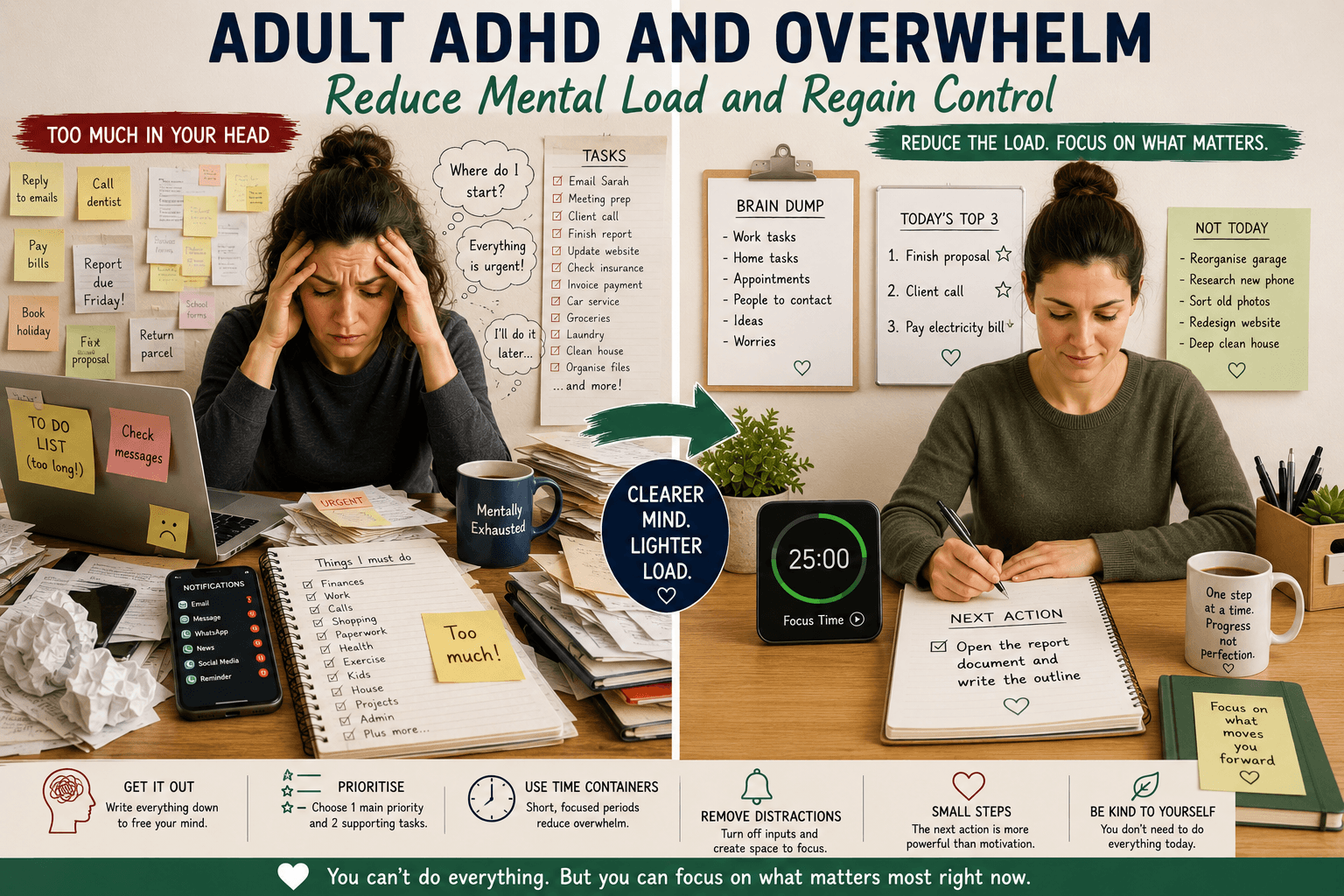
Adult ADHD and Overwhelm: How to Reduce Mental Load and Regain Control
Adult ADHD and overwhelm can make a normal day feel as though too many things are happening at once. For related guidance on decision fatigue, routines, motivation and work, use our Adult ADHD practical guide.
There are emails to answer, appointments to remember and household jobs to complete. In addition, you may have work deadlines, messages, paperwork and shopping competing for your attention.
Meanwhile, several unfinished tasks may still be sitting in the background.
At first, each responsibility may seem manageable. However, when they all compete for attention together, the combined mental load can become much harder to carry.
You may know that something needs to be done. Yet, choosing where to start can become difficult. Then, another thought appears. Meanwhile, another reminder arrives, and a notification flashes.
Eventually, the day can begin to feel like one large unfinished task.
At that point, it is easy to think:
“I need to get everything under control.”
However, trying to control everything at once usually increases the pressure.
Instead, the first step is often to reduce how much you are asking yourself to hold, decide and complete at the same time. If the pressure is mainly about choosing between options, see ADHD decision fatigue; if you know what matters but cannot generate momentum, see ADHD and motivation.
What Does Overwhelm Actually Feel Like?
Overwhelm can look different from person to person.
For some people, it feels like mental noise. For others, it can feel like freezing.
As a result, you may become irritable or start avoiding tasks. In addition, you might move between activities without finishing any of them.
Alternatively, you may become so focused on one small detail that the bigger picture disappears.
Common signs can include:
- not knowing where to start;
- feeling that everything is urgent;
- difficulty prioritising;
- jumping between tasks;
- forgetting what you were doing;
- putting off simple actions;
- feeling mentally exhausted before much has been completed.
Therefore, adult ADHD and overwhelm may become easier to approach when the goal is to reduce competing demands rather than simply increase pressure.
Overwhelm Is Often a Load Problem
Imagine carrying one shopping bag.
That may be easy.
Then, add another. Add another after that.
Eventually, the problem is not that any single bag is too heavy. Instead, the problem is the total load.
Mental demands can work in a similar way.
For example, one appointment, one email, one household task and one decision may each be manageable alone.
However, when many demands remain active at the same time, your attention has to keep moving between them.
As a result, even simple tasks may begin to feel difficult.
Therefore, the solution is often not:
“Try harder.”
Instead, a better question is:
“What can I take out of my head right now?”
Adult ADHD and Overwhelm: Externalise the Load
One of the most useful first steps is to move information out of your head.
First, write it down.
Do not organise it perfectly yet. Instead, simply capture what is competing for your attention.
For example:
- reply to email;
- pay bill;
- call dentist;
- finish report;
- buy food;
- return parcel;
- book appointment.
You could use a notebook, phone note or piece of paper.
Once the information is visible, you no longer have to keep mentally rehearsing it.
As a result, some of the pressure may begin to reduce.
Do a Brain Dump
A brain dump is simply a quick list of everything currently occupying your attention.
First, set a timer for five or ten minutes.
Then, write down anything that feels unfinished.
This could include work, home, appointments, people you need to contact, things to buy, ideas, worries and tasks.
Importantly, do not sort the list while writing.
Instead, get the information out first.
Afterwards, you can decide what deserves attention.
In this way, you separate capture from decision-making.
As a result, you are no longer trying to remember, organise and prioritise everything at exactly the same time.
Not Everything on the List Is Equally Important
A long list can create the impression that every item is urgent.
Usually, however, it is not.
Therefore, after completing the brain dump, divide the list.
For example:
Must Do
Genuinely important or time-sensitive.
Should Do
Useful, but not immediate.
Could Do
Can wait.
In this way, the day begins to develop more shape.
As a result, the list stops behaving like one large emergency.
Choose One Main Priority
When everything feels important, nothing feels clear.
Therefore, ask:
“If I complete only one meaningful thing today, what should it be?”
Choose one.
Then, identify two secondary tasks.
That gives you:
One Main Priority
Two Supporting Tasks
Everything else remains on the wider list.
Importantly, this does not mean the other tasks no longer matter.
Instead, it gives your attention a centre.
Adult ADHD and Overwhelm: Reduce the Visible List
A master task list may contain twenty, fifty or even one hundred items.
That may be useful for storage.
However, it may not be useful to stare at all day.
Therefore, keep the master list somewhere safe and create a smaller daily view.
For example:
Today
- Finish proposal.
- Call supplier.
- Pay bill.
That is what you see.
The rest still exists. However, it does not need to compete for your attention right now.
Consequently, your immediate workload can appear much more manageable.
Use a “Not Today” List
Sometimes it is helpful to actively decide what you are not doing.
For example:
Not today:
- reorganise garage;
- research new phone;
- sort old photos;
- redesign filing system.
This can feel surprisingly calming.
Why?
Because unresolved decisions can remain mentally active.
Therefore, saying “not today” temporarily closes the decision.
You are not rejecting the task forever. Instead, you are giving yourself permission not to carry it today.
Make the Next Action Obvious
Overwhelm often increases when tasks are vague.
For example:
“Sort finances.”
That could mean many things.
Instead, make the next action specific:
“Open bank statement.”
Likewise, “Deal with school paperwork” becomes:
“Find the permission form.”
Similarly, “Plan holiday” becomes:
“Check possible travel dates.”
The smaller and clearer the action, the less mental work is required before beginning.
Consequently, a task that initially felt overwhelming may become much easier to approach.
Stop Looking at the Whole Project
Large projects can create overwhelm because your mind sees the entire distance.
Suppose you need to create a presentation.
You may immediately think about research, slides, graphics, speaking notes, timing, editing and practice.
That is a lot.
However, none of those things need to happen at the same moment.
Therefore, ask:
“What is the next step only?”
Perhaps it is:
Create the title slide.
Do that first.
Then, identify the next step.
In this way, progress can become easier because you are no longer mentally carrying the entire project at once.
Use Short Time Containers
When a task feels endless, give it a time boundary.
For example:
10 minutes — paperwork
15 minutes — kitchen reset
20 minutes — email
25 minutes — report
Now you are not committing to complete everything.
Instead, you are committing to a defined period of effort.
As a result, the task may feel easier to approach.
Adult ADHD and Overwhelm at Work
Work can become overwhelming when several priorities arrive from different directions.
You may have email, messages, meetings, colleagues, deadlines and projects competing for attention.
Therefore, begin by deciding what deserves your strongest attention.
A simple workday structure might be:
First block: important work.
Second block: meetings or communication.
Later: routine admin.
This will not always be possible.
However, even a small amount of structure can reduce constant switching.
As a result, it may become easier to see what deserves attention now and what can wait.
Turn Off Inputs Temporarily
Overwhelm often grows because new information continues arriving while you are trying to process existing information.
Notifications, emails, messages, news and social media can all add more input.
Therefore, create short periods where new information stops arriving.
For example, put the phone on silent.
Next, close your email.
Then, turn off non-essential notifications and close unrelated browser tabs.
Now work with what is already in front of you.
As a result, the mental load stops increasing for a while.
Stop Checking Everything
When overwhelmed, you may repeatedly check email, your task list, calendar, phone and messages.
However, each check can introduce something new.
Instead, decide when you will check.
For example:
10:30 — Email
Lunchtime — Messages
Morning and afternoon — Calendar review
Consequently, you reduce the feeling that everything requires immediate attention.
Use a Holding List for New Tasks
New tasks will still appear.
Someone calls.
An idea appears.
You suddenly remember something.
Instead of switching immediately, capture it on a holding list.
For example:
Later
- email Sarah;
- buy printer ink;
- check insurance;
- book car service.
Then, return to the current task.
In this way, the new item remains safe without forcing an immediate switch.
Adult ADHD and Overwhelm at Home
Home responsibilities can create a different type of overload.
Cleaning, laundry, food, shopping, paperwork, family schedules and repairs can all compete for attention.
Therefore, avoid thinking:
“I need to sort the house.”
That is too broad.
Instead, choose one zone or one task.
For example, clear the kitchen surface, put one load of washing on, sort the post for ten minutes or prepare tomorrow’s bags.
As a result, one completed area may reduce more stress than starting five household jobs.
Use Home Zones
Earlier in this series, we discussed adult ADHD and home zones.
Zones can reduce overwhelm because they create clearer purposes.
For example, a focus zone holds work.
An admin zone holds paperwork.
A transition zone holds keys, bags and outgoing items.
Meanwhile, a rest zone protects recovery.
Therefore, when things begin spreading across the home, return items to their zones rather than trying to reorganise everything from scratch.
Reduce Visual Clutter
Visual clutter can increase the number of things competing for attention.
Therefore, if a room feels mentally noisy, do not automatically try to clean the whole room.
Instead, clear one visible surface.
Put unrelated items into one temporary basket.
Then, move paperwork into the admin zone.
As a result, the environment becomes easier to read.
Moreover, this can create a useful sense of control without requiring a major cleaning session.
Decision Fatigue Can Increase Overwhelm
Article 9 explored adult ADHD and decision fatigue.
The connection is important.
When you are already overloaded, even small choices can feel difficult.
What should I eat?
Which task should I do first?
Should I answer this now?
Therefore, use defaults where they help.
Choose a simple meal.
Follow today’s top three.
Use your usual routine.
Put common items in fixed locations.
As a result, every decision you remove leaves more mental space for the decisions that genuinely matter.
Time Blindness Can Increase Overwhelm
Article 10 explored adult ADHD and time blindness.
If several tasks feel urgent because you are unsure how long they will take, overwhelm can increase.
Therefore, make time more visible.
Set a timer.
Estimate the task.
Add a buffer.
Then, schedule the action.
Now the task has a place.
As a result, it no longer floats vaguely through the entire day.
Procrastination Can Increase Overwhelm
Article 11 explored adult ADHD and procrastination.
Avoided tasks do not simply disappear.
Instead, they can remain mentally active.
Consequently, the backlog grows and overwhelm may increase.
Therefore, where possible, reduce avoided tasks to very small starting actions.
Open the document.
Find the form.
Write one sentence.
Make one call.
In this way, small progress can remove something from the mental background.
Adult ADHD and Overwhelm on Low-Energy Days
Low-energy days require a different standard.
If you are tired, stressed or mentally drained, your usual workload may be unrealistic.
Therefore, reduce the plan.
For example:
Essential
One important task.
Helpful
One small household or admin task.
Optional
Everything else.
As a result, the day can continue moving without pretending that every day has the same capacity.
Create a Minimum Day
A minimum day is the smallest useful version of the day.
For example:
Eat.
Take essential medication if prescribed.
Attend important commitments.
Complete one priority.
Do one small reset.
Prepare tomorrow.
For some days, that may be enough.
Importantly, a minimum day is not failure.
Instead, it is a flexible system for periods when energy is limited.
Use a Reset Point
Sometimes the day has already gone wrong.
The schedule is broken.
Several tasks remain unfinished.
As a result, you may feel behind.
At this point, trying to rescue the whole day may create even more pressure.
Instead, create a reset.
For example:
- Stop for five minutes.
- Write down what remains.
- Choose one important task.
- Clear the immediate workspace.
- Begin again.
Therefore, you do not need to repair the entire day.
Instead, you simply need a new starting point.
The Five-Minute Overwhelm Reset
When everything feels too much, try this:
Minute 1
Stop new input.
Put the phone on silent.
Minute 2
Write down what is competing for attention.
Minute 3
Circle the one thing that matters most.
Minute 4
Define the next physical action.
Minute 5
Prepare the environment and begin.
This is not a magic solution.
However, it can help turn an unclear mental load into one visible next step.
Therefore, the purpose is not to solve everything in five minutes. The purpose is to make the next action clearer.
Do Not Organise When You Need to Act
Sometimes overwhelm triggers the urge to create a new organisation system.
A new planner.
A new app.
New folders.
New categories.
However, this can sometimes delay the actual work.
Therefore, ask:
“Do I need a better system right now, or do I simply need to complete the next action?”
If the existing system is good enough, use it.
After all, organisation should reduce work.
It should not become another project.
Limit the Number of Open Projects
Too many active projects can create background pressure.
You may have a work project, home project, fitness goal, course, side project, organisation project and travel planning all active at once.
Therefore, consider limiting how many significant projects remain active at the same time.
Some can move to:
Later
or:
Not currently active
This does not mean abandoning them.
Instead, it means reducing simultaneous mental load.
Close Small Loops
Some unfinished tasks take only a few minutes.
For example:
Book an appointment.
Send a document.
Confirm a meeting.
Pay a bill.
If practical, closing one or two small loops can create noticeable relief.
However, do not spend the entire day completing minor tasks simply because they are easy.
Instead, use them strategically.
Close a few.
Then, return to the main priority.
Be Careful With Urgency
When overwhelmed, everything may begin to feel urgent.
Therefore, ask:
“What genuinely happens if this waits until tomorrow?”
Sometimes the answer is:
Nothing significant.
In that case, the task can move.
Therefore, try to distinguish between actual urgency and emotional urgency.
They are not always the same.
Create an “Emergency Filter”
When everything feels urgent, use three questions:
- Does this have a real deadline today?
- Will someone be negatively affected if it waits?
- Does delaying it create a serious consequence?
If the answer is no, it may not belong in today’s emergency category.
As a result, this simple filter can help shrink the immediate workload.
Adult ADHD and Overwhelm After a Late Diagnosis
After a late ADHD diagnosis, past overwhelm may begin to look different.
Perhaps you were often told that you were disorganised.
Alternatively, you may have handled many responsibilities well until they accumulated beyond a certain point.
You may also have worked effectively under clear structure but struggled when several unstructured demands arrived together.
Understanding adult ADHD and overwhelm can provide another way to examine these patterns.
The aim is not to remove every difficult feeling.
Instead, it is to build systems that reduce unnecessary mental load before it reaches breaking point.
Notice What Usually Comes Before Overwhelm
Overwhelm often has warning signs.
For example, your desk may become cluttered.
You may stop checking the calendar.
Meanwhile, emails begin accumulating.
Perhaps you start switching between tasks more frequently or avoid opening the task list completely.
Therefore, learn your early signals.
As a result, if you notice these signs sooner, you can reduce the load before everything feels unmanageable.
Create an Early Intervention Plan
Your plan might say:
When I notice overwhelm building:
- Stop adding optional commitments.
- Review the calendar.
- Reduce today’s priorities to three.
- Clear one working surface.
- Turn off unnecessary notifications.
- Move non-urgent tasks to later.
- Protect recovery time.
As a result, you do not need to invent a solution while already overwhelmed.
The plan already exists.
Use Recovery Without Guilt
Sometimes the most useful action is a short break.
For example, walk, eat, drink water, sit somewhere quiet or step away from the screen.
However, choose recovery that actually helps.
Scrolling through more information may not reduce mental load.
Instead, a quieter break may be more effective.
Afterwards, return to one clear task.
Ask for Help Before the Load Becomes Too Large
Some responsibilities can be shared.
For example, at home, another person may handle a task.
At work, priorities may need clarification.
Alternatively, a professional may help with complicated paperwork or administration.
Therefore, asking for support does not need to wait until everything feels impossible.
In fact, early clarification or delegation may prevent later overwhelm.
Build a Personal Overwhelm Toolkit
Your toolkit might include:
Brain Dump
Move everything out of your head.
Top Three
Choose only today’s main priorities.
Not Today List
Temporarily close non-urgent decisions.
Time Container
Give a task a clear boundary.
Holding List
Capture new tasks without switching.
Five-Minute Reset
Turn mental noise into one next action.
Minimum Day
Reduce expectations when energy is low.
Home Zones
Give important activities and objects clear places.
You do not need every tool every day.
Instead, use the one that matches the problem you are facing.
A Simple Overwhelm Routine
When adult ADHD and overwhelm begin to build, try this sequence:
First: Stop taking in new information for a few minutes.
Next: Write down everything competing for attention.
Then: Mark what genuinely needs attention today.
After that: Choose one priority.
Next: Define the smallest physical action.
Finally: Start that action before reorganising anything else.
In this way, you move from:
Everything
to:
One thing.
As a result, the situation may begin to feel much more manageable.
Start With One Thing
If you are overwhelmed right now, do not try to implement this whole article.
Instead, choose one action.
Perhaps write everything down.
Alternatively, clear the desk.
You could choose today’s top three.
Or, set a ten-minute timer.
First, do that one thing.
Afterwards, decide what the next useful step should be.
The goal is not to solve your entire life in one session.
Instead, it is to reduce the load enough to move again.
Reflection Questions
- What usually triggers overwhelm for you?
- What are you currently trying to keep in your head?
- Which three things genuinely matter today?
- What can move to a “not today” list?
- Is your current task clear enough to start?
- Which notifications or inputs could you pause?
- What would your minimum day look like?
- What warning signs appear before overwhelm becomes intense?
- Which responsibility could be shared or delegated?
- What one action would reduce your mental load today?
Conclusion
Adult ADHD and overwhelm can make ordinary responsibilities feel much larger when too many tasks, decisions and reminders remain active at the same time.
However, you do not need to solve everything at once.
Instead, reduce the load.
Write things down.
Then, shrink the visible task list and choose one main priority.
Create a “not today” list.
Use short time containers.
In addition, pause new inputs when your attention is already overloaded.
Most importantly, make the next action clear.
You do not need to carry the whole day at once.
Instead, you only need to know what comes next.
Therefore, when everything feels urgent, try replacing:
“How am I going to manage all of this?”
with:
“What can I remove, postpone or simplify right now?”
Over time, adult ADHD and overwhelm may become easier to manage when your systems reduce mental load before it becomes too heavy.
SUGGESTED INTERNAL LINKS
- Adult ADHD and Procrastination: How to Make Starting Tasks Easier
- Adult ADHD and External Memory: How to Stop Holding Everything in Your Head
DISCLAIMER
This article is provided for general educational and informational purposes only. It does not provide medical, psychological, diagnostic or therapeutic advice and should not be used as a substitute for individual guidance from an appropriately qualified healthcare professional.
Feelings of overwhelm can have many causes, and ADHD experiences vary considerably between individuals. If overwhelm is persistent, severe or significantly affecting your wellbeing or daily functioning, or if you have concerns about ADHD, mental health, diagnosis, medication or treatment, please speak with an appropriately qualified healthcare professional.