
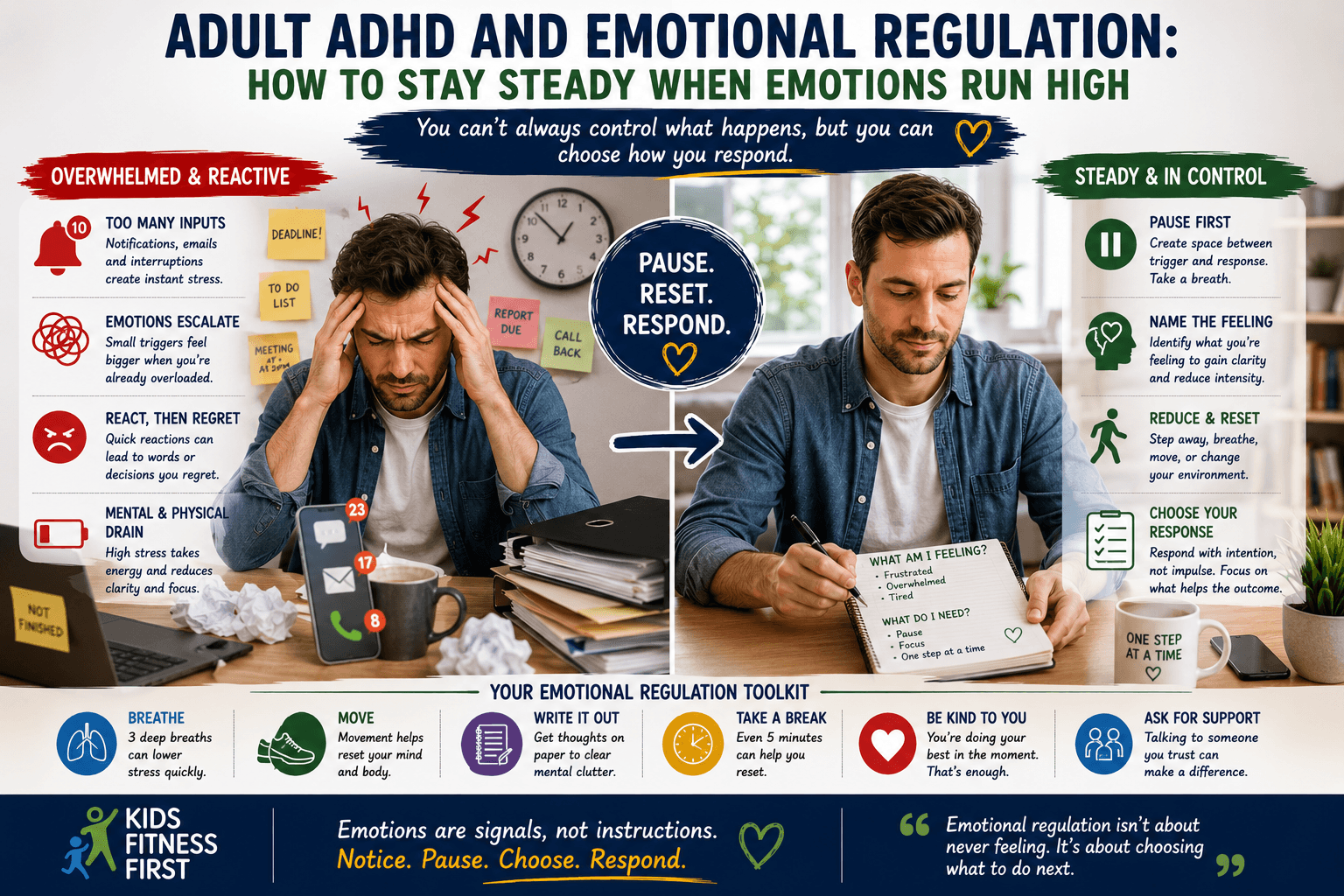
Adult ADHD and Emotional Regulation: How to Stay Steady When Emotions Run High
Adult ADHD and emotional regulation can become difficult when stress, frustration or pressure builds quickly. This guide sits within our wider Adult ADHD practical resource, which routes readers to related topics without treating every difficulty as the same problem.
You may begin the day feeling fine.
Then one small thing goes wrong.
An email arrives with bad news.
Someone interrupts you.
A task takes longer than expected.
Another problem appears.
Meanwhile, your mental load is already high.
At first, you may try to ignore the pressure. However, as more demands appear, your emotional response can become stronger.
You might feel irritated.
You may become impatient.
Alternatively, you may shut down and want to avoid everything.
Later, when the moment passes, you may think:
“Why did that affect me so much?”
The answer is not always that the situation itself was enormous.
Instead, the emotional response may have been shaped by everything that came before it.
Therefore, one useful goal is to recognise the build-up earlier and create more space between the feeling and the response. This article focuses particularly on cumulative stress and overload: what happens when sleep, workload, interruptions and competing demands lower your capacity before the final trigger arrives.
What Is Emotional Regulation?
Emotional regulation is the ability to notice, understand and respond to emotions in a way that supports the situation.
It does not mean never feeling angry, frustrated, disappointed or overwhelmed.
In fact, those emotions are a normal part of life.
The goal is not to remove emotion.
Instead, it is to reduce the chance that a temporary emotional state completely controls what happens next.
For example, you may still feel frustrated.
However, you can learn to pause before sending an angry email.
You may still feel overwhelmed.
Yet, you can reduce the number of things competing for attention before reacting.
That is where practical strategies can help.
Why Adult ADHD and Emotional Regulation Can Feel Difficult
Daily life contains many small emotional triggers.
Being interrupted.
Waiting.
Running late.
Losing something.
Receiving criticism.
Feeling misunderstood.
Making a mistake.
Individually, each event may seem manageable.
However, when several happen close together, the combined load can become much harder to manage.
This is why adult ADHD and emotional regulation are often connected with stress, attention and overload.
The emotional response does not exist separately from the rest of the day.
Instead, it is influenced by sleep, energy, workload, environment and the number of demands already competing for attention.
Learn Your Early Warning Signs
Strong emotions rarely appear from nowhere.
Often, there are signs first.
For example:
your body feels tense;
you begin speaking more quickly;
you become more impatient;
you start checking things repeatedly;
your thoughts become more negative;
you feel the urge to escape the situation.
Therefore, one of the most useful skills is learning to notice what happens before the emotional response becomes intense.
Ask:
“What does stress feel like in my body?”
Perhaps your shoulders tighten.
Maybe your breathing changes.
You might begin clenching your jaw.
Once you recognise the signal, you have an earlier opportunity to respond.
Adult ADHD and Emotional Regulation: Name the Feeling
Sometimes emotion becomes more manageable when it has a name.
For example:
“I am frustrated.”
“I feel overwhelmed.”
“I am embarrassed.”
“I am disappointed.”
Naming the feeling does not remove it.
However, it creates a little distance.
Instead of:
“Everything is going wrong.”
you may be able to say:
“I am feeling overwhelmed because several things are happening at once.”
That is a more specific problem.
As a result, the next action becomes easier to identify.
Separate the Feeling From the Action
A feeling is not the same as an instruction.
You can feel angry without sending the message.
You can feel frustrated without walking away permanently.
You can feel embarrassed without deciding that everything has failed.
Therefore, when emotions run high, ask:
“What am I feeling?”
Then ask:
“What action would actually help?”
Those two answers may be different.
Use a Short Pause
A short pause can create space between emotion and action.
This does not need to be dramatic.
For example:
take three slower breaths;
stand up;
walk to another room;
drink some water;
wait five minutes before replying.
The purpose is not to suppress the emotion.
Instead, it is to allow the intensity to reduce slightly before making a decision.
Use the “Pause Before Send” Rule
Digital communication makes quick reactions easy.
An upsetting email arrives.
You immediately begin typing.
However, the first draft may reflect the emotion more than the outcome you actually want.
Therefore, create a rule:
If the message makes me angry, I do not send the first response immediately.
Write it if necessary.
Save it.
Then return later.
As a result, you can decide whether the message still represents what you want to say.
Adult ADHD and Emotional Regulation at Work
Work can create emotional pressure through deadlines, criticism, uncertainty and interruptions.
Therefore, emotional regulation at work often begins with reducing avoidable overload.
For example:
do not answer difficult emails while already rushing;
create short buffers after intense meetings;
clarify priorities when several people are demanding different things;
step away briefly after a difficult conversation.
As a result, you reduce the number of triggers arriving on top of each other.
Build a Buffer After Difficult Conversations
A difficult conversation can continue affecting attention long after it ends.
You may replay it mentally.
Meanwhile, the next task is waiting.
Therefore, build a short reset where possible.
For example:
write down any action points;
take a short walk;
drink water;
return to one clear task.
Consequently, the emotional event is less likely to spread into the rest of the day.
Avoid Making Big Decisions in the Peak of Emotion
Strong emotion changes how a situation feels.
Something may seem catastrophic in the moment.
Later, it may look more manageable.
Therefore, avoid major decisions during the emotional peak where possible.
For example:
do not resign in anger;
do not send an irreversible message;
do not make a major purchase to change your mood;
do not end an important relationship because of one difficult moment.
Instead, pause.
Gather information.
Return to the decision later.
Adult ADHD and Emotional Regulation at Home
Home can also contain repeated triggers.
Noise.
Mess.
Interruptions.
Family demands.
Unfinished chores.
Therefore, emotional regulation at home often improves when the environment becomes simpler.
Earlier in this series, we discussed adult ADHD and home zones, visual clutter and daily friction.
These ideas connect directly.
If your environment already feels chaotic, small emotional triggers can have a larger effect.
As a result, reducing clutter and repeated friction may support emotional steadiness too.
Reduce the Load Before Solving the Problem
When emotionally overloaded, trying to solve everything at once can make the feeling stronger.
Instead, reduce the immediate load.
For example:
silence notifications;
move away from the noisy room;
write down competing tasks;
choose one problem;
leave the rest for later.
Then, deal with the issue in front of you.
This can make the situation feel more manageable.
Use a Reset Routine
A reset routine can help when emotion and overwhelm begin to build.
For example:
Step 1
Stop new input.
Step 2
Name the feeling.
Step 3
Take a short physical pause.
Step 4
Write down the problem.
Step 5
Choose one helpful action.
This creates structure in a moment that might otherwise feel chaotic.
Adult ADHD and Emotional Regulation on Low-Energy Days
Low energy can reduce patience.
You may react more strongly when tired, hungry or mentally exhausted.
Therefore, emotional regulation is partly about recognising capacity.
On low-energy days:
reduce optional commitments;
avoid stacking difficult conversations;
eat regularly;
build in short breaks;
lower the number of active priorities.
As a result, fewer emotional triggers compete for limited energy.
Notice the Role of Sleep
Poor sleep can make emotional reactions feel stronger.
A small frustration may feel much larger after a bad night.
Therefore, do not judge every difficult reaction as a permanent problem.
Sometimes the body is simply running with less capacity.
That does not mean the situation should be ignored.
Instead, it means you may need more support and fewer demands that day.
Adult ADHD and Emotional Regulation With Criticism
Criticism can be difficult even when it is useful.
You may immediately feel defensive.
However, not every critical comment is a personal attack.
Therefore, create a two-step response.
First:
“What exactly was said?”
Second:
“Is there useful information inside it?”
This helps separate the emotional reaction from the content.
Ask for Specific Feedback
Vague criticism is difficult to act upon.
For example:
“This is not good enough.”
That creates uncertainty.
Instead, ask:
“Which part needs changing?”
Or:
“What specific outcome are you looking for?”
As a result, the feedback becomes more practical and less emotionally overwhelming.
Do Not Replay Every Difficult Interaction
The mind can keep returning to an uncomfortable conversation.
What did they mean?
What should I have said?
Why did I respond like that?
However, repeatedly replaying the interaction may continue the emotional state long after the event has ended.
Therefore, use a closure step.
For example:
write down what happened;
identify any action required;
decide what you will do differently next time;
then move on.
This turns rumination into a practical review.
Use External Memory for Emotional Situations
Article 8 explored adult ADHD and external memory.
External memory can help emotionally too.
For example, after a difficult meeting, write:
What happened.
What needs action.
What can wait.
What I need to remember.
Now the information no longer has to stay active in your head.
As a result, the emotional loop may become easier to close.
Decision Fatigue Can Increase Emotional Reactivity
Article 9 explored adult ADHD and decision fatigue.
When you have already made dozens of decisions, small problems may feel larger.
Therefore, use defaults and routines where possible.
Reduce repeated choices.
As a result, more mental capacity remains available when an emotionally difficult situation appears.
Time Blindness Can Create Emotional Pressure
Article 10 explored adult ADHD and time blindness.
Running late can create stress quickly.
Then one small delay becomes another trigger.
Therefore, use buffers and preparation alarms.
As a result, fewer situations begin from a rushed or pressured state.
Procrastination Can Build Emotional Stress
Article 11 explored adult ADHD and procrastination.
Avoided tasks remain in the background.
Consequently, guilt and stress can build.
Therefore, reduce avoided tasks into small starting actions.
A small amount of progress can reduce emotional pressure.
Overwhelm Can Intensify Emotional Responses
Article 12 explored adult ADHD and overwhelm.
When everything already feels too much, one additional problem can feel enormous.
Therefore, use the same overwhelm tools:
brain dump;
top three;
not-today list;
short time containers;
reduced inputs.
As a result, the emotional problem is no longer sitting on top of an already overloaded system.
Prioritisation Can Protect Emotional Energy
Article 13 explored adult ADHD and prioritisation.
When priorities are unclear, you may constantly feel behind.
Therefore, choose one main priority.
Move non-urgent tasks away.
Consequently, the day carries less background pressure.
Routine Can Create Emotional Stability
Article 14 explored adult ADHD and routine.
Routine can create predictable anchors.
For example:
morning check-in;
lunch break;
shutdown routine;
evening reset.
These familiar points can make the day feel more stable.
Therefore, routine can support emotional regulation indirectly by reducing uncertainty.
Follow-Through Reduces Emotional Background Noise
Article 15 explored adult ADHD and follow-through.
Unfinished tasks can remain mentally active.
Therefore, closing loops can reduce background stress.
Finish one open task.
Save the confirmation.
Put the item away.
As a result, fewer unfinished demands remain in the background.
Use Movement as a Reset
Physical movement can help create separation from an intense moment.
For example:
walk around the block;
stretch;
step outside;
climb stairs;
move to another room.
This is not about “exercising the emotion away.”
Instead, movement can mark the end of one state and the beginning of another.
Use Breathing as a Pause, Not a Cure
Breathing exercises are often recommended for stress.
They may help some people.
However, they should not be presented as a magical solution.
The purpose is simply to slow the moment.
For example:
inhale comfortably;
exhale slightly longer;
repeat several times.
Then decide what action is needed.
Create a Personal Calm-Down List
When emotions are already intense, it can be difficult to remember what helps.
Therefore, prepare a list beforehand.
For example:
My Reset Options
- step outside;
- drink water;
- walk for five minutes;
- turn off notifications;
- write down the problem;
- wait before replying;
- talk to someone I trust.
As a result, you do not need to invent a strategy in the middle of the difficult moment.
Adult ADHD and Emotional Regulation With Conflict
Conflict can escalate quickly when both people feel unheard.
Therefore, if a conversation becomes too heated, consider pausing.
For example:
“I want to discuss this properly, but I need a few minutes before continuing.”
This does not mean avoiding the issue.
Instead, it protects the conversation from becoming less constructive.
Focus on the Outcome You Want
When angry, the immediate goal can become:
“I need them to know how angry I am.”
However, the real goal may be:
resolve the problem;
be understood;
set a boundary;
get an answer.
Therefore, ask:
“What outcome do I actually want?”
Then choose the response that is most likely to move towards that outcome.
Avoid All-or-Nothing Thinking
Strong emotions can create extreme conclusions.
“Everything is ruined.”
“I always get this wrong.”
“Nothing is working.”
However, one difficult moment rarely defines the whole situation.
Therefore, use more specific language.
Instead of:
“Everything is wrong.”
try:
“This particular part is difficult right now.”
That creates room for problem-solving.
Adult ADHD and Emotional Regulation After a Late Diagnosis
After a late ADHD diagnosis, past emotional experiences may begin to look different.
Perhaps you were told that you were “too sensitive.”
Maybe frustration arrived quickly.
Perhaps you struggled with criticism or became overwhelmed by too many demands at once.
Understanding adult ADHD and emotional regulation can provide another way to examine these patterns.
The goal is not to justify every reaction.
Instead, it is to recognise the conditions that make emotional responses easier or harder to manage.
Once those conditions are clearer, you can build better support around them.
Build a Personal Emotional Regulation Toolkit
Your toolkit might include:
Early Warning Signs
Know what stress looks like for you.
Name the Feeling
Turn a vague reaction into specific information.
Pause Before Responding
Create space between feeling and action.
Reduce Inputs
Lower environmental overload.
Short Movement Reset
Change physical state and location.
Outcome Question
Ask what result you actually want.
Calm-Down List
Keep helpful options ready.
Closure Step
Turn difficult events into clear next actions.
You do not need every strategy every time.
Use the one that matches the situation.
A Simple Emotional Reset Routine
When adult ADHD and emotional regulation become difficult, try this sequence:
First: Notice the physical or mental warning sign.
Next: Name the feeling.
Then: Pause before acting.
After that: Reduce unnecessary inputs.
Next: Ask what outcome you want.
Finally: Choose one response that supports that outcome.
If possible, return to the situation when the emotional intensity is lower.
Start With One Trigger
Think about a situation that regularly causes a strong reaction.
Perhaps:
being interrupted;
running late;
criticism;
too many messages;
unfinished work.
Then ask:
What happens just before I react?
Identify the warning sign.
Afterwards, choose one pause strategy.
For example:
When I notice my jaw tightening during a difficult email, I will wait ten minutes before replying.
That is specific.
It can be tested.
Reflection Questions
- Which situations most often trigger a strong emotional response?
- What physical signs appear before the reaction becomes intense?
- Which feeling is hardest for you to name?
- Do you respond immediately to difficult messages?
- Would a short pause help before replying?
- Which environments make emotional overload worse?
- What usually helps you recover?
- Which unfinished tasks create background stress?
- What outcome do you usually want during conflict?
- What one reset strategy could you prepare today?
Conclusion
Adult ADHD and emotional regulation can become difficult when stress, overload and repeated demands build faster than your ability to recover.
However, the goal is not to eliminate emotion.
Instead, recognise the warning signs earlier.
Name the feeling.
Create a short pause.
Reduce unnecessary inputs.
In addition, avoid making important decisions at the peak of emotion where possible.
Most importantly, focus on the outcome you actually want.
A strong feeling can be real without needing to control the next action.
Therefore, instead of asking:
“Why am I reacting like this?”
try asking:
“What is this feeling telling me, and what response would help most?”
Over time, adult ADHD and emotional regulation may become easier when you recognise the build-up earlier, reduce overload and create practical space between emotion and action.
SUGGESTED INTERNAL LINKS
- Adult ADHD and Follow-Through: How to Finish What You Start
- Adult ADHD and External Memory: How to Stop Holding Everything in Your Head
DISCLAIMER
This article is provided for general educational and informational purposes only. It does not provide medical, psychological, diagnostic or therapeutic advice and should not be used as a substitute for individual guidance from an appropriately qualified healthcare professional.
Emotional regulation difficulties can have many causes, and ADHD experiences vary considerably between individuals. Therefore, if emotional reactions are severe, persistent or significantly affecting your wellbeing, relationships or daily life, or if you have concerns about ADHD, mental health, diagnosis, medication or treatment, please speak with an appropriately qualified healthcare professional.