
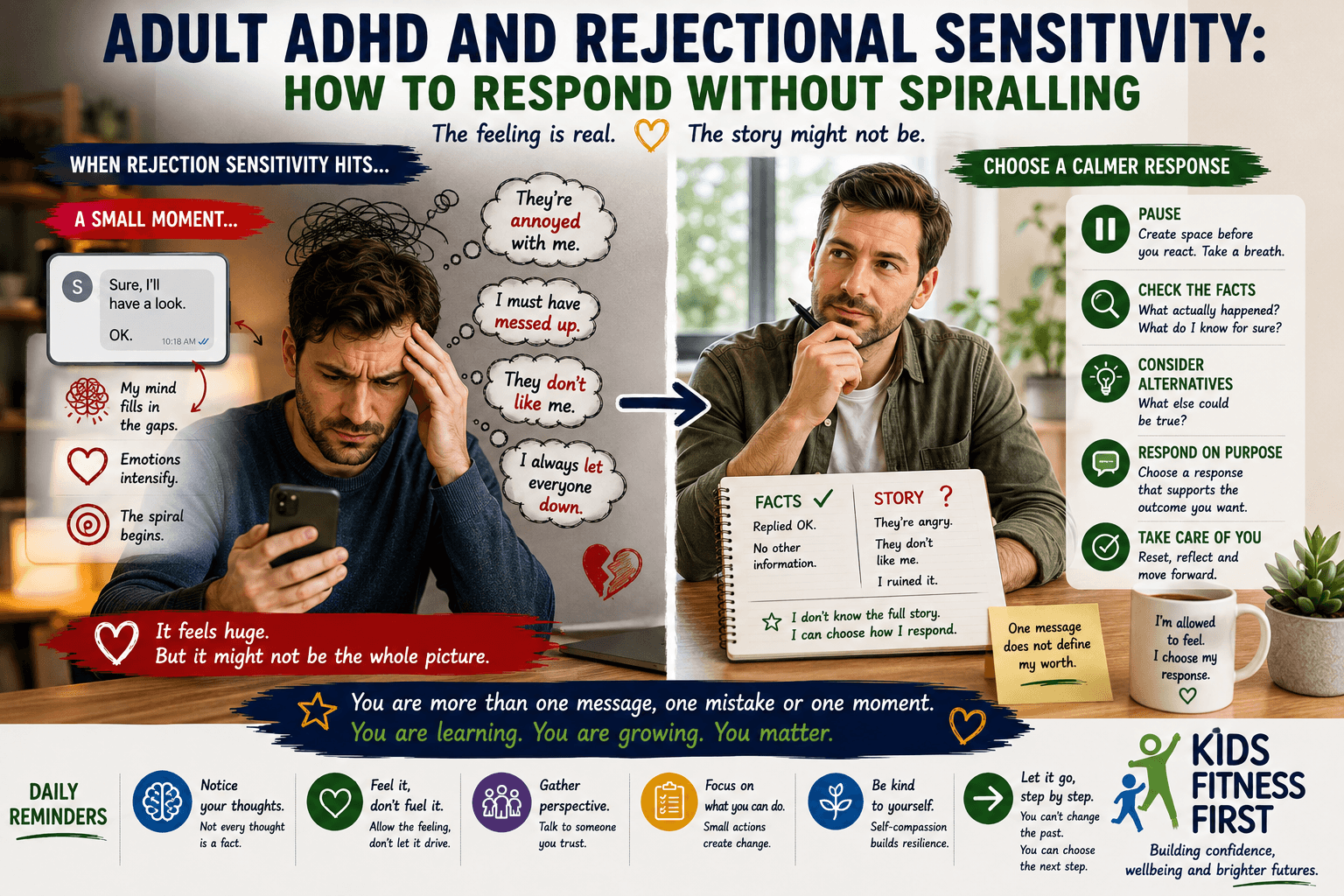
Adult ADHD and Rejection Sensitivity: How to Respond Without Spiralling
Adult ADHD and rejection sensitivity can make an ordinary interaction feel much bigger than it appears from the outside.
A message arrives.
The reply is short.
Your manager sounds disappointed.
A friend does not answer.
Someone gives you feedback.
At first, the situation may seem small. However, your mind quickly begins filling in the gaps.
“They are annoyed with me.”
“I have ruined this.”
“They do not want me around.”
“I have let everyone down.”
Meanwhile, the emotional response becomes stronger.
You may feel embarrassed, rejected, angry or ashamed.
As a result, one comment can begin to affect the rest of your day.
Later, when the emotion settles, you may look back and think:
“Why did that hit me so hard?”
The important point is that the feeling itself can be real even when your first interpretation of the situation is incomplete.
Therefore, the goal is not to tell yourself that you should not care.
Instead, the goal is to create enough space to check what actually happened before deciding what it means.
What Is Rejection Sensitivity?
“Rejection sensitivity” is commonly used to describe a strong emotional response to actual, expected or perceived rejection, criticism or disapproval.
It is not a standalone diagnosis.
However, many people use the term to describe experiences where criticism or possible rejection feels unusually intense.
For example, you may react strongly to:
- a short message;
- a critical comment;
- being left out;
- a delayed reply;
- a disagreement;
- a mistake;
- feedback at work;
- feeling ignored;
- believing someone is disappointed in you.
Importantly, the emotional response may happen before you have had time to examine the situation carefully.
That is why adult ADHD and rejection sensitivity can become easier to manage when you slow down the meaning-making process.
The Feeling Is Real, But the Story May Not Be Complete
Suppose someone replies:
“OK.”
That is the fact.
However, your mind may add:
“They are angry.”
That is an interpretation.
The interpretation may be correct.
However, it may also be wrong.
Perhaps they are busy.
Maybe they are tired.
Perhaps they simply use short messages.
Therefore, one of the most useful skills is separating:
What happened?
from:
What am I assuming it means?
That small distinction can reduce a great deal of unnecessary distress.
Adult ADHD and Rejection Sensitivity: Use the Facts First
When a situation feels painful, write down the facts.
For example:
Fact: My manager said the report needs more detail.
Then write the interpretation:
Interpretation: My manager thinks I am incompetent.
These are not the same thing.
Therefore, ask:
“What do I actually know?”
Then ask:
“What am I adding?”
As a result, the situation becomes easier to examine without dismissing the emotion.
Create a Facts and Story List
A simple two-column exercise can help.
FACTS
They have not replied for six hours.
STORY
They are deliberately ignoring me.
Another example:
FACTS
The presentation needs changes.
STORY
I embarrassed myself and everyone thinks I am useless.
In this way, you can see where certainty ends and interpretation begins.
This does not mean the story is definitely wrong.
Instead, it means it has not yet been proven.
Pause Before Reacting
A strong emotional reaction can create an urge to respond immediately.
You may want to:
send another message;
defend yourself;
apologise repeatedly;
withdraw;
cancel plans;
argue;
quit.
However, immediate action can make the situation harder.
Therefore, create a pause.
For example:
“I will wait 20 minutes before replying.”
Or:
“I will write the response but not send it yet.”
As a result, the emotion has more time to settle before you make a decision.
Use the Draft, Don’t Send Rule
If you need to express what you are feeling, write it down.
Write the angry reply.
Write the defensive email.
Write what you wish you could say.
However, do not send it immediately.
Instead, save it as a draft.
Then return later.
Ask:
“Does this response help the outcome I actually want?”
Often, the second version is calmer and more effective.
Adult ADHD and Rejection Sensitivity at Work
Workplaces naturally contain feedback.
That means criticism is sometimes unavoidable.
A manager may ask for changes.
A colleague may disagree.
A client may reject an idea.
However, feedback about work is not always a judgement about you as a person.
Therefore, separate:
“This piece of work needs improvement.”
from:
“I am a failure.”
That distinction matters.
Ask for Specific Feedback
Vague criticism is much harder to process.
For example:
“This is not good enough.”
That leaves many questions.
Instead, ask:
“Which part would you like me to improve?”
Or:
“What specifically is missing?”
As a result, the situation moves from emotional uncertainty to something practical.
Now there is an action.
Turn Feedback Into Tasks
Suppose the feedback is:
“This report needs more evidence.”
Instead of thinking:
“They hated it.”
turn it into actions:
- Add two supporting examples.
- Check figures.
- Expand conclusion.
- Resubmit.
Therefore, the feedback becomes work to complete rather than a judgement to carry.
Adult ADHD and Rejection Sensitivity in Relationships
Personal relationships can create stronger emotional reactions because they matter deeply.
A partner seems quiet.
A friend cancels.
Someone takes longer than usual to reply.
Immediately, your mind may search for meaning.
However, guessing often increases distress.
Therefore, where appropriate, ask.
For example:
“You seem quieter than usual. Is everything OK?”
This gives the other person an opportunity to explain.
As a result, you rely less on assumptions.
Avoid Mind Reading
Mind reading happens when we decide we know what another person thinks without clear evidence.
For example:
“They think I am annoying.”
“They are disappointed in me.”
“They do not want me there.”
These thoughts may feel convincing.
However, feeling certain is not the same as having evidence.
Therefore, ask:
“What evidence do I actually have?”
Then consider another possible explanation.
Use the Three Explanations Rule
When you notice yourself assuming the worst, create three possible explanations.
For example:
They have not replied.
Possible explanation 1: They are annoyed.
Possible explanation 2: They are busy.
Possible explanation 3: They saw the message and forgot to reply.
Now the situation contains uncertainty rather than one catastrophic conclusion.
As a result, the emotional intensity may begin to reduce.
Adult ADHD and Rejection Sensitivity After Making a Mistake
Mistakes can trigger powerful self-criticism.
You send the wrong file.
You forget something.
You miss a deadline.
Then, the internal response becomes:
“I always mess things up.”
However, one mistake is not evidence that everything you do is wrong.
Therefore, describe the mistake precisely.
Instead of:
“I am useless.”
say:
“I sent the wrong attachment.”
That is a problem you can solve.
Move From Identity to Action
Identity statements are broad.
“I am terrible at everything.”
Action statements are specific.
“I forgot to check the attachment before sending.”
The second version creates a solution.
For example:
Next time → check attachment before pressing send.
Therefore, specific language can protect you from turning one mistake into a judgement about your whole identity.
Adult ADHD and Rejection Sensitivity With Social Media
Social media can create constant opportunities for comparison and perceived rejection.
Someone does not like your post.
A message is seen but unanswered.
Other people appear to be doing better.
Meanwhile, the brain begins filling in meaning.
Therefore, be careful about using online responses as a measure of your worth.
A like, reply or view is not a complete picture of how another person thinks about you.
As a result, reducing repeated checking may also reduce emotional pressure.
Stop Checking for Reassurance
After an upsetting interaction, you may repeatedly check:
Has the message been read?
Did they reply?
Did they unfollow me?
Did they like the post?
However, each check can restart the emotional loop.
Therefore, set a boundary.
For example:
“I will check again after lunch.”
Then put the phone away.
This creates space for your attention to move elsewhere.
Reassurance Can Become a Loop
It is normal to seek reassurance sometimes.
However, repeated reassurance may not create lasting relief.
You ask:
“Are you angry?”
They say no.
Five minutes later, you ask again.
The uncertainty returns.
Therefore, instead of asking repeatedly, notice the pattern.
Ask yourself:
“Do I need new information, or am I trying to reduce discomfort?”
That question can be useful.
Adult ADHD and Rejection Sensitivity Can Affect Confidence
Repeated emotional responses to criticism can slowly change self-confidence.
You may begin avoiding situations where you could be judged.
For example:
not applying for a job;
not sharing an idea;
not speaking in meetings;
avoiding new relationships.
However, avoiding every possible rejection also removes opportunities.
Therefore, the goal is not to eliminate risk.
Instead, it is to build enough support that discomfort does not automatically decide what you do.
Separate Discomfort From Danger
Rejection feels unpleasant.
Criticism can hurt.
However, discomfort does not always mean danger.
Therefore, when the emotional response becomes intense, ask:
“Is this actually unsafe, or is it uncomfortable?”
Those are different situations.
If it is unsafe, act accordingly.
If it is uncomfortable, you may have more options than the emotion suggests.
Adult ADHD and Rejection Sensitivity on Low-Energy Days
Low energy can make emotional reactions stronger.
You may have less patience.
Feedback may feel harsher.
A delayed response may feel more personal.
Therefore, take capacity into account.
On low-energy days:
reduce unnecessary conflict;
avoid important conversations when exhausted where possible;
eat regularly;
take breaks;
delay non-urgent decisions.
As a result, you reduce the chance that fatigue amplifies the situation.
Emotional Regulation Supports Rejection Sensitivity
Article 16 explored adult ADHD and emotional regulation.
These ideas connect directly.
When rejection sensitivity appears, use the same pause process:
Notice the feeling.
Name it.
Pause.
Reduce input.
Check the facts.
Choose the response.
Therefore, rejection sensitivity becomes a specific situation where emotional regulation tools can be applied.
Overwhelm Can Make Rejection Feel Stronger
Article 12 explored adult ADHD and overwhelm.
If your mental load is already high, even small criticism can feel much bigger.
Therefore, reduce the load before interpreting the situation.
Write down tasks.
Silence notifications.
Step away.
Take a short reset.
Then, return to the interaction.
You may see it differently with less pressure.
Decision Fatigue Can Affect Your Response
Article 9 explored adult ADHD and decision fatigue.
When mentally tired, it can become harder to choose a balanced response.
You may send the first message that comes to mind.
Therefore, use defaults for emotional situations.
For example:
If I am angry, I wait before replying.
If feedback feels vague, I ask for specifics.
If I am unsure what a message means, I do not assume the worst.
These pre-made rules reduce decision-making during emotional moments.
Time Blindness Can Increase Social Anxiety
Article 10 explored adult ADHD and time blindness.
Sometimes delays feel longer than they actually are.
A message sent two hours ago may begin to feel as though it has been ignored all day.
Therefore, check the actual time before interpreting the silence.
Ask:
“How long has it really been?”
This small reality check can help.
Procrastination Can Create Fear of Judgement
Article 11 explored adult ADHD and procrastination.
When a task is late, fear of criticism can make you avoid it even longer.
For example:
You are late replying.
Then you feel embarrassed.
So you delay again.
Consequently, the problem grows.
Therefore, use a simple repair message:
“Apologies for the delay. I am dealing with this now.”
Then take the next action.
Follow-Through Can Protect Confidence
Article 15 explored adult ADHD and follow-through.
Closing tasks can reduce the background fear that someone will be disappointed.
For example:
send the form;
reply to the email;
finish the report;
save confirmation.
As a result, fewer unfinished responsibilities remain available to trigger worry.
Adult ADHD and Rejection Sensitivity: Use a Recovery Routine
After an upsetting interaction, create a simple recovery sequence.
For example:
Step 1
Name what happened.
Step 2
Write down the facts.
Step 3
Write down the story you are telling yourself.
Step 4
Generate another explanation.
Step 5
Decide whether action is needed.
Step 6
Return to the day.
This helps prevent one interaction from consuming several hours.
Create a “Do I Need to Act?” Question
Not every uncomfortable feeling requires action.
Sometimes the best response is no response.
Therefore, ask:
“Is there actually something I need to do?”
If yes, define the action.
If no, allow the feeling to pass without turning it into a project.
This can be especially useful with minor social uncertainty.
Use a Trusted Reality Check
Sometimes you genuinely cannot tell whether your interpretation is reasonable.
In that case, consider asking someone you trust.
For example:
“Can I check how this message sounds to you?”
However, use this thoughtfully.
The aim is not to outsource every emotional decision.
Instead, it is to get perspective when the situation is genuinely unclear.
Adult ADHD and Rejection Sensitivity in Conflict
Conflict can create a strong urge to defend yourself immediately.
However, defending too quickly may stop you hearing useful information.
Therefore, try:
“I want to understand what you mean.”
Then ask for specifics.
Afterwards, decide what you agree with.
You do not need to accept every criticism.
However, understanding it first gives you a stronger position.
Do Not Over-Apologise
Some people respond to perceived rejection by apologising repeatedly.
For example:
“Sorry, sorry, I know I have ruined everything.”
This may increase anxiety for both people.
Instead, if an apology is appropriate, make it specific.
For example:
“I am sorry I missed the deadline. I have completed the work now and will send it by 3 pm.”
That is clear.
It includes repair.
Build Evidence Against the Spiral
When emotion is strong, your mind may remember every past mistake.
Therefore, deliberately remember evidence that does not fit the negative conclusion.
For example:
“My manager has trusted me with important work before.”
“My friend has cancelled before and we were fine.”
“One mistake does not erase everything I have done well.”
This creates balance.
Keep a Confidence Record
You might keep a simple note of:
positive feedback;
things you handled well;
problems you solved;
times you recovered after mistakes;
people who value you.
This is not about pretending everything is positive.
Instead, it prevents one painful moment from becoming the only evidence you remember.
Adult ADHD and Rejection Sensitivity After a Late Diagnosis
After a late ADHD diagnosis, certain experiences may look different.
Perhaps criticism always felt unusually intense.
Maybe you avoided situations where rejection was possible.
You may have spent years assuming these reactions meant you were simply “too sensitive.”
Understanding adult ADHD and rejection sensitivity can offer a different way to examine those patterns.
However, the goal is not to label every uncomfortable reaction as ADHD.
Instead, it is to understand your own patterns and build practical strategies around them.
Build a Personal Rejection Sensitivity Toolkit
Your toolkit might include:
Facts vs Story
Separate evidence from interpretation.
Pause Before Replying
Create time before action.
Three Explanations
Challenge automatic assumptions.
Specific Feedback
Turn vague criticism into useful information.
Recovery Routine
Prevent one interaction from taking over the day.
Confidence Record
Remember the wider evidence.
Trusted Reality Check
Get perspective when needed.
Action Question
Ask whether anything actually needs to be done.
Use the tools that fit the situation.
A Simple Rejection Sensitivity Reset
When adult ADHD and rejection sensitivity become intense, try this:
First: Name the feeling.
Next: Write down what actually happened.
Then: Separate facts from assumptions.
After that: Create at least one alternative explanation.
Next: Decide whether action is required.
Finally: If action is needed, choose the calmest useful response.
Then return to something grounded and practical.
Start With One Common Trigger
Think about the situation that most often creates a spiral.
Perhaps:
short replies;
criticism;
being left out;
delayed messages;
mistakes;
someone sounding disappointed.
Then create one rule.
For example:
“If a short message makes me think someone is angry, I will wait before replying and check the facts first.”
That gives you something specific to practise.
Reflection Questions
- Which situations make you feel rejected most quickly?
- What thoughts usually appear first?
- Can you separate the facts from the story?
- Do you respond immediately when hurt?
- Could a pause-before-send rule help?
- Which criticism is hardest for you to receive?
- Do you often assume you know what others are thinking?
- What alternative explanations could you practise considering?
- What evidence supports your confidence when one interaction goes badly?
- What one reset strategy could you use next time?
Conclusion
Adult ADHD and rejection sensitivity can make criticism, uncertainty or perceived rejection feel much larger than the situation initially appears.
However, the emotional response does not need to make every decision for you.
Instead, slow the moment down.
Separate facts from assumptions.
Consider other explanations.
Ask for specific feedback.
In addition, pause before sending emotional responses and avoid making major decisions while the feeling is at its strongest.
Most importantly, remember that one difficult interaction is not the whole story.
Therefore, instead of asking:
“Why does this affect me so much?”
try asking:
“What actually happened, what am I assuming, and what response would help most?”
Over time, adult ADHD and rejection sensitivity may become easier to manage when you create space between the emotional reaction and the meaning you give it.
SUGGESTED INTERNAL LINKS
- Adult ADHD and Emotional Regulation: How to Stay Steady When Emotions Run High
- Adult ADHD and Follow-Through: How to Finish What You Start
DISCLAIMER
This article is provided for general educational and informational purposes only. It does not provide medical, psychological, diagnostic or therapeutic advice and should not be used as a substitute for individual guidance from an appropriately qualified healthcare professional.
“Rejection sensitivity” is a commonly used descriptive term rather than a standalone medical diagnosis. Strong reactions to rejection, criticism or interpersonal uncertainty can have many causes, and ADHD experiences vary considerably between individuals. Therefore, if these reactions are severe, persistent or significantly affecting your wellbeing, relationships or daily life, please speak with an appropriately qualified healthcare professional.