Adult ADHD and Sustainable Change: How to Build a Life That Works for You
Adult ADHD and sustainable change is not about fixing everything at once.
Instead, it is about understanding what repeatedly helps you and what repeatedly gets in your way.
You do not need to wake up tomorrow as a completely different person. Likewise, you do not need the perfect planner, routine, diet, exercise programme or productivity system.
Instead, sustainable change starts with understanding yourself.
For example, what helps you focus? Which situations repeatedly create problems? When is your energy strongest? Which tasks create unnecessary friction? What do you regularly forget? Where does your time tend to disappear?
Most importantly, ask yourself:
“What could I change around myself so that everyday life requires less effort to manage?”
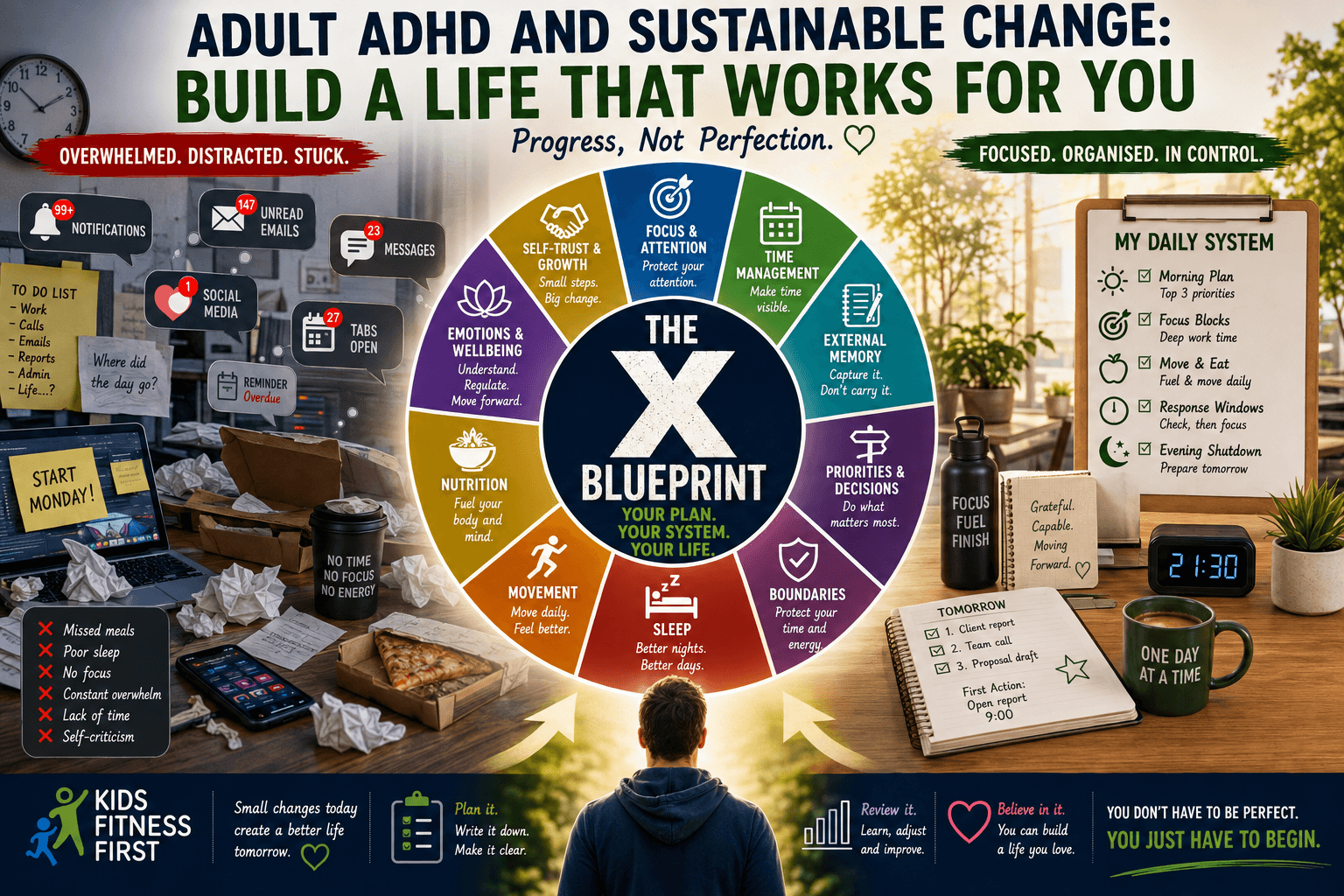
Throughout The X Blueprint, we have explored practical ways to answer those questions. Now, in this final article, we can bring those ideas together.
The goal is not perfection. Instead, the goal is to build a life that works better for the person you actually are.
The Problem With Trying to Change Everything
A fresh start can feel exciting.
For example, Monday arrives. Perhaps it is a new month, a new year or the day you buy a new planner.
Suddenly, you decide:
“This time, everything is going to change.”
You may plan to wake earlier, exercise every day, eat perfectly, clear every email, finish every task, stop procrastinating, reduce screen time and sleep better.
At first, that plan can feel motivating.
However, the plan itself may soon become exhausting.
Then one difficult day arrives. Perhaps something unexpected happens, one part of the routine is missed or you simply have less energy than expected.
As a result, the whole system can begin to feel broken.
Therefore, sustainable change needs a different approach. Rather than changing everything at once, it usually helps to change a few important things and allow them time to become useful.
Adult ADHD and Sustainable Change Starts Small
Large goals can provide direction. However, everyday change usually happens through smaller actions.
For example, instead of saying:
“Become organised.”
try:
“Check my calendar every morning.”
Likewise, instead of:
“Stop procrastinating.”
try:
“Work on the difficult task for five minutes.”
Similarly, instead of:
“Improve my health.”
try:
“Walk for ten minutes after lunch.”
Specific actions are easier to understand and repeat. As a result, progress becomes something you can actually see.
Therefore, when a goal feels too large, reduce it until the first action becomes obvious.
Build Systems Around Repeated Problems
Throughout this series, one principle has appeared repeatedly:
Do not solve the same problem from scratch every day.
For example, if you regularly lose your keys, give them one permanent home. If you forget appointments, use a calendar. If you lose track of time, use alarms and timers.
Likewise, if tasks disappear from memory, capture them externally. If your phone interrupts focused work, move it away. If meals disappear during busy days, use meal reminders or routine anchors.
Therefore, repeated problems deserve repeated systems.
Once a useful system exists, you no longer need to depend entirely on remembering, motivation or willpower.
Adult ADHD and Sustainable Change: Design the Environment
Willpower changes from day to day. However, your environment can remain much more consistent.
Therefore, make the environment support the behaviour you want.
For example, if you want to walk more often, put your trainers somewhere visible. If you want to drink more regularly, keep an appropriate drink where you can see it.
Likewise, if you want fewer phone interruptions, keep the phone away during focused work. If something must be remembered tomorrow, put it somewhere visible or create a reminder.
As a result, the environment begins carrying some of the mental workload for you.
Instead of repeatedly asking yourself to remember the right action, the surroundings help point you towards it.
Make the Right Action Easier
A useful design question is:
“How can I make the behaviour I want easier to start?”
Suppose you want to exercise.
Instead of beginning by asking how you can become more motivated, ask practical questions.
Where are my clothes?
Is my bag ready?
What exactly am I doing?
When am I starting?
Similarly, if you want to eat lunch regularly, ask:
What will I eat?
Is the food available?
When does lunch fit into the day?
Do I need a reminder?
Therefore, good systems remove unnecessary steps.
Consequently, the desired action requires less thinking at the exact moment when you need to begin.
Make Unhelpful Actions Slightly Harder
The reverse principle can also help.
For example, if you want to check your phone less, put it in another room during focused work.
If late-night scrolling regularly continues longer than intended, charge the phone away from the bed.
Likewise, if email repeatedly interrupts important work, close the programme and return at a planned time.
As a result, the automatic behaviour now requires an extra step.
That small amount of friction may be enough to interrupt the habit and create a moment in which you can choose what to do next.
External Memory Is Not Cheating
Article 8 explored adult ADHD and external memory.
This remains one of the most important principles in the series.
You do not need to remember everything internally. Instead, you can use calendars, alarms, checklists, notes, visual cues and written next actions.
Therefore, rather than asking:
“How can I make myself remember all of this?”
ask:
“Where does this information need to live so I do not have to keep remembering it?”
As a result, information becomes easier to retrieve and the mental load can become lighter.
Adult ADHD and Sustainable Change Needs Visible Time
Article 10 explored adult ADHD and time blindness.
Time becomes easier to respond to when it is visible.
Therefore, use timers, clocks, calendar blocks, departure alarms, countdowns and realistic buffers where they help.
Instead of thinking:
“I have plenty of time.”
you may be able to see:
“I have 35 minutes.”
As a result, the decision becomes based on visible information rather than an uncertain feeling about time.
Give Important Tasks a Start Time
A task without a start point can remain vague throughout the day.
For example:
“Do accounts.”
But when?
Instead, write:
“10:00 — accounts for 30 minutes.”
Now the task has somewhere to live.
Consequently, intention becomes more concrete because the task has both an action and a starting point.
Decision Fatigue Needs Defaults
Article 9 explored adult ADHD and decision fatigue.
Every repeated decision uses some mental energy.
Therefore, create useful defaults for situations that appear frequently.
For example, you might have a usual breakfast, a regular shopping list, one fixed location for keys, a standard work-start routine, usual exercise days and a regular admin period.
You can still change them when necessary. However, you no longer need to make the same basic decisions from scratch every day.
As a result, more attention remains available for decisions that genuinely require thought.
Adult ADHD and Sustainable Change Needs Priorities
Article 13 explored adult ADHD and prioritisation.
When everything feels important, very little feels clear.
Therefore, choose fewer priorities.
Ask:
“What matters most today?”
rather than:
“What could I possibly do today?”
Those questions create very different outcomes.
A long list creates options. However, a priority creates direction.
Use the Top Three
One simple system is to choose three levels.
1. Must Move Forward
This is the most important task.
2. Important
This deserves attention next.
3. Useful
Complete this if time and capacity remain.
Everything else can wait.
As a result, the day gains a clearer hierarchy. Moreover, you spend less time repeatedly deciding which task deserves attention.
Procrastination Needs Smaller Starts
Article 11 explored adult ADHD and procrastination.
A task often becomes easier when the entry point becomes smaller.
For example, instead of:
“Finish the report.”
try:
“Open the report.”
Then:
“Write the first paragraph.”
Alternatively, commit to five minutes.
Therefore, when a task feels impossible, shrink the beginning.
Once movement has started, you can decide whether to continue.
Adult ADHD and Sustainable Change Needs Flexible Routines
Article 14 explored adult ADHD and routine.
Routine can provide valuable structure. However, overly rigid routines can collapse when real life changes.
Therefore, build anchors rather than attempting to control every minute.
For example:
Morning Anchor
Check the calendar.
Midday Anchor
Eat and review the afternoon.
Evening Anchor
Prepare tomorrow.
These anchors give the day structure. At the same time, they leave enough space for circumstances to change.
Create Minimum Versions
Every important routine benefits from a difficult-day version.
For example:
Normal Morning
Shower, breakfast, calendar and work preparation.
Minimum Morning
Get ready, eat something suitable, check the calendar and start.
Therefore, the routine can survive imperfect days.
Importantly, this is one of the foundations of sustainable change because a system that only works on your best days is unlikely to remain useful for long.
Follow-Through Requires Closing Loops
Article 15 explored adult ADHD and follow-through.
Starting creates activity. However, finishing creates results.
Therefore, consider creating completion periods.
For example:
4:00–4:30 — close open tasks.
During this period, you might send a document, finish a form, make the final call or file information that no longer needs attention.
As a result, fewer unfinished tasks remain mentally active.
Adult ADHD and Sustainable Change Includes Emotions
Article 16 explored adult ADHD and emotional regulation.
Not every difficult feeling requires an immediate response.
Therefore, when emotions become intense, pause where possible.
Ask:
What happened?
What am I feeling?
What needs action now?
What can wait?
In this way, you create space between emotion and response.
As a result, decisions, relationships and self-trust may be better protected from an impulsive reaction made during an emotional peak.
Rejection Does Not Define Your Value
Article 17 explored adult ADHD and rejection sensitivity.
Criticism, disagreement and rejection can hurt. However, another person’s reaction does not automatically define your worth.
Therefore, separate:
What happened
from:
What I am telling myself it means.
For example:
“They disagreed with my proposal.”
is different from:
“Nobody values my ideas.”
Consequently, separating the fact from the interpretation can prevent one event from becoming a much larger judgement about yourself.
Self-Criticism Is Not a Productivity Tool
Article 18 explored adult ADHD and self-criticism.
Calling yourself lazy, useless or hopeless does not create a better system.
Instead, ask practical questions.
Was the task unclear?
Was it too large?
Was it boring?
Was it poorly timed?
Did you forget?
Were you overwhelmed?
As a result, failure becomes information.
Then, that information can help you redesign the task rather than simply criticise yourself for struggling with it.
Adult ADHD and Sustainable Change Requires Self-Trust
Article 19 explored adult ADHD and self-trust.
Self-trust grows when you make realistic promises and then keep them.
Therefore, smaller commitments can be particularly valuable.
For example:
“I will walk for ten minutes.”
“I will make that call before lunch.”
“I will check my calendar tonight.”
Each completed promise provides evidence.
Over time, the message becomes:
“I can rely on myself when the commitment is realistic.”
Boundaries Protect the System
Article 20 explored adult ADHD and boundaries.
Without boundaries, other people’s priorities can repeatedly replace your own.
Therefore, useful phrases may include:
“Not today.”
“I can do that tomorrow.”
“I have capacity for twenty minutes.”
“Which existing priority should this replace?”
A boundary is not necessarily rejection. Instead, it protects capacity.
As a result, you have more opportunity to use your time and energy according to genuine priorities.
Adult ADHD and Sustainable Change Needs Recovery
You cannot optimise every hour.
Rest matters.
Article 21 explored adult ADHD and sleep.
Therefore, a sustainable system should include a clear endpoint to the day.
For example, stop work, capture unfinished tasks, prepare tomorrow, reduce stimulation and begin the wind-down routine.
In this way, recovery does not become something you receive only after finishing absolutely everything.
Instead, recovery becomes part of the plan.
Movement Does Not Need to Be Perfect
Article 22 explored adult ADHD and exercise.
Movement can be simple.
You might walk, swim, cycle, stretch, go to the gym or play a sport.
Importantly, difficult days can have a minimum version.
Five minutes can still count.
Ten minutes can still count.
Therefore, the aim is not perfect exercise consistency. Instead, the goal is to make movement something you can return to.
Eating Needs a System Too
Article 23 explored adult ADHD and nutrition.
Food can become difficult when every meal requires a completely new decision.
Therefore, default meals, reusable shopping lists, meal reminders, visible food, low-energy options and simple preparation can all reduce friction.
As a result, eating becomes less dependent on remembering and deciding at exactly the right moment.
Digital Attention Needs Protection
Article 24 explored adult ADHD and digital overload.
Technology can help you. However, it can also interrupt you constantly.
Therefore, turn off unnecessary notifications, use focus modes, create response windows, reduce digital clutter and move the phone away when concentrating.
As a result, technology can return to being a useful tool rather than a constant source of incoming demands.
Adult ADHD and Sustainable Change: Build Your Personal Blueprint
Now bring the pieces together.
You do not need every strategy from all 25 articles. In fact, trying to use everything would probably create another overwhelming system.
Instead, choose the tools that solve your biggest repeated problems.
Your blueprint might look like this:
Morning
Check the calendar, choose the top three and begin the first priority before opening unnecessary communication.
Workday
Use focus blocks, check messages at planned times, take movement and meal breaks and capture tasks externally.
Afternoon
Review unfinished work, close important loops and prepare tomorrow’s first action.
Evening
Stop work at a defined point, reduce digital stimulation, prepare essential items for tomorrow and begin the wind-down routine.
That is a blueprint.
However, it is not a prison.
You can adjust it when circumstances change.
Build Around Your Actual Life
A system must fit your circumstances.
For example, a parent with young children will need a different routine from somebody living alone. Likewise, a shift worker will need a different structure from someone working nine to five.
A student will also need different systems from a business owner.
Therefore, do not copy another person’s routine without considering whether it genuinely fits your own circumstances.
Instead, ask:
“Which parts of this actually fit me?”
Then, adapt them.
Stop Comparing Your Behind-the-Scenes With Someone Else’s Highlight Reel
Online, you may see perfect desks, perfect morning routines, perfect meal preparation, perfect fitness plans and perfect productivity systems.
However, you are not seeing the full reality of those people’s lives.
Therefore, judge your own system using a more useful question:
“Is my life becoming easier to manage?”
If the answer is yes, the system is doing something valuable.
Adult ADHD and Sustainable Change Is About Progress
Progress can be quiet.
For example, you may arrive on time more often, lose fewer things, finish more tasks or recover from mistakes faster.
Likewise, you may say no when overloaded, remember lunch, sleep a little more consistently or spend less time searching for information.
These changes may not look dramatic individually.
However, together they can significantly change how everyday life feels.
Therefore, do not dismiss small improvements simply because they do not look transformational from the outside.
Measure What Matters
You do not need to track everything.
Instead, identify one or two outcomes that genuinely tell you whether the system is helping.
For example:
Am I missing fewer appointments?
Am I finishing more important tasks?
Do I feel less overwhelmed at the end of the day?
Am I getting to bed closer to my intended time?
The purpose of tracking is to learn.
Therefore, use measurements as information rather than as another reason to judge yourself.
Use Weekly Reviews
A short weekly review can help you notice patterns.
Ask:
What Worked?
Which systems genuinely helped?
What Did Not Work?
Where did friction appear?
What Kept Repeating?
Which repeated problem still needs a system?
What Will I Change?
Choose one adjustment.
Importantly, choose one adjustment, not twenty.
As a result, improvement remains manageable rather than becoming another major project.
Adult ADHD and Sustainable Change Needs Experimentation
Think like an experimenter.
First, try something.
Then, observe what happens.
For example:
Experiment: Phone outside the room during morning focus.
Result: Better concentration.
Therefore: Keep it.
Another experiment:
Experiment: Gym every morning at 6 am.
Result: It repeatedly does not happen.
Do not conclude:
“I am lazy.”
Instead, conclude:
“6 am appears to be a poor fit for me.”
Then test another time.
In this way, failed systems become useful information rather than personal failures.
Ask “What Does This Teach Me?”
This question can change how you respond to setbacks.
Missed appointment?
Ask:
“What does this teach me about my reminder system?”
Late night?
Ask:
“What does this teach me about my wind-down routine?”
Unfinished project?
Ask:
“What does this teach me about task size or clarity?”
Therefore, problems become feedback.
As a result, you can adjust the system rather than repeatedly blaming yourself.
Do Not Change a System That Is Working
Novelty can be attractive.
A new app appears.
Then a new planner.
Then another productivity method.
However, if your current system works, be careful about replacing it simply because something new looks interesting.
Ask:
“What specific problem will this new system solve?”
If there is no clear answer, you may not need it.
Therefore, sustainable change sometimes means keeping useful systems long enough for them to become familiar.
Adult ADHD and Sustainable Change After a Setback
You will have difficult days.
Routines will sometimes break.
Plans will change.
You will forget something.
Occasionally, you will procrastinate.
However, none of this means that the whole system has failed.
Therefore, use the next-action principle.
Ask:
“What is the next useful thing I can do?”
Do not ask:
“How do I fix everything immediately?”
Instead, identify the next useful action and begin there.
Return at the Next Reasonable Opportunity
If a routine matters and you miss it once, try to return at the next sensible opportunity.
For example, if you miss Monday’s walk, walk on Wednesday.
If you forget Tuesday’s review, complete it on Wednesday.
If you stay awake too late one night, return to the wind-down routine the following evening.
As a result, one disruption remains one disruption rather than automatically becoming a new pattern.
Create a Reset Routine
A simple reset routine might be:
- Stop.
- Check the calendar.
- Write down open tasks.
- Choose one priority.
- Clear the immediate workspace.
- Begin the smallest useful action.
You can use this after a difficult day, holiday, illness, busy period or disrupted routine.
Therefore, even when the normal system breaks, you still have a clear route back.
Adult ADHD and Sustainable Change Does Not Mean Doing Everything Alone
Systems can help. However, support can also matter.
Depending on your circumstances, support might include family, friends, workplace adjustments, coaching, educational support, healthcare professionals or ADHD specialists.
Seeking appropriate support is not a failure of independence.
Instead, it can be part of designing an environment that helps you function well.
Know When Professional Support Is Appropriate
Practical strategies can support everyday organisation. However, they do not replace appropriate clinical assessment or treatment.
Therefore, if ADHD symptoms or related difficulties are significantly affecting work, education, relationships, health, finances, daily functioning or emotional wellbeing, consider speaking with an appropriately qualified healthcare professional.
Likewise, questions about diagnosis, medication or treatment should be discussed with the professionals responsible for your care.
The X Blueprint: Your Core Principles
Across these 25 articles, several principles have appeared again and again.
1. Externalise What You Can
Do not keep everything in your head. Instead, use systems that hold information for you.
2. Make Time Visible
Use alarms, timers and calendars. As a result, time becomes easier to respond to.
3. Reduce Decisions
Create useful defaults. Therefore, fewer repeated choices consume attention.
4. Shrink the Start
Make difficult tasks easier to enter. Then, build momentum from there.
5. Protect Attention
Reduce unnecessary interruptions. Consequently, important work has more room.
6. Work With Energy
Not every hour is equal. Therefore, match tasks to capacity where possible.
7. Build Flexible Routines
Use anchors rather than perfection. As a result, routines can survive change.
8. Close Loops
Starting matters. However, finishing matters too.
9. Protect Capacity
Use boundaries. Therefore, other people’s priorities do not automatically replace your own.
10. Design for Difficult Days
Every important system should have a minimum version. In this way, one difficult day does not destroy the routine.
11. Learn From Setbacks
Use information instead of self-criticism. Then, adjust what is not working.
12. Keep What Works
You do not need a new system every week. Instead, let useful systems become familiar.
Together, these principles form the foundation of The X Blueprint.
Create Your One-Page X Blueprint
Take one sheet of paper.
First, write:
MY THREE MAIN CHALLENGES
1. ______________________________
2. ______________________________
3. ______________________________
Next, write:
THE SYSTEM I WILL USE
Challenge 1 → ______________________________
Challenge 2 → ______________________________
Challenge 3 → ______________________________
Then, add:
MY DAILY ANCHORS
Morning → ______________________________
Midday → ______________________________
Evening → ______________________________
Finally, write:
MY RESET ACTION
When everything goes wrong, I will:
Keep this simple.
After all, the blueprint should be usable rather than impressive.
Your 7-Day Experiment
For the next seven days, choose only three changes.
For example:
Change 1
Check the calendar every morning.
Change 2
Keep the phone away during the first focus block.
Change 3
Prepare tomorrow before ending the day.
That is enough.
At the end of seven days, ask:
What worked?
What helped?
What was unrealistic?
What needs adjusting?
Then, keep what helped and change what did not.
Your 30-Day Approach
After the first week, keep the systems that worked.
Then, add only one new improvement where necessary.
Week 1: Establish the basics.
Week 2: Remove one source of friction.
Week 3: Strengthen one useful routine.
Week 4: Review and simplify.
At the end of the month, your life does not need to look completely different.
Instead, ask whether it works slightly better.
If it does, that is meaningful progress.
Adult ADHD and Sustainable Change: The Goal Is Not Normal
There is an important final point.
The goal is not to force yourself into somebody else’s definition of normal.
Likewise, the goal is not:
“How do I make myself function exactly like everyone else?”
Instead, ask:
“How do I create the conditions in which I function well?”
Perhaps you need more reminders. If so, use them.
Perhaps you need visible time. Then, create it.
Perhaps you work better in shorter focused periods. In that case, use them.
Perhaps you need movement between tasks. Therefore, build it into the day.
Success is not about hiding how your brain works.
Instead, it is about understanding it well enough to build around it.
What Success Can Look Like
Success may mean knowing where your keys are.
It may mean remembering an appointment.
Alternatively, it may mean starting the difficult task or finishing something important.
Success may also mean having lunch before the afternoon disappears, putting the phone down, going for a walk, saying no when overloaded or recovering after a difficult day.
In addition, success can mean recognising when you need help and asking for it.
These things may sound ordinary.
However, ordinary life is where systems matter most.
Therefore, allow practical everyday improvements to count.
Reflection Questions
- Which three problems create the most difficulty in your everyday life?
- Which strategies from this series have felt most relevant?
- What are you currently trying to remember internally that could be externalised?
- Which repeated decision could become a default?
- What part of your day needs a clearer boundary?
- What task needs a smaller starting point?
- What would your minimum routine look like on a difficult day?
- Which current system is already working and should be kept?
- What one experiment would you like to run for seven days?
- What would “a life that works better for me” actually look like?
Conclusion: Your Blueprint Belongs to You
Adult ADHD and sustainable change does not require a perfect life.
Instead, it requires useful systems.
Throughout The X Blueprint, we have explored attention, time, memory, decisions, procrastination, overwhelm, priorities, routines, follow-through, emotions, rejection, self-criticism, self-trust, boundaries, sleep, exercise, nutrition and digital overload.
At first, these may appear to be separate subjects.
However, they connect.
When you reduce unnecessary decisions, you preserve mental energy.
Likewise, when you externalise memory, you reduce the amount of information you need to carry internally.
When you protect attention, you improve the conditions for follow-through.
In addition, when you use boundaries, you protect capacity.
When you stop attacking yourself after every setback, you gain useful information about what needs to change.
Therefore, the final lesson of The X Blueprint is simple:
Do not build your life around the person you think you should be.
Instead, build systems around the person you actually are.
Start small.
Then, keep what works.
Change what does not.
After a setback, return rather than starting from zero.
Ask for appropriate support when you need it.
Most importantly, allow progress to count even when it is imperfect.
Your blueprint does not need to look like anybody else’s.
Ultimately, it simply needs to work for you.
SUGGESTED INTERNAL LINKS
Because this is the final article, I recommend using it as a hub page linking back through the strongest articles in the entire series:
- Adult ADHD and Digital Overload: How to Reduce Distraction and Reclaim Focus
- Adult ADHD and Emotional Regulation: How to Stay Steady When Emotions Run High
DISCLAIMER
This article is provided for general educational and informational purposes only. It does not provide medical, psychological, nutritional, fitness, diagnostic or therapeutic advice and should not be used as a substitute for individual guidance from an appropriately qualified professional.
ADHD experiences vary considerably between individuals. Strategies that are helpful for one person may not be suitable for another. If ADHD symptoms or related difficulties are persistent, severe or significantly affecting your health, emotional wellbeing, work, education, relationships or everyday functioning, please seek appropriate professional advice.
If you have questions about ADHD diagnosis, medication or treatment, discuss these with an appropriately qualified healthcare professional. Do not start, stop or change prescribed medication based on general information contained in this article.