Adult ADHD and Your CV: Why Your Resume May Be Telling the Wrong Story
Adult ADHD and your CV can create a strange experience.
You open the document.
You read through the job titles.
Then you notice the dates.
Perhaps there are several short roles.
Maybe there is a gap.
One position looks like a step backwards.
Another belongs to a completely different industry.
Immediately, you may begin thinking about how to explain all of it.
Why did I leave?
How do I explain the gap?
Will they think I am unreliable?
Why does my career not look more straightforward?
However, there may be something important you are forgetting.
A CV is not your whole working life.
It was never designed to be.
Instead, a CV is a short professional document created for a specific purpose: to help a recruiter or employer understand whether there is enough reason to continue the conversation.
That distinction sits at the heart of Chapter Two of Work That Fits. The book argues that many neurodivergent adults have gradually begun treating their CV as a judgement on their working life rather than as a practical hiring document.
Therefore, this article asks a different question:
What if the problem is not your career history, but the way the traditional CV format represents it?
A CV Is Not a Biography
Your CV contains selected facts.
For example:
job titles;
employers;
dates;
qualifications;
responsibilities;
achievements.
That information matters.
However, it does not tell the whole story.
A CV does not usually show:
the colleague you quietly mentored;
the process you redesigned;
the problem everyone came to you to solve;
the project where you suddenly came alive;
the daily task that took far more energy than anyone realised;
the working environment that made an otherwise good role unbearable.
Therefore, when thinking about adult ADHD and your CV, it helps to remember that the document is a summary, not a complete portrait.
Why Your CV Can Start Feeling Like a Confession
Work That Fits uses the phrase “confession mode” to describe a particular way people can begin writing about their careers.
Instead of confidently describing experience, the CV starts quietly defending it.
For example:
“Seeking new challenges.”
Perhaps the real story was:
“The work had become unbearably repetitive.”
Or:
“Career break.”
Perhaps the fuller story was:
“I was exhausted and needed time to recover and reassess.”
Or:
“Moved into a new sector for professional development.”
Perhaps the reality was:
“I was trying to find work that suited me better.”
None of these professional phrases are necessarily dishonest.
However, problems can begin when every line of the CV feels as though it must defend you against an imagined accusation.
Adult ADHD and Your CV: Look for Defensive Language
Read your CV slowly.
Then ask:
“Am I describing what I did, or am I trying to prove that nothing about my career is a problem?”
For example, phrases such as:
“Despite…”
“Although…”
“Successfully transitioned…”
“Seeking greater stability…”
may be perfectly appropriate.
However, if your whole CV sounds like an explanation, you may be writing in confession mode.
Therefore, the first change is not necessarily rewriting the entire document.
Instead, recognise the tone.
The Traditional CV Rewards a Particular Career Shape
One of the central arguments in Chapter Two is that conventional CVs are built around assumptions.
Those assumptions may work reasonably well for some careers.
However, they can make varied careers look unnecessarily problematic.
For example, the traditional format tends to reward:
linear progression;
long tenure;
continuous employment;
increasing seniority;
clear relationships between one role and the next.
That creates a neat story.
Junior.
Manager.
Senior manager.
Director.
However, many working lives do not look like that.
Sideways Moves Can Be Intelligent Moves
Suppose you moved from a senior role into a smaller position.
On paper, it may appear that your career went backwards.
However, perhaps the new role offered:
less social pressure;
more analytical work;
greater autonomy;
fewer meetings;
better hours;
more meaningful work.
Therefore, what appears to be a downward move on the CV may actually have been a significant improvement in career fit.
That is why job title alone cannot tell you whether a career decision was good.
Adult ADHD and Your CV: Job Duration Does Not Equal Job Quality
Traditional career culture often assumes that staying longer is better.
Five years looks stronger than one year.
Ten years can look more stable than three.
However, duration and fit are not the same thing.
You may have done some of your best work during the first year of a role.
Likewise, you may have spent five years in another job surviving through exhaustion and masking.
Therefore, a long job is not automatically evidence of success.
Similarly, a short job is not automatically evidence of failure.
The more useful question is:
“What happened while I was there?”
Career Gaps Are Not Always Empty
Another traditional assumption is that uninterrupted employment is ideal.
Therefore, career gaps can feel as though they need to be hidden or heavily explained.
However, a gap may contain meaningful activity.
Perhaps you:
recovered from burnout;
cared for family;
studied;
freelanced;
built a project;
volunteered;
reassessed your direction;
managed major personal responsibilities.
A CV may compress all of that into six blank months.
However, the blank space does not mean nothing happened.
Your CV May Hide Your Most Valuable Work
One of the strongest ideas in Chapter Two is invisible work.
This is the work you genuinely contributed but which may never have appeared in your formal job description.
For example:
mentoring younger colleagues;
calming difficult clients;
designing workarounds;
solving recurring problems;
informally leading projects;
maintaining important relationships;
handling emergencies;
improving systems;
helping teams think more clearly.
These contributions may be central to your actual professional value.
However, because they were unofficial, they often disappear from the CV.
Adult ADHD and Your CV: Ask What You Actually Did
For each past role, ignore the job description for a moment.
Instead, ask:
“What did people actually rely on me for?”
That question is often much more revealing.
Perhaps your official responsibility was administration.
However, colleagues constantly asked you to solve complicated problems.
Maybe your title was account manager.
However, your real strength was seeing the strategic issue behind a client’s complaint.
Perhaps you were a deputy manager.
Yet, during a difficult period, you effectively ran the whole team.
That work matters.
The Working Self Portrait
Chapter Two introduces one of Book Four’s most useful tools:
The Working Self Portrait
Unlike your CV, the Working Self Portrait is not written for recruiters.
It is written for you.
Its purpose is to record what your professional history actually says about how you work.
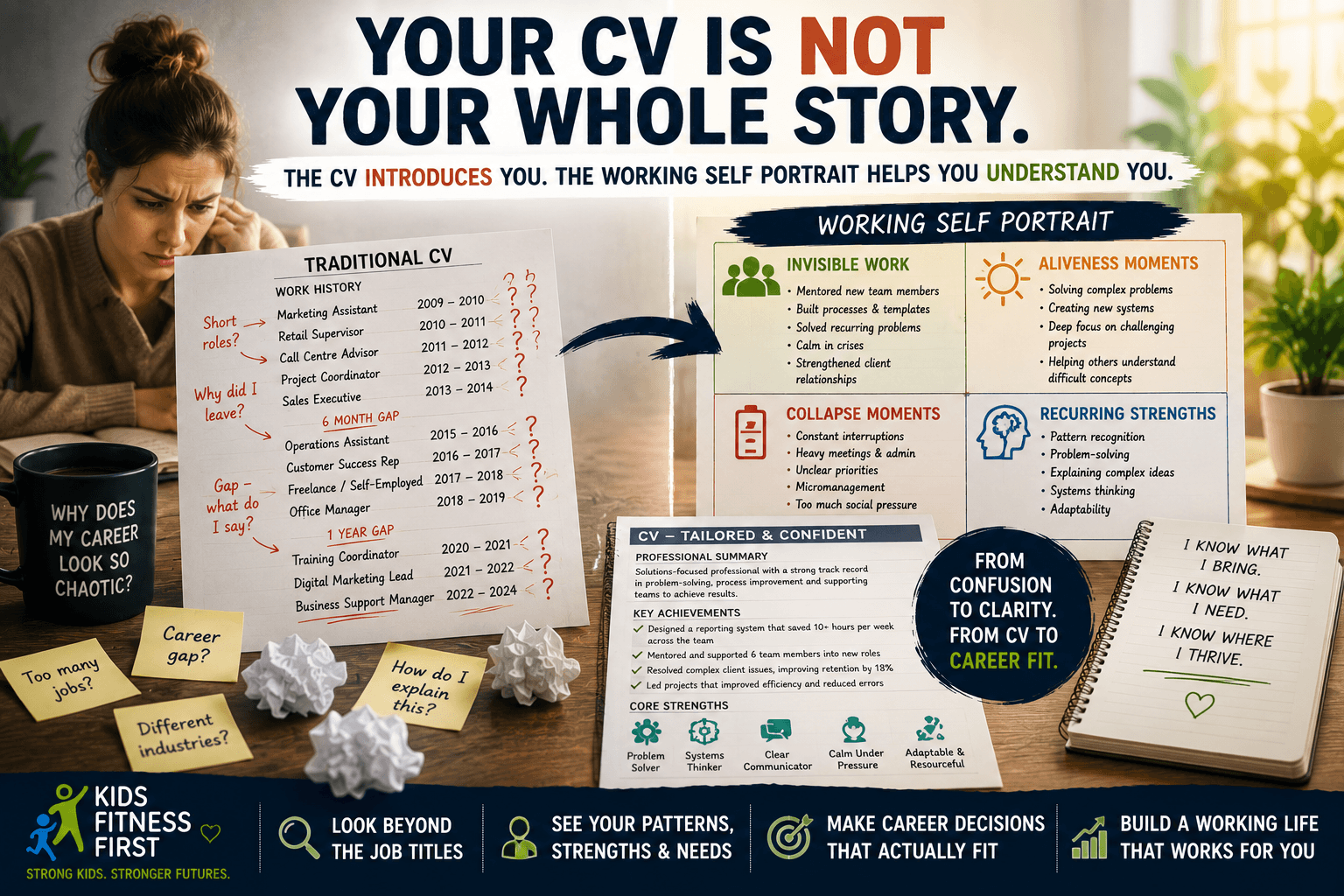
The book builds the Portrait around four areas:
Invisible Work
Aliveness Moments
Collapse Moments
Recurring Strengths
Together, these can reveal information that a normal CV cannot show.
Part One: Invisible Work
Start with what happened outside the official role description.
For every job, ask:
Who did I help?
What did I improve?
What did I quietly take responsibility for?
Which problems did people repeatedly bring to me?
What did I contribute that never appeared in a performance review?
As a result, you begin identifying your actual contribution rather than simply your contractual responsibilities.
Part Two: Aliveness Moments
Next, think about the moments when you felt genuinely engaged at work.
Not merely productive.
Not simply busy.
Instead, think about moments when you felt:
absorbed;
energised;
capable;
interested;
fully present.
Work That Fits describes these as aliveness moments because they can reveal the conditions your brain responds to particularly well.
For example:
a difficult problem-solving session;
designing a new system;
presenting an idea;
working independently on a complex challenge;
helping someone understand something.
These moments are valuable evidence.
Adult ADHD and Your CV: Do Not Dismiss What Felt Easy
Sometimes your strongest ability is difficult to recognise precisely because it feels natural.
Perhaps people regularly say:
“You explain things really well.”
You think:
“That’s nothing.”
Or:
“You always see what the real problem is.”
Again, you dismiss it.
However, if a capability appears repeatedly across unrelated jobs, it deserves attention.
What feels ordinary to you may not be ordinary at all.
Part Three: Collapse Moments
Now look at the opposite experiences.
When did work become especially difficult?
Perhaps:
a certain kind of meeting drained you;
written work under tight deadlines repeatedly overwhelmed you;
constant interruptions destroyed concentration;
heavy stakeholder management made an otherwise good role unbearable;
unclear expectations created repeated stress.
These are your collapse moments.
They should not be treated simply as embarrassing memories.
Instead, they can reveal the conditions under which your performance becomes much harder to sustain.
Collapse Moments Are Career Information
Suppose three unrelated jobs all became difficult when you moved into people management.
That matters.
Alternatively, perhaps several jobs deteriorated after the work became mainly repetitive administration.
Again, that matters.
Therefore, collapse moments help you identify what future roles may need to contain less of.
The purpose is not avoidance of every uncomfortable task.
Instead, the goal is recognising repeated high-cost conditions.
Part Four: Recurring Strengths
The final part of the Working Self Portrait asks:
“What have different people repeatedly said I am good at?”
Not only formal managers.
Think about:
colleagues;
clients;
friends;
people from different jobs;
people from different industries.
Perhaps the same feedback keeps appearing.
For example:
“You spot things other people miss.”
“You make complicated things easy to understand.”
“You’re calm when everything goes wrong.”
“You always find another way.”
When the same capability is recognised repeatedly across unrelated settings, it becomes significant evidence.
Adult ADHD and Your CV: Why the Portrait Matters
Most people plan their next career move from their existing CV.
That seems logical.
However, if the CV contains only job titles, dates and formal responsibilities, then the next move may simply reproduce the previous career pattern.
For example:
Operations Manager → Senior Operations Manager.
Yet your Working Self Portrait may reveal something very different:
You loved analysis.
You disliked people management.
You came alive during complex problem-solving.
You repeatedly collapsed under constant stakeholder interaction.
Therefore, another larger operations-management role may be exactly the wrong move.
The CV says:
“Progress upward.”
The Portrait may say:
“Move sideways towards the work you actually do well.”
That distinction is central to Book Four.
The CV Is for Recruiters; the Portrait Is for You
This is one of the clearest principles in Chapter Two:
Your CV is a tactical professional document.
Your Working Self Portrait is the deeper career document.
They serve different purposes.
Your CV asks:
“Why should this employer speak to me?”
Your Portrait asks:
“What kind of working life should I be building?”
Do not ask one document to do both jobs.
You Still Need a CV
None of this means abandoning the CV.
Employers still use them.
Recruiters still need them.
Applicant tracking systems may still screen them.
Therefore, you should still create a strong, accurate and professional CV.
However, your relationship with the document can change.
Instead of treating it as the final judgement on your career, treat it as an introduction.
Write the CV as an Invitation, Not an Alibi
Work That Fits makes this distinction directly.
A CV should invite a conversation rather than defend you against imaginary charges.
Read yours aloud.
Does it sound like someone who has useful experience to discuss?
Or does it sound like someone trying to explain why they should not be rejected?
That difference can often be heard more easily than it can be seen.
Adult ADHD and Your CV: Lead With Contribution
Where appropriate and truthful, bring more of your invisible work into the CV.
For example, rather than:
“Responsible for team support.”
you might say:
“Informally mentored three new team members and created a simplified onboarding process.”
Instead of:
“Supported operational improvements.”
perhaps:
“Redesigned a recurring process that reduced duplicated work across the team.”
The precise wording will depend on what actually happened.
However, the principle is simple:
Describe contribution, not just duties.
Stop Making Every Career Gap Sound Suspicious
Where explanation is needed, a short, accurate statement is usually clearer than a long defence.
For example:
Career break for family responsibilities.
Career break for recovery and reassessment.
Independent projects and professional development.
The exact wording needs to be truthful and appropriate to your circumstances.
However, you do not necessarily need to turn every gap into a complicated apology.
Tailor the CV to the Role
One CV does not need to serve every job.
Different opportunities may require different parts of your experience to be emphasised.
That is normal professional practice.
Therefore, if one role values strategic problem-solving, foreground the evidence that supports it.
If another values client communication, emphasise that evidence instead.
You are not changing the truth.
You are selecting the most relevant parts of it.
Adult ADHD and Your CV: Do Not Hide Sideways Progress
Suppose you deliberately moved into a role with less seniority but much better fit.
You do not need to pretend it was something else.
Instead, focus on what the role allowed you to contribute and develop.
For example:
more specialised work;
deeper responsibility;
new technical expertise;
greater autonomy;
different market experience.
Therefore, career development does not always need to be framed only as promotion.
Your CV Should Not Carry Your Whole Identity
This is especially important after years of difficult work experiences.
Perhaps your confidence has become tied to the document.
Every short role feels personal.
Every gap feels embarrassing.
Every redundancy feels like a permanent mark.
However, the CV is not a judgement of your worth.
It is not even a complete judgement of your professional ability.
It is simply one method of presenting relevant information to a particular audience.
The Two-Hour Working Self Portrait Exercise
Book Four recommends building the Working Self Portrait deliberately rather than trying to squeeze it into the CV.
Set aside some uninterrupted time.
Then divide a page or document into four sections.
1. Invisible Work
For each major role, write down the work you did that did not appear in the formal job description.
Keep it specific.
2. Aliveness Moments
Identify several moments across your career when you felt especially engaged and capable.
Again, be specific.
Which project?
Which conversation?
Which morning?
3. Collapse Moments
Identify moments when you were clearly struggling to function well at work.
What exactly was happening?
4. Recurring Strengths
Write down the abilities people have repeatedly noticed in you across different jobs or settings.
Then read the whole document.
Do not immediately try to turn it into a career plan.
Instead, notice what repeats.
A Simple Example
Imagine a CV that says:
Project Coordinator
2019–2022
Managed timelines, meetings and stakeholder communication.
The Working Self Portrait might say:
Invisible work: Became the person colleagues brought complex project problems to.
Aliveness moment: Designing a recovery plan when a major project went wrong.
Collapse moment: Weekly meeting-heavy days with constant interruptions.
Recurring strength: Seeing dependencies and risks before other people noticed them.
That tells a much richer story.
Moreover, it may suggest a different future role than the job title alone would.
Adult ADHD and Your CV After a Late Diagnosis
A late ADHD diagnosis may change how you read your work history.
You may recognise that some things you previously labelled as personal failings had patterns.
Perhaps repeated administrative overload mattered.
Maybe constant switching mattered.
Perhaps novelty helped you engage.
However, do not assume every career difficulty was caused by ADHD.
Bad management, unsuitable roles, economic conditions, family responsibilities and ordinary career changes matter too.
Instead, use diagnosis as one additional lens.
Neurodivergent Careers Are Not All the Same
Although Work That Fits is primarily ADHD-led, it also includes dyslexic and autistic working experiences.
That distinction matters.
For example, a dyslexic professional may discover that a CV hides strong verbal, systems or strategic abilities because formal work disproportionately rewarded rapid written output.
Likewise, an autistic professional may discover that years of technical excellence were overshadowed by social or stakeholder expectations unrelated to the core work.
Therefore, the principle is broader:
Your formal career document may not accurately capture the conditions in which your particular brain produces its best work.
What Not to Put on Your CV
Your Working Self Portrait is personal.
That means you do not need to put every detail from it into your application documents.
For example, your Portrait may contain:
private emotional experiences;
difficult workplace memories;
health information;
personal reflections;
specific collapse moments.
Those may be useful for your own career decisions.
However, they do not necessarily belong on the CV.
Again:
The Portrait is for understanding.
The CV is for communication.
A Better Way to Review Your CV
Instead of asking only:
“Does this look impressive?”
ask four questions.
Does It Show Contribution?
Not only responsibilities.
Does It Sound Defensive?
Look for confession mode.
Does It Represent Relevant Strengths?
Especially strengths supported by evidence.
Is It Appropriate for This Particular Role?
Do not send an identical generic document everywhere if tailoring would materially improve it.
These questions make the CV more useful without asking it to tell your whole life story.
Adult ADHD and Your CV: Create Two Documents
A practical approach is to keep two career documents.
Document One: Your Working Self Portrait
Private.
Detailed.
Honest.
Includes invisible work, aliveness moments, collapse moments and recurring strengths.
Document Two: Your CV
Professional.
Relevant.
Concise.
Tailored to the opportunity.
Evidence-based.
As a result, you stop asking one document to serve two completely different purposes.
The Portrait Should Guide the CV, Not the Other Way Around
This is perhaps the most important practical lesson.
Do not build your understanding of yourself from the CV.
Instead, build the CV from a clearer understanding of yourself.
Your Working Self Portrait comes first.
Then the CV becomes a selective presentation of the most relevant evidence.
Therefore, career planning begins from who you actually are at work rather than from the narrow version of you that fits neatly onto two pages.
Start With One Role Today
Choose one past job.
Then answer four questions:
What did I actually contribute beyond the job description?
When did I feel most alive in the role?
When did I struggle most?
What ability did other people repeatedly value?
Do not worry about CV wording yet.
Just collect the truth.
Afterwards, compare those answers with what appears on your existing CV.
The difference may be revealing.
Reflection Questions
- Does your current CV sound confident or defensive?
- Which parts of your career are you repeatedly trying to explain away?
- What important work has never appeared on your CV?
- Which career gap have you treated as more embarrassing than it needs to be?
- When have you felt most alive at work?
- Which workplace situations repeatedly caused you to struggle?
- What ability have people across different jobs repeatedly noticed?
- Does your CV overemphasise responsibilities and understate contribution?
- Are you planning your next move from your job titles rather than your actual working patterns?
- What would your Working Self Portrait say that your CV currently does not?
Conclusion
Adult ADHD and your CV can become difficult when a traditional professional document starts feeling like a judgement on your whole career.
However, your CV was never designed to carry that weight.
It is not your biography.
It is not your complete professional identity.
It is not a verdict on whether your career has been successful.
Instead, it is a tactical document designed to open a professional conversation.
Your deeper career story belongs somewhere else.
That is the purpose of the Working Self Portrait.
By recording your invisible work, aliveness moments, collapse moments and recurring strengths, you create a much richer picture of who you are at work.
Then, your CV can become easier to write.
You can foreground real contributions.
You can explain gaps simply where appropriate.
You can tailor the document to the opportunity.
Most importantly, you can stop asking the CV to tell you who you are.
Therefore, rather than asking:
“How do I make my career history look acceptable?”
try asking:
“What does my actual working history show that I contribute, need and do particularly well?”
Once you know that, the CV has a much simpler job.
It only needs to introduce you.
SUGGESTED INTERNAL LINKS
- Adult ADHD and Self-Trust: How to Rebuild Confidence in Yourself
- Adult ADHD and Sleep: How to Build a Better Night-Time Routine
DISCLAIMER
This article is provided for general educational and informational purposes only. It does not provide medical, psychological, diagnostic, employment, recruitment or legal advice and should not be used as a substitute for individual guidance from an appropriately qualified professional.
CV expectations, recruitment practices and employment law vary between employers, industries and jurisdictions. Therefore, career gaps, health information, disability or neurodivergence disclosure and other sensitive information should be handled according to your individual circumstances. Where necessary, consider obtaining appropriate recruitment, employment or legal advice.
ADHD and other neurodivergent experiences also vary considerably between individuals. A varied career history, short job tenure or difficulty with particular work tasks should not automatically be attributed to ADHD or neurodivergence.