
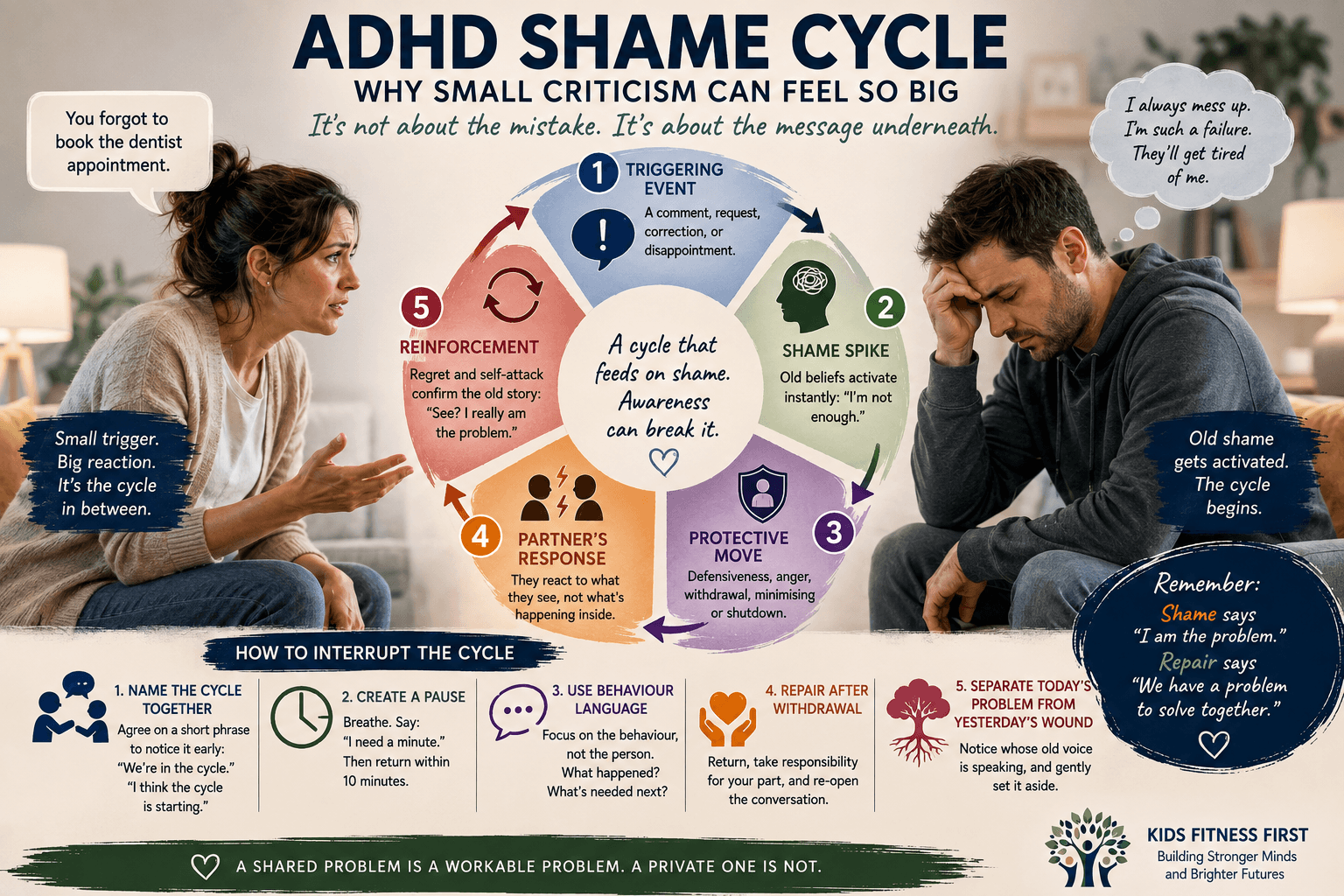
ADHD Shame Cycle: Why Small Criticism Can Feel So Big
The ADHD shame cycle can begin with something so small that the person on the outside struggles to understand what happened.
For example, a partner might simply ask:
“Did you remember to book the dentist?”
Alternatively, they might say:
“Could you put your phone away while I’m talking?”
Or perhaps:
“You forgot to send that form again.”
At first, none of these comments necessarily sounds severe. However, the emotional response can sometimes be surprisingly powerful.
The other person may immediately become defensive. Alternatively, they may suddenly go quiet. Meanwhile, another person may snap back, leave the room or shut down completely.
As a result, the partner reacts to that response rather than to the original problem.
Consequently, what began as a practical request can quickly become an emotional argument.
Later, both people may wonder:
How did something so small become something so big?
One useful explanation is the ADHD shame cycle.
Essentially, it is a five-stage pattern that can move extremely quickly through a neurodivergent relationship. However, once the pattern becomes visible, it also becomes much easier to interrupt.
What Is the ADHD Shame Cycle?
The Shame Cycle describes what may happen when a small present-day event touches a much older belief about the self.
For example, somebody may hear:
“The appointment wasn’t booked.”
However, internally they may experience something very different:
“You have failed again.”
Or:
“You are unreliable.”
Or even:
“You are still the person everyone said you were.”
Therefore, the current partner may believe they are discussing one behaviour, while the neurodivergent nervous system may be responding to years of earlier criticism.
As a result, the emotional reaction can appear far larger than the present event.
Nevertheless, that does not mean the reaction is fake or deliberately exaggerated. Instead, the reaction may be carrying emotional history that neither person can immediately see.
The Shame Cycle can be divided into five stages:
- Triggering event
- Shame spike
- Protective move
- Partner’s response
- Reinforcement
Most importantly, understanding these stages helps both people identify exactly where the cycle can be interrupted.
Stage 1: The Triggering Event
First, the cycle usually begins with something relatively small.
For example:
- a forgotten task;
- a missed appointment;
- an unanswered message;
- a disappointed facial expression;
- a request to do something differently;
- or a mistake being pointed out.
At first, the trigger may seem ordinary. However, this is precisely why the resulting argument can feel so confusing.
One partner may think:
“I only asked a question.”
Meanwhile, the other person’s nervous system may already be responding to something much larger.
Perhaps the present event has touched an old wound. Therefore, the size of the trigger does not necessarily predict the size of the emotional response.
Stage 2: The Shame Spike
Next, the shame spike appears.
Often, this can happen extremely quickly. In fact, the emotional meaning may arrive before the person has carefully processed the actual words.
For example, the internal message may become:
I have failed again.
I always mess things up.
I’m disappointing them.
They are going to get tired of me.
Maybe everyone was right about me.
Therefore, understanding the person’s history matters.
Many neurodivergent adults grew up hearing character-level criticism rather than behaviour-level feedback.
For example, instead of hearing:
“You forgot your homework,”
they may repeatedly have heard:
“You are careless.”
Likewise, instead of:
“This task isn’t finished,”
they may have heard:
“You never try.”
Over time, those messages can become an internal voice. Consequently, a present-day comment may activate a much older story.
Guilt and Shame Are Not the Same Thing
Importantly, guilt and shame are not identical.
Guilt says:
I did something wrong.
By contrast, shame says:
There is something wrong with me.
That difference matters enormously.
For example, guilt may lead someone towards repair:
“I forgot the appointment. Therefore, I will book it now and put a reminder into the calendar.”
However, shame tends to turn attention away from the behaviour and towards the entire self.
Instead of thinking:
“I made a mistake,”
the person may think:
“I am the mistake.”
Consequently, practical problem-solving becomes harder.
At that point, the nervous system is no longer simply trying to solve the appointment problem. Instead, it is trying to protect the person’s sense of self.
That leads directly to stage three.
Stage 3: The Protective Move
Afterwards, the person may move into protection.
This protection can appear in several different ways.
Defensiveness
For example, the person may immediately explain:
“I’ve had a lot going on.”
“You never told me properly.”
“I was going to do it.”
“You forget things too.”
Therefore, the conversation moves away from the original behaviour and towards defending the self.
Anger
Alternatively, the response may become sharper:
“Why are you always criticising me?”
“Nothing I do is ever good enough.”
“You make everything into a massive issue.”
Again, anger may be the visible behaviour. However, underneath it there may be shame, fear or emotional overload.
Withdrawal
On the other hand, some people protect themselves by withdrawing.
They may stop talking, leave the room, avoid eye contact or appear emotionally flat.
From the outside, this can look like indifference. However, withdrawal is not always a sign that the person does not care.
Instead, it may be a way of escaping emotional overload.
Minimising
Alternatively, the person may minimise the problem.
For example:
“It doesn’t really matter.”
“It’s only an appointment.”
“Why are you making such a big deal about this?”
Consequently, the original practical issue disappears once again.
The conversation is now dominated by self-protection.
Stage 4: The Partner Responds to What They Can See
Meanwhile, the partner usually cannot see the internal shame spike.
They cannot hear the old internal messages. Likewise, they cannot see the childhood memories or earlier criticism that may have been activated.
Instead, they see the protective behaviour.
They see defensiveness.
Or anger.
Or silence.
Or withdrawal.
Therefore, they naturally respond to what is visible.
For example, they may think:
Why can’t I raise anything without this happening?
Why does every request become an argument?
Why are they shutting me out?
Do they actually care what this is doing to me?
Those questions are understandable. However, frustration may then make the partner’s language harder.
Consequently, the neurodivergent person may experience that stronger response as confirmation of the original shame:
See? I really have failed again.
As a result, the cycle accelerates.
Stage 5: Reinforcement
Finally, the argument ends.
Perhaps somebody apologises. Alternatively, both people withdraw. Sometimes, the original subject is simply abandoned.
However, the Shame Cycle may continue internally.
Later, the neurodivergent person may replay what happened.
They remember snapping.
Then they remember leaving.
Afterwards, they remember their partner’s expression.
Consequently, the internal voice may say:
See? You did it again.
You hurt someone again.
You really are difficult.
Therefore, the original shame belief becomes stronger.
The next time a similar trigger appears, the nervous system may become defensive even more quickly.
As a result, the cycle becomes self-reinforcing.
The Five Stages at a Glance
| Stage | What Happens | Possible Internal Experience |
|---|---|---|
| 1. Trigger | A request, correction or disappointment appears | “Something is wrong.” |
| 2. Shame spike | Old feelings of inadequacy activate | “I’ve failed again.” |
| 3. Protective move | Defensiveness, anger, minimising or withdrawal | “Protect yourself.” |
| 4. Partner response | The partner reacts to the visible behaviour | “Why are they behaving like this?” |
| 5. Reinforcement | Regret strengthens the old shame belief | “See? I really am the problem.” |
Therefore, the argument visible on the surface is only part of the process.
Much of the cycle happens internally before either partner fully understands what is occurring.
How Shame May Look Different Across Neurodivergence
Although ADHD shame cycle is the main SEO keyphrase for this article, the pattern can also be relevant more broadly.
ADHD and Shame
For some people with ADHD, criticism may trigger an extremely fast emotional response.
Therefore, defensiveness or anger may appear before the person has fully processed what was said.
Meanwhile, the partner experiences the reaction rather than the emotional surge underneath it.
Dyslexia and Competence-Based Shame
For some dyslexic adults, shame may be closely connected with competence.
For example, years of struggling with reading, paperwork, spelling or detail-heavy tasks may have produced messages such as:
“Lazy.”
“Slow.”
“Careless.”
“Not trying.”
Consequently, a simple administrative task can carry years of emotional history.
Autism and Internalised Shame
Likewise, some autistic people may have spent years being told that their natural communication style, sensory needs or social behaviour were wrong.
As a result, criticism may sometimes lead to withdrawal, shutdown or increased masking.
However, these are patterns rather than rules. Every neurodivergent person is different.
How to Interrupt the ADHD Shame Cycle
The most hopeful part of the Shame Cycle framework is that there are several places where the pattern can be interrupted.
Therefore, you do not have to wait until the argument has completely unfolded.
Instead, both partners can learn to recognise the cycle earlier.
1. Name the Cycle Together
First, discuss the cycle when neither person is angry.
For example, agree on a simple phrase such as:
“I think the cycle is starting.”
Or:
“We’re in the shame loop.”
Or simply:
“We’re in it.”
The exact phrase is not important. Instead, what matters is that both people understand what it means.
Consequently, the relationship moves from:
you versus me
towards:
both of us versus the cycle.
2. Create a Pause Before the Protective Response
Next, create a small gap between the shame spike and the protective response.
For example, breathe before answering.
Then say:
“I need a minute.”
However, the pause should not become disappearance.
Therefore, add a clear return point:
“I need ten minutes to settle. Afterwards, I want to come back and talk about this.”
That sentence protects both people.
One person gets time to regulate. Meanwhile, the other person knows the conversation has not been abandoned.
3. Use Behaviour Language, Not Character Language
In addition, behaviour-focused language can reduce unnecessary shame.
Compare:
“You are unreliable.”
with:
“The appointment hasn’t been booked. Therefore, can we find a system that makes sure it happens?”
Likewise, instead of:
“You never listen.”
try:
“I need ten minutes of your full attention. When can we do that?”
Therefore, the issue remains clear without turning one behaviour into a judgement about the whole person.
4. Repair After Withdrawal
Sometimes the cycle will still happen.
However, that does not mean the relationship has failed.
After the nervous system settles, the person can return and say:
“I went into the shame cycle earlier. I became defensive and left the conversation. However, your original request was reasonable. I would like to try again.”
Notice the difference.
The person does not say:
“I’m terrible.”
Instead, they identify the behaviour and reopen communication.
Consequently, repair becomes practical rather than dramatic.
5. Separate Today’s Problem From Yesterday’s Wound
Moreover, some shame is older than the current relationship.
Therefore, ask yourself:
Whose voice am I hearing when I think, ‘I’m useless’?
Perhaps it sounds like a teacher.
Or a parent.
Or a former partner.
Or a school report.
Consequently, separating past messages from today’s conversation can reduce the emotional weight carried into the present.
Try This: The Shame Cycle Map
Think about one recent conversation that ended badly.
Then complete this table:
| Stage | What Happened? |
|---|---|
| Triggering event | What small event started the conversation? |
| Shame spike | What did you immediately think or feel about yourself? |
| Protective move | Did you defend, attack, minimise, shut down or withdraw? |
| Partner response | What did the other person do next? |
| Reinforcement | What did you tell yourself afterwards? |
Afterwards, ask:
Where was the earliest point at which this cycle could have been interrupted?
Perhaps it was immediately after the trigger.
Alternatively, perhaps it was before the defensive sentence.
Maybe it was when somebody withdrew.
Finally, perhaps repair could simply have happened sooner afterwards.
The aim is not perfection. Instead, the aim is visibility.
Return to the Original Request
Another useful technique is surprisingly simple.
Once the argument has escalated, ask:
What was the original request?
Often, the answer is small.
Book the appointment.
Listen for ten minutes.
Reply to the message.
Help with the paperwork.
Say when you need space.
Come back after the argument.
However, once shame enters the conversation, that original request can become buried under layers of defence.
Therefore, ask:
“Before we got into everything else, what did you actually need from me?”
Sometimes, this brings both people back into the same conversation.
Shame Is Not Accountability
Most importantly, feeling terrible about yourself is not the same as taking responsibility.
For example:
Shame:
“I’m useless. I ruin everything.”
By contrast, accountability:
“I forgot something important. I understand the impact. Therefore, here is what I am going to do differently.”
The second response sounds less dramatic. However, it is far more useful.
Therefore, the aim is not to remove every uncomfortable feeling.
Instead, the aim is to move from self-condemnation towards specific repair.
For the Partner: Understanding Does Not Mean Accepting Everything
If you are living on the other side of the Shame Cycle, your needs still matter.
For example, you are still allowed to need:
- reliability;
- shared responsibility;
- communication;
- repair;
- emotional safety;
- and practical change.
However, character attacks rarely make those things more likely.
Therefore, keep your request specific whenever possible.
For example:
“When the form wasn’t sent, I had to deal with it at the last minute. Therefore, I need us to create a system so I am not automatically responsible for checking everything.”
That is both clear and actionable.
By contrast, saying:
“I can’t rely on you for anything.”
may trigger more shame without creating a solution.
For the Neurodivergent Partner: A Feeling Is Not Always a Verdict
When the shame spike arrives, it can feel completely convincing.
However, feeling criticised does not automatically mean somebody is rejecting you.
Likewise, feeling that you have failed does not mean you are a failure.
Feeling exposed does not automatically mean the relationship is unsafe.
Most importantly, feeling ashamed does not prove that the story shame is telling you is true.
Therefore, practise noticing the difference between:
what happened
and:
what shame says it means about you.
That gap creates room for choice.
Reflection: Recognising Your Shame Cycle
Pause for a moment and think about a recent conversation in which your reaction felt bigger than the original issue.
Perhaps somebody reminded you about something you forgot.
Maybe your partner pointed out a mistake.
Alternatively, they asked you to do something differently.
At first, the comment may have seemed small. However, something inside you may have reacted very quickly.
Now look underneath that reaction.
Do not begin by asking whether you were right or wrong.
Instead, ask:
What happened inside me between hearing the comment and responding to it?
Consider these questions:
- What was the original trigger?
What was actually said or done before the situation became emotional? - What did I immediately tell myself?
Did your mind jump to thoughts such as:- “I’ve failed again.”
- “I’m never good enough.”
- “They are disappointed in me.”
- “I always ruin things.”
- “They are going to get tired of me.”
- Was I feeling guilt or shame?
Guilt says: “I made a mistake.”
Shame says: “I am the mistake.” - How did I protect myself?
Did you:- defend yourself;
- argue back;
- minimise the problem;
- blame something else;
- go silent;
- leave the room;
- or emotionally shut down?
- What did my partner see?
Remember, they could not see the shame inside you.
Therefore, what behaviour were they actually responding to? - What happened next?
Did their frustration make your shame stronger?
Likewise, did your withdrawal make them feel ignored or rejected? - What did I tell myself afterwards?
Did the argument reinforce an old belief such as:
“See? I really am difficult.” - Where could the cycle have been interrupted?
Could you have paused after the trigger?
Could you have named the shame?
Could you have asked for ten minutes before responding?
Alternatively, could repair have happened sooner afterwards?
Look for the Older Voice
Now ask one deeper question:
Does the voice of shame actually belong to the person in front of me?
Or does it sound older?
Perhaps it sounds like:
- a teacher who repeatedly called you careless;
- a parent who said you were lazy;
- a previous partner who criticised you;
- a school report that made you feel inadequate;
- or years of being misunderstood.
Importantly, recognising where that voice came from does not remove responsibility for your present behaviour.
However, it can help you separate today’s mistake from yesterday’s wound.
Complete These Sentences
Write down your answers without overthinking them:
“When somebody points out a mistake, I often immediately feel…”
“The story shame tells me about myself is…”
“When I feel ashamed, I usually protect myself by…”
“What my partner probably sees is…”
“The earliest point where I could interrupt the cycle is…”
“A more helpful response next time could be…”
Finally, complete this sentence:
“Making a mistake means that I made a mistake. It does not mean that I am __________.”
Choose your own word.
A failure.
Useless.
Lazy.
Unlovable.
Difficult.
Not enough.
The purpose of this reflection is not to eliminate uncomfortable emotions.
Instead, it is to recognise when shame has turned one behaviour into a judgement about your entire identity.
Once you can recognise that shift, you have more choice about what happens next.
Reflection Takeaway
Shame says: “There is something wrong with me.”
Accountability says: “Something went wrong, and I can repair it.”
Therefore, the goal is not to defend yourself from every mistake.
The goal is to become safe enough to see the mistake without turning yourself into the mistake.
Conclusion: A Named Cycle Can Become a Shared Problem
The ADHD shame cycle is powerful partly because it moves so quickly.
First, a small request touches an older wound.
Then the wound produces a shame spike.
Next, shame produces protection.
Afterwards, the protective behaviour hurts the partner.
Consequently, the partner reacts.
Finally, the conflict reinforces the original shame.
Therefore, the cycle starts again more easily next time.
However, once both people can see those stages, the pattern becomes less mysterious.
Instead of saying:
“Here we go again.”
they can say:
“We know this pattern. Therefore, where can we interrupt it?”
Name the trigger.
Then notice the shame spike.
Next, pause before protection takes over.
Afterwards, return to the original request.
Finally, repair what happened.
Most importantly, remember this:
Shame says the person is the problem.
By contrast, repair says there is a problem that two people can work on.
That difference matters.
Because once the cycle becomes a shared problem, both people have a much better chance of creating a different ending.
SUGGESTED INTERNAL LINKS
Article 1: Neurodivergent Relationships: Why the Same Conversation Keeps Failing
Disclaimer
This article is provided for general educational and informational purposes only. It is not medical, psychological, diagnostic or therapeutic advice and should not replace support from an appropriately qualified professional.
Neurodivergent people are individuals. Therefore, ADHD, autism, dyslexia and other neurodivergent experiences should never be assumed to affect every person in the same way.